Quick answer: Veterinary products carry pharmaceutical-style stability and documentation expectations but end up stored in barns, tack rooms, feed sheds, kennels and truck cabs — uncontrolled environments with wide daily temperature swings. That combination means the packaging has to survive a worse duty cycle than most human-pharma packs while producing the same evidence trail. Size the desiccant against real storage conditions rather than a 25°C/60% RH assumption, and choose a format that will not be lost, eaten or scooped out on a farm.
Animal health is an awkward middle ground. Regulators treat many of these products with pharmaceutical seriousness. End users treat them like feed. The packaging engineer has to satisfy both.
What actually goes wrong
Across medicated premixes, water-soluble powders, oral pastes with powder components, and companion-animal supplements, the recurring failures look like this:
- Caking in the sack or tub, which breaks dose uniformity. A premix that has set into lumps no longer distributes evenly through feed, and uneven distribution is a compliance issue, not a cosmetic one.
- Loss of solubility in water-soluble powders intended for drinker lines. Partially hydrated powder disperses poorly and blocks dosing equipment.
- Vitamin and trace-mineral degradation in premixes, accelerated by moisture in the presence of reactive mineral carriers.
- Probiotic viability loss in direct-fed microbial products, where water activity is the dominant survival variable — covered in more depth in desiccant for probiotic and enzyme powders.

The storage assumption is usually wrong
Most desiccant sizing starts from a controlled-warehouse assumption. Veterinary product rarely lives there. A 20 kg premix sack may sit for months in a feed store with no climate control. A companion-animal supplement tub gets left in a garage. An equine powder rides in a horsebox through a summer.
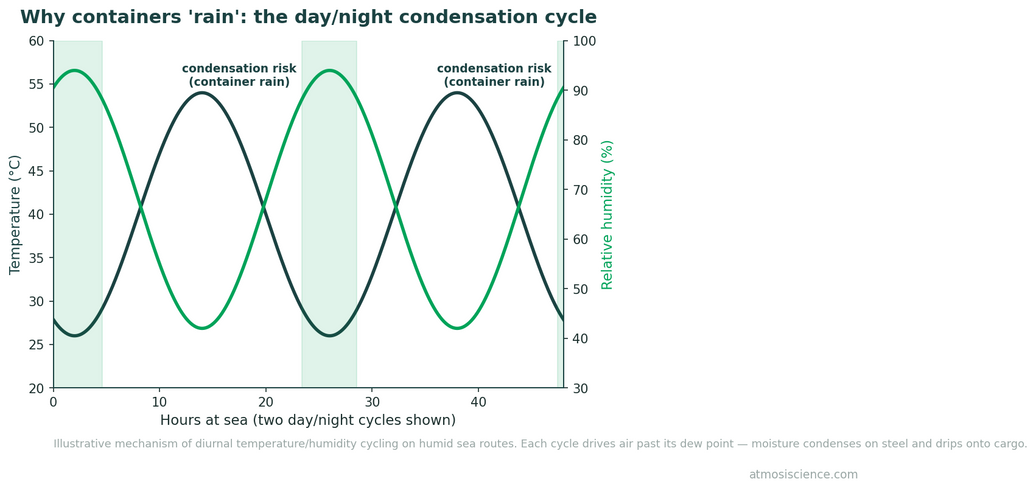
Two consequences follow. First, the ambient RH driving permeation is higher and more variable than the sizing assumption. Second, daily temperature cycling drives condensation events inside the pack — the same physics that causes container rain, described in condensation after cold storage. A pack that never sees liquid water in a stability chamber can see it repeatedly in a barn.
Practical response: size against the worst plausible storage profile for the market, not the label storage statement. And test it — the protocol is in how to run a desiccant sample evaluation.
Format matters more than usual
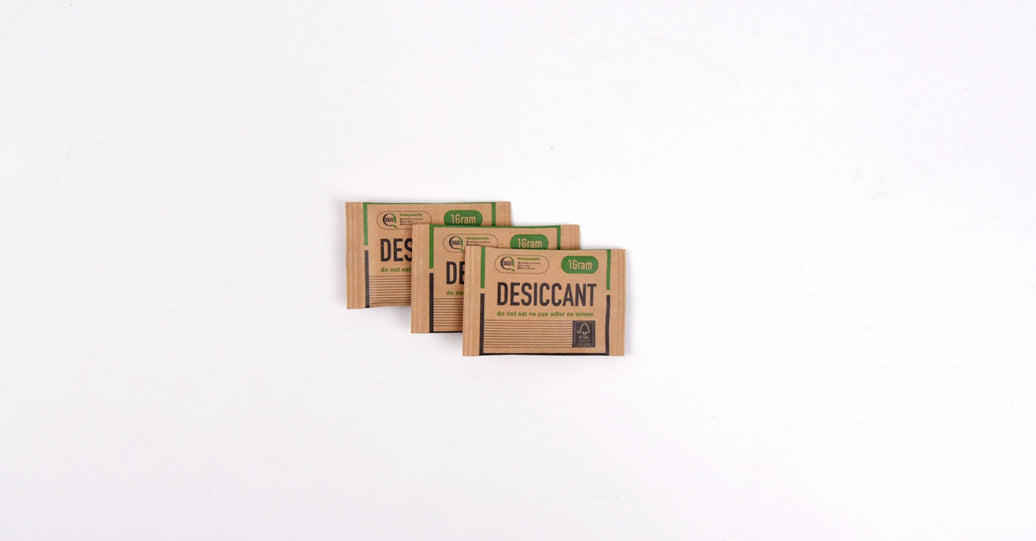
In a human-pharma bottle, a loose sachet is normal and the user is a patient reading a leaflet. On a farm, a loose sachet in a 5 kg tub is a foreign object that gets scooped into a feed bucket, or found by a dog.
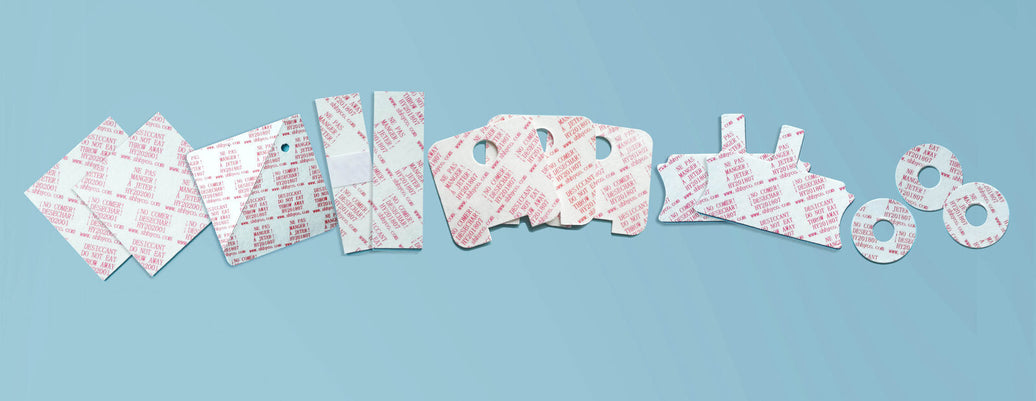
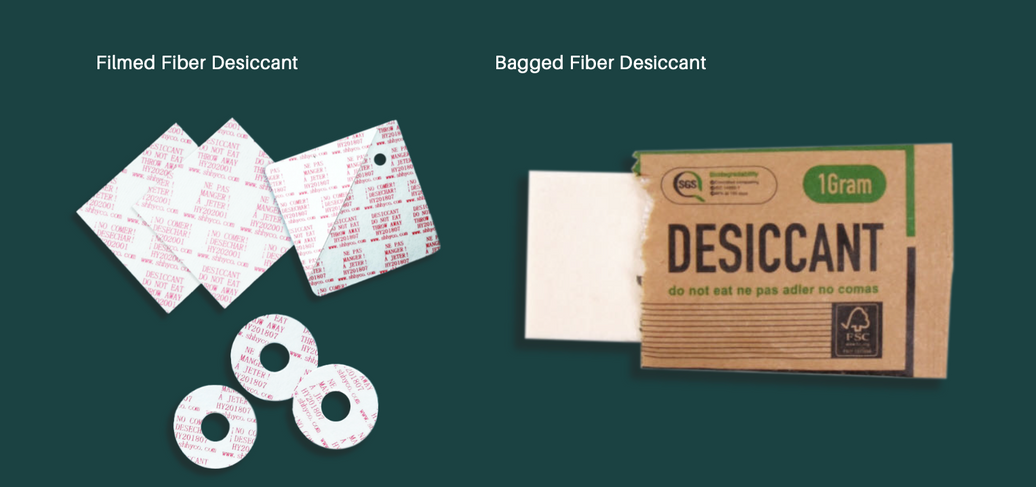
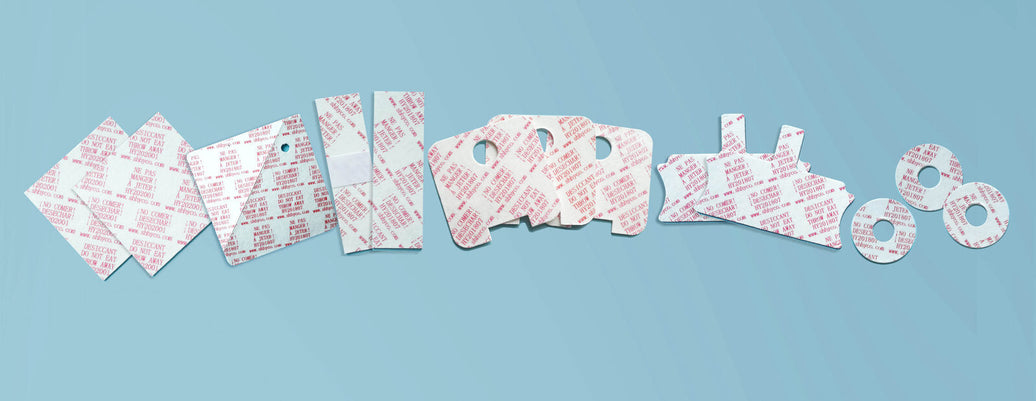
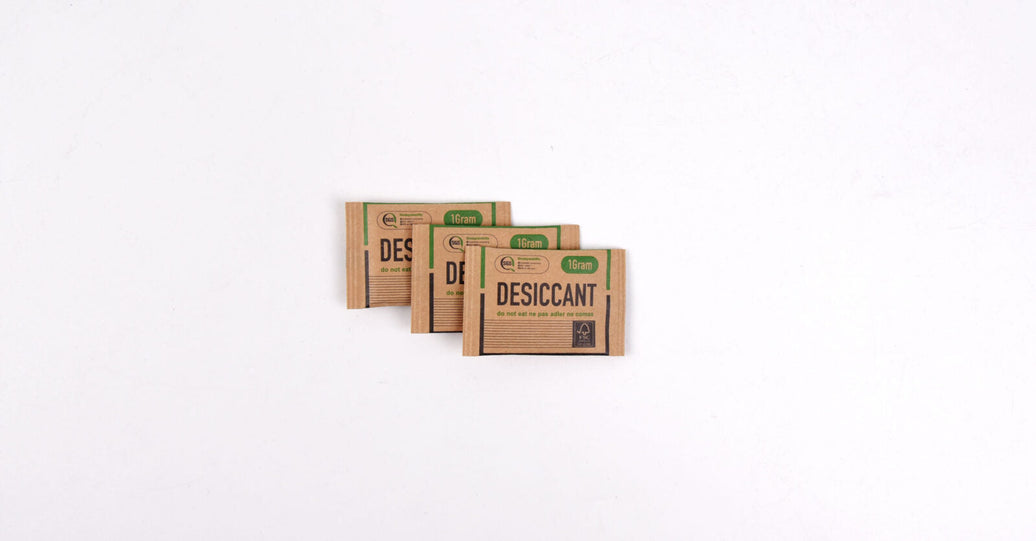
- Bottles and jars. A die-cut card seated in the closure or under the induction seal. Fiber Desimat is supplied in 0.5 mm and 1.0 mm thicknesses, cut square or circular to the neck diameter, and can be printed — useful for a visible "do not feed" marking.
- Tubs and pails. Cap-mounted inserts rather than loose sachets, for the reason above.
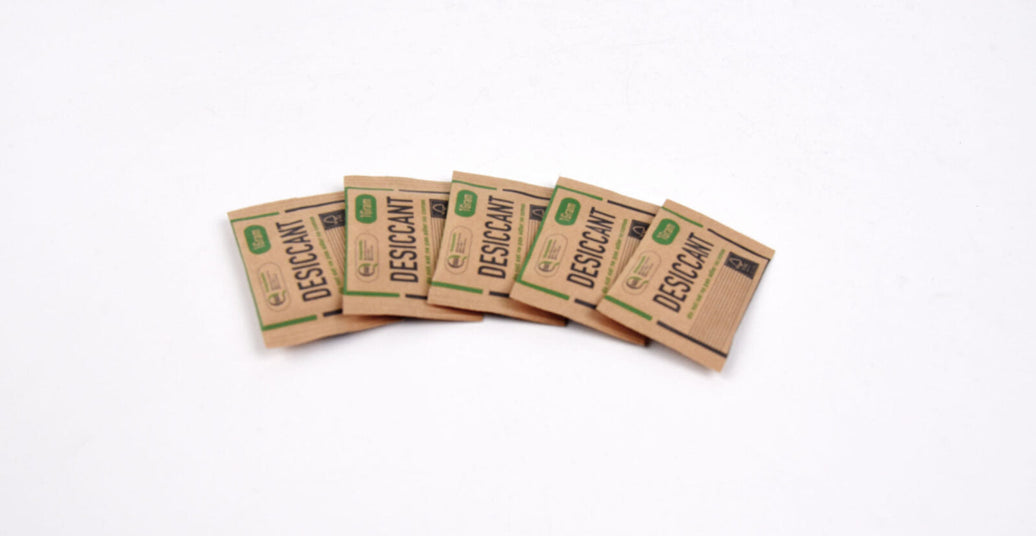
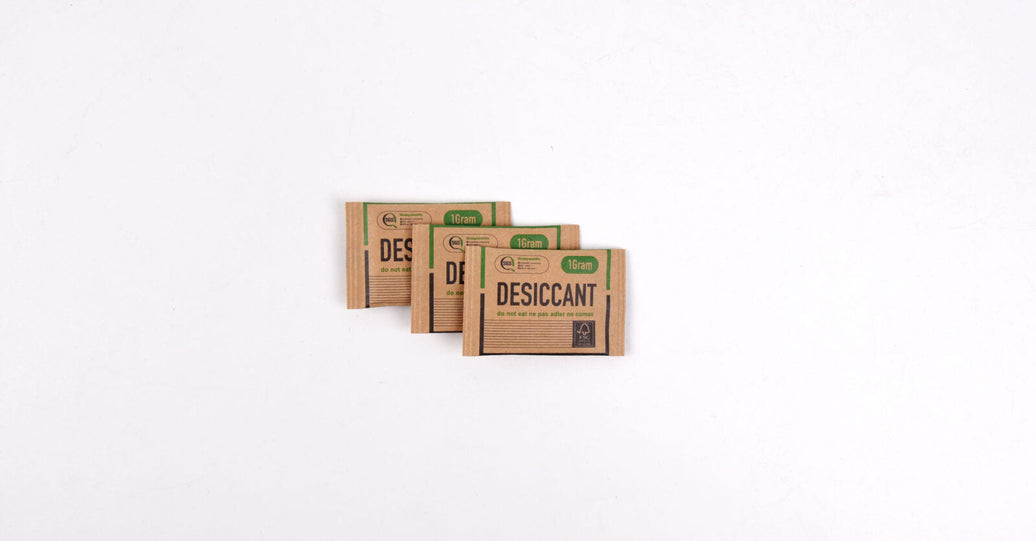
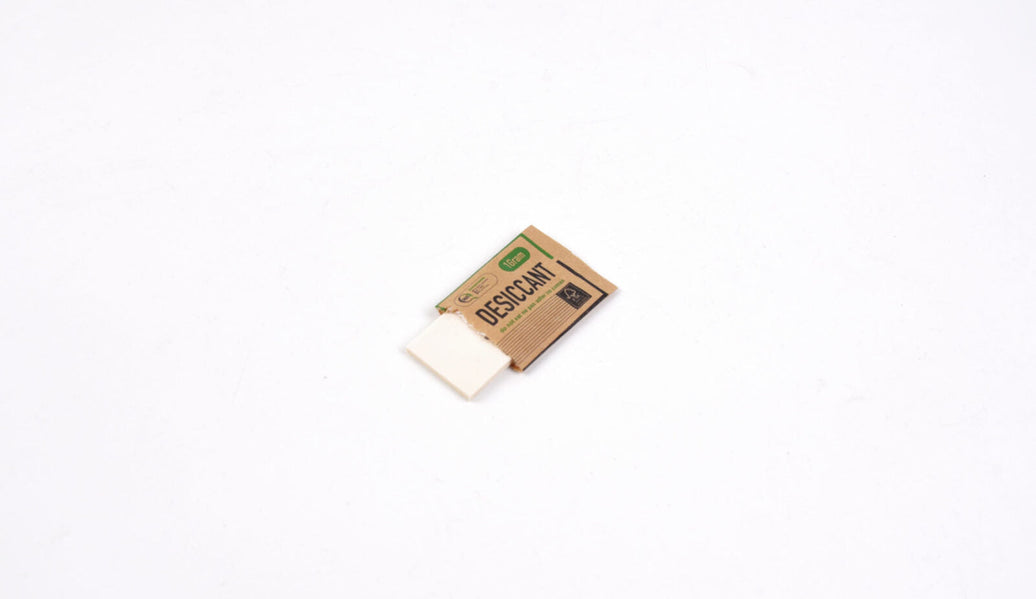
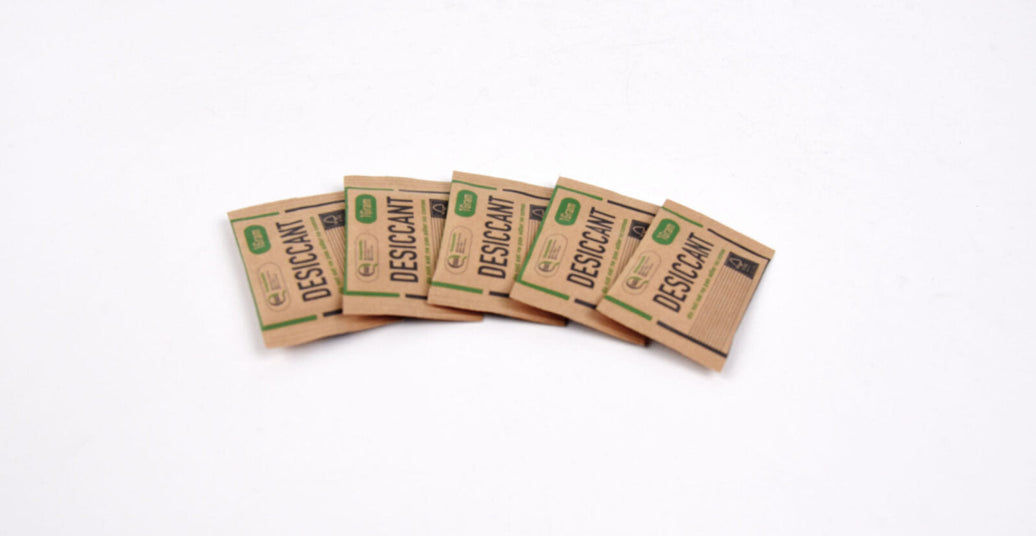
- Premix sacks and bulk bags. Larger pouches sized to headspace and storage window. ATMOSIScience supplies pouches from 1 g to 1,000 g. Bulk-format guidance is in desiccant for FIBC bulk bags, drums and super sacks.
- Sachets in secondary packaging. Where in-pack insertion is not viable, protect at carton or shipper level.
Whichever route, safety marking matters more in this sector than most — see the "do not eat" label.
Dust and contamination
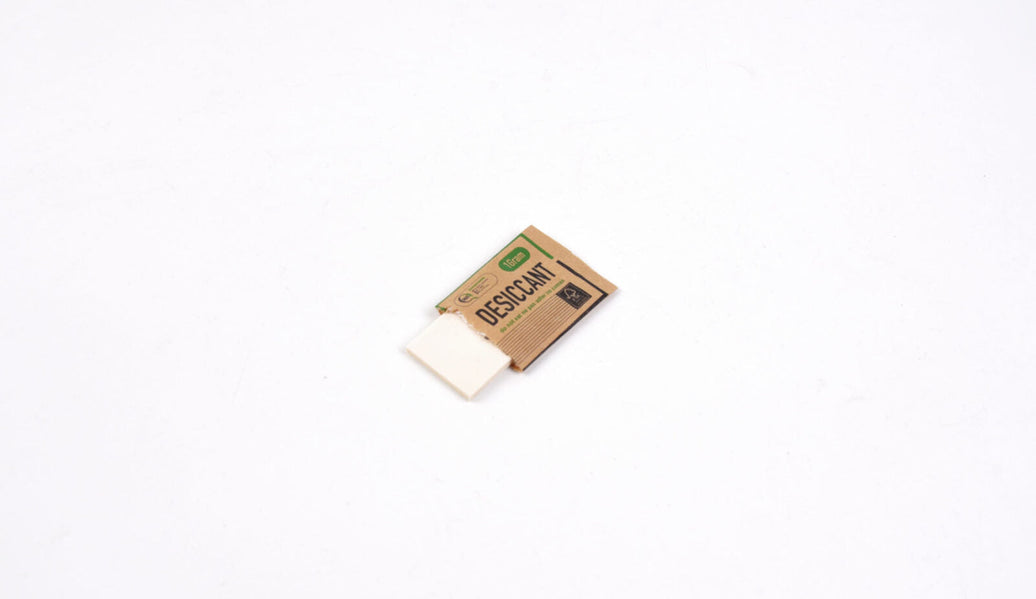
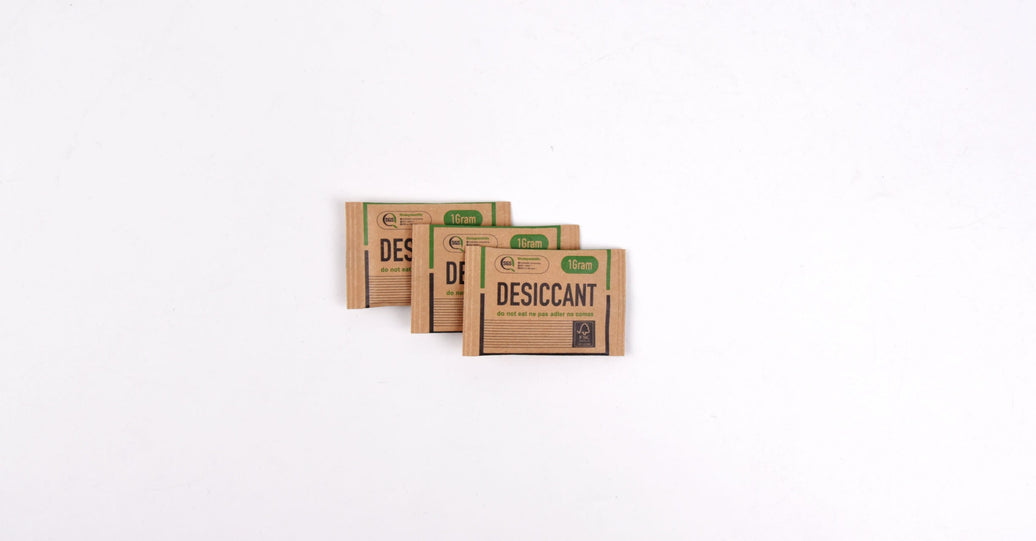
Loose-fill silica beads or clay granules that escape a compromised sachet become a foreign body in a product an animal will consume. Bound-pad construction removes that failure mode entirely: there is nothing loose to escape. ATMOSIScience fiber desiccant is a natural plant-fiber substrate around 2.5 mm thick, held inside a pouch, with no free powder.
Capacity, and why it changes the pack

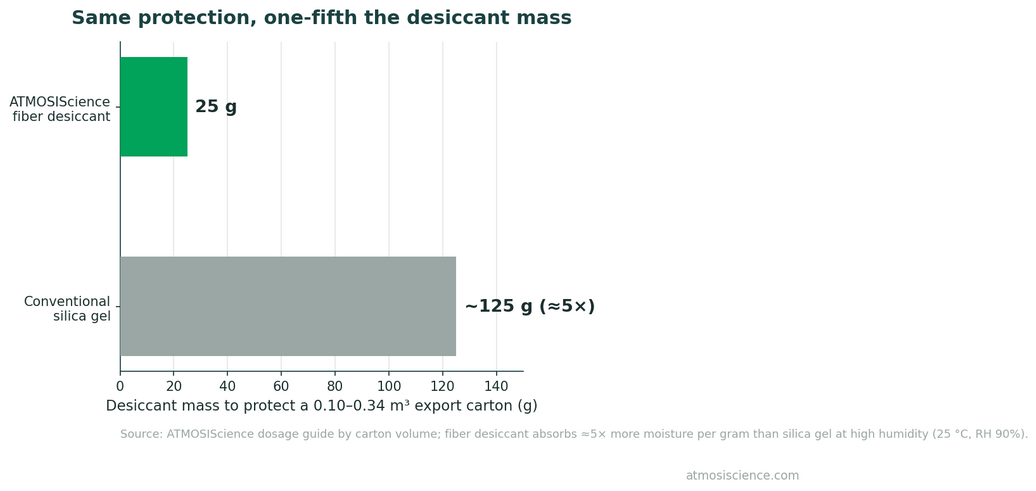
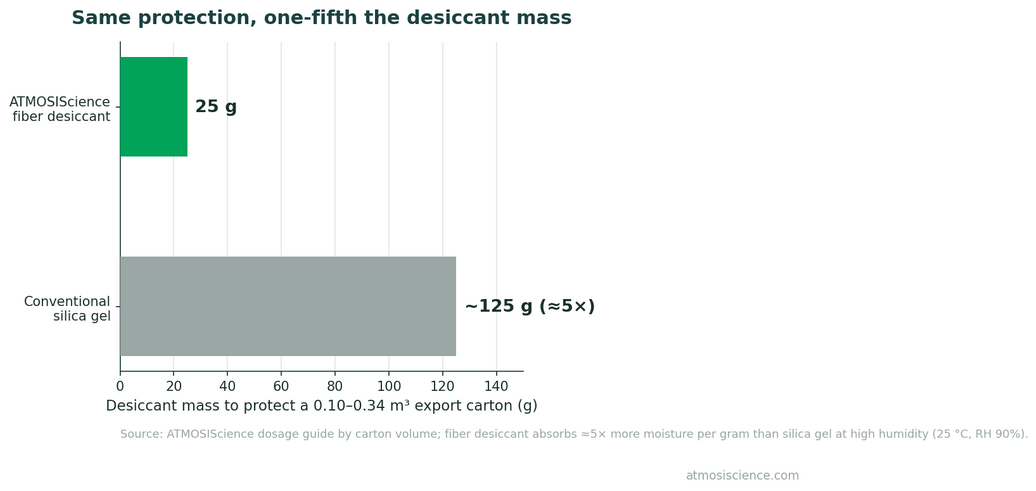
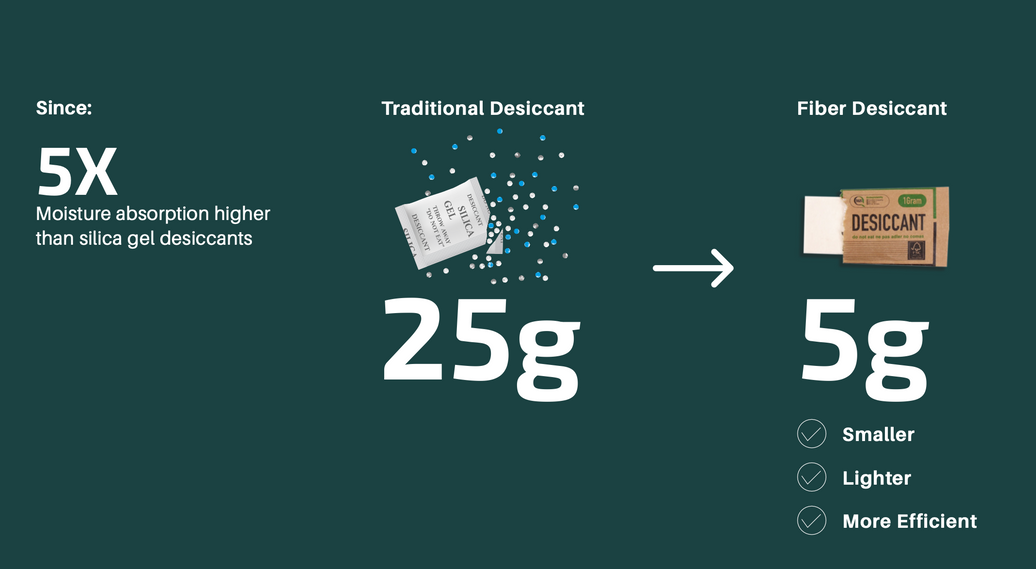
ATMOSIScience fiber desiccant adsorbs more than 70% of its own weight at RH90 (25°C) and more than 100% at saturation, against roughly 30% for common silica gel at the same condition. In a climate-controlled warehouse that gap is a cost argument. In a humid feed store it is a functional one: the high-RH end of the curve is exactly where veterinary packs spend their time.
The documentation file
Distributors, contract manufacturers and regulators converge on a similar list:
- Food-contact / material safety documentation. ATMOSIScience fiber desiccant is supported by FDA 21 CFR 175.300 documentation — see food-contact desiccants and FDA 21 CFR.
- Per-lot COA stating adsorption capacity with the test RH and temperature. Line-by-line reading guidance is in how to read a desiccant COA.
- Manufacturing quality-system evidence — ATMOSIScience manufacturing is SGS ISO 9001 certified.
- RoHS testing report where the product ships into markets that ask for it.
- Stability data linking the desiccant to the claimed shelf life, in the format described in accelerated stability testing with desiccant.
Frequently asked questions
Do veterinary products need pharmaceutical-grade desiccant documentation?
In practice, yes for anything medicated. Registration dossiers and distributor qualification packs ask for the same evidence chain used in human pharma — material documentation, per-lot COA, quality-system certification and stability support. Supplements for companion animals sit closer to food-supplement expectations, but the safest posture is to hold one file that satisfies both.
Can the same desiccant go in a feed premix and a companion-animal supplement?
Usually the same material, but rarely the same dosage or format. Sack headspace, permeation rate and storage exposure are completely different between a 20 kg premix and a 500 g tub.
What about products that must not be over-dried?
Some premixes and probiotic products perform badly if driven too dry. A two-way material buffers toward a band rather than pulling to near-zero — the reasoning is in why "drier is better" is wrong.
Is a compostable sachet appropriate for farm products?
It can be, and it removes a disposal problem where packaging is opened outdoors. The ATMOSIScience sachet film is certified to ASTM D6400 and EN 13432; the certification applies to the pouch material. Claim wording matters — see the sustainable desiccant guide.
How do we prove the desiccant is doing anything?
Pair it with a humidity indicator card at the RH points that matter to your product, and record the readings through stability. Spec guidance is in humidity indicator cards: which RH points to spec.
Talk to ATMOSIScience about a veterinary pack
Send the product type, pack format and realistic storage conditions. ATMOSIScience returns a sizing recommendation, the documentation pack and samples.
Prefer email? info@atmosiscience.com