Quick answer: Sea freight and air freight fail in different ways, so sizing a desiccant by transit days alone gives the wrong answer for both. Sea freight is a long exposure — four to eight weeks of day-night temperature cycling that repeatedly drives condensation inside a container. Air freight is short, but a sealed pack experiences a pressure drop as the aircraft climbs, then a deep cold soak in an unheated hold, then rapid warming on arrival, which condenses moisture onto cold product. Sea freight needs capacity. Air freight needs seal integrity and a pack that tolerates a fast temperature swing. A dose calculated for one is not automatically right for the other.
Most desiccant dosing conversations start with a barrier film's moisture vapour transmission rate and a number of days. That model is a good one and we set it out in desiccant dosage by MVTR. It has a blind spot: it assumes moisture ingress is a steady process driven by a gradient. In transit it is not steady, and the shape of the exposure differs sharply by mode.
Sea freight: capacity is the constraint
A container crossing from Asia to Europe or North America spends four to eight weeks in a steel box that heats in the sun and cools at night. Each cycle moves the dew point past the temperature of the container walls and the cargo, and moisture condenses — the phenomenon commonly called container rain.
Three features define the exposure:
- Duration. Long enough that cumulative permeation through pack walls is significant, not marginal.
- Repetition. Dozens of condensation cycles rather than one event, so a desiccant that saturates partway through leaves the remaining weeks unprotected.
- A large moisture reservoir. Water enters the system from cargo moisture content, dunnage, pallets and the air sealed in at loading.
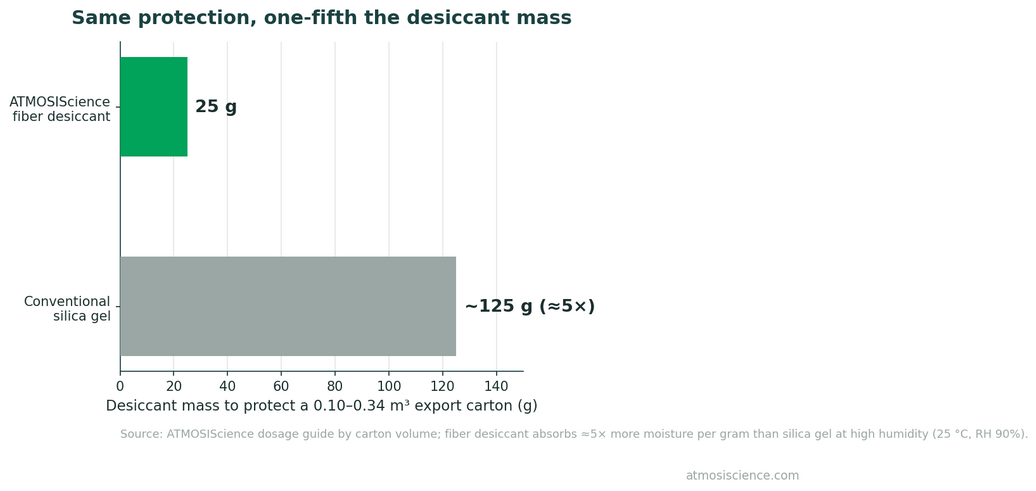
The design answer is capacity and durability, not speed. This is where a desiccant's adsorption at the humidity band it will actually see matters more than its headline figure, and where the difference between a one-way desiccant and a two-way humidity regulator becomes practically important over a long cycling exposure.

Air freight: the pack is the constraint
Air freight is often treated as the low-risk option because transit is measured in days. Cumulative permeation is indeed small. Three other things are not.
Pressure differential. Cargo holds are pressurised, but to an altitude equivalent well above sea level. A pack sealed at sea level expands as external pressure falls. Flexible pouches pillow; weak seals and thin films are the first to fail. A burst seal on a pouch is not a moisture problem in the air — it becomes one for the entire remaining supply chain after landing.
Cold soak. Hold temperatures can fall well below the conditions the pack was designed for. Films become brittle, adhesives stiffen, and seals that pass a room-temperature test can fail cold.
Warm-up condensation. This is the one that actually damages product. A cold pack unloaded into a warm, humid destination — a Gulf or Southeast Asian airport apron, for example — has cold surfaces in warm moist air. Water condenses on and in the pack. The desiccant's job here is not the flight; it is the two hours after it.
The same physics governs product coming out of chilled storage, which we cover in condensation after cold storage.
Sizing the two cases differently
| Factor | Sea freight | Air freight |
|---|---|---|
| Dominant moisture source | Cumulative permeation plus repeated condensation | Sealed-in headspace air plus arrival condensation |
| Governing spec | Total adsorption capacity at service humidity | Seal strength, film cold performance, adsorption rate |
| Typical failure | Caking, mould, corrosion, label lift | Burst seal, pouch deformation, surface condensation on arrival |
| Where to spend | More desiccant mass, container-level protection | Better seals, validated film, correctly placed in-pack desiccant |
| Test protocol | Extended cycling at elevated temperature and humidity | Altitude or reduced-pressure test plus cold-to-warm transition |
Transit testing standards cover both, and using them is the difference between a documented dose and a guess. Our overview is in ISTA and ASTM transit testing with desiccant.
The mixed-mode trap
A single SKU rarely travels one way. The same pack may go by sea to a distribution centre, then by air for an urgent replenishment, then sit in an unconditioned warehouse. Specifying to the average exposure protects against neither extreme.
The workable approach is to define one worst-case profile per SKU and size to it — typically the longest sea leg for capacity, with the pack's seal and film validated for the air leg. That gives one specification rather than a mode-dependent matrix that a co-packer will not follow reliably. How to construct that worst case is set out in the worst-case test protocol, and for tropical destinations specifically in shipping to Zone IV markets.
Frequently asked questions
Will a desiccant sachet burst at altitude?
The sachet itself is small and porous, so it is not usually the failure point — the primary pack is. A sealed, non-permeable overwrap around a desiccant is a different case and should be pressure-tested if it flies.
Does air freight mean I can skip the desiccant?
Rarely. Even a short flight seals in headspace moisture at the origin's humidity, and arrival condensation is a real event. What changes is the required capacity, not the requirement.
Should container desiccants be used in addition to in-pack sachets?
For sea freight with moisture-sensitive cargo, the two do different jobs — container-level products manage the container atmosphere, in-pack products manage the pack. The container-level case is covered in desiccant for container shipping and the sizing pitfalls in why desiccants fail in sea freight.
Does the desiccant need to work at low temperature?
Adsorption behaviour is temperature-dependent, and a cold-soaked pack behaves differently from a lab bench at 25 degrees Celsius. Ask for data at the temperature range your route actually sees rather than at standard conditions only.
How do I evidence a moisture claim if cargo arrives damaged?
Surveyors and insurers ask for a specific evidence set, and most of it must be collected before the container is unstuffed. See moisture damage cargo claims.
Have us size the dose for your actual route
Tell us the origin, destination, transport mode and pack format, and we will come back with a dose recommendation and the test protocol to validate it.
Prefer email? info@atmosiscience.com