Quick answer: A forecast published on 5 October 2026 puts the global moisture absorber market at USD 1.74 billion in 2026, rising to USD 2.70 billion by 2032 at a 7.59% CAGR. The more useful number for a US packaging buyer sits underneath it: North American desiccant demand is forecast to grow at roughly 4.3% to 4.5%, around half the global rate. Growth here is not mostly about shipping more sachets. It is about the same volume being re-specified, driven by e-commerce packaging, state EPR fees and export compliance. If you buy desiccant in the United States, the decision in front of you is which format and which material, not how many packets.
Market forecasts are usually the least useful thing a packaging engineer reads. They tell you a category is growing, which you already knew, and they stop exactly where your decision starts. The moisture absorber forecast published in October 2026 is worth a closer look, though, because of what it says when you line it up against the regional numbers and against its own segment list.
What the October 2026 forecast actually says
The headline figures, as published:
| Measure | Figure |
|---|---|
| Global market value, 2026 | USD 1.74 billion |
| Global market value, 2032 | USD 2.70 billion |
| CAGR, 2026 to 2032 | 7.59% (the report's own summary table states 7.5%) |
| Stated drivers | E-commerce growth, sustainable packaging, supply chain resilience, awareness of humidity-related losses, cold chain logistics |
| Suppliers profiled | 31, almost entirely silica gel, clay and calcium chloride producers |
Source: Moisture Absorber Market, Global Forecast 2026 to 2032, Research and Markets, 5 October 2026.
The number that matters more: North America grows at about half the global rate
Put three independent forecasts side by side and a pattern appears that no single one of them states outright.
Those four figures measure four different things, so the gap between them is indicative rather than exact. But the direction is consistent across all three publishers, and it fits what buyers actually report. Asia Pacific is where unit volume is being added, at an estimated 45% of the sachet market growing around 6.5%. North America holds roughly 20% of that market and grows at about 4.5%.
Read it as a practical statement: in the United States, the desiccant category is growing a few points a year while the requirements attached to it are changing much faster. You are not being asked to buy many more desiccants. You are being asked to prove more about the ones you already buy, and in several states to pay a fee per gram for them.
The gap in the category map
The segmentation in the October forecast is worth reading closely. Product types are listed as crystals, gel packets and humidity absorbing bags. Materials are listed as activated charcoal, calcium chloride, carbon, clay, graphene oxide and silica gel.
There is no paper or plant fiber category anywhere in it. Paper-based packaging appears only as a trend. Of the 31 suppliers profiled, effectively all of them make silica gel, clay or calcium chloride products.
That is not an error in the report. It reflects a category whose taxonomy was set when the only real question was which mineral went inside the sachet. The problem is that it no longer matches the brief many US buyers are now working to. If your retail pack has to come apart into a paper stream, a mineral-in-plastic-film sachet is the part that fails, and it fails for reasons that have nothing to do with how well it adsorbs water. We wrote about the mechanics of the alternative in paper desiccant: what it is and how it works and the format options in desiccant sheets, rolls or die-cut cards.
Three stated drivers, three spec decisions
1. E-commerce: more individual packs, each one its own humidity problem
Every forecast in this set names e-commerce first. The mechanism is simple: direct-to-consumer shipping replaces one pallet-level moisture problem with hundreds of pack-level ones, each with its own headspace, its own barrier and its own time in an unconditioned van. A dose that was adequate as a case insert is often wrong at unit level.
There is a second-order effect that the forecasts do not mention. From 2030, PPWR limits empty space in e-commerce packaging to 50%, which shrinks the headspace your desiccant was sized against. Smaller void means less air to dry, but also less room for the insert. See the PPWR 50% empty space rule and your desiccant.
2. Sustainable packaging: the cost moved from the material to the paperwork
This is where the US diverges most sharply from the global picture. Minnesota and Maryland packaging EPR obligations land across 2026 and 2027, and they are assessed on packaging components by weight and by recyclability. A 3 gram desiccant is a packaging component. Run the arithmetic in what a 3 gram desiccant actually costs you under US packaging EPR and check the dates in the Minnesota and Maryland deadlines.
If you also sell into the EU, the desiccant has to clear two further tests: whether it counts as packaging at all under PPWR Article 3, covered in is a desiccant sachet packaging under PPWR, and whether the environmental wording on your pack survives the EmpCo rules that became applicable on 27 September 2026, covered in the rule that actually governs your packaging copy.
3. Supply chain resilience: longer, hotter, less predictable transit
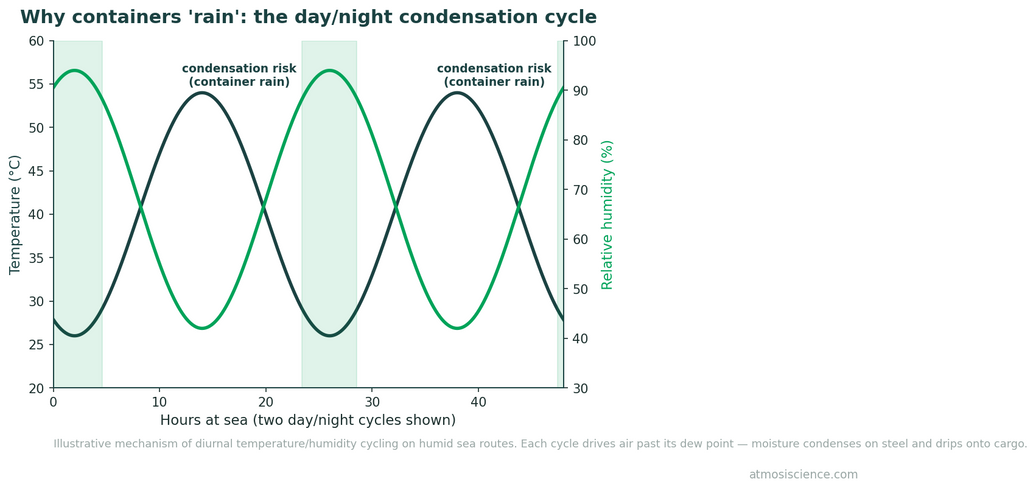
Resilience in a desiccant spec means designing for the bad route rather than the average one. Transport mode changes the dose, as set out in air freight or sea freight desiccant sizing, and tropical transshipment changes it again, as in shipping powders through tropical ports.
What to do with this before your next packaging review
- Weigh the desiccant, then price it as a packaging component. Grams per unit multiplied by annual units, against the fee schedule of every state you sell into.
- Check which part of your pack the desiccant disqualifies. Usually it is the film or the overwrap, not the adsorbent.
- Stop comparing price per sachet. Compare cost per gram of water adsorbed at the humidity you actually store at. The method is in desiccant cost per gram of water adsorbed.
- Get the dose from your barrier, not from a rule of thumb. Water vapour transmission rate and surface area give a defensible number. Validate it with accelerated shelf-life testing.
- Ask any supplier for the document pack up front. If a customer questionnaire is coming, you will need it anyway. See answering EcoVadis and CDP questions about your desiccant.
Where a plant fiber desiccant fits
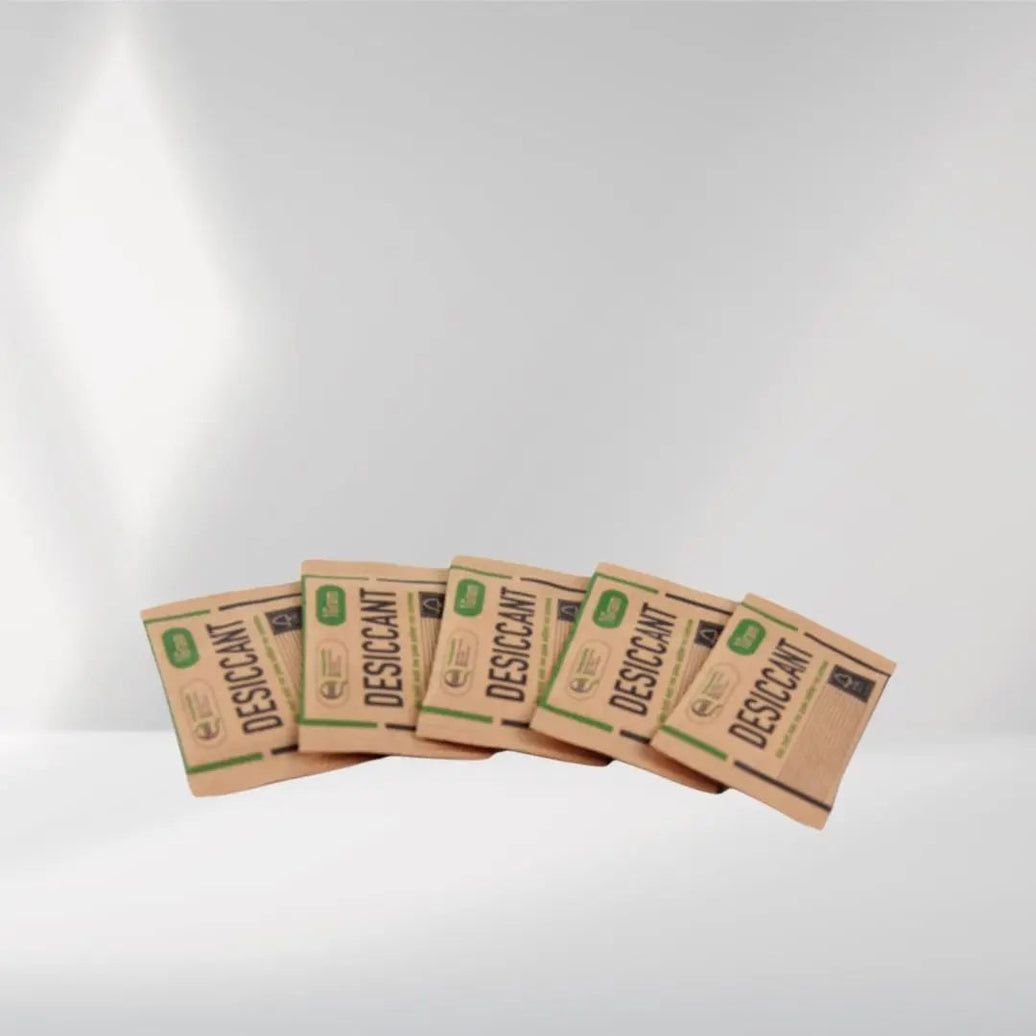
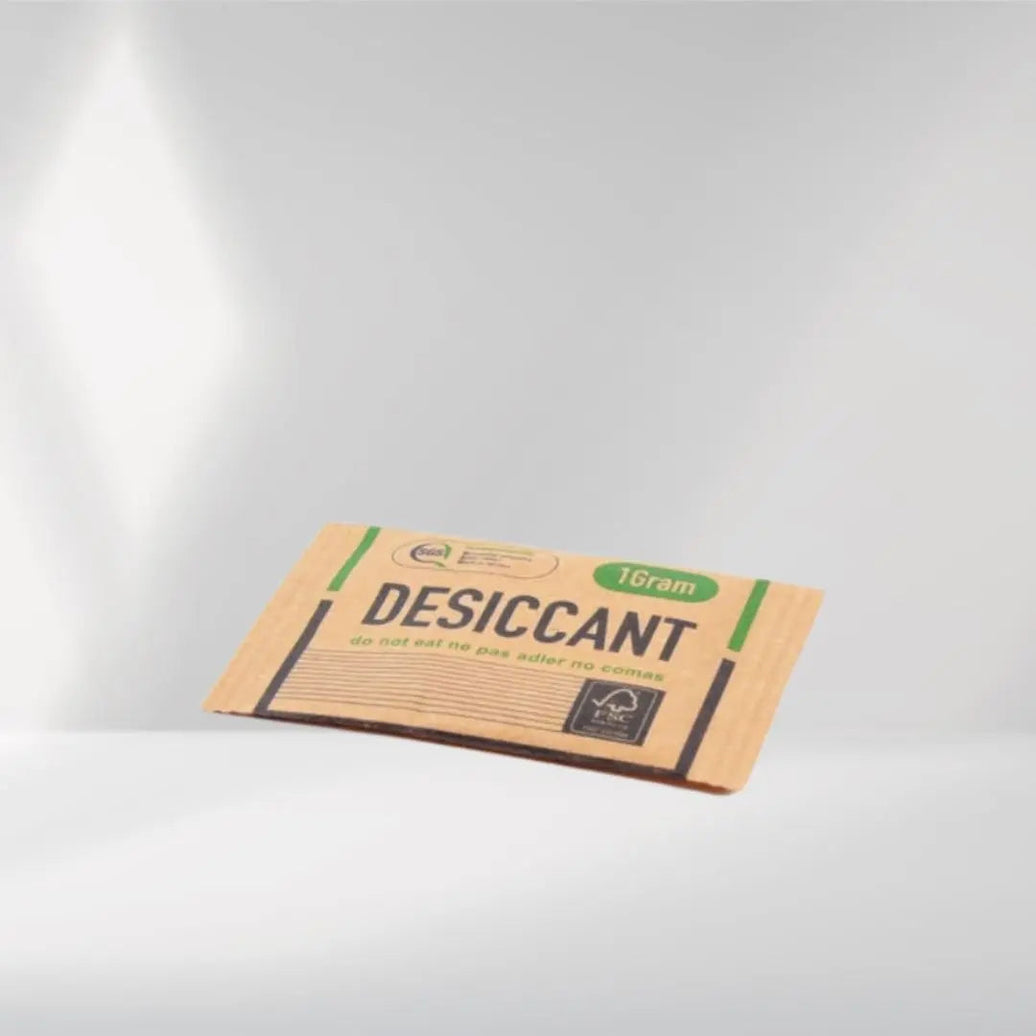
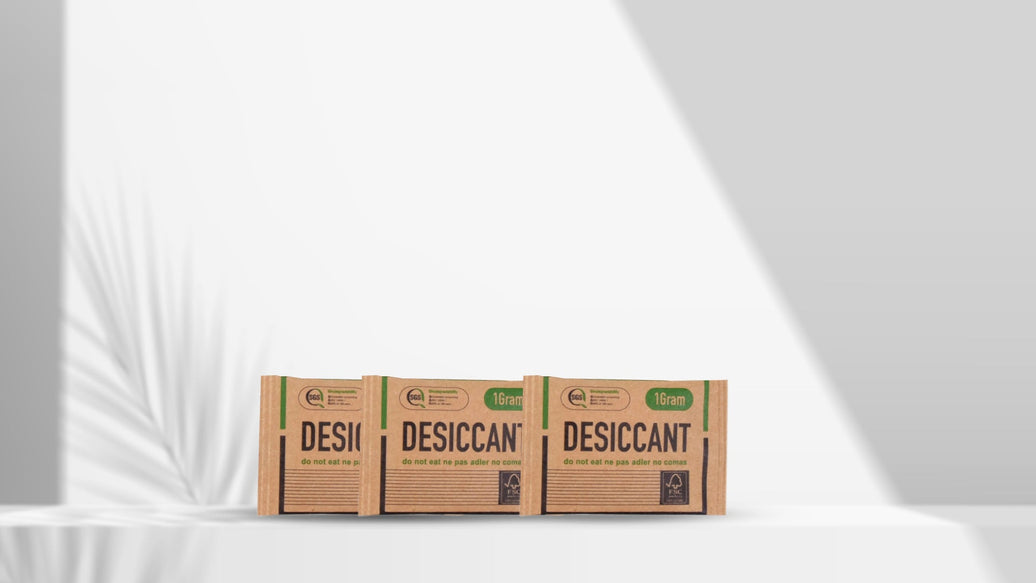
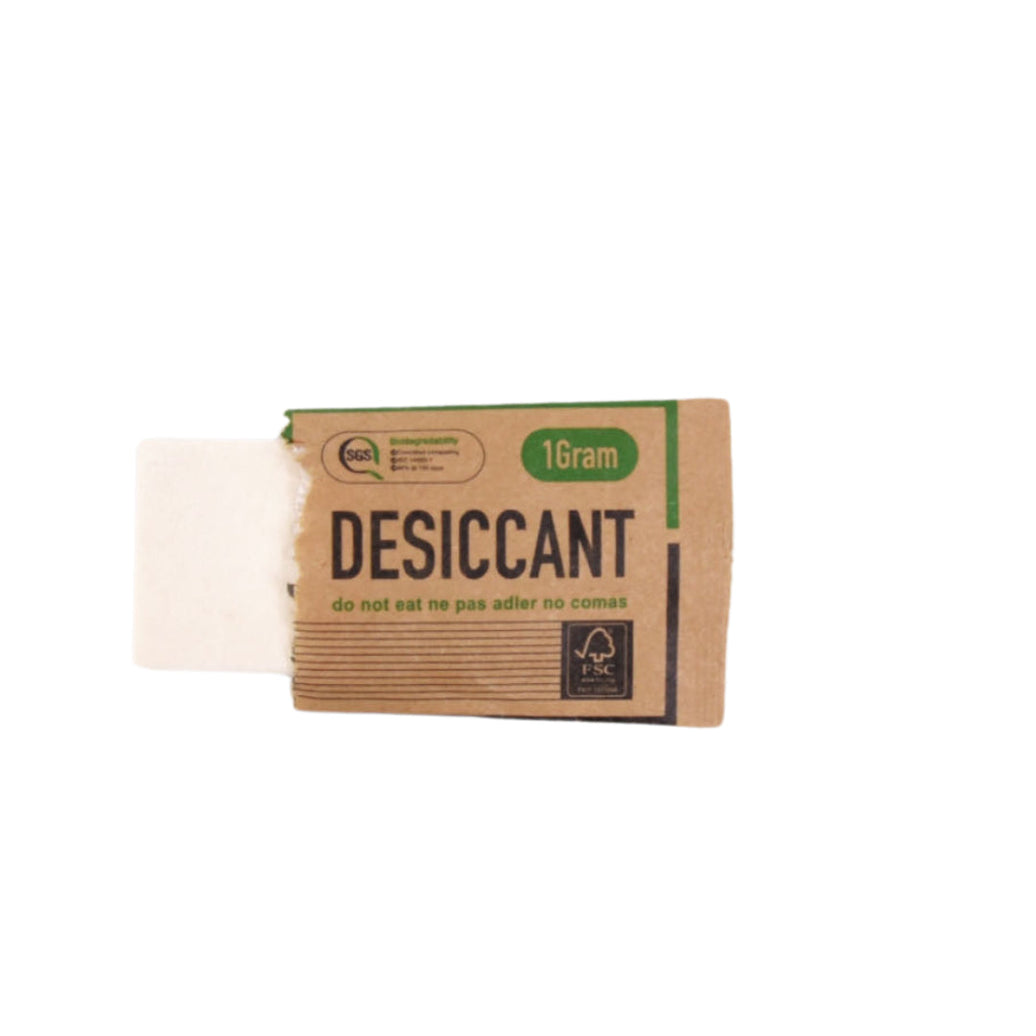
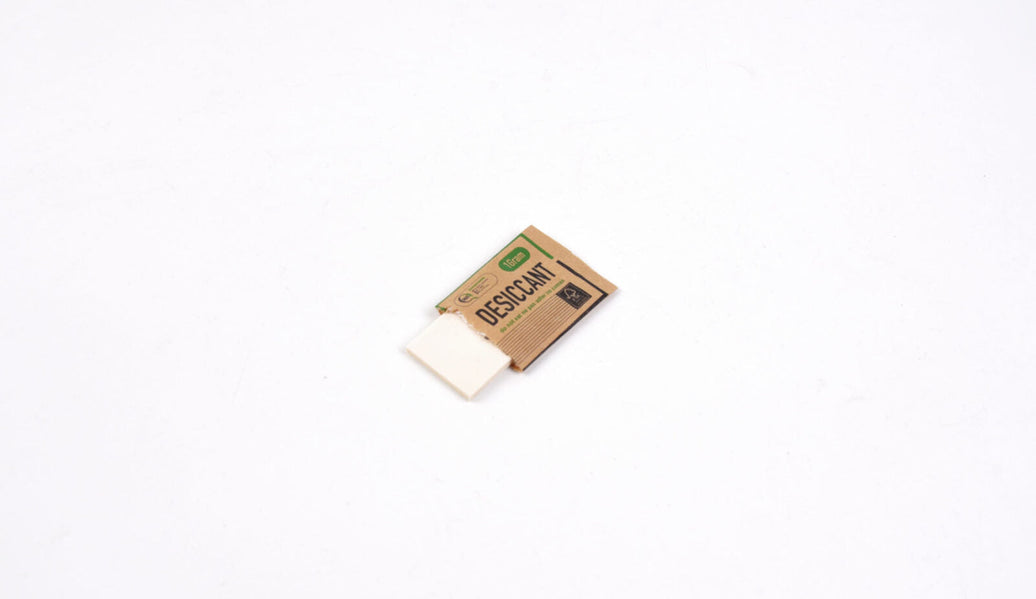
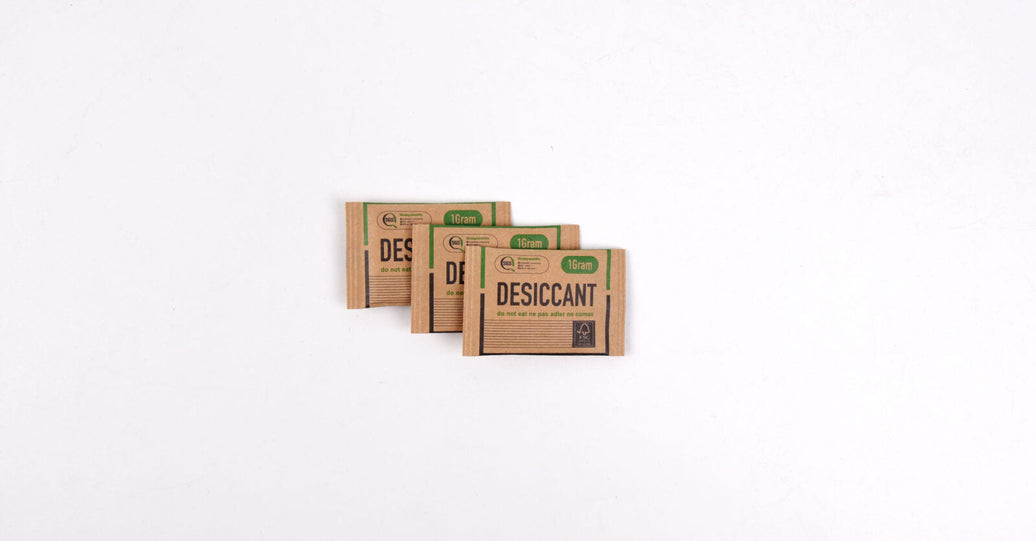
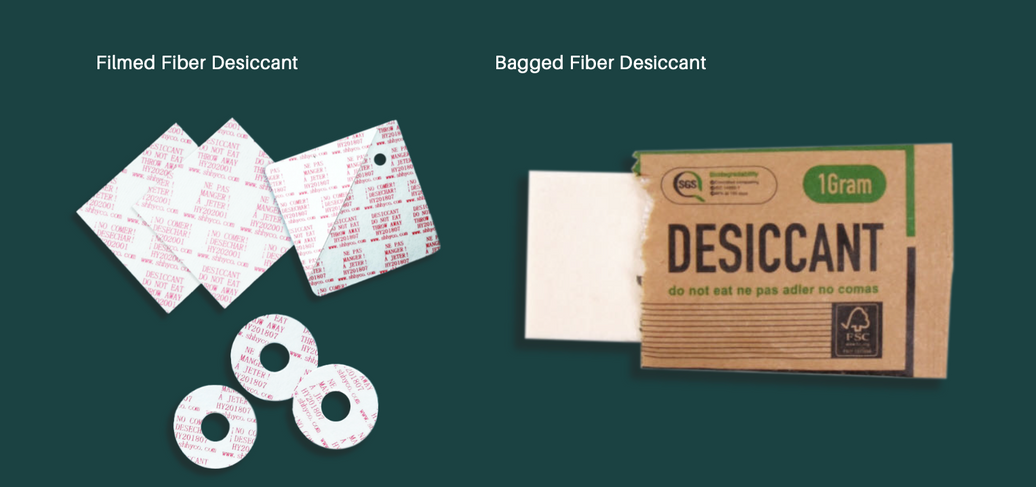
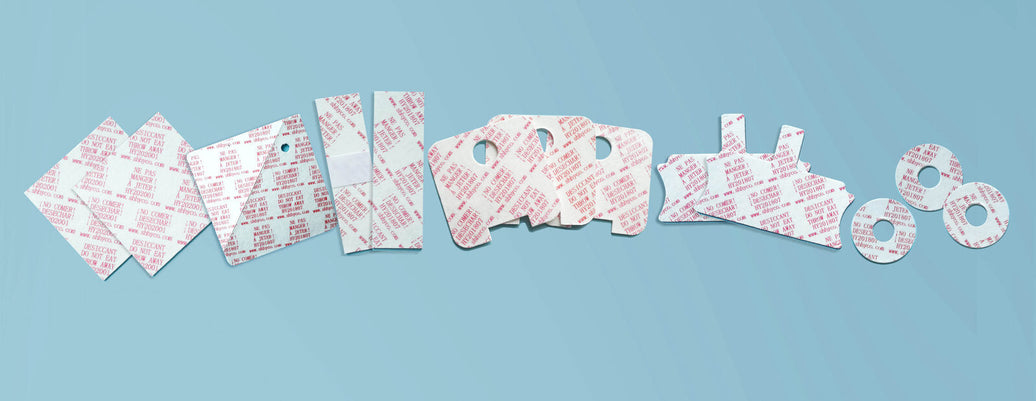
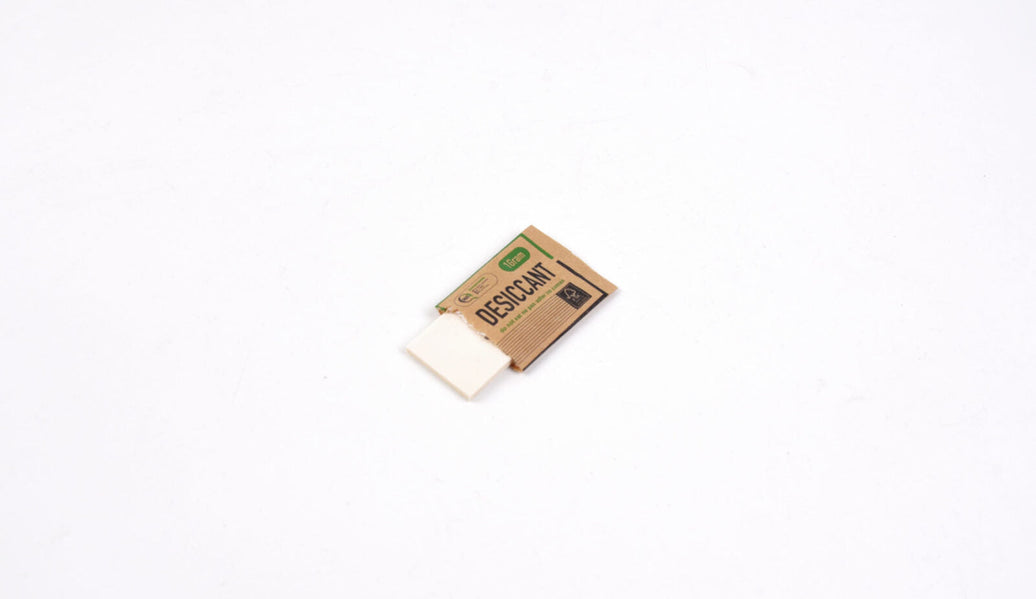
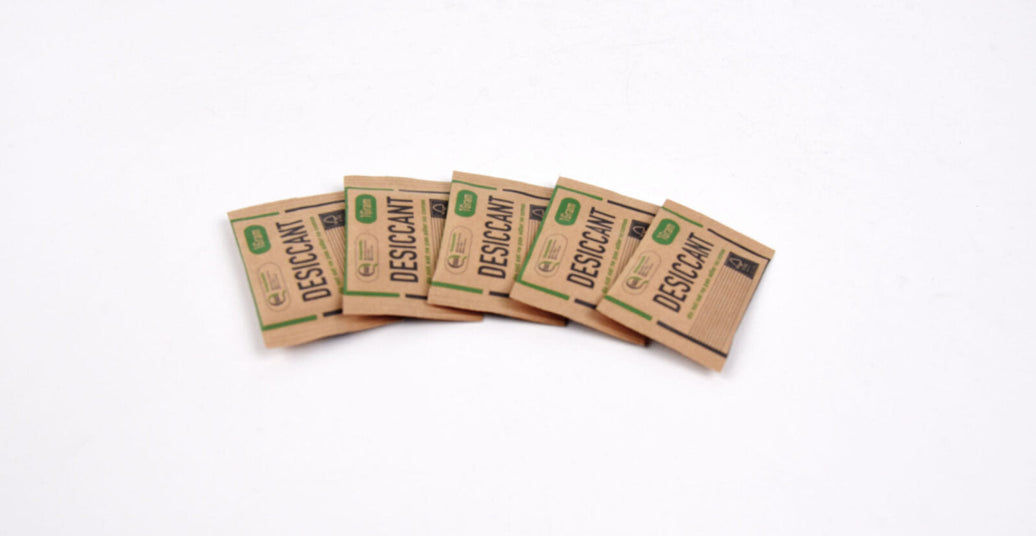
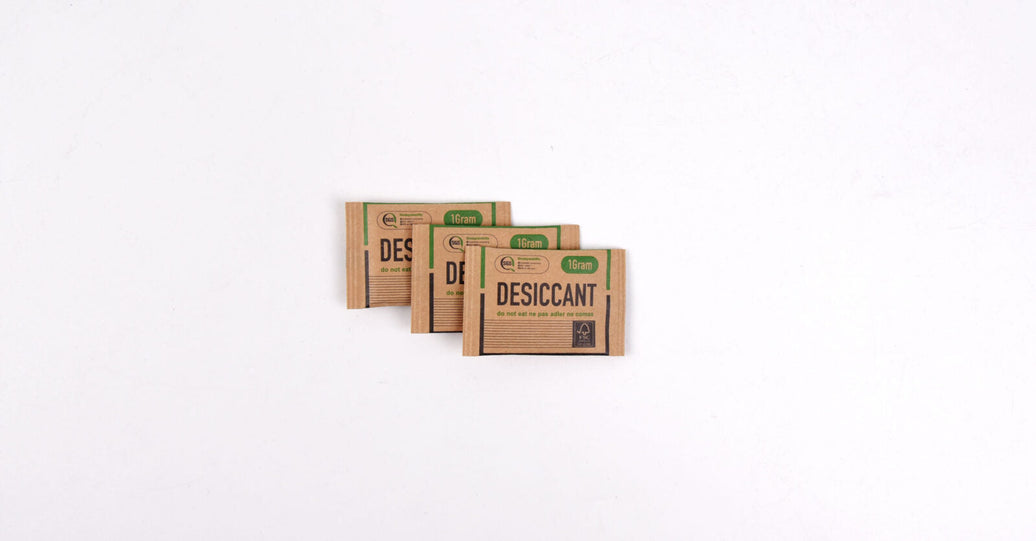
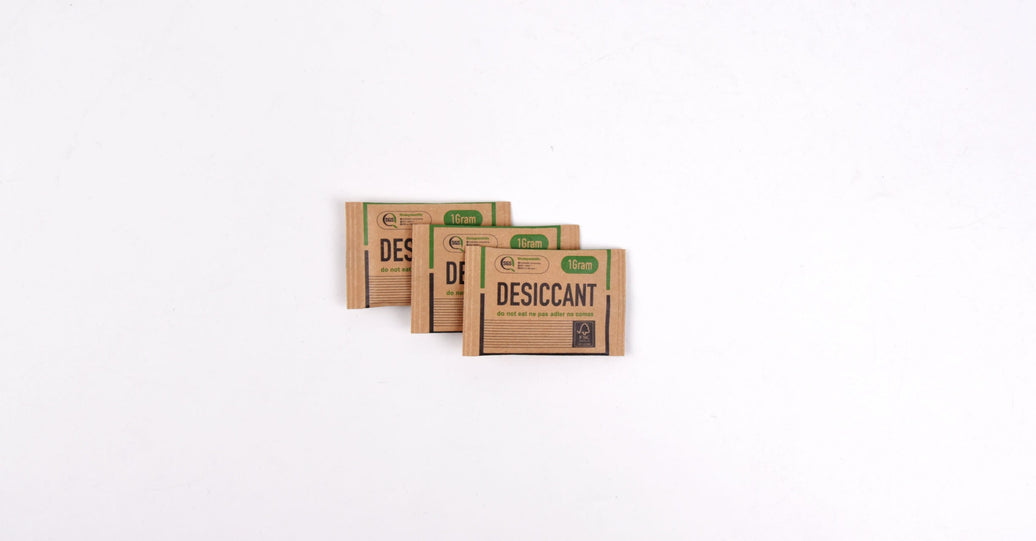
ATMOSIScience® makes the format that the standard category map leaves out: a plant fiber substrate with calcium chloride bound into the fibers, supplied either as a bagged pouch or as a thin printable card. The measured performance, at 25 °C, from our product documentation:
| Condition | Moisture adsorption, share of own weight |
|---|---|
| 20% RH | more than 10% |
| 50% RH | more than 35% |
| 90% RH | more than 70% |
| Saturated, bagged pouch | over 100% |
| Loss on drying | under 10% |
Measured values at 25 °C, fiber desiccant technical criteria — ATMOSIScience
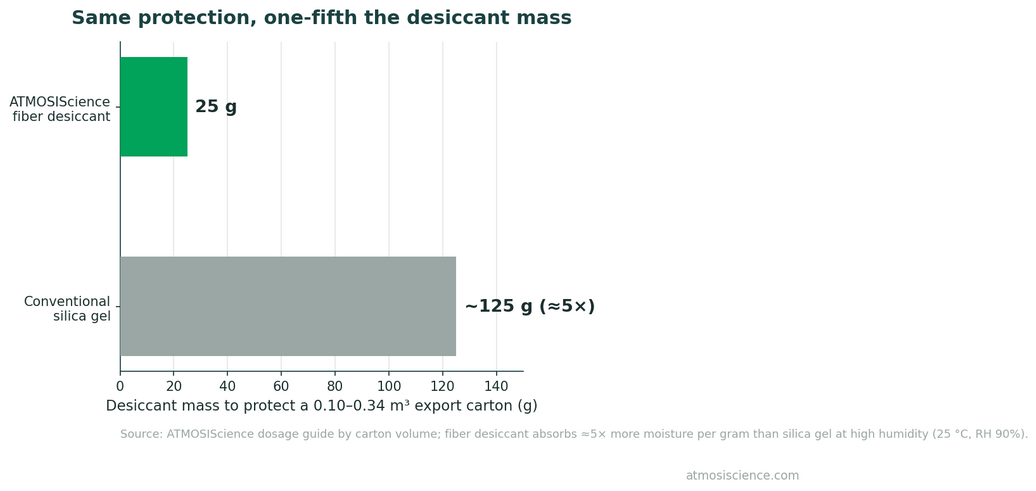
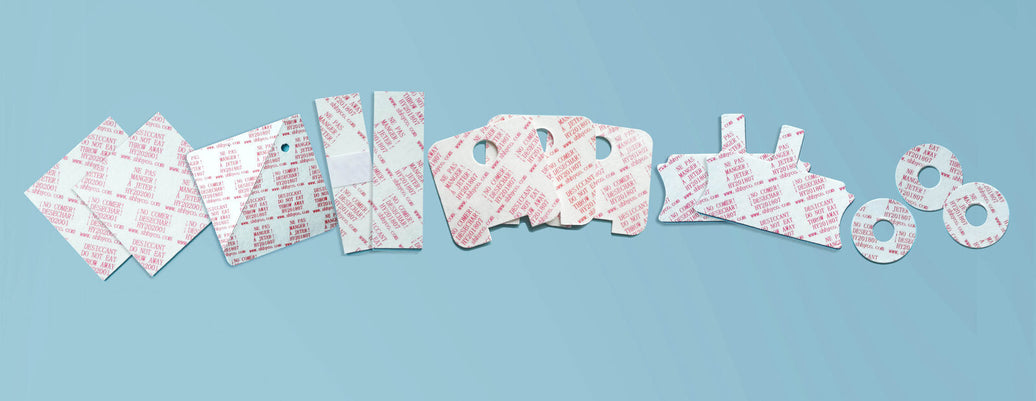
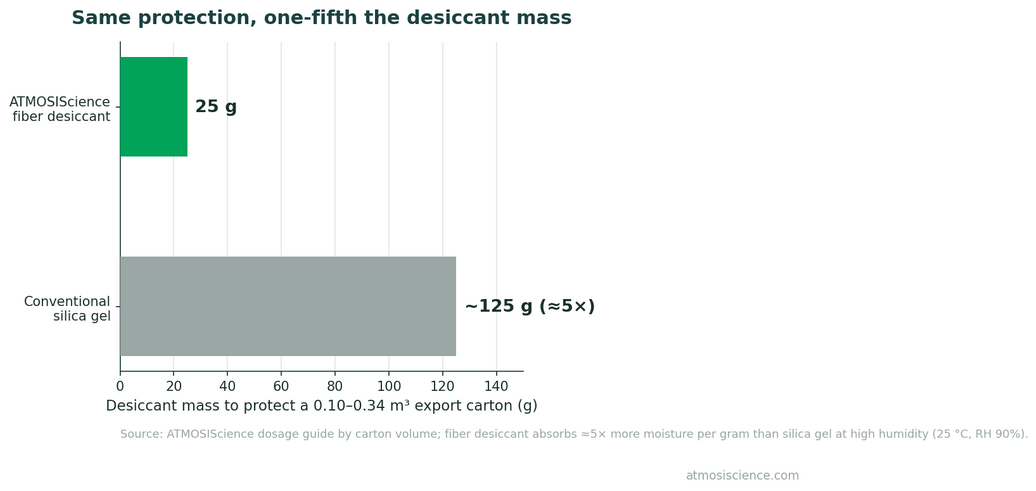
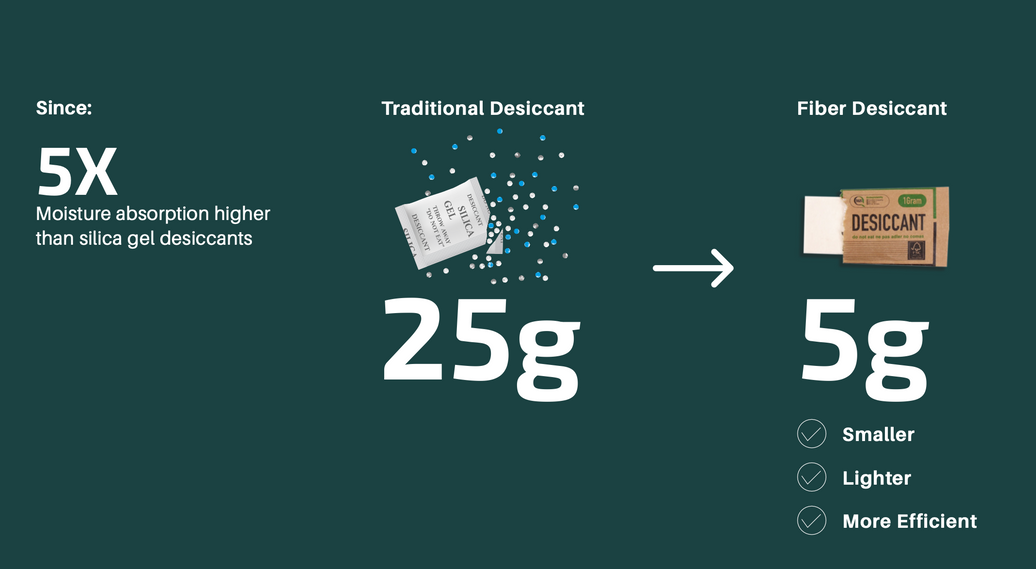
Across the humidity band where packaged goods are actually stored, that is roughly two to three times the capacity of common silica gel by weight, which is why a lighter insert can replace a heavier sachet. In card form the sizing is explicit: an FF-15 card at 60 by 25 by 1 mm weighs 1.0 g, adsorbs 0.75 g of water and substitutes for about 2.5 g of silica gel. Thicknesses of 0.5 mm and 1.0 mm are available, the card can be cut to shape and the outer layer is printable. Full specifications are in the Fiber Card spec guide, and the bagged format sits at Fiber Desiccant with pouches from 1 g to 1,000 g.
On the sustainability questions that the forecast drivers point at, the documented position is narrow and specific by design. SGS report CQMR260700043401, dated 17 July 2026, classifies the plant fiber desiccant as paper and scores it 100 out of 100 for recyclability, with a fibre yield of 69.78%. That result applies to the fiber layer itself and not to an assembled finished product, which is the distinction most suppliers blur. The product carbon footprint is 1.44 kg CO₂e per kg, calculated to ISO 14067. The underlying humidity control technology is covered by 70+ patents worldwide.
Frequently asked questions
How big is the desiccant market in the United States?
No published US dollar figure is available in the sources above. The forecasts give growth rates rather than a US market value: about 4.3% CAGR for US desiccants over 2025 to 2034, and roughly 20% of the global sachet market held by North America. The global moisture absorber market is put at USD 1.74 billion in 2026.
Why is the US growing more slowly than the global market?
Unit volume growth is concentrated in Asia Pacific, where more of the world's moisture-sensitive goods are packed. In mature markets the change shows up as substitution and compliance cost rather than as volume.
Is the 7.59% figure reliable?
Treat it as one publisher's estimate. The same report states 7.5% in its own summary table, and competing publishers put adjacent markets at 6.0%. Use the direction, not the decimal.
Does a paper or fiber desiccant adsorb as much as silica gel?
By weight it adsorbs more across the normal storage range. A fair comparison needs the same temperature and the same relative humidity for both materials, which is why capacity should always be quoted with its test conditions.
What should I ask a desiccant supplier in 2027?
Component weight and material declaration for EPR reporting, recyclability evidence and its exact scope, capacity curve with test conditions, and a sizing calculation against your own barrier rather than a standard dose.
Re-specifying a desiccant for 2027?
Send us the pack: what is inside it, the barrier material, the route and the shelf life you need. We will size the insert against your own numbers and send samples in the format you are evaluating.
Buying for a converter or a brand portfolio? Start at wholesale, or email info@atmosiscience.com
Sources
- Research and Markets, Moisture Absorber Market, Global Forecast 2026 to 2032, press release dated 5 October 2026.
- IndexBox, Desiccant Silica Gel Sachets Market Forecast to 2035, 2 October 2026.
- Expert Market Research, United States Desiccants Market, 2025 to 2034, listed via Research and Markets, August 2025.
- ATMOSIScience® fiber desiccant and Fiber Desimat product documentation; SGS recyclability assessment CQMR260700043401, 17 July 2026; product carbon footprint to ISO 14067.