Quick answer: Fiber desiccant is a plant-fiber matrix carrying calcium chloride, used wherever a sealed or semi-sealed pack needs moisture control without loose silica beads or clay dust: electronics and circuit boards, supplements and dry foods, diagnostic kits, garments and footwear, wooden toys and furniture, optics, and art or archive storage. It comes as bagged sachets from 1 to 1,000 g and as thin die-cut sheets at 0.5 or 1.0 mm. It is the wrong choice in three places: pharmaceutical packs that must meet USP <670>, targets below about 10% RH, and products that are damaged by over-drying.
"Fiber desiccant uses" is one of the most common follow-up searches after someone first meets the term. The honest answer has two halves. The material does a lot of jobs well, and there are a few jobs where another desiccant is the better tool. Both halves are below.
What fiber desiccant is, in one paragraph
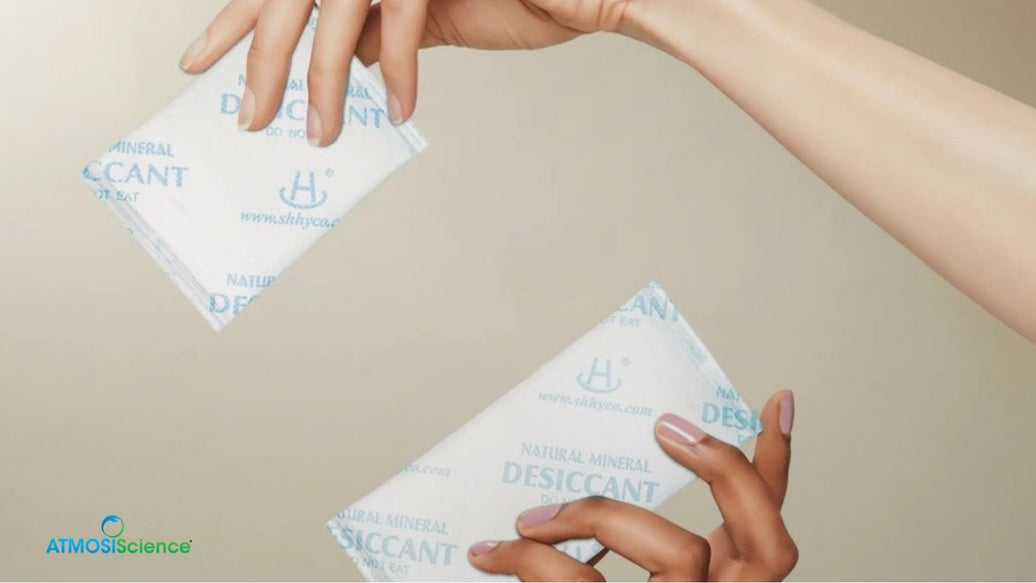
ATMOSIScience fiber desiccant uses natural plant fiber as the adsorption substrate and calcium chloride as the active, held in the fiber matrix so it does not shed powder or leak. It contains no silica gel. In the bagged format, saturated uptake can exceed 100% of its own weight; the minimum specification at 25 °C is above 10% of its weight at 20% RH, above 35% at 50% RH and above 70% at 90% RH, with loss on drying below 10%. How it works in detail is in how fiber desiccant works.

Nine uses where fiber desiccant fits
| Use | Typical format | Why fiber suits it |
|---|---|---|
| Electronics, PCBs, appliances | Sachet or flat sheet in the carton or bag | No loose particles near contacts; flat formats fit tight enclosures. See desiccant for electronics |
| Supplements and nutraceutical powders | Card under the lid, sachet in tub or pouch | Silica-free, no beads to spill into powder. See desiccant for supplements |
| Dried and vacuum-packed foods | Sachet or sheet | Sea moss, dried fruit and snacks are named applications in the product documentation |
| Diagnostic and bio kits | Die-cut sheet in the pouch | Thin, cuttable to the cassette. See desiccant for test kits |
| Garments, footwear, leather | Sachet or printable hang-tag sheet | Can double as a branded tag. See garments and footwear |
| Wooden toys and furniture | Sachet in the carton | Controls mould risk in export cartons. See wooden toys and furniture |
| Optics and precision instruments | Sheet in the case | Low profile, no dust on lenses |
| Art, archives and cultural objects | Sheet or sachet in the storage box | Calligraphy, paintings and relics are named applications. See museums and fine art |
| Bottle caps and closures | Round die-cut card as a cap cushion | Sits in the closure instead of loose in the product. See bottle cap inserts |

Three places fiber desiccant is the wrong choice
1. Pharmaceutical packs that must meet USP <670>
USP <670> names the desiccant materials it covers: bentonite, calcium chloride, calcium oxide, molecular sieves and silica gel. Cellulose and plant fiber are not on that list. A pharmaceutical solid-dose pack that has to cite USP <670> is a structural mismatch, not a paperwork gap. Background is in USP <670> and <671> explained.
2. Targets below about 10% RH
Fiber desiccant keeps working in dry air (its measured uptake at 10% RH and 25 °C is about twice that of silica gel), but products that need the bag held very close to zero, such as some probiotics, lyophilised reagents or certain electronic parts, are better served by molecular sieve. Compare the three in molecular sieve vs silica gel vs fiber.
3. Products that are damaged by over-drying
Any one-way desiccant keeps pulling water until it is full. Gelatin capsules, wooden instruments and some foods need humidity held inside a band, not driven down. These need two-way humidity control or a very carefully calculated dose. See the capsule brittleness trap.
Container-level drying is a different job
In-carton protection for goods shipped by sea is a common fiber desiccant use. Container-level bars hung on the container wall are a different product class: some trade specifications for those bars are written around a minimum calcium chloride loading, a composition test a fiber product is not built to meet. For in-carton sizing on long routes, see desiccant for container shipping.
Choosing the format for your use
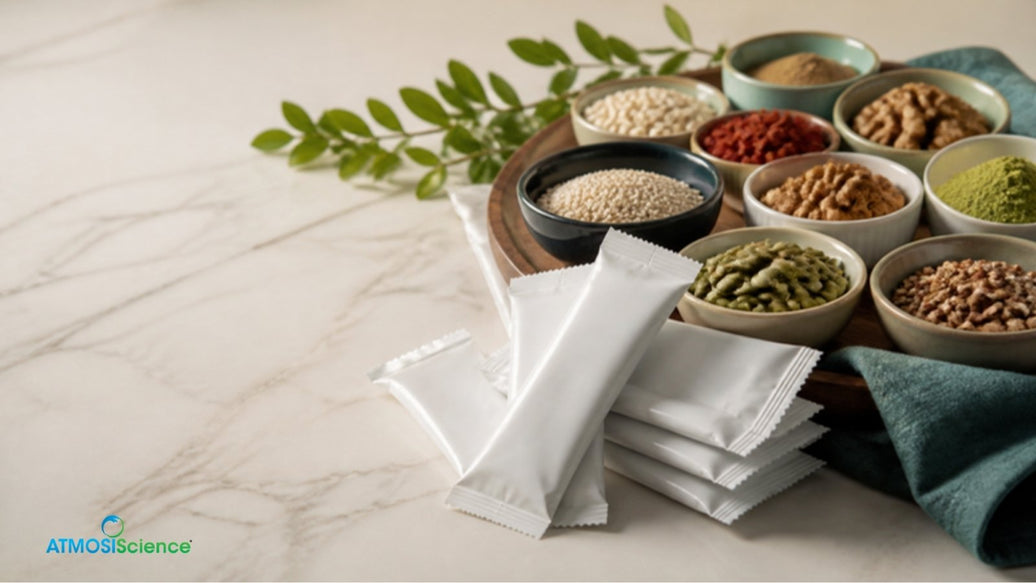
- Bagged sachet (FPH-1 type): 1 to 1,000 g per pouch, about 2.5 mm fiber substrate inside. For cartons, tubs, drums and larger enclosures.
- Filmed fiber sheet (Desimat type): 0.5 mm or 1.0 mm, cut to any shape, printable. For caps, kits, tags and tight packs.
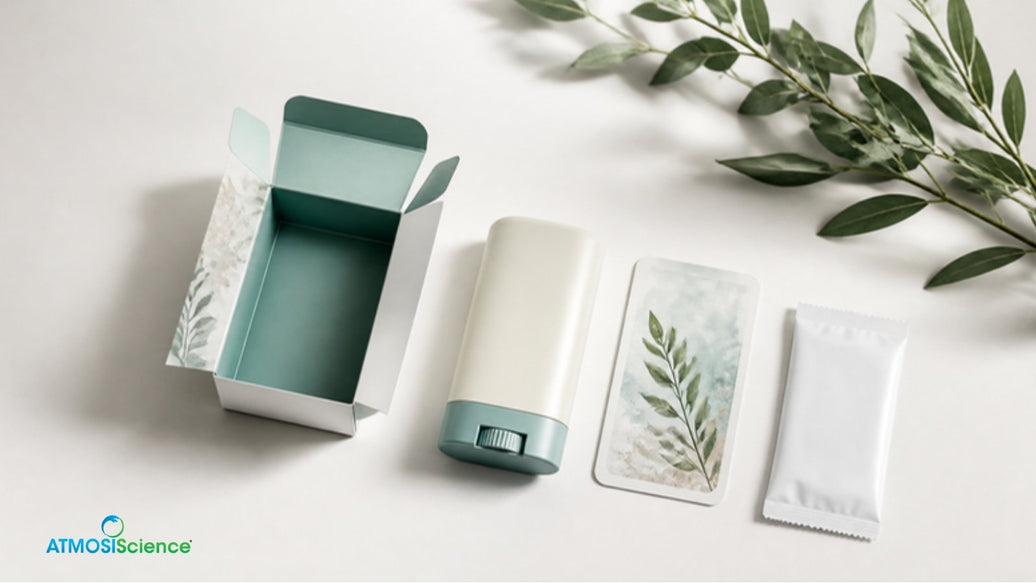
- Fiber Desiccant Card: die-cut and surface-printed, supplied ready for automated line placement. See what a desiccant card is.
Frequently asked questions
What is fiber desiccant used for?
Moisture control in packs for electronics, supplements, dry foods, diagnostic kits, garments, wooden goods, optics and art storage, wherever loose beads or clay dust are unwanted.
Is fiber desiccant the same as paper desiccant?
Fiber desiccant is a kind of paper-like desiccant, and an SGS recyclability assessment (report CQMR260700043401, July 2026) evaluated the ATMOSIScience fiber sheet as paper. Most US "desiccant paper", however, is cellulose carrying silica gel. Fiber desiccant carries calcium chloride and no silica gel. See paper desiccant explained.
Can fiber desiccant be used with food?
It is used in dried and vacuum-packed food applications. Ask for the food-contact documentation pack for your market before approval, and confirm it with your own QA.
Is fiber desiccant safe to eat?
No desiccant is food. Fiber desiccant packs carry a do-not-eat warning like any other.
How do I size fiber desiccant for my pack?
Start from pack volume, barrier, climate and shelf life. The desiccant sizing calculator gives a first estimate.
Check if fiber desiccant fits your product
Tell ATMOSIScience what you pack and how it ships. We will say plainly whether fiber is the right desiccant, and if not, which type is.
Prefer email? info@atmosiscience.com