Most desiccants work one way. Silica gel and bentonite clay both rely purely on physical adsorption — water molecules cling to a porous surface and release again as humidity rises. That single mechanism caps their capacity at around 30% of their weight and makes them reversible in the wrong direction: they give moisture back when conditions swing. Fiber desiccant is different because it uses two complementary mechanisms in one composite.
This article explains how fiber desiccant works at the material level, and why combining capillary adsorption with chemical binding produces higher, more stable capacity.

Mechanism 1: physical adsorption through capillary action
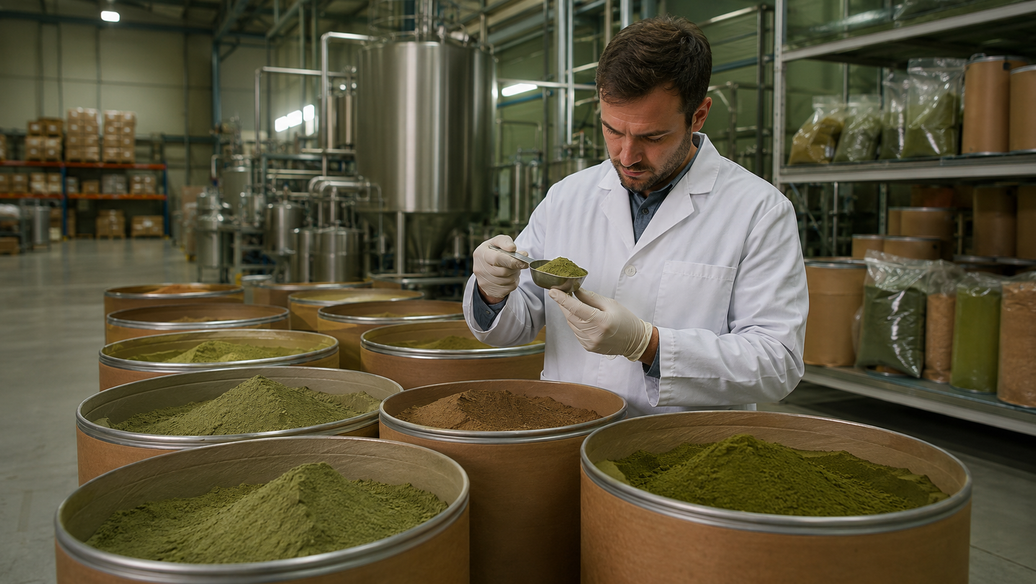
The substrate is porous lignocellulose — plant fiber with extensive internal surface area and open micro-channels. When humid air reaches it, capillary action draws moisture into those channels and van der Waals forces hold it there. Because the porosity is open rather than dense, uptake kinetics are faster than dense bentonite clay: the fiber pulls water in quickly rather than waiting for surface saturation.
This is the same family of mechanism silica gel uses, but with a more open structure tuned for speed.
Mechanism 2: chemical binding via calcium chloride
The second mechanism is where the capacity comes from. Calcium chloride and other functional groups are bound to the fiber matrix. As water arrives, the calcium chloride binds it through hydrogen bonding — a chemical hold, not just a surface cling. That delivers the high absorption capacity associated with deliquescent salts.
The critical engineering detail is that the calcium chloride is anchored in the fiber, not loose. Loose CaCl₂ would liquefy as it saturates, leaking brine and risking corrosion. Bound in the composite, it holds the water in place — the liquid does not release back, even under compression — with no dust and no leak.
Why two mechanisms beat one
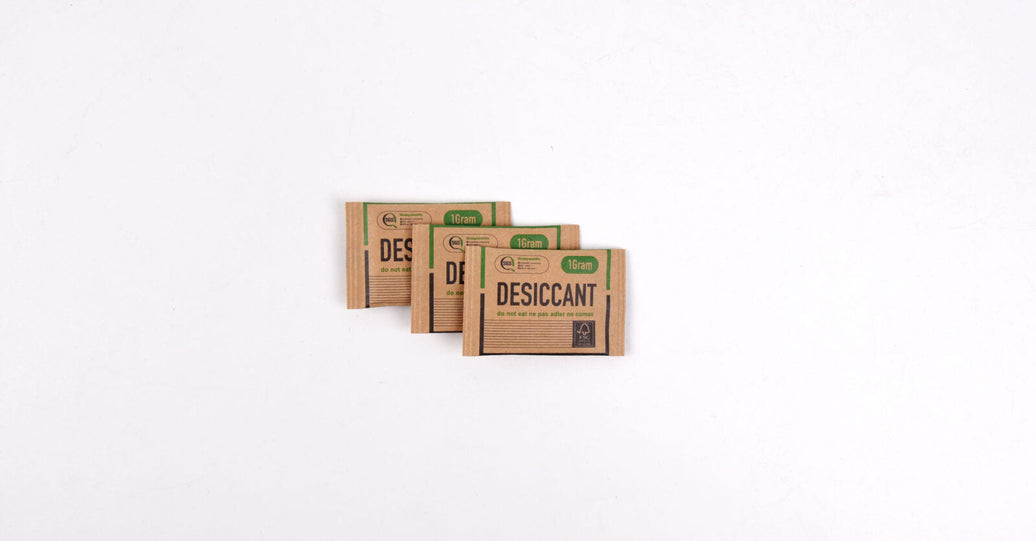
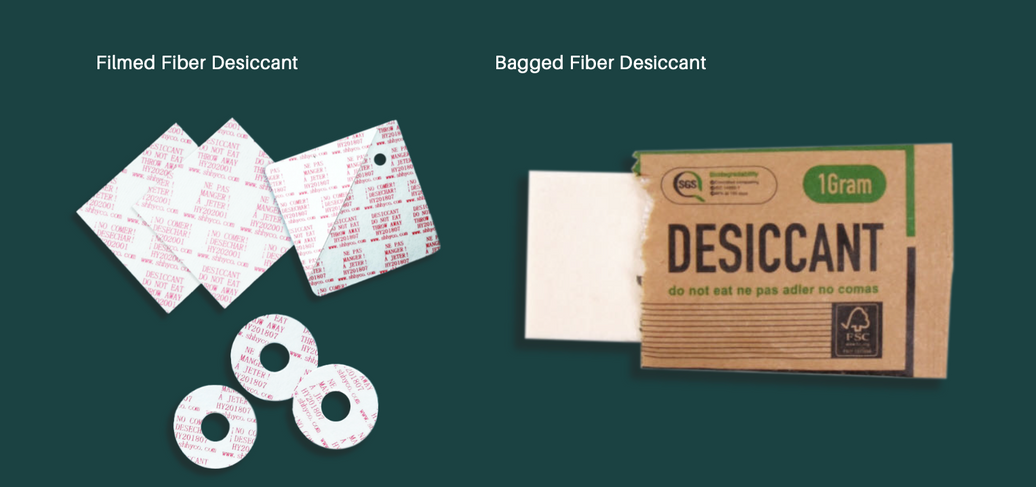
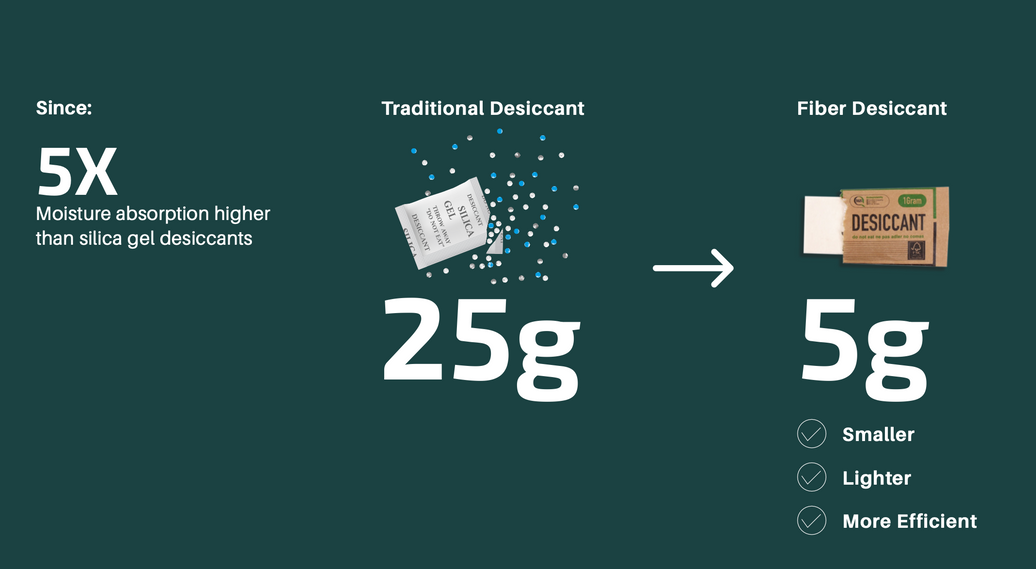
Capillary adsorption gives speed; chemical binding gives capacity and retention. Together they explain the numbers: the bagged FPH-1 format absorbs over 100% of its own weight at saturation, and at RH90% / 25°C one kilogram of patented fiber absorbs around 1,500 ml of water versus about 300 ml for silica gel. At RH95% / 45°C the fiber reaches around 2,400 ml. Across the board that is roughly three to five times silica-gel capacity.
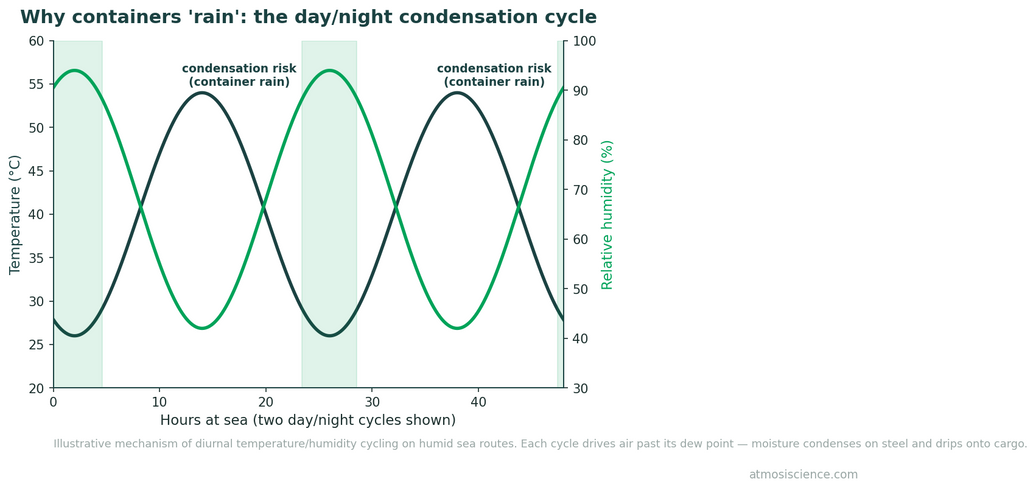
Retention matters as much as capacity. Because the water is chemically bound, the fiber does not dump moisture back into the package when humidity drops — the failure mode that limits pure-adsorption desiccants in temperature-cycling environments.
What the science means for a packaging engineer
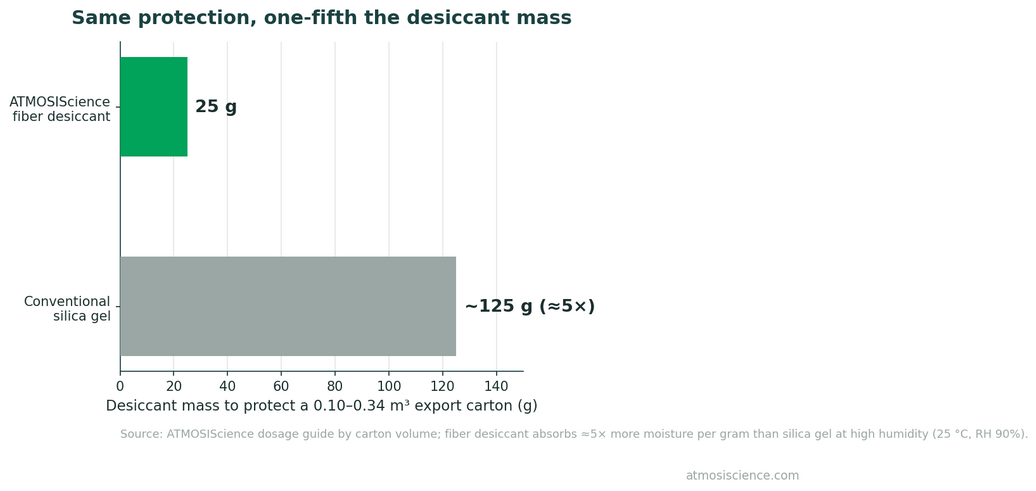
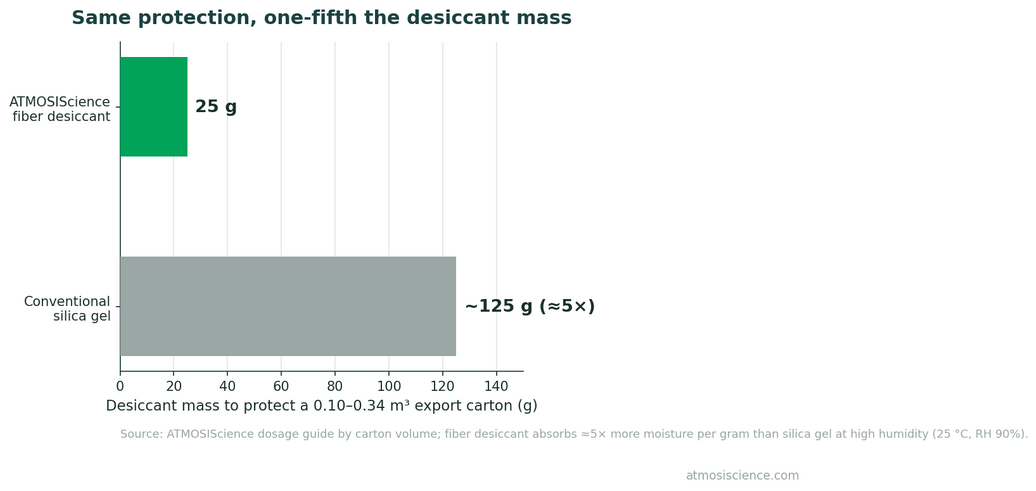
Higher capacity per gram means less desiccant per package — roughly one-third to one-fifth of the silica-gel mass for equivalent protection — which lowers material cost, freight weight, and package footprint. Bound chemistry means no dust to contaminate product and no brine to corrode metal or electronics. And the same composite air-dries to regenerate without an oven, because the binding is reversible by design when you want it to be.
Frequently asked questions
How does fiber desiccant absorb more than silica gel?
It pairs capillary physical adsorption in porous lignocellulose with chemical binding by calcium chloride. Silica gel uses physical adsorption alone, capping it near 30% of its weight; fiber reaches over 100% (bagged).
Does the calcium chloride leak?
No. It is bound to the fiber matrix rather than loose, so it holds water without liquefying — no brine leak, dust, or corrosion, even under compression.
Why does retention matter?
Pure-adsorption desiccants release moisture back as humidity falls. Chemically bound water stays put, so fiber desiccant protects better through temperature and humidity cycling.
Can fiber desiccant be regenerated?
Yes — it air-dries to regenerate, with no oven or heat source required, unlike silica gel.
See the performance for yourself
ATMOSIScience supplies the patented plant-fiber desiccant described here, with full performance data and certifications.
Request the technical data pack and bulk pricing through our desiccant solutions page or contact our team, or evaluate it with the Fiber Desiccant.
Related reading: Bentonite Clay vs. Fiber Desiccant · Calcium Chloride vs. Silica Gel vs. Fiber Desiccant
Get a desiccant spec & bulk quote for your product
Tell us about your packaging needs, and our sales team will respond with a customized fiber-desiccant solution, supporting certificates and competitive bulk pricing.