Quick answer: There is no universal “dry.” Every product has a humidity band where it stays sellable: most dry powders need the pack held below their caking threshold; cannabis flower is merchandised at 58–62% RH; premium cigars at 65–72%; wooden instruments live comfortably in the mid-band; electronics need “low and stable, never condensing.” The table below gives working starting points — then validate your own number with water-activity or sorption-isotherm testing, because the threshold belongs to the formulation, not the category.
“What humidity should my packaging hold?” is the first sizing question, and the honest answer is a table plus a method. ATMOSIScience publishes deep guides per category; this page is the cross-reference buyers keep asking for — the starting points in one place, with links to the reasoning.
The RH reference table
Working starting points for sealed-pack targets — validate per product before committing a spec.
| Product category | Working RH target | Control logic |
|---|---|---|
| Dry powders (protein, greens, spices, drink mixes) | Below the product's caking threshold — formulation-specific | One-way desiccant sized to hold the pack under threshold for full shelf life |
| Dry foods generally (mold-safety rule of thumb) | Water activity below ~0.6 aᴡ | aᴡ, not %RH of the room, is the spec that predicts microbial safety |
| Effervescent tablets, diagnostics, moisture-critical pharma | Very low — ultra-dry class | Molecular-sieve territory; overspec for most other goods |
| Cannabis flower (cured, stored, merchandised) | 58–62% RH | Two-way control holds the band — drying ruins it as surely as damp |
| Premium cigars | 65–72% RH by preference | Two-way set-point per house style |
| Wooden instruments | Stable mid-band — avoid dry extremes | Two-way buffering; cracking risk is a dryness problem, not a damp one |
| Electronics & PCB | Low and stable; never condensing | Stability and anti-condensation matter more than the absolute number |
| Seeds (viability storage) | Cool and dry — low band | Moisture drives respiration and viability loss |
Why targets beat “as dry as possible”
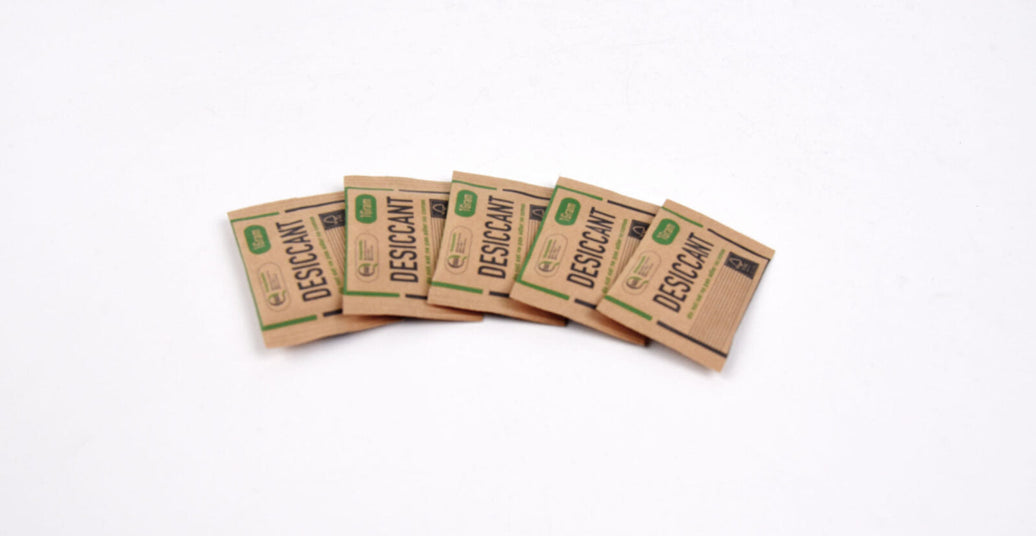
Half the categories above are damaged by over-drying: cannabis loses weight and character, cigar wrappers crack, instrument wood shrinks, gummies harden. That is why the industry distinction that matters is one-way versus two-way: a desiccant only pulls down; a two-way humidity-control pack pulls the enclosure toward a set band from either side. The full argument is in Why 'Drier Is Better' Is Wrong.

How to find your product's real number
Water activity first. For foods and powders, measure aᴡ — the spec that actually predicts caking and microbial risk, explained in Water Activity vs. Relative Humidity.
Then the isotherm. A moisture sorption isotherm shows exactly where your formulation starts to cake — the walk-through is in the isotherm guide.
Then hold the number. One-way desiccant to stay below a threshold; two-way control to sit inside a band. Category-specific set-points for cigars are compared in the humidor set-point guide.
FAQ
What humidity should packaged food be kept at?
Specify water activity below roughly 0.6 aᴡ for mold safety, and lower where texture demands it — crispy snacks and effervescents sit far below that ceiling. The pack-air RH follows from the product's isotherm.
Is 40–60% RH the “safe zone” for everything?
It is a comfortable mid-band for hygroscopically balanced goods (wood, botanicals) — and wrong for dry powders (too humid) and effervescents (far too humid). Category first, then formulation.
What happens if humidity is too low?
Over-dried botanicals crumble and lose volatiles; wood shrinks and cracks; gummies and soft chews harden. Products with a floor need two-way control, not more desiccant.
How is the target held during shipping swings?
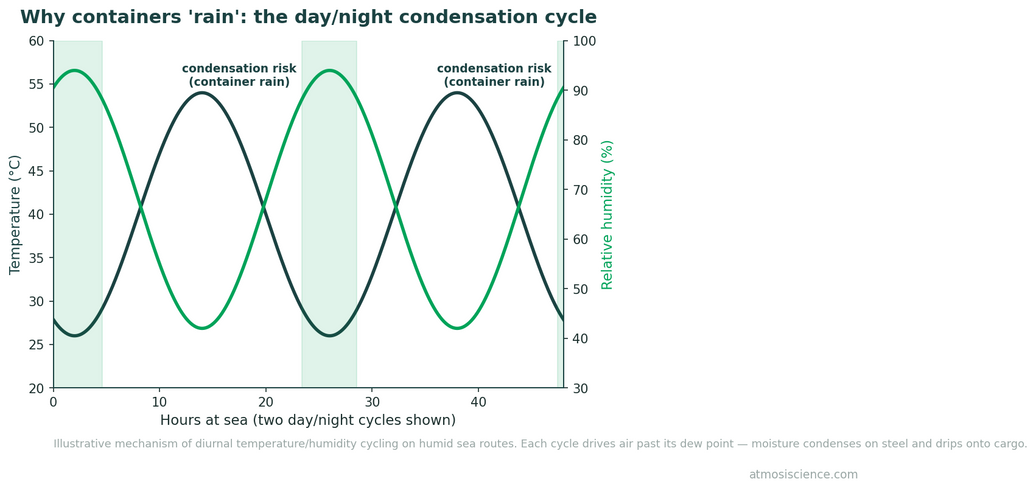
Sealed barrier + correctly sized control unit. Temperature cycling en route raises and drops RH inside the pack — buffering behavior through those swings is the two-way platform's core job.
Get your target RH validated
Send the product and its current spec (or “we don't have one” — most brands don't). The team returns a recommended target band, the test to confirm it, and the control format that holds it.