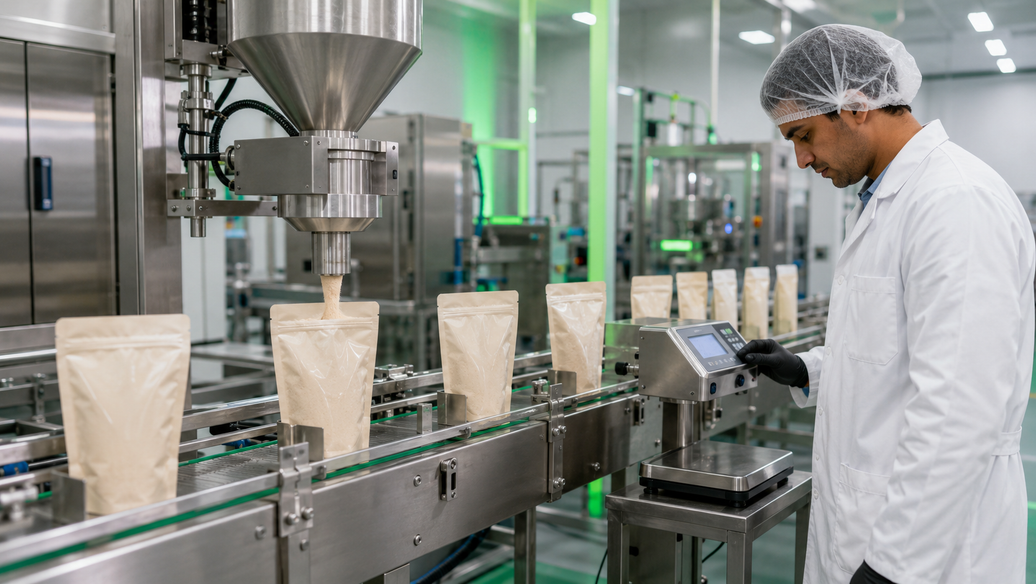
Quick answer: Moisture control packaging is a system with four layers, not a product you add at the end. Layer one is the product's own starting moisture. Layer two is the barrier film and seal. Layer three is the headspace atmosphere sealed in at fill. Layer four is the in-pack desiccant, which handles what the first three let through. Getting the order right matters: a desiccant cannot rescue a bad seal, and an excellent film still ships whatever humidity was in the filling room.
The global desiccants market is projected to grow from roughly $1.29 billion in 2025 to about $1.36 billion in 2026, at a compound annual growth rate near 5.5%. Growth is being pulled by pharmaceutical cold-chain expansion, e-commerce packaging, and — increasingly — by sustainability regulation that changes what packaging is allowed to weigh and made of.
That last driver is why 2026 is a different buying year than 2024 was. The barrier film that used to be the obvious choice may now be the one that fails a recyclability grade.
Layer 1: the product's starting condition
Every downstream decision inherits from the moisture the product carries at fill. A powder packed at the top of its acceptable range has consumed most of its own safety margin before the pack is sealed.
The number that governs behaviour is water activity, not total moisture content — available water is what migrates, cakes and supports microbial growth. Distinction: water activity vs. moisture content. The formulation-specific relationship between them lives in the sorption isotherm: how to read one.
Layer 2: barrier and seal
Barrier performance is measured as water vapour transmission rate — grams of water passing a square metre of film per day at stated temperature and humidity. Lower is better, and no commercial film reaches zero.
Two things get missed. First, the seal usually fails before the film does; most real-world ingress is a seal-integrity problem, not a barrier-material problem. Second, PPWR recyclability grading is pushing brands toward mono-material structures, which typically have weaker barrier than the multi-layer laminates they replace. The consequence is direct: as barrier weakens, in-pack desiccant does more work, not less. This is worked through in why weaker packaging barriers mean more desiccant and choosing a mono-material-compatible desiccant.
Layer 3: sealed-in headspace
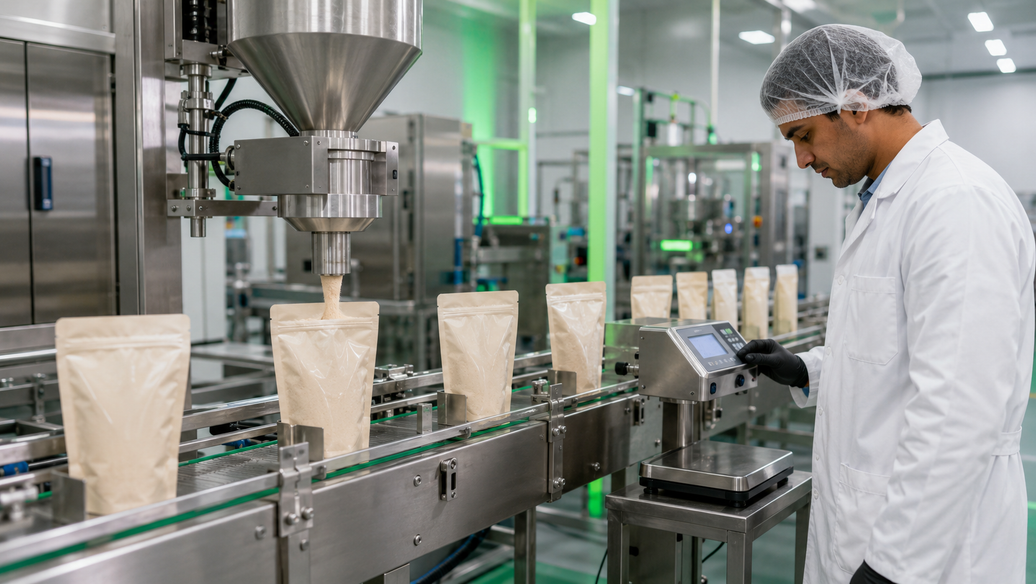
The air enclosed at fill is a permanent moisture load. It cannot be removed later; it can only be adsorbed. Three ways to reduce it: lower the filling-room humidity, reduce headspace volume, or displace the atmosphere with nitrogen.
Nitrogen flushing displaces oxygen and reduces water vapour along with it, but it is not humidity control — it sets an initial condition and does nothing about permeation afterwards. Comparison: desiccant vs. oxygen absorber vs. nitrogen flush.

Layer 4: the in-pack desiccant
The desiccant absorbs the residual: sealed-in water, permeated water, and — for resealable formats — water admitted at each opening cycle.
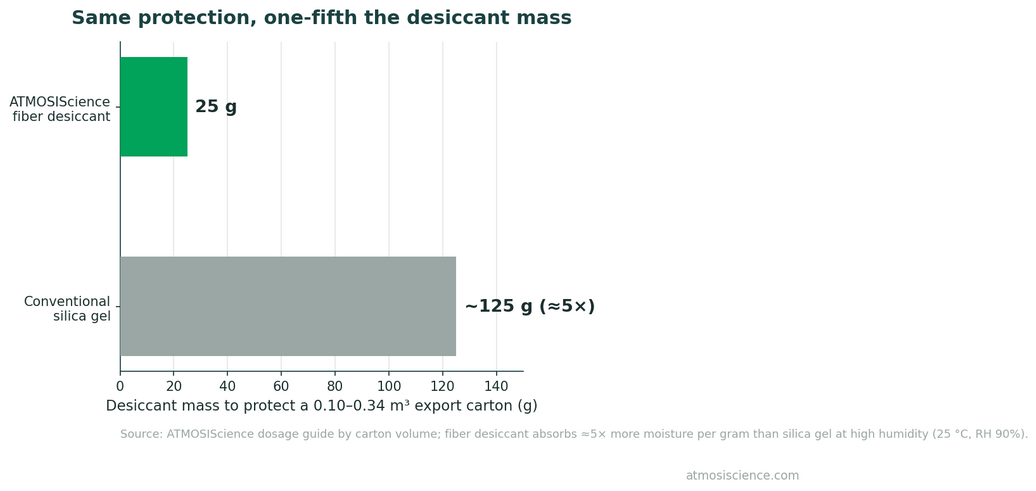
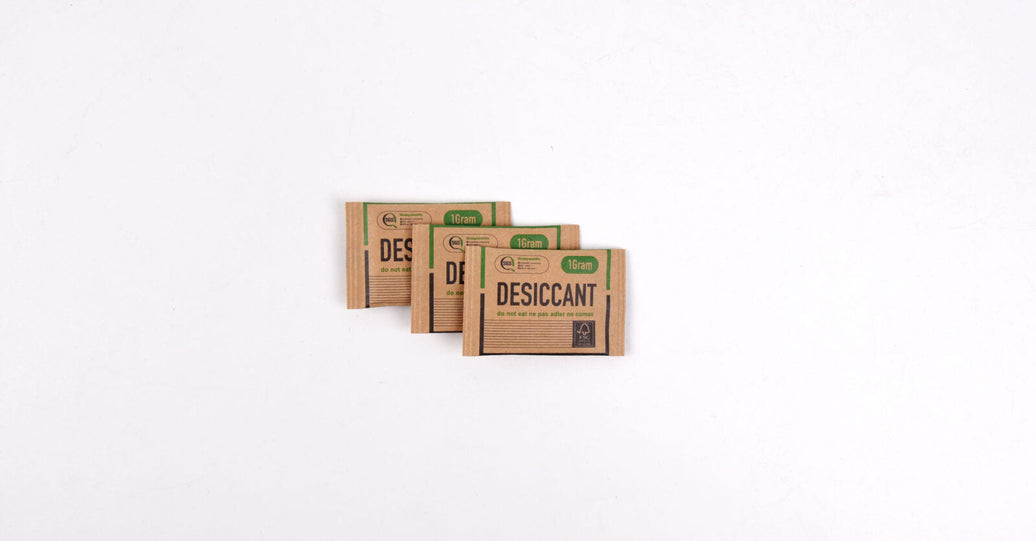
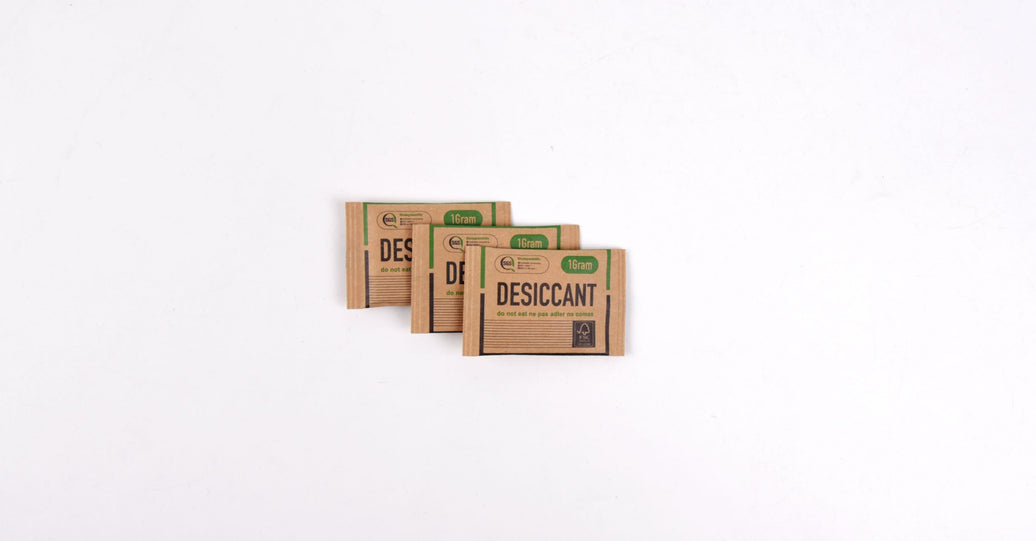
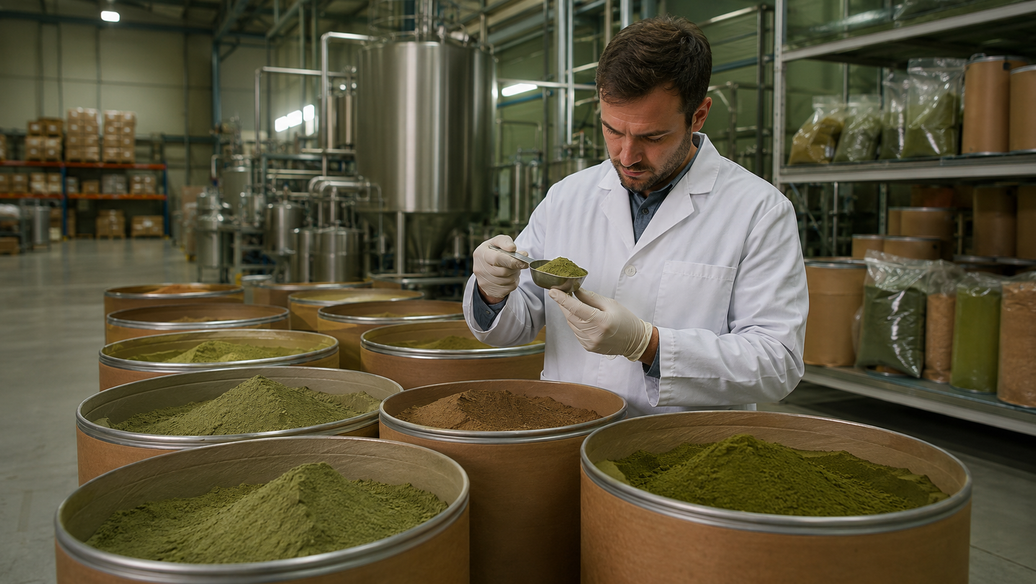
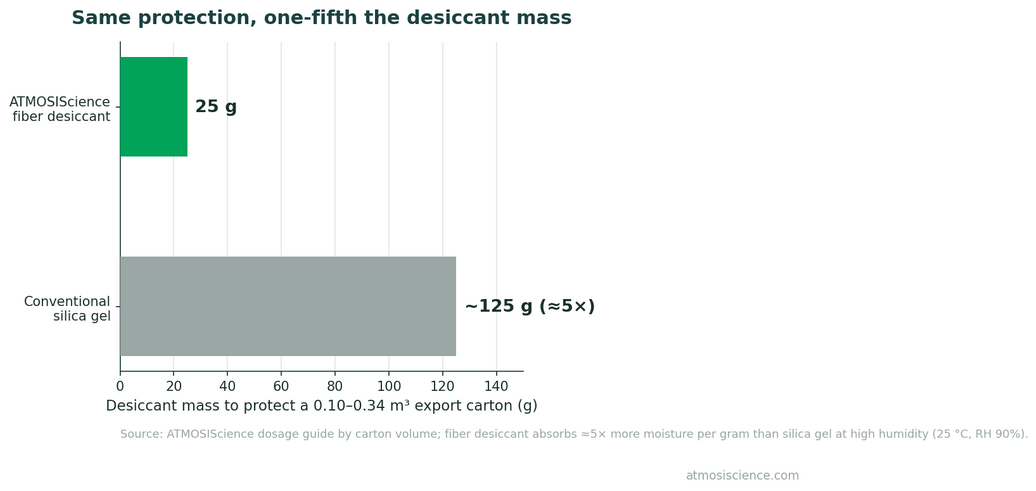
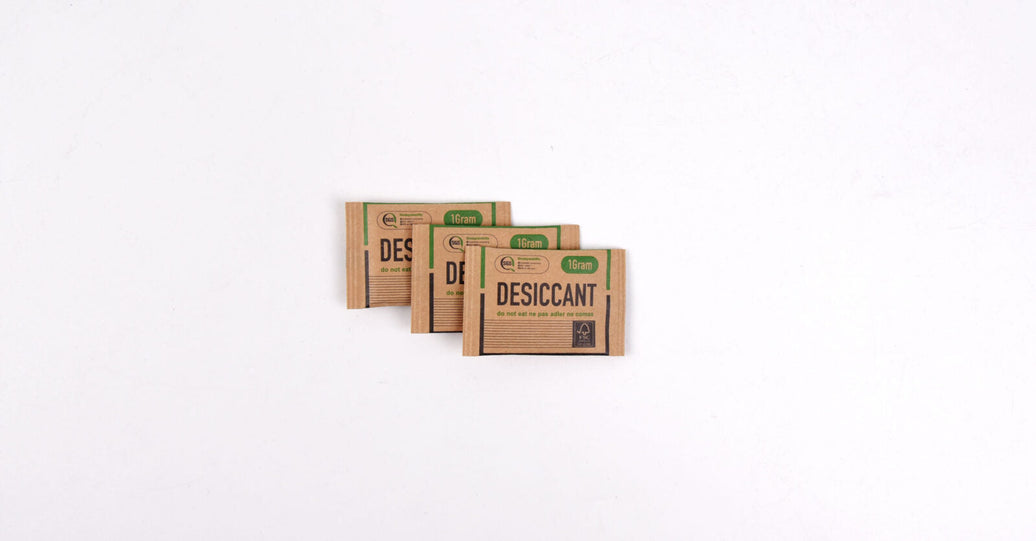
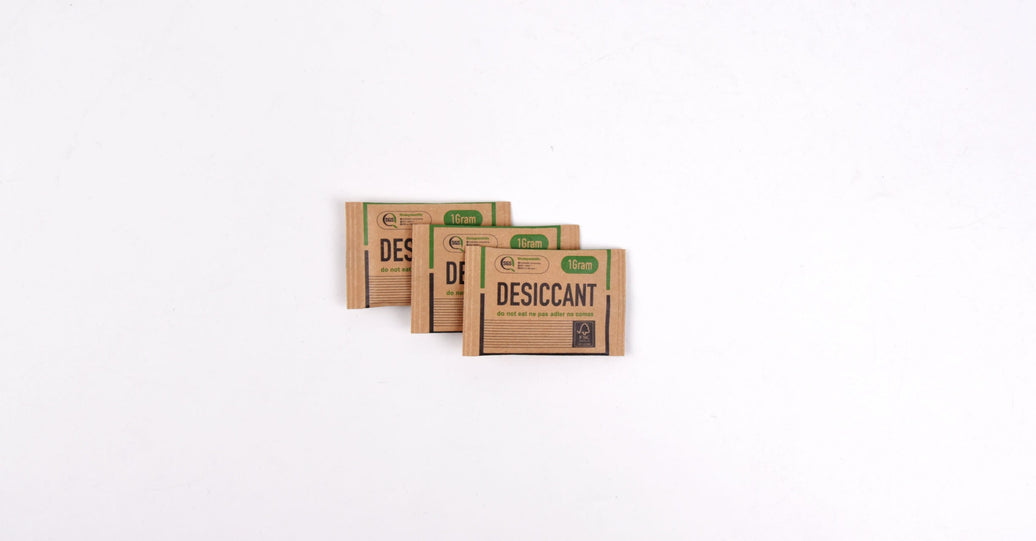
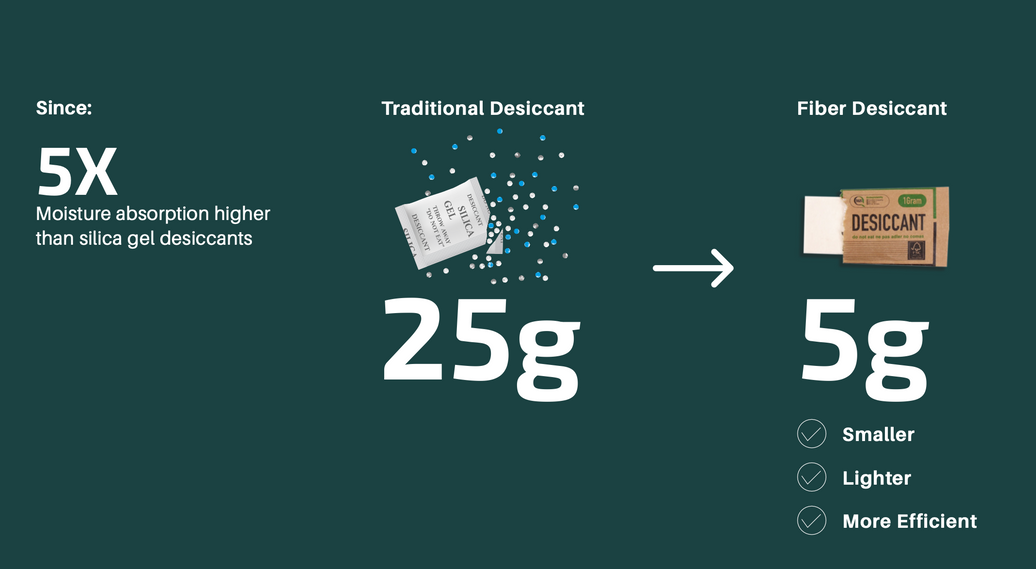
Material. Silica gel is the incumbent, at roughly 30% of own weight. Molecular sieve wins at ultra-low humidity. Clay is cheap and low-capacity. Calcium chloride is high-capacity and needs containment. Plant-fiber desiccant carries above 70% of own weight at RH90 (25°C), above 35% at RH50 and above 10% at RH20, with saturated capacity above 100%. Full comparison: six silica gel alternatives compared.
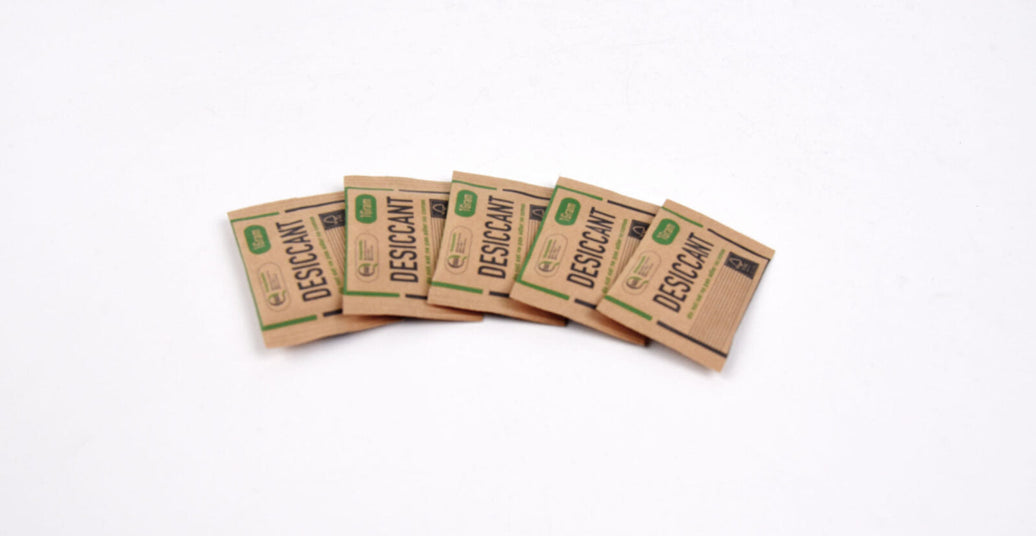
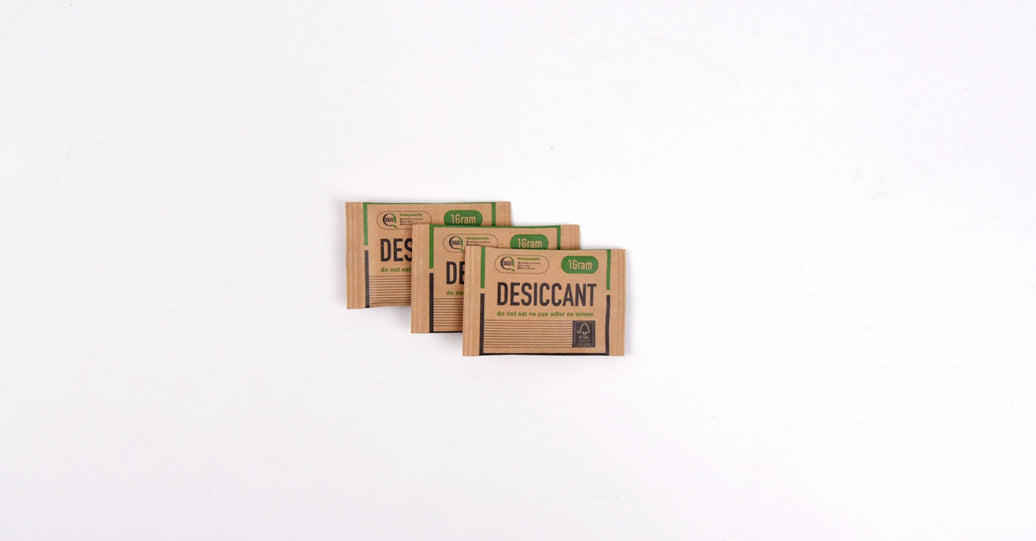
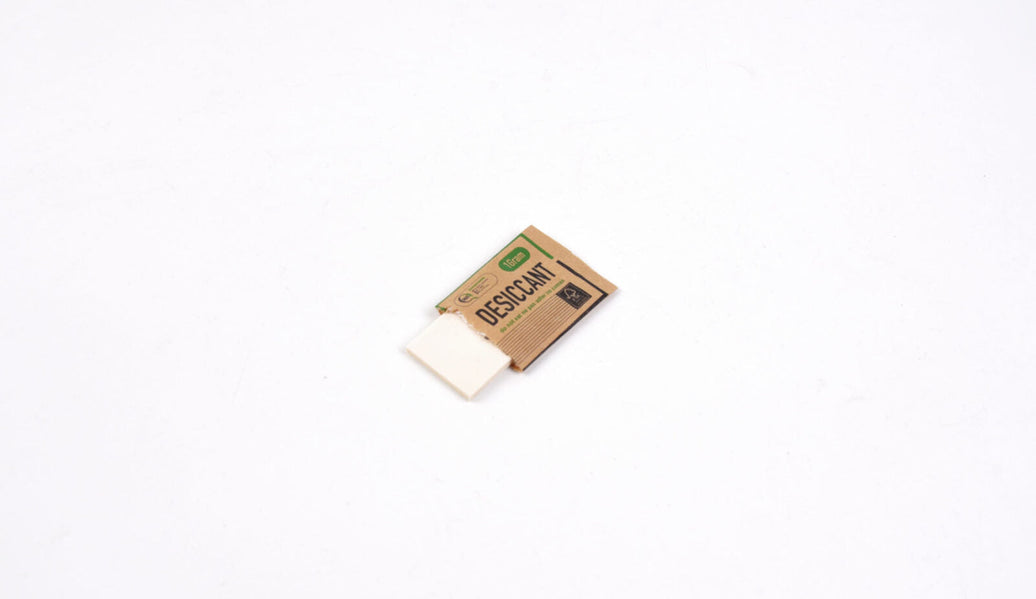
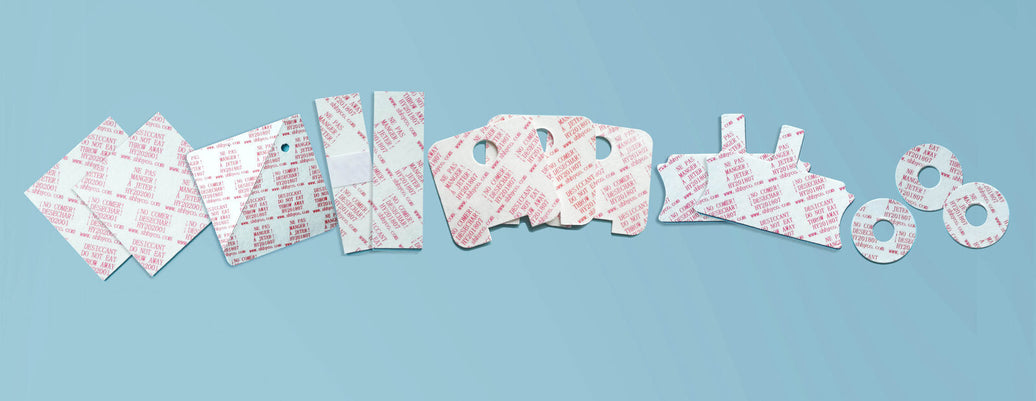
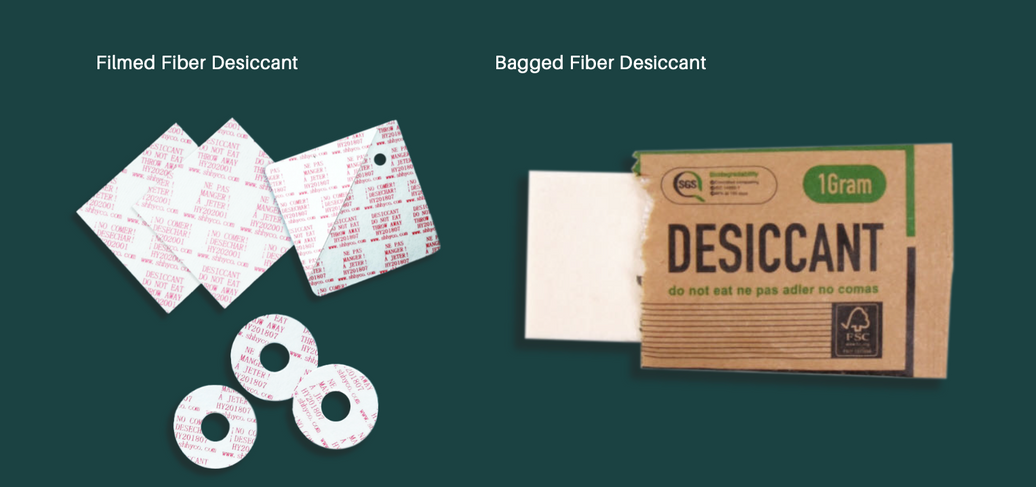
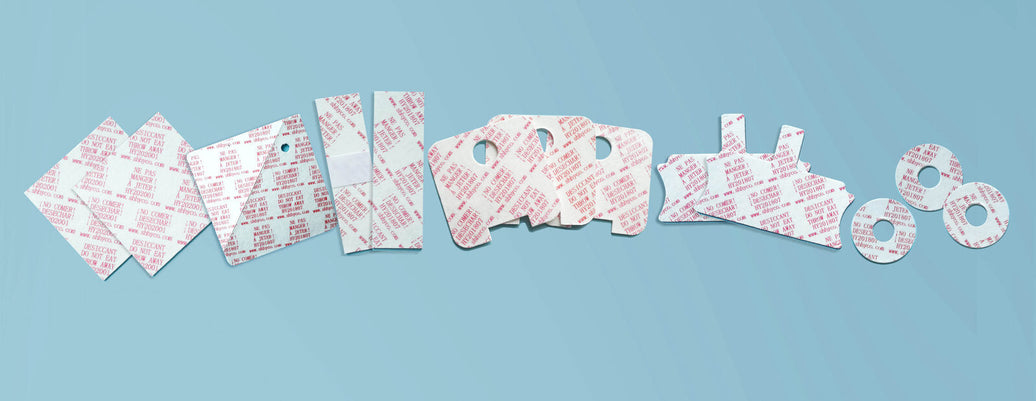
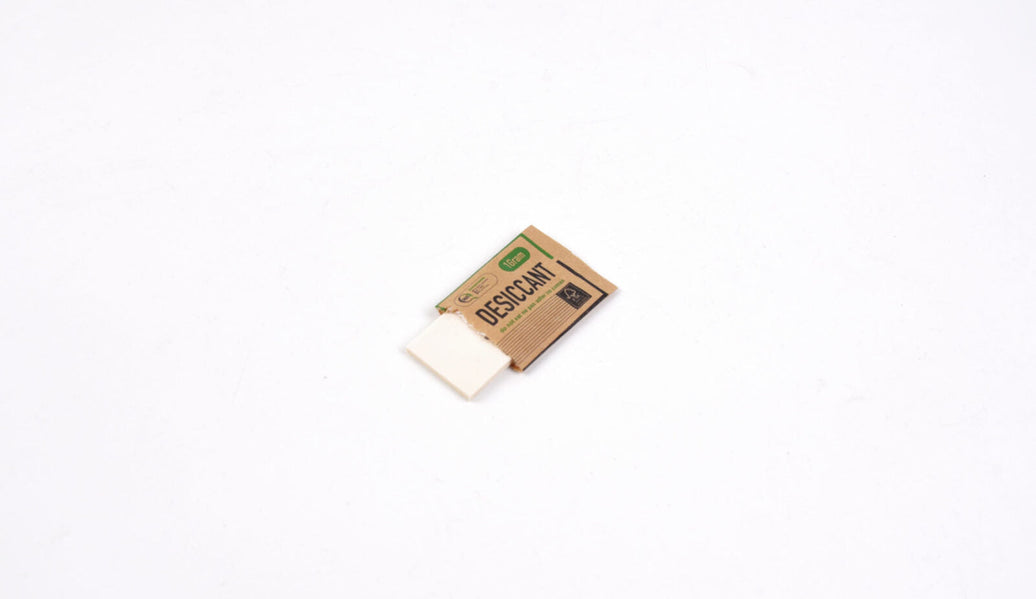
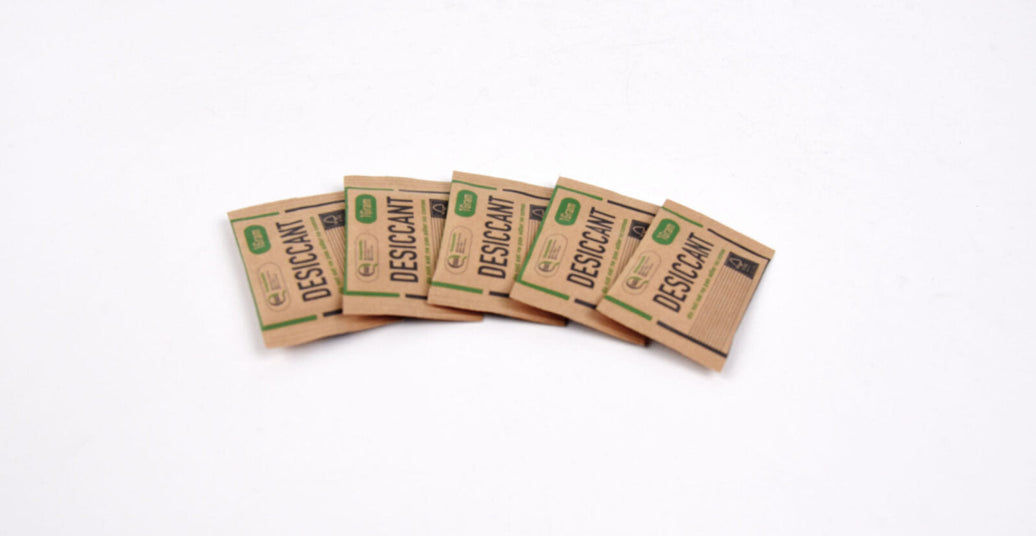
Format. Sachets for bulk and cartons; die-cut filmed cards at 0.5 mm or 1.0 mm for blisters, pouches and low-headspace formats; cap inserts for bottles. Selection logic: sachet, film card or cap insert.
Direction. One-way materials drive toward zero. Two-way materials hold a band. Products with a moisture floor — many botanicals, some proteins, anything with a hydrated crystalline form — need the second kind. Reasoning: why "drier is better" is wrong.
Sizing the system
Four terms, summed, then validated.
- Sealed-in load: headspace volume × absolute humidity at fill.
- Permeation load: film WVTR × surface area × humidity differential × shelf life.
- Opening load: exchanged volume × ambient humidity × expected number of openings.
- Safety factor: applied to the total, sized to consequence.
Convert the total to a desiccant mass using capacity at your target RH, not at the supplier's most flattering test point. Working method: dosage by carton volume and the service-life math.
Then validate at worst case rather than at ambient — the test protocol — because a calculation that has not been tested is a hypothesis.
What changed for 2026
- PPWR applies from 12 August 2026. Regulation 2025/40 entered force in February 2025; recyclability performance grading follows by 2030 and tightens in 2035. In-pack components count. Hub: EU PPWR and desiccant sachets.
- US EPR is live in five states. California, Colorado, Maine, Oregon and Washington fee packaging by weight and recyclability, which prices desiccant mass directly.
- Bio-based adsorbents moved from novelty to specification. Driven mainly by the two items above rather than by preference.
- Mono-material conversion is weakening barrier. The single most under-modelled change in packaging right now.
Frequently asked questions
Is a desiccant needed if the barrier film is good?
Usually yes. A high-barrier film slows permeation but does nothing about the humidity sealed in at fill, and nothing about opening cycles. Barrier and desiccant solve different parts of the same problem.
What is a reasonable target RH inside a package?
It depends entirely on the product. Hygroscopic powders commonly target the 20–40% band; some botanicals and proteins need a floor to avoid over-drying. Category targets: the RH reference table.
Where should the desiccant sit in the pack?
In the headspace, with genuine air contact, and not buried under product or trapped against a wall. Placement causes more field failures than material choice: where to place desiccant.
How much does moisture control packaging add per unit?
Typically cents, and the comparison that matters is against the failure it prevents — one caked batch, one contamination hold, one recall. Arithmetic: the moisture-failure ROI worksheet.
Can one system cover a whole product range?
Often, if the platform supports multiple formats from one qualified material. That keeps a single document file across sachets, cards and cap inserts instead of qualifying three separate supply chains.
Have your moisture control system reviewed
Send the pack format, film WVTR, target RH and shelf life. ATMOSIScience returns a layer-by-layer assessment and a dosage recommendation.
Prefer email? info@atmosiscience.com