"How much desiccant per package?" is one of the most-searched questions in packaging engineering — and one of the most expensive to get wrong. Under-dose, and moisture damages the product, triggers returns, or fails a stability test. Over-dose, and the program wastes material, freight, and budget on every single unit shipped.
This guide gives a practical method for how much desiccant per package, a ready dosage table by carton volume, and the variables that should adjust the baseline up or down.

The short answer: dose by enclosed volume, then adjust
The starting point for desiccant dosage is the enclosed air volume of the package, not the size of the product inside it. Moisture lives in the air and in the materials sealed alongside the product, so volume is the first lever.
For ATMOSIScience Fiber Desiccant, the recommended dosage scales cleanly with carton volume:
| Enclosed volume (m³) | Fiber desiccant (g) |
|---|---|
| 0.01 | 1 |
| 0.049 | 5 |
| 0.099 | 10 |
| 0.10 – 0.34 | 25 |
| 0.35 – 0.59 | 50 |
| 0.60 – 0.79 | 75 |
| 0.80 – 1.0 | 100 |
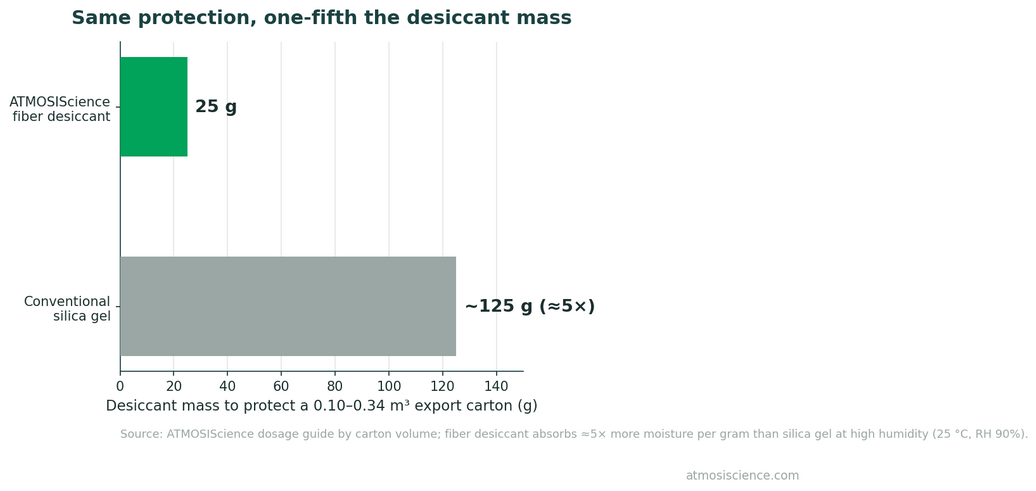
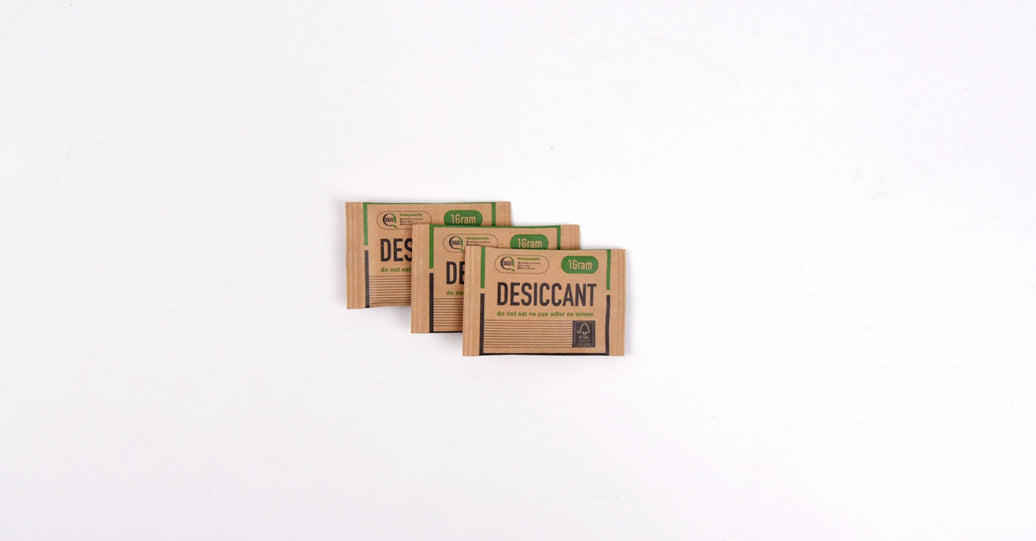
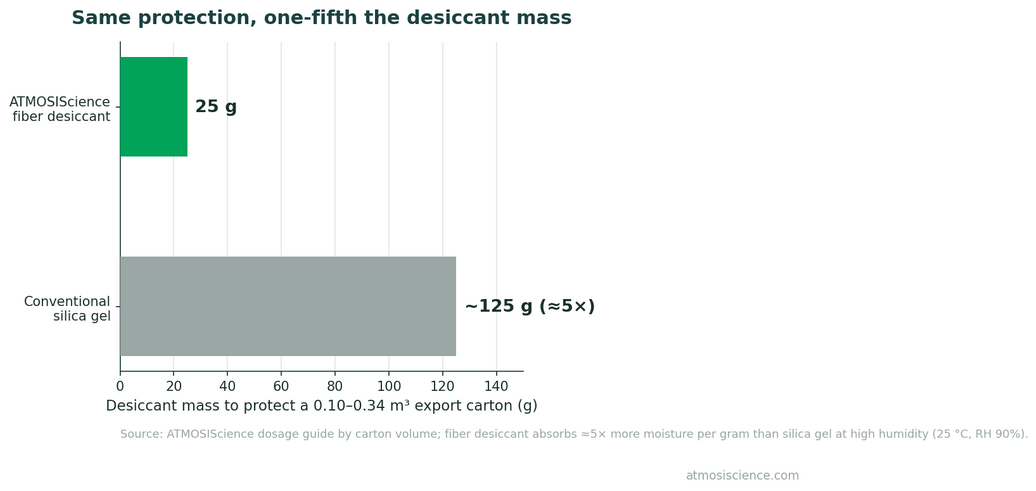
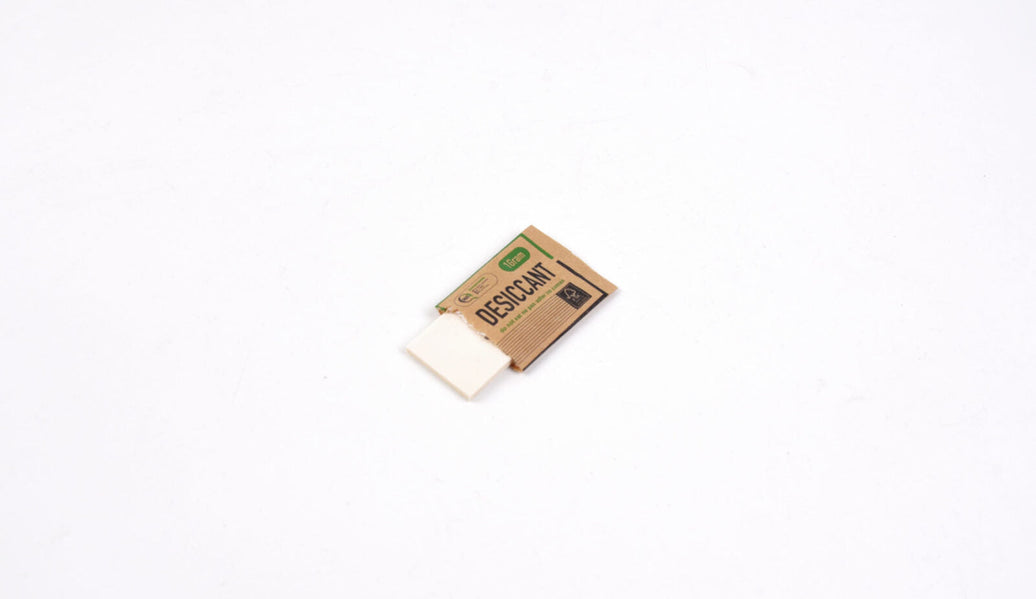
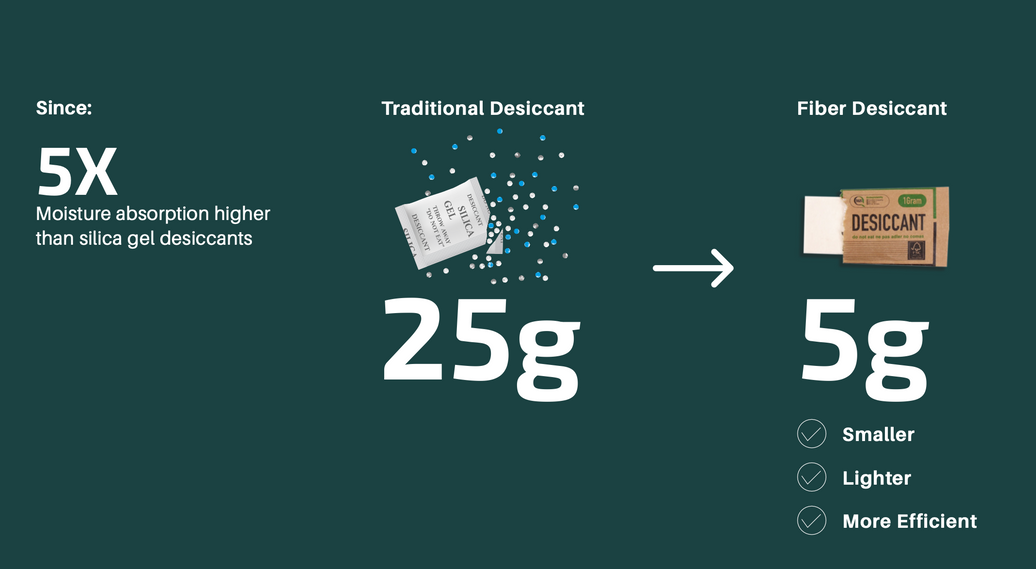
A common reference point: to protect a standard 0.10–0.34 m³ carton, only about 25 g of fiber desiccant is required. That figure already reflects a material that absorbs roughly 5x more moisture than the same weight of silica gel — which is why the gram counts above look low compared to traditional dosing tables.
Why material choice changes the dosage math
The table above is specific to fiber desiccant for a reason. Absorption capacity per gram directly determines how many grams a package needs.
The team observed fiber desiccant absorbing over 70% of its own weight at RH90% and 25°C, versus roughly 30% for conventional silica gel under the same conditions — and the bagged FPH-1 format reaches over 100% of its own weight at saturation, around three times silica gel. At RH95% and 45°C, one kilogram of patented fiber absorbed around 2,400 ml of moisture in testing, compared with about 300 ml for silica gel.
The practical consequence: a package that would need a large silica gel charge can often be protected with a fraction of the fiber weight. Less desiccant per unit means lower freight weight, smaller package footprints, and fewer inserts to handle on the line — savings that compound across a production run.
Five variables that adjust the baseline
The volume table is a starting point. Five factors should push the dose up or down from there.
1. Barrier quality of the package. A high-barrier, sealed package holds the desiccant's work in. A breathable or loosely sealed package lets ambient moisture in continuously, raising the required dose or shortening protection time.
2. Moisture sensitivity of the product. Electronics, certain pharmaceuticals, and hygroscopic powders demand a lower, tightly held humidity. Less-sensitive goods tolerate more variation, allowing a leaner dose.
3. Initial moisture sealed inside. Paper inserts, cardboard, wood, and the product itself carry moisture into the package at sealing. Wet components effectively raise the load the desiccant must absorb.
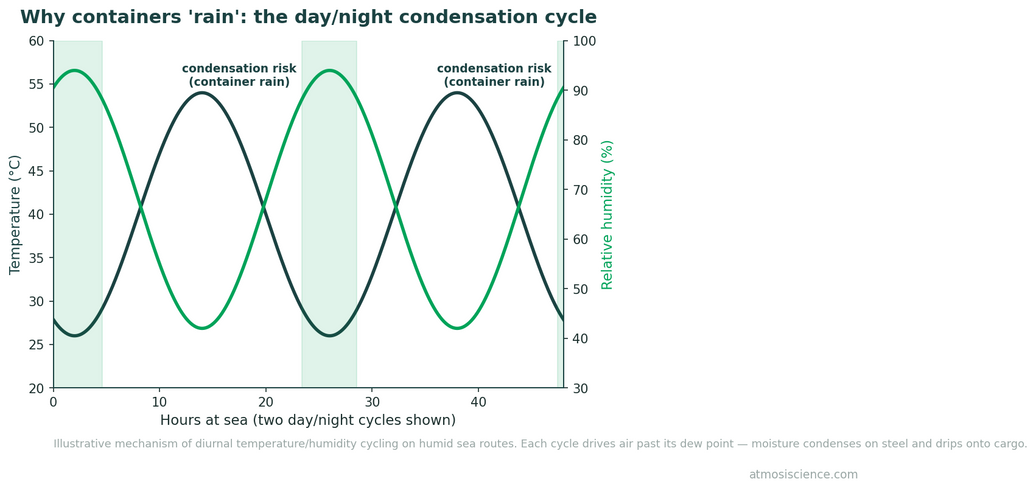
4. Distribution climate and duration. A container crossing a humid equatorial route for six weeks is a far heavier moisture challenge than a domestic shipment in two days. Longer, hotter, more humid transit raises the dose.
5. Target shelf life. The desiccant must keep working until the product is opened. A 24-month shelf life needs more absorptive reserve than a 6-month one.
A simple four-step dosing method
For teams sizing a new package, this sequence works without specialized software:
First, measure the enclosed air volume in cubic meters and read the baseline gram count from the table. Second, adjust upward if the package is breathable, the contents are wet at sealing, or distribution is long and humid. Third, adjust downward only if the package is high-barrier, contents are dry, and transit is short. Fourth — and most important — validate the chosen dose with a humidity indicator card inside a test package under real or simulated conditions before committing to a full run.
That validation step is where good programs separate from guesses. A humidity indicator card costs little and turns a theoretical dose into a measured one.
Over-dosing and under-dosing: the real costs
Under-dosing is the obvious failure — visible as moisture damage, mold, corrosion, clumping, or a failed stability test. The cost shows up as returns, scrap, and lost trust.
Over-dosing is the quieter, more common waste. Every excess gram is paid for on every unit: material cost, freight weight, and warehouse space, multiplied across the entire run. A program shipping hundreds of thousands of units can spend tens of thousands of dollars a year on desiccant nobody needed. Right-sizing the dose is one of the cleanest cost-out opportunities in packaging.
Frequently asked questions
How much desiccant do I need for a standard carton?
For a carton of 0.10–0.34 m³, about 25 g of fiber desiccant is the baseline. Smaller volumes scale down (1 g for 0.01 m³, 10 g for ~0.10 m³); larger volumes scale up (100 g near 1.0 m³). Adjust for barrier quality, transit, and shelf life.
Why does fiber desiccant use fewer grams than silica gel?
Fiber desiccant absorbs roughly 5x more moisture per gram than silica gel, so a package needs far less of it to achieve the same protection — reducing material, weight, and cost per unit.
How do I know if my dose is correct?
Place a humidity indicator card inside a test package and hold it under real or simulated distribution conditions. The card shows whether the package stays within the target RH range, validating the dose before a full production run.
Can I over-dose a package with desiccant?
Technically the product stays dry, but every excess gram adds material cost and freight weight on every unit shipped. Over-dosing is a hidden, recurring waste — right-sizing is the goal.
Right-size your desiccant — and prove it
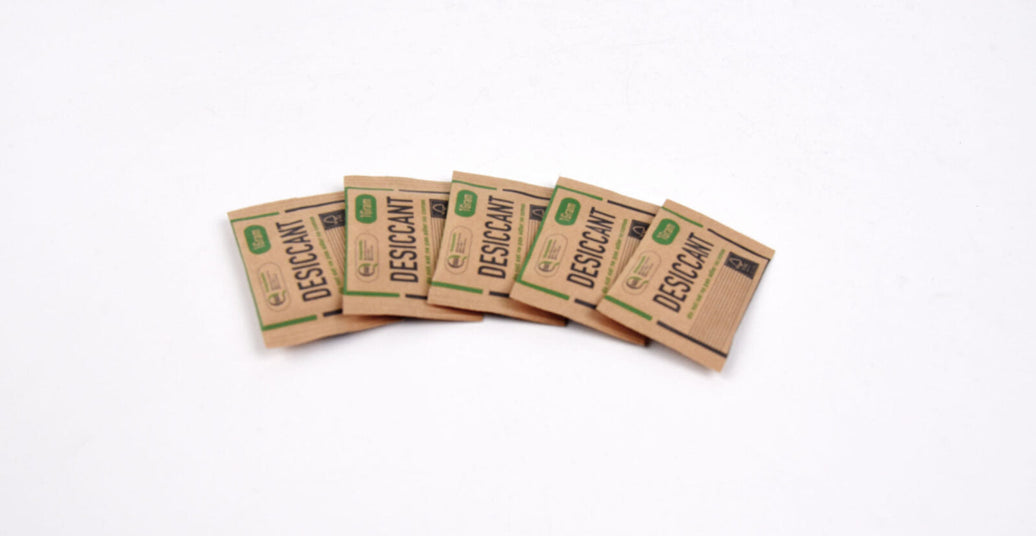
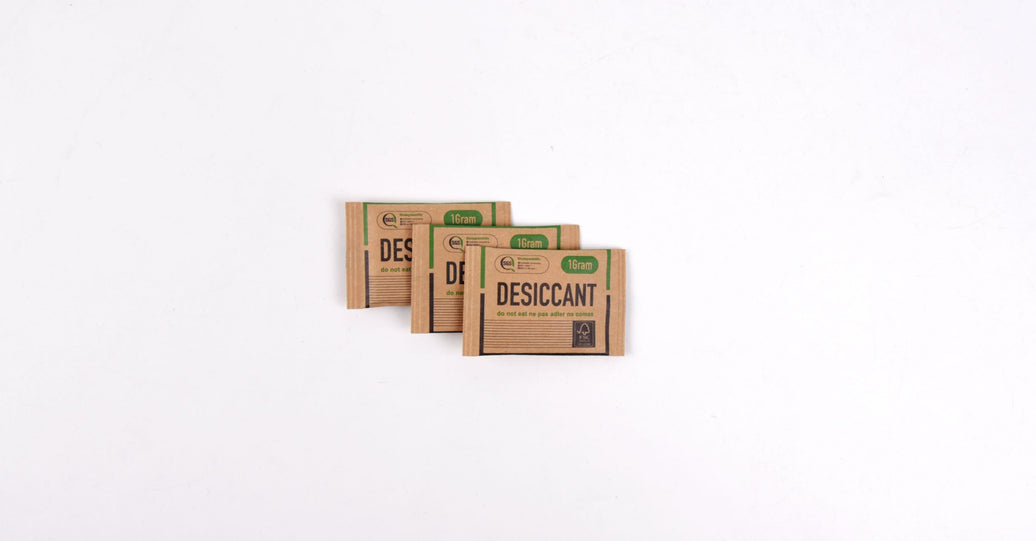
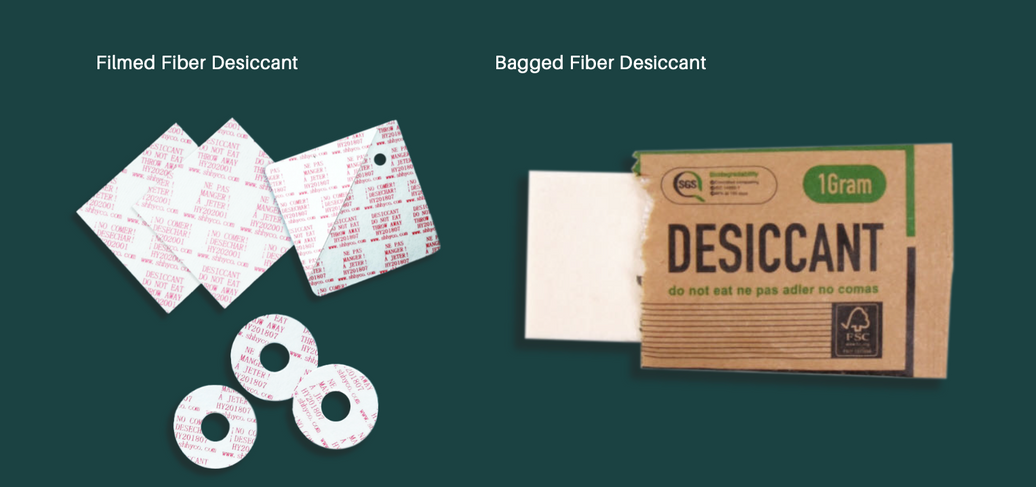
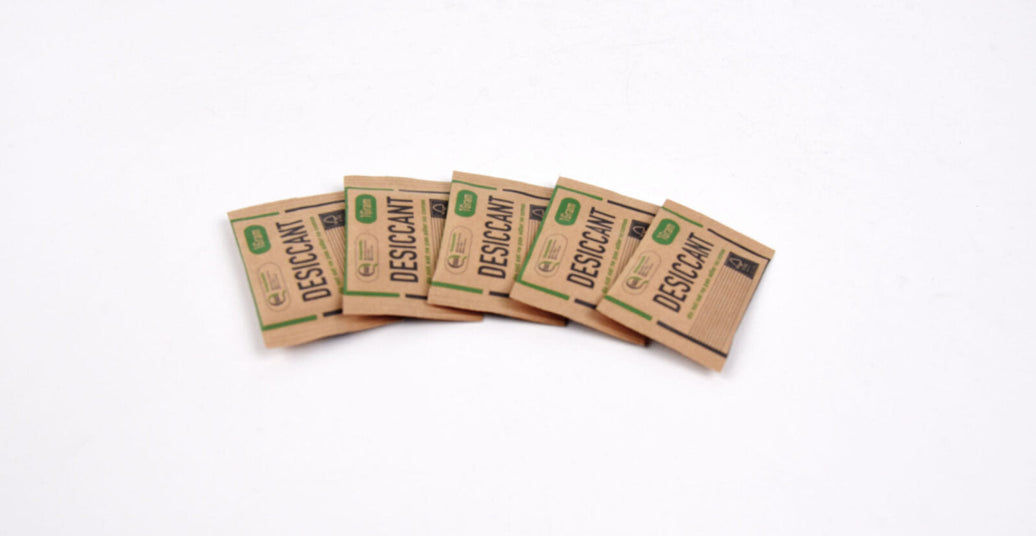
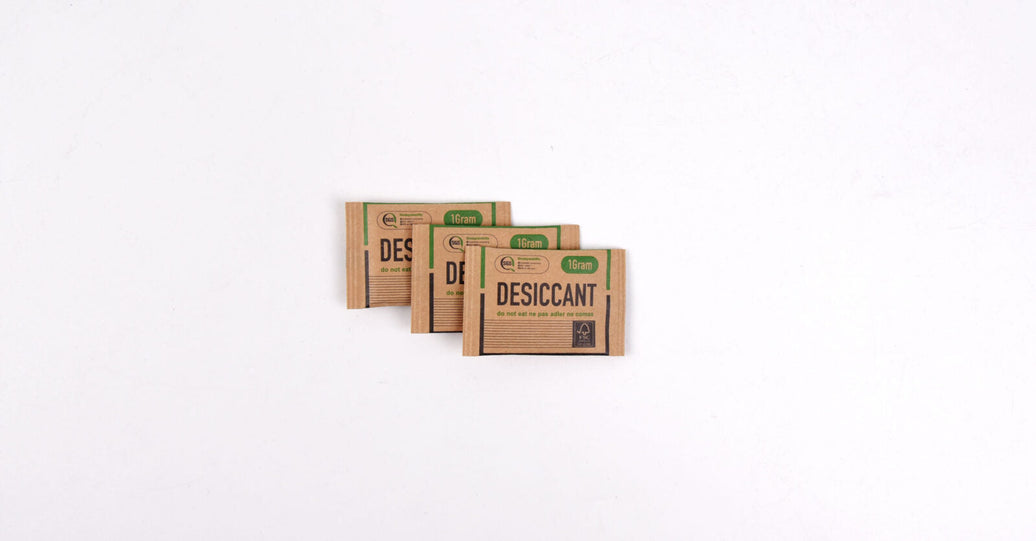
ATMOSIScience supplies fiber desiccant across a full weight range (1 g to 100 g and custom) plus humidity indicator cards to validate every dose before scale-up.
Need a dosage spec for your exact package? Request bulk pricing and a tailored recommendation through our desiccant solutions page or contact our team, or order the Fiber Desiccant with humidity indicator cards to test your dose first.
Get a desiccant spec & bulk quote for your product
Tell us about your packaging needs, and our sales team will respond with a customized fiber-desiccant solution, supporting certificates and competitive bulk pricing.