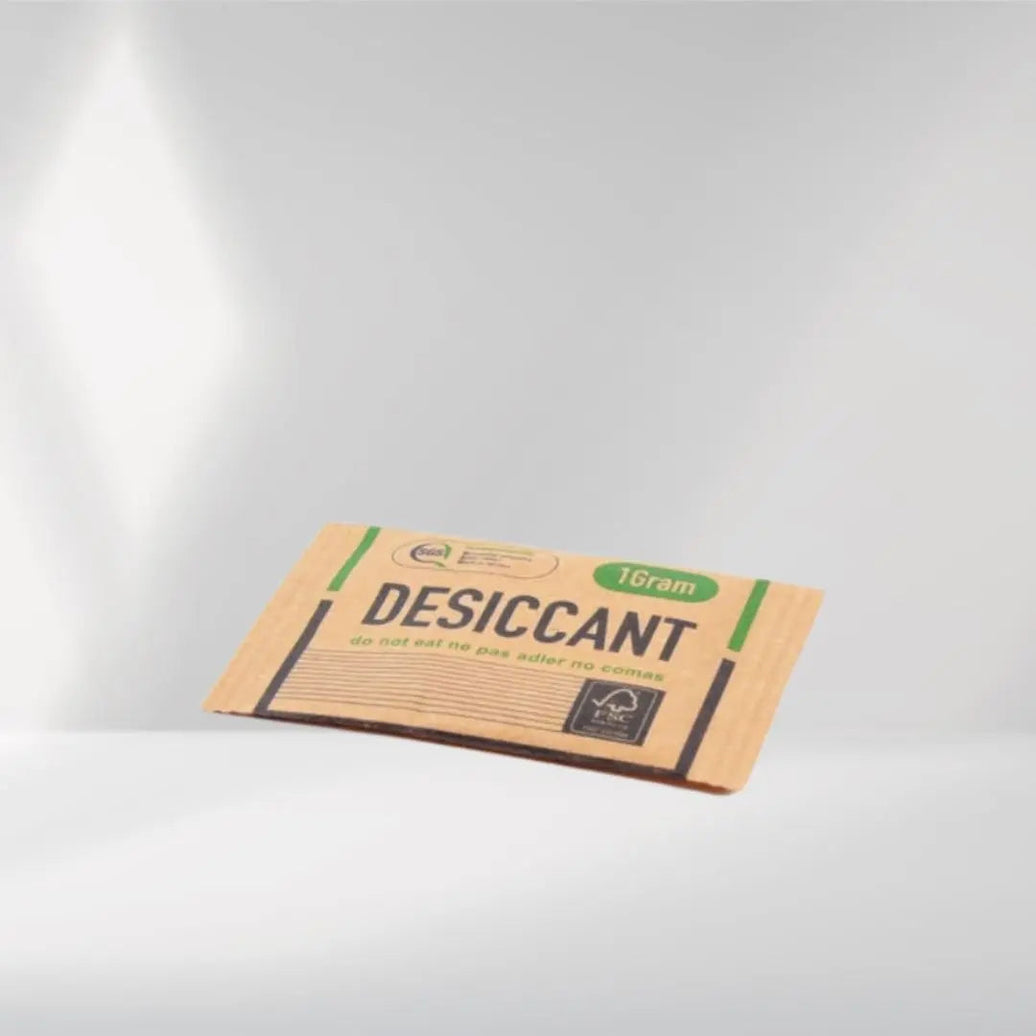
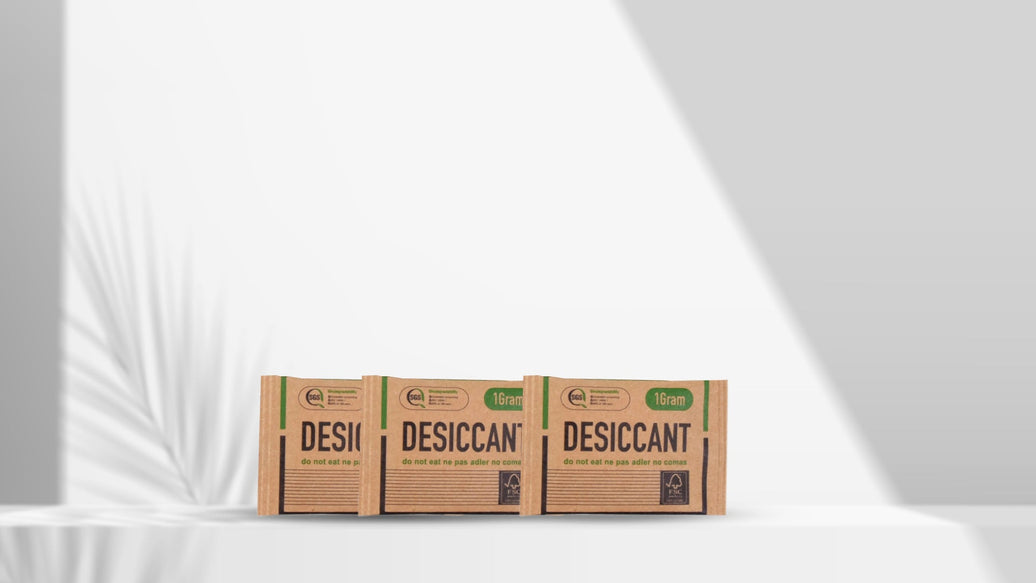
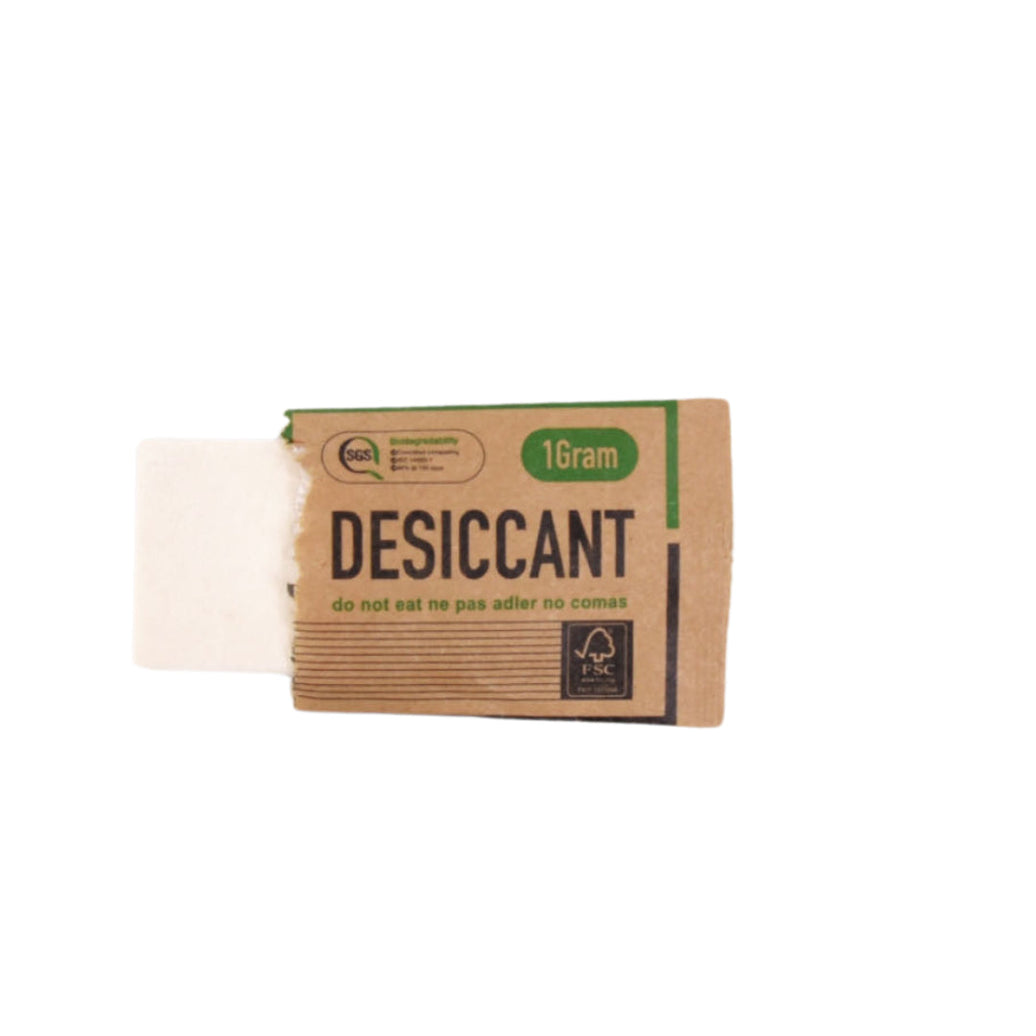
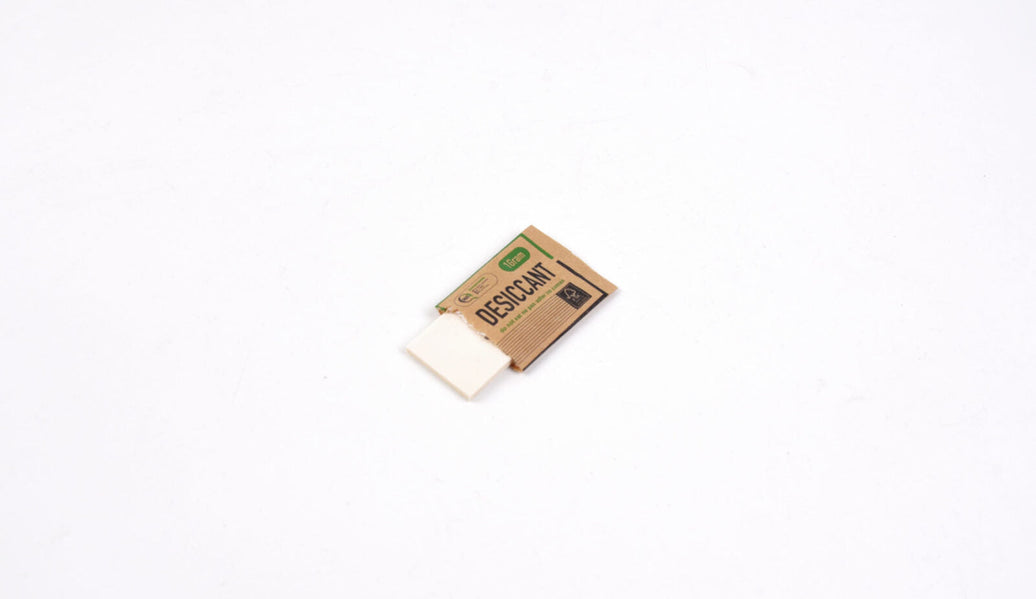
Quick answer: Desiccant is a purchased good, so its emissions sit in Scope 3 category 1 (purchased goods and services) and, because it ships, in category 4 (upstream transportation). Both are driven by mass. That makes desiccant unusual among packaging components: the same decision that cuts carbon also cuts freight cost and — in EPR jurisdictions — fee-bearing packaging weight. ATMOSIScience fiber desiccant carries a cradle-to-gate footprint of 1.44 kg CO₂e per kg against 1.89 for silica gel, verified to ISO 14067, and delivers equivalent protection at lower mass.
Packaging teams asked to contribute to a corporate emissions target usually start with the primary pack, because that is where the volume is. Desiccant rarely appears on the first list. It appears on the second, when someone notices that a component nobody had costed carries mass on every single unit shipped.
Where desiccant sits in the inventory
Under the widely used Scope 3 categorisation:
- Category 1 — purchased goods and services. The cradle-to-gate emissions of producing the desiccant you buy. This is the main term.
- Category 4 — upstream transportation and distribution. Getting it to your plant. Driven by mass and distance, and by volumetric weight where the material is bulky.
- Category 9 — downstream transportation. The desiccant travels inside your finished goods, adding mass to every outbound shipment.
- Category 12 — end-of-life treatment of sold products. How the desiccant is disposed of by the end customer.
Four categories from one small component. None of the individual numbers is large; the reason they add up is that desiccant is present on every unit.

Per kilogram is the wrong comparison
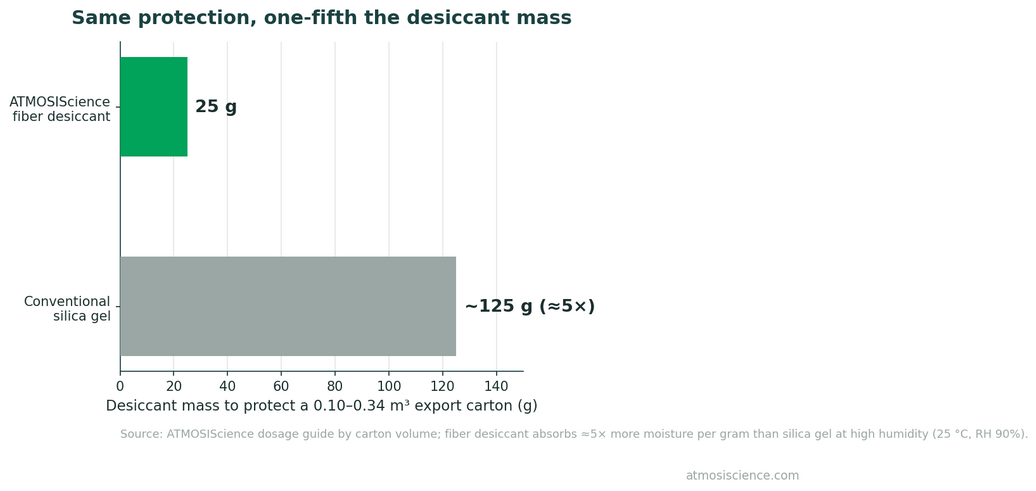
The 1.44 versus 1.89 kg CO₂e per kg comparison is real, but on its own it understates the difference. What actually ships is not a kilogram of desiccant — it is however much material is needed to protect one carton, one bottle or one pouch.
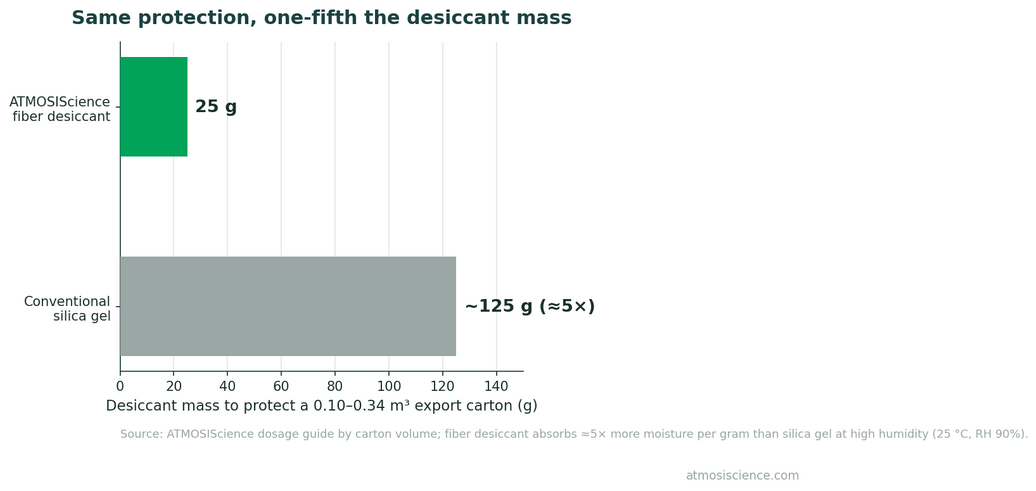
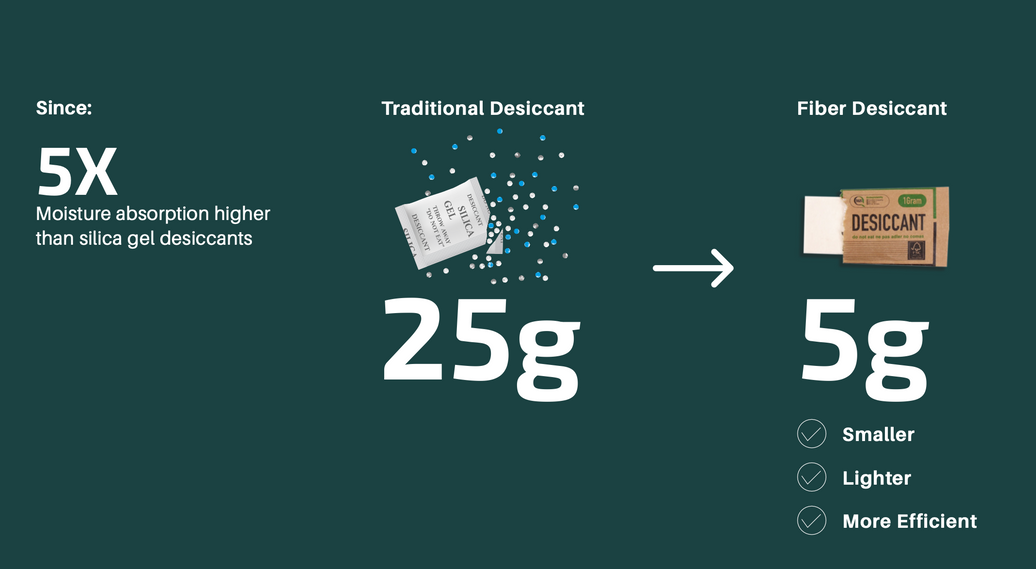
Because fiber desiccant adsorbs more per gram than common silica gel at comparable conditions, the mass required to deliver equivalent protection is lower. Compare on emissions per protected unit, not per kilogram of material, and the gap widens well beyond the 24% difference in the footprint figures. The dosage arithmetic behind that is in silica gel equivalency and the capacity data in desiccant capacity compared.
How to source a usable number from a supplier
Ask for four things, in this order:
- The standard. ISO 14067 for product carbon footprint is the one to ask for. A number with no standard attached is not auditable.
- The boundary. Cradle-to-gate and cradle-to-grave are different scopes and are not interchangeable in a report.
- The functional unit. Per kilogram of material, or per unit of moisture protection delivered. Insist on knowing which.
- Third-party verification status. Self-declared, reviewed, or verified. Reporting teams need to state this.
Suppliers who hold a real report will send it. Suppliers who do not will offer a generic industry average, which cannot be used to support a company-specific claim.
The three levers that actually move the number
- Reduce mass. The largest, simplest lever. It cuts category 1, 4 and 9 simultaneously, plus freight cost and EPR fees.
- Shorten the supply chain. Regional supply cuts category 4. Worth quantifying rather than assuming — domestic versus overseas trade-offs are examined in domestic vs overseas desiccant sourcing.
- Change the end-of-life route. Affects category 12 and, separately, the recyclability assessment of the pack it sits in.
Where this collides with regulation
The reporting question and the compliance question increasingly arrive together. In the EU, the Packaging and Packaging Waste Regulation applies from 12 August 2026 with recyclability-by-design obligations, and PFAS limits in food-contact packaging start on the same date. In the US, packaging EPR fee programmes are live in Oregon and Colorado, with California's regime phasing in and fee payments expected from 2027. All of them assess packaging by material and by weight, and all of them now count the desiccant as part of the packaging system rather than as a separate consumable.
The practical consequence is that the mass-reduction lever pays three times: lower reported emissions, lower freight, lower fee-bearing weight. Compliance detail is in EU PPWR and desiccant sachets and US packaging EPR laws and your desiccant.
Avoiding a greenwashing exposure
A footprint figure is a claim, and claims about environmental performance now carry legal risk in several markets. Two rules keep a report defensible: state the standard and boundary every time the number appears, and never let a certification that applies to one component be described as covering the whole product. The distinction — and where teams get it wrong — is covered in compostable desiccant and the Green Claims Directive, with the broader picture in the sustainable desiccant guide.
FAQ
Which Scope 3 category does desiccant belong in?
Primarily category 1 as a purchased good, with transport emissions in categories 4 and 9 and disposal in category 12.
Is 1.44 kg CO₂e per kg a cradle-to-grave figure?
It is cradle-to-gate under ISO 14067. State the boundary whenever the figure is reproduced.
Can a supplier's footprint be used directly in our disclosure?
Supplier-specific data is generally preferred over industry averages, subject to your assurance provider's requirements on verification status and boundary alignment.
Does compostability reduce the carbon footprint?
Not necessarily. Compostability describes end-of-life behaviour under defined conditions; carbon footprint measures emissions across a defined boundary. They are separate claims and should be reported separately.
What is the fastest change with a measurable effect?
Reducing desiccant mass while holding protection constant. It is measurable, auditable, and it lowers cost at the same time — the arithmetic is in the true cost of silica gel.
Need supplier data for your Scope 3 report?
ATMOSIScience supplies the ISO 14067 product carbon footprint report, material composition and unit weights in a format your reporting and EPR teams can file.
Prefer email? info@atmosiscience.com