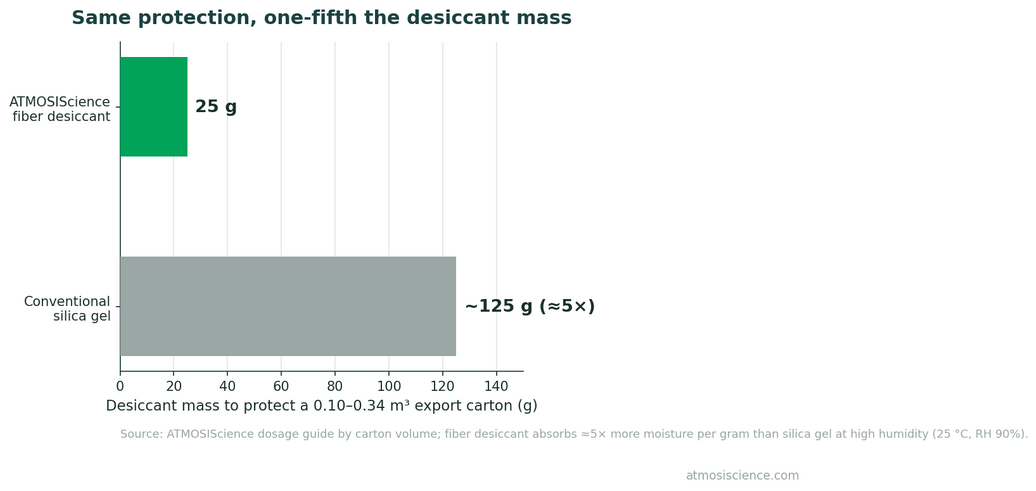
Quick answer: PPWR Article 10 requires that, by 1 January 2030, packaging placed on the EU market be designed so its weight and volume are reduced to the minimum necessary to ensure its functionality. Annex IV explicitly names humidity, moisture loss and microbiological infection as legitimate protection requirements — so a desiccant is not something you have to remove. But Annex VII requires you to identify, for each performance criterion, the design requirements that prevent further reduction of weight or volume. If 5 g of one material does the work of 25 g of another, that clause is where the difference has to be explained. Article 43 adds the tonnage pressure: 5% per-capita packaging waste reduction by 2030, 10% by 2035, 15% by 2040, against a 2018 baseline.
Recyclability has absorbed almost all the attention PPWR gets in packaging teams, and understandably — the grade thresholds are concrete and the market-access consequence is stark.
Minimisation is the quieter obligation, and in day-to-day terms it may be the more demanding one. Recyclability is largely a materials-choice question you answer once per format. Minimisation is a design-justification question you answer for every component, in writing, and defend.
First: is a desiccant sachet even in scope?
Yes, and it is worth being precise about why, because the answer determines whose obligation it is.
Article 3 defines packaging to include an item that is necessary to contain, support or preserve a product throughout its lifetime, without being an integral part of the product, and which is intended to be used, consumed or disposed of together with the product. It also captures a component of, and ancillary element to, such an item that is integrated into it.
A desiccant preserves the product, is not part of it, and is disposed of with the pack. It is packaging. The fuller argument, including who carries the obligation for an imported component, is in PPWR and desiccant sachets and who issues the declaration of conformity.
Article 10, in the words that matter
Paragraph 1. By 1 January 2030 the manufacturer or importer shall ensure packaging placed on the market is designed so that its weight and volume is reduced to the minimum necessary to ensure its functionality, taking account of shape and material.
Two nouns, not one. Weight and volume. A component that is light but bulky is not compliant by virtue of being light, and vice versa.
Paragraph 2. Packaging that does not comply with the Annex IV performance criteria must not be placed on the market — nor may packaging with characteristics that aim only to increase perceived volume, including double walls, false bottoms and unnecessary layers.
There are two narrow exemptions: designs protected by registered Community design rights or trade marks predating the Regulation, where applying the rule would destroy the design’s novelty or the mark’s distinctiveness; and products carrying a protected geographical indication or covered by an EU quality scheme. Neither has ever applied to a desiccant sachet, and neither is likely to.
Annex IV protects the desiccant — read criterion 1 carefully
Minimisation is not a mandate to strip protection out of packs, and Annex IV Part A makes that explicit. The first performance criterion is product protection, and its list of requirements names, among others:
… protection against mechanical or chemical damage, vibration, compression, humidity, moisture loss, oxidation, light, oxygen, microbiological infection, pest, deterioration of organoleptic properties …
Humidity. Moisture loss. Microbiological infection. Three of the exact reasons a desiccant or a two-way humidity pack exists, written into the Regulation as legitimate design drivers.
Note that moisture loss is there alongside humidity. A pack that must not dry out is as much a protection case as one that must not take up water — which is the legal footing for a set-point pack rather than a one-way desiccant.
Criterion 2 helps too. Packaging manufacturing and filling processes are recognised as legitimate constraints, including packing line speed and efficiency, stability in conveying, effective closing, minimum headspace and hygiene. If a format is chosen because a thinner card feeds reliably on an inserter, that is a defensible design requirement rather than an indulgence.
The clause that actually bites
Compliance is demonstrated through the technical documentation described in Annex VII, and it must contain three things:
- An explanation of the technical specifications, standards and conditions used to assess the packaging against the Annex IV performance criteria and methodology.
- For each of those performance criteria, the identification of the design requirements which prevent further reduction of the packaging weight or volume.
- Any test results, studies or other relevant sources — including modelling and simulations — used to assess the minimum necessary volume or weight.
Item 2 is the one to sit with. It does not ask you to state your packaging weight. It asks you to state what stops it being lower.
Apply that to a desiccant and the question becomes uncomfortably specific: what design requirement prevents this sachet from being lighter?
“It is what we have always used” is not a design requirement. “It is what our incumbent supplier offers” is not a design requirement. A moisture-ingress calculation showing the mass of water that must be adsorbed over the stated shelf life is a design requirement — and it is a calculation, not an opinion. If you have never done it for your pack, the sizing method is here.
Where 25 grams becomes 5
Once the requirement is stated as grams of water adsorbed over N months at RH X, the material question follows immediately: which material delivers that with the least mass?
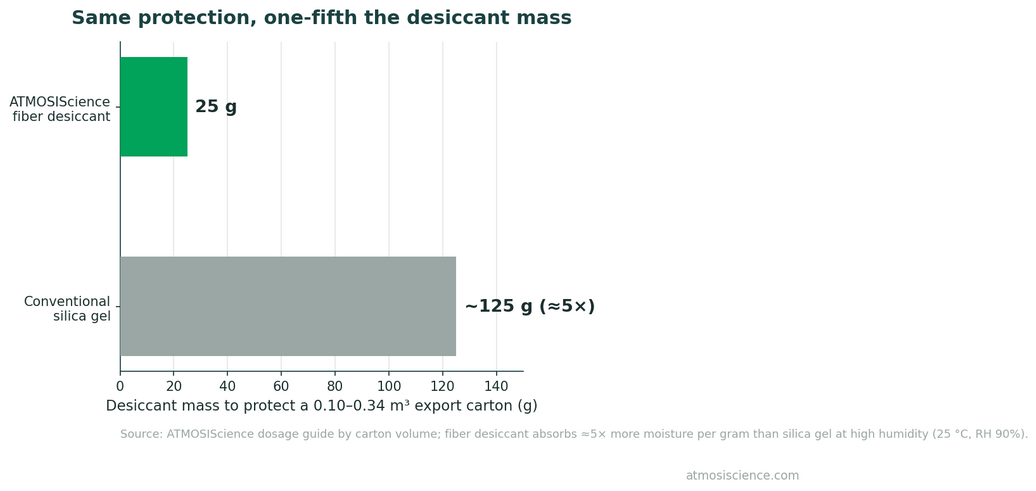
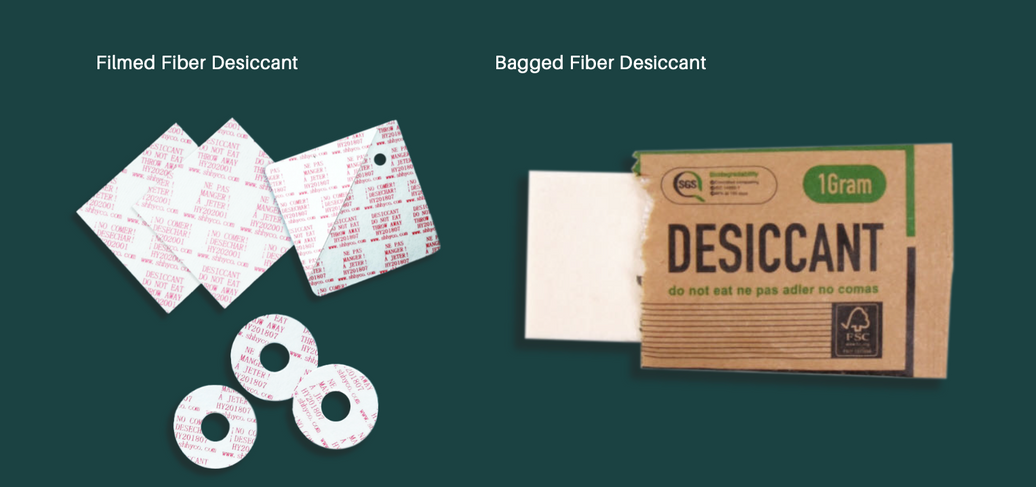
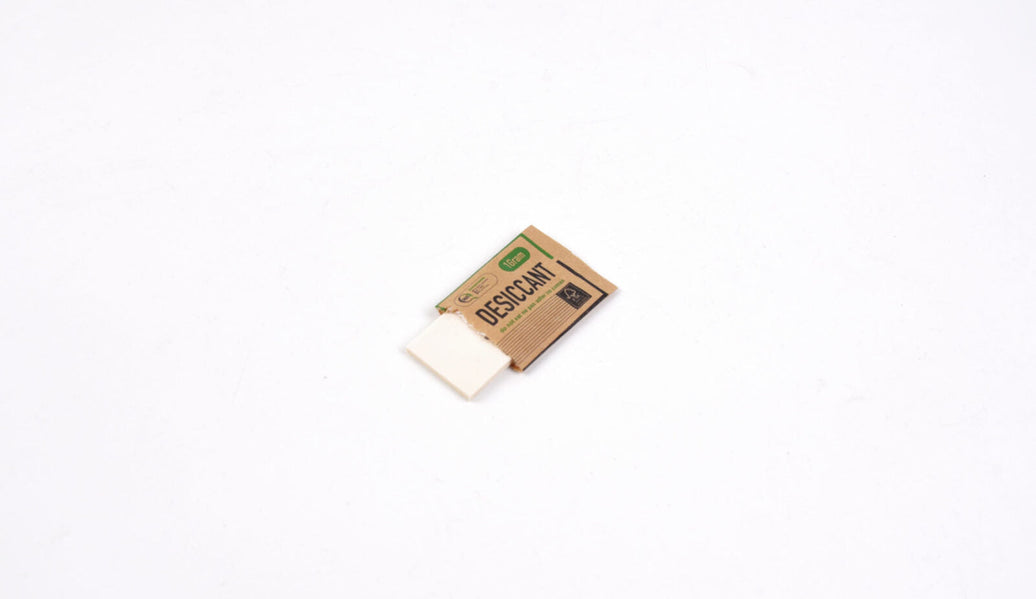
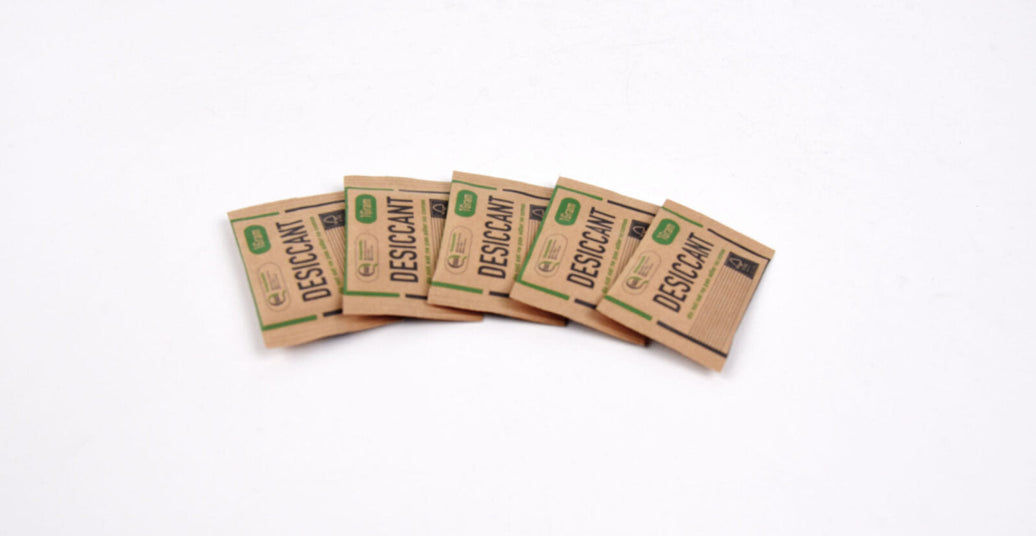
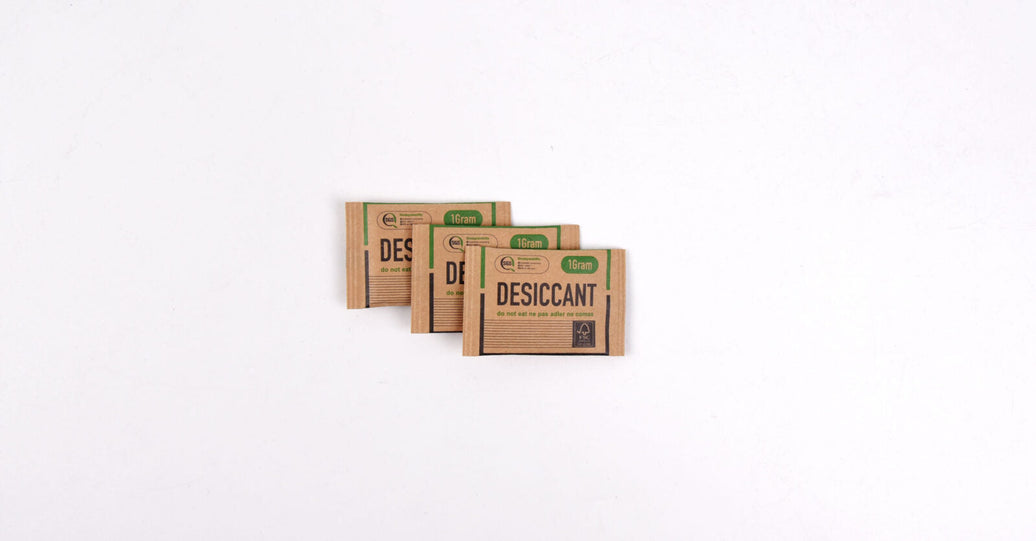
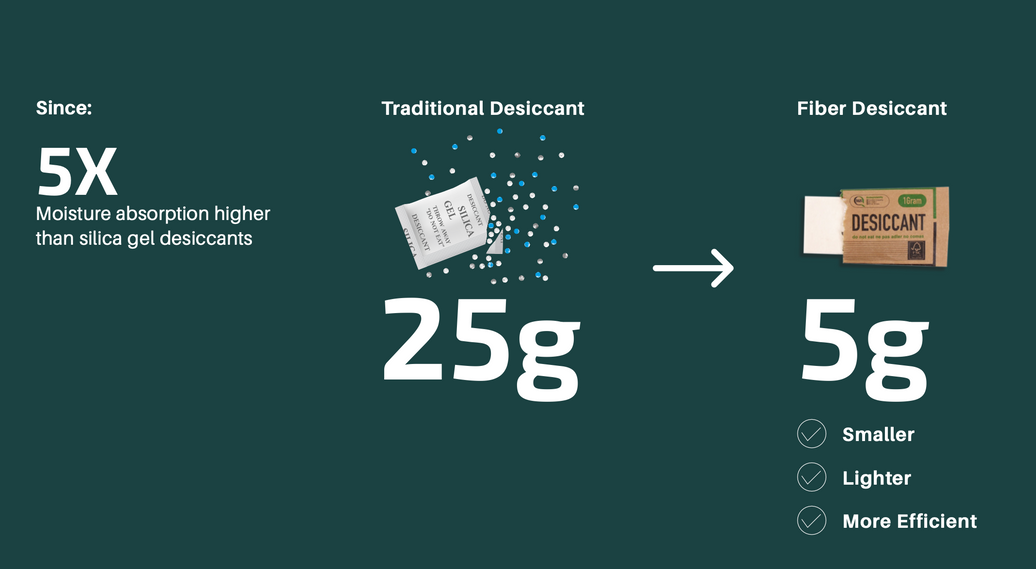
Published substitution figures put 1 g of fiber desiccant against 3–5 g of silica gel, 5 g against 15–20 g, and 9 g against 30–40 g — with the headline case being 25 g of traditional desiccant replaced by 5 g. Underlying it: about 300 ml of water per kilogram for silica gel at RH 90% and 25 °C, against about 1,500 ml for the patented fiber at the same condition.
That is not a marketing comparison in this context. It is precisely the evidence Annex VII item 3 asks for — a test result used to assess the minimum necessary weight. And it inverts the burden: if a documented alternative meets the same protection requirement at a fifth of the mass, the file has to explain why the heavier option was retained.
The substitution arithmetic is in silica gel equivalency and replacing silica gel one-for-one.
Volume has its own rule
Article 24 adds a separate obligation on excessive packaging. From 1 January 2030 (or three years after the calculation methodology is adopted, whichever is later), operators filling grouped, transport or e-commerce packaging must keep the maximum empty space ratio to 50%. And within 36 months of entry into force, operators filling sales packaging must reduce empty space to the minimum necessary for functionality, including product protection.
The methodology is required to take account of packaging that needs empty space to protect the product, and for foods requiring headspace, compliance is assessed at pack-fill level at the time of filling, with air between or within foodstuffs and protective gases excluded from empty space.
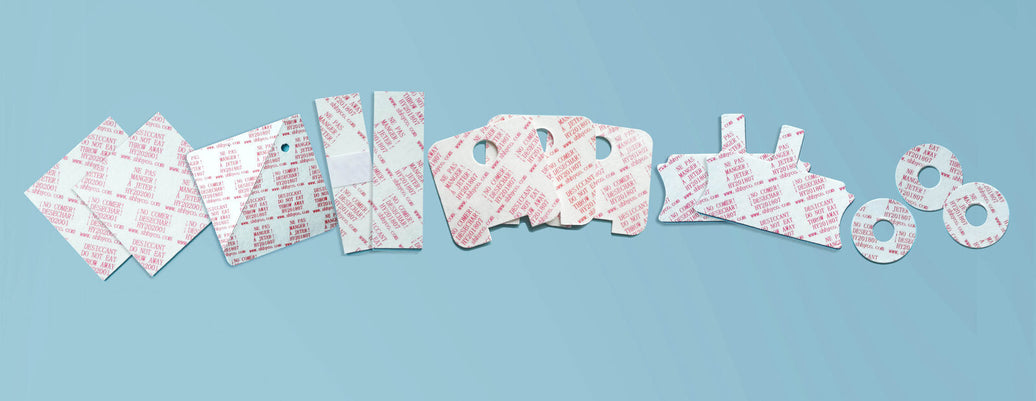
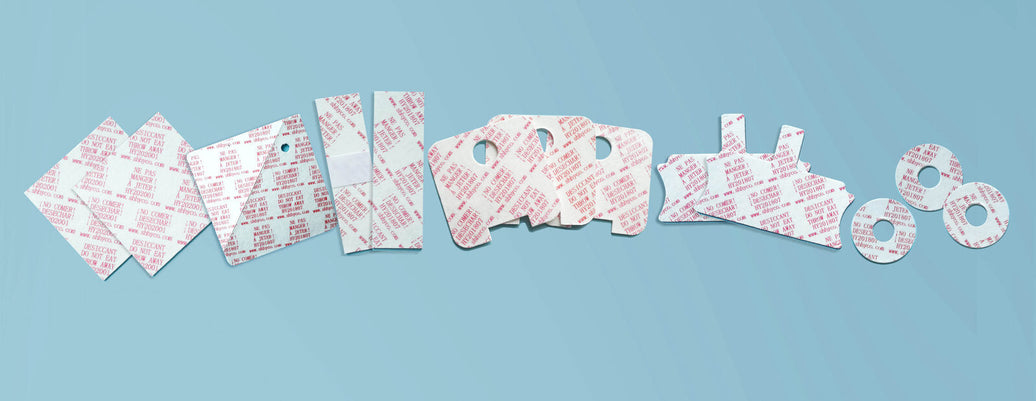
For a desiccant, the practical consequence is about format rather than existence. A bulky canister occupies headspace that a thin die-cut card or a cap insert does not — which is why thickness and zero-headspace cap inserts are becoming compliance choices as much as engineering ones.
Article 43: the tonnage behind the design rule
Article 10 works on individual packs. Article 43 works on national totals, and it is why Member States will keep pressure on the first.
| By | Reduction in packaging waste generated per capita, vs. 2018 |
|---|---|
| 2030 | at least 5% |
| 2035 | at least 10% |
| 2040 | at least 15% |
Member States are also required to implement further prevention measures, which may include economic instruments, incentives through extended producer responsibility schemes, and obligations on producers to adopt waste prevention plans. In other words, the mechanism by which national tonnage targets reach your packaging file is largely EPR fees — the same lever already operating in several US states, covered in US packaging EPR laws and your desiccant.
Mass is what EPR fees are assessed on. Twenty grams saved per pack, across a run, is a line item.
The standards are not written yet — and that is the risk
Within 24 months of entry into force, the Commission is required to ask the European standardisation organisations to prepare or update harmonised standards setting out the calculation and measurement methodology for minimisation. For the most common packaging types and formats, those standards should specify maximum adequate weight and volume limits and, where appropriate, wall thickness and maximum empty space.
Read that as a warning shot. The direction of travel is toward numerical ceilings per format, not open-ended justification. A packaging file built around “we minimised as far as functionality allowed” without arithmetic behind it will not survive contact with a published limit.
The Regulation applies 18 months after entry into force, with the Article 10 design duty biting from 1 January 2030. For a component with a qualification cycle measured in months and a shelf-life validation measured in years, that is not a comfortable margin — the full sequence is in the real 2026–2030 compliance timeline.
Build the file in this order
- State the protection requirement quantitatively. Grams of water to be adsorbed, or the RH band to be held, over the stated shelf life, at the stated conditions. This is your Annex IV criterion 1 evidence.
- State the process and logistics constraints. Format, thickness, feed behaviour on your line, headspace. Annex IV criteria 2 and 3.
- Name what prevents further reduction. The Annex VII item 2 clause. Be specific: this mass, because this ingress rate, over this period.
- Attach the evidence. Sizing calculation, supplier capacity data at your conditions, transit or stability test results. Annex VII item 3.
- Re-run it when the barrier changes. A thinner or mono-material film raises moisture ingress and may raise the desiccant mass you need — the tension explored in why weaker barriers mean more desiccant, not less.
Frequently asked questions
Does minimisation mean we should remove the desiccant?
No. Annex IV names humidity, moisture loss and microbiological infection as protection requirements. Removing a desiccant that is preventing product deterioration would fail criterion 1 and, in a food context, potentially other law as well. Minimisation applies to the mass and volume, not to the function.
Who has the Article 10 obligation — us or the desiccant supplier?
The manufacturer or importer of the packaging. For a brand placing a packed product on the EU market, the design and documentation duty for the pack as a whole — desiccant included — sits with you. Your supplier provides evidence; they do not carry your obligation.
What if our packaging design is trade-mark protected?
The exemption is narrow. It requires the design right or mark to have been protected before the Regulation entered into force, and that applying the requirement would alter the design’s novelty or individual character, or destroy the mark’s distinguishing capacity. It is aimed at iconic container shapes, not at internal components.
How does this interact with recycled content and recyclability?
Annex IV criterion 8 acknowledges the tension directly: where reusability, recyclability or recycled-content requirements apply, weight or volume may have to be increased beyond what the other criteria alone would allow. Minimisation is not lexically first — it is balanced against the other criteria, and your file should show the balancing.
What is the single most useful number to put in the file?
A mass, with the calculation behind it. It is verifiable, it converts directly into EPR fees and prevention-target tonnage, and unlike a percentage it does not depend on a functional unit — the trap described in 31% or 294%.
Need the evidence for your minimisation file?
Send us your pack, your barrier film and your shelf life. We will come back with the moisture arithmetic and the lightest format that meets it — stated so it can go straight into your Annex VII documentation.
Prefer email? info@atmosiscience.com