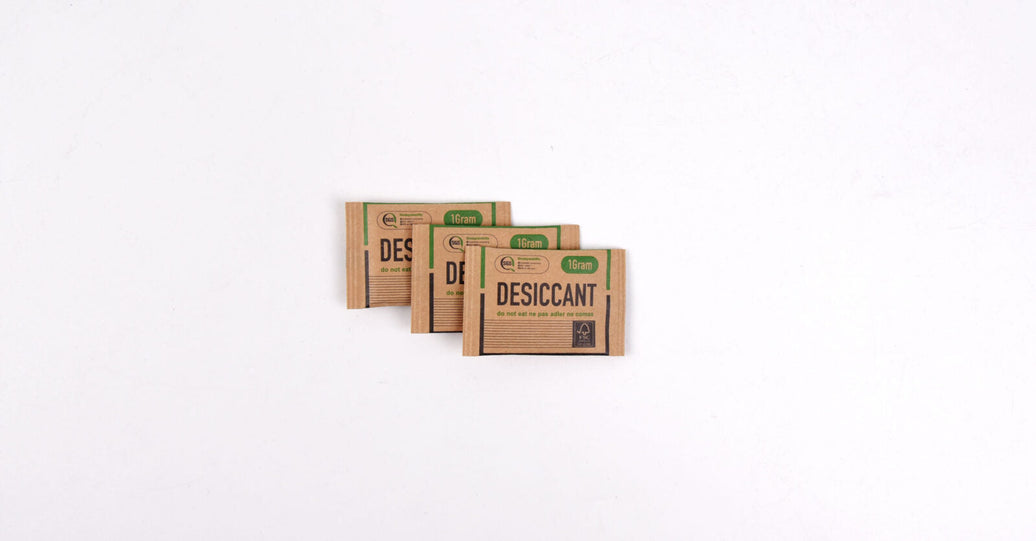
Quick answer: Loss on drying (LOD) is the mass a desiccant loses when heated to a defined endpoint — in other words, the moisture it is already carrying before it ever enters your package. ATMOSIScience fiber desiccant is specified at 10% or less, published on both the product technical criteria and the safety data sheet. A desiccant delivered at its LOD ceiling has already spent part of its working capacity in the supply chain. Test it on receipt, write the limit into your specification, and store material sealed.
Every desiccant conversation is about capacity. Almost none of them are about how much of that capacity is left by the time the product reaches a filling line.
Loss on drying is the number that answers it, and it is routinely ignored because it sounds like a housekeeping figure rather than a performance one.
What the number represents

Set the two figures side by side and the relationship is obvious.
Fiber desiccant is specified to adsorb more than 100% of its own weight when saturated at 25 °C and 90% RH. It is also specified at loss on drying of 10% or less. Those numbers live on the same spec sheet and describe opposite ends of the same property: how much water the material can hold, and how much it is already holding.
A desiccant delivered at 3% LOD arrives close to its full working range. A desiccant delivered at 9.8% LOD is technically in specification and has measurably less to give. Both pass. They do not perform identically in your pack.
Where the moisture comes in
Four places, in rough order of how often they are the culprit:
- Open packaging in the plant. The safety data sheet is explicit: avoid wet or high-humidity locations, and do not leave packed material in an open state. A part-used carton left open beside a filling line is adsorbing room air all shift.
- Transit and warehousing. Sea freight through humid routes, uncontrolled 3PL storage, long dwell times. See why desiccants fail on sea freight routes.
- Time. Even sealed, outer packaging is not a perfect barrier over long periods. See does desiccant expire.
- Production conditions at the supplier. Rooms are typically held around 50% RH; exposure time before sealing is a real variable. See our note on the manufacturing environment.
Notice that three of those four are downstream of the supplier. LOD is not purely a supplier quality metric — it is a shared one, and treating it as an incoming-goods gate without also fixing your own storage is only half the job.
How to test it
Loss on drying is a gravimetric test: weigh the sample, dry it to a defined endpoint under defined conditions, weigh again, express the loss as a percentage of the original mass.
Three points that decide whether the result is usable:
- The conditions are the method. Temperature and duration must be stated and matched between you and your supplier. Two labs using different endpoints will produce different numbers on the same material and both will be correct.
- Sample handling dominates the error. Open the pack, weigh immediately. A sample sitting on a bench in an ambient room is changing while you set up.
- Do not conflate it with the product’s own moisture test. LOD on a desiccant and LOD or Karl Fischer on a powder are different measurements on different materials — see measuring moisture in powder.
What to write into a specification
A usable LOD clause has four parts, and most specifications carry only the first:
- The limit. 10% or less, or tighter if your application justifies it.
- The method and conditions. Stated temperature and endpoint, agreed with the supplier.
- Where it is measured. At the point of manufacture, or on receipt at your site? These give different numbers, and the difference is the supply chain.
- What happens on a marginal result. A value at 9.8% passes. Decide in advance whether you accept it, quarantine it, or trigger a review.
Point three is where most disputes come from. A certificate of analysis reports what a lot measured at the supplier. If your incoming test disagrees, the honest first hypothesis is transit, not misreporting. See how to read a desiccant certificate of analysis.
The reciprocal metric worth pairing it with

The technical criteria publish minimum adsorption at three humidity points: more than 10% of own weight at 20% RH, more than 35% at 50% RH, and more than 70% at 90% RH.
Read those alongside LOD and the practical implication is clear. In a pack that will equilibrate around 50% RH, a desiccant carrying 9% incoming moisture is starting a long way into a curve whose specified minimum at that point is 35%. Specify both numbers, or you are only managing half the equation.
Frequently asked questions
Is a lower LOD always better?
Lower means more available capacity on arrival, so as an incoming-goods criterion, yes. It is a supply-chain and freshness indicator rather than a measure of the material’s intrinsic quality.
Can we dry a desiccant that arrives high?
Regeneration is possible for some chemistries under controlled conditions, but doing it in-house introduces validation and contamination questions most quality systems will not accept. See reusing and recharging desiccant.
How often should incoming LOD be tested?
Every lot during qualification and after any change of route or supplier; on a reduced sampling plan once a supplier is established and data is stable.
Does LOD appear on a certificate of analysis?
It should. If it does not, ask for it to be added — it is a standard measurement and its absence is worth a question.
What is a realistic in-house target?
Work backwards from your pack. Calculate the moisture load, add the capacity already consumed at your accepted LOD, and confirm the remaining capacity covers the shelf life with margin. That calculation, not a rule of thumb, sets the number.
Get the specification and test method in writing
Tell us your format and application and the ATMOSIScience team will send the technical criteria, the loss-on-drying method and a certificate of analysis example.
Prefer email? info@atmosiscience.com