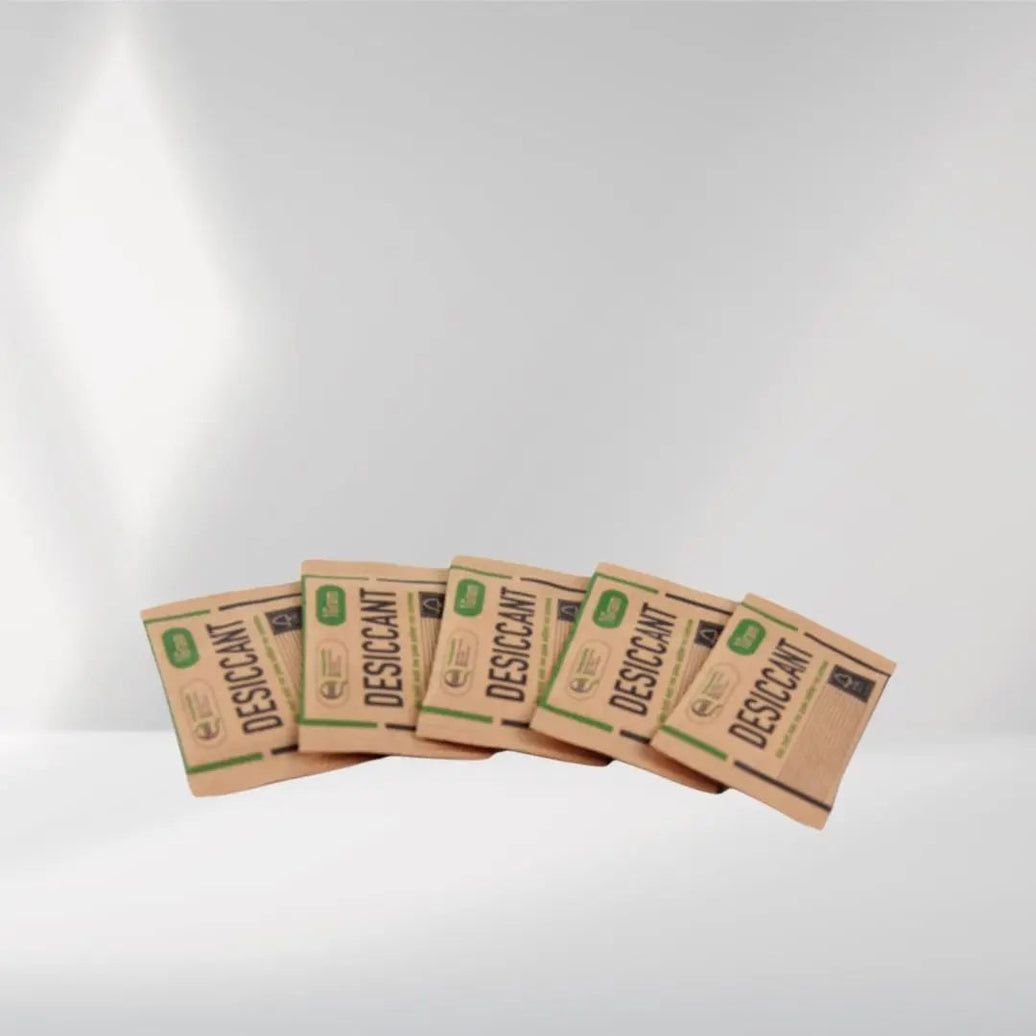
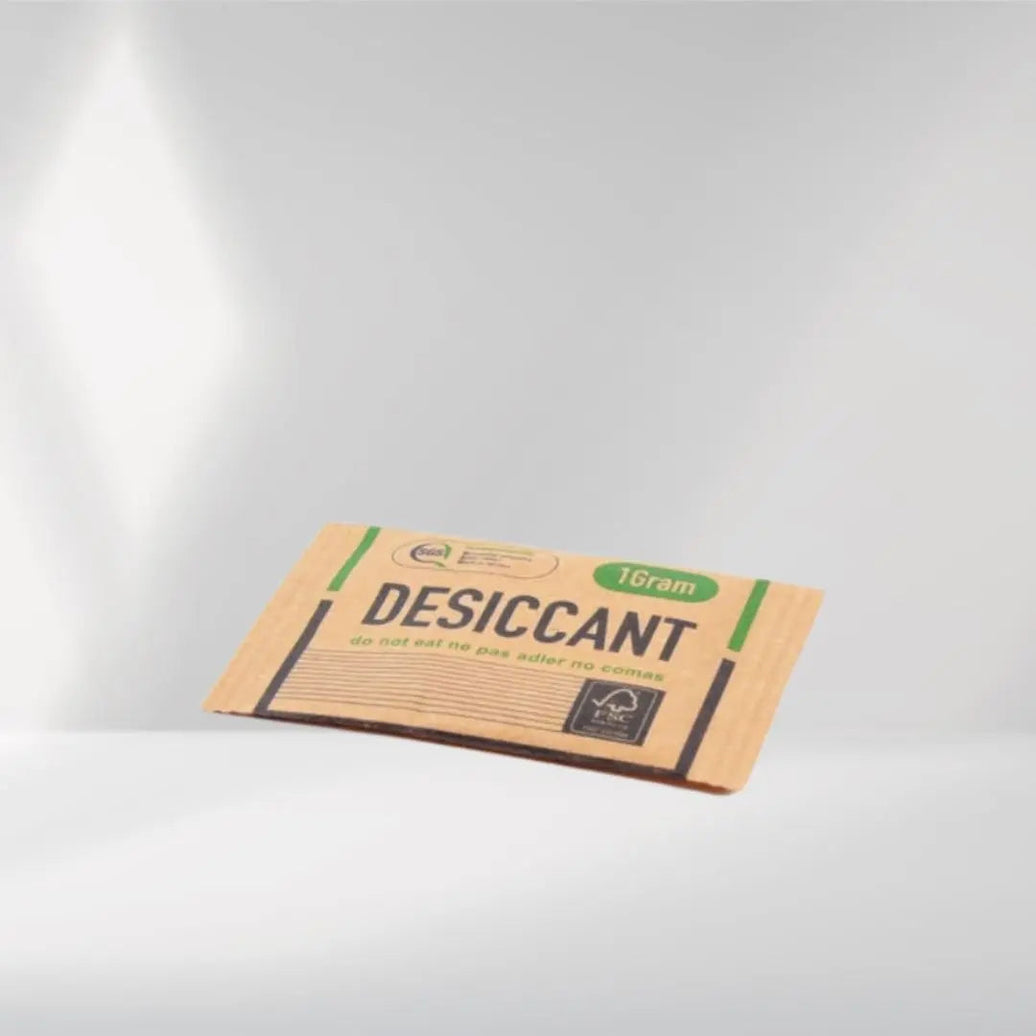
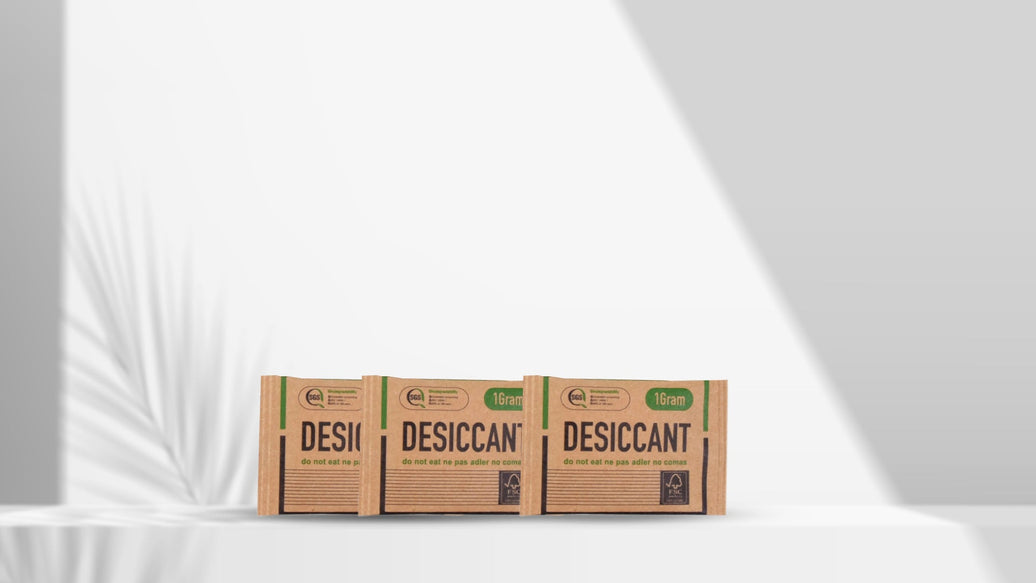
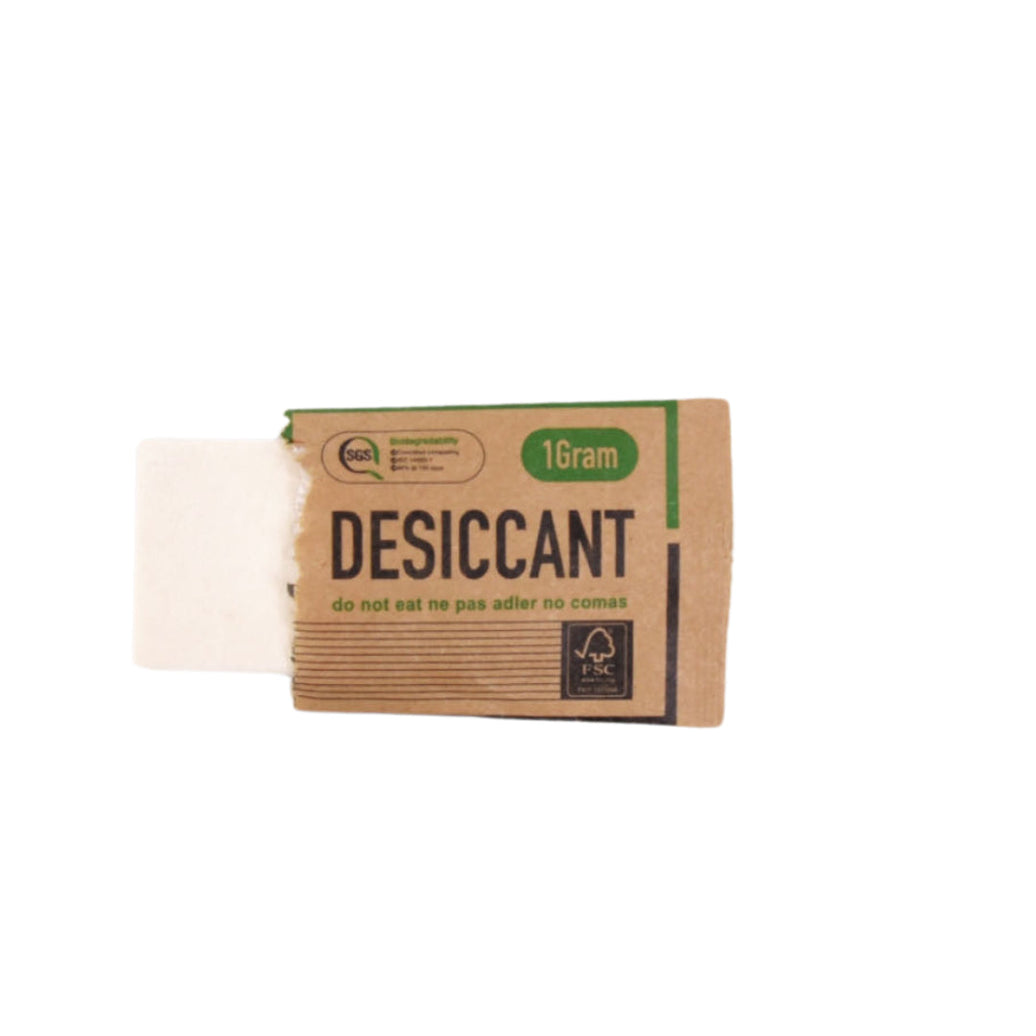
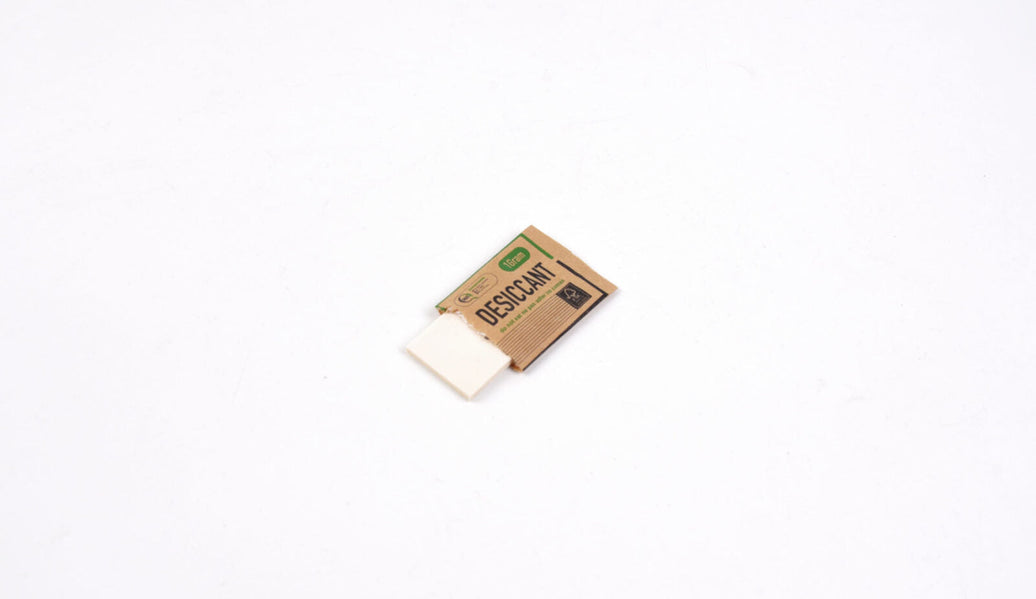
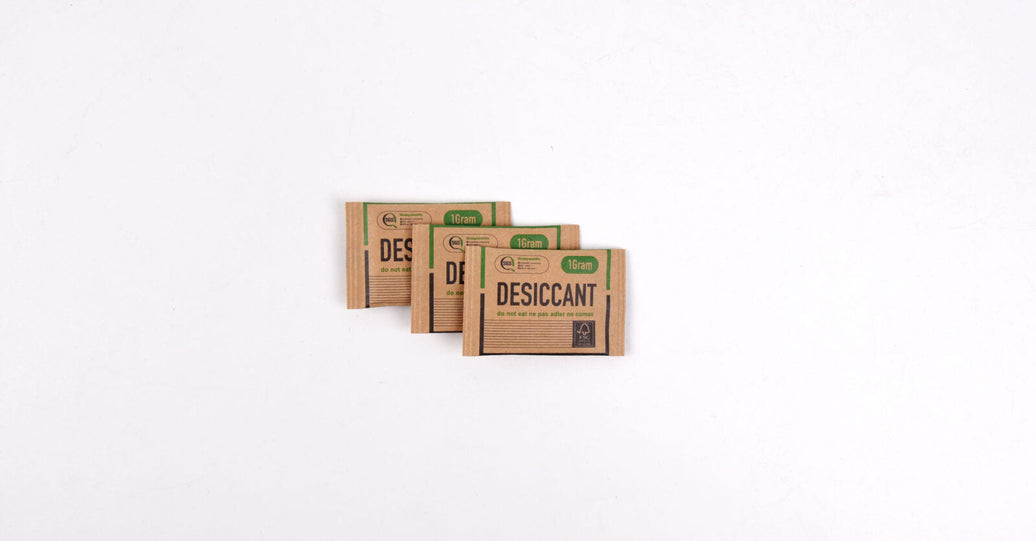
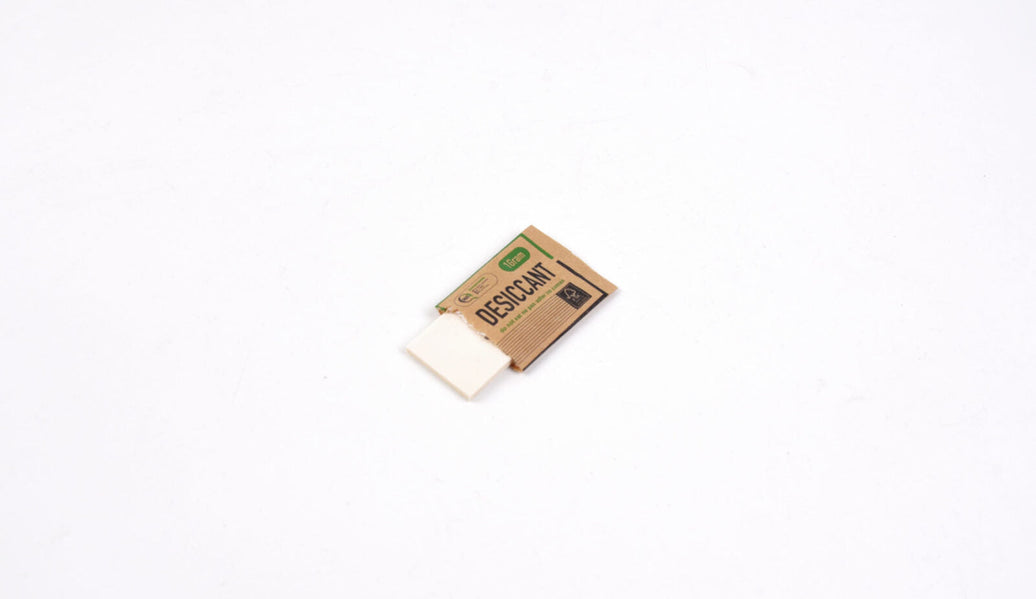
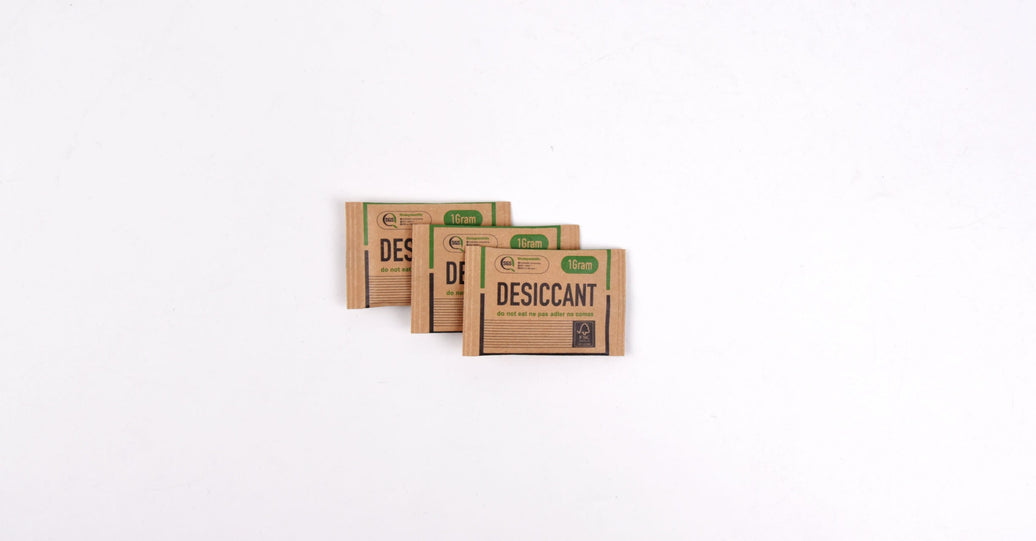
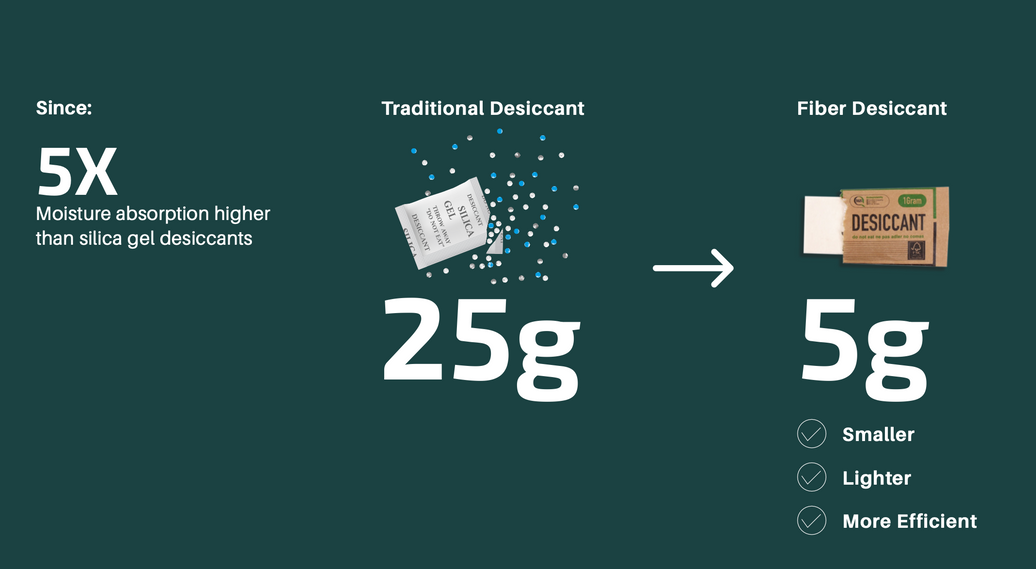
Quick answer: In the United States, paper desiccant almost always means cellulose paper impregnated with silica gel beads, typically 40% to 65% silica gel by weight. The paper is the carrier; the silica gel does the adsorbing. A plant-fiber desiccant is different: the fiber itself is the adsorbent, with a hygroscopic salt bound into it and no silica gel beads at all. Four fields on any datasheet tell you which one is in front of you: basis weight in GSM, caliper in mils or mm, percent desiccant by weight, and the activation temperature. If percent silica gel is stated at all, it is a silica-impregnated paper. If activation calls for 300 to 500 °F, it is a silica-impregnated paper. That distinction decides whether the insert can be put in a paper recycling stream and how it is declared for packaging EPR.
The term is genuinely confusing, and the confusion is not your fault. Two very different products are sold under the same words, and buyers often discover the difference only when a sustainability team asks where the insert goes at end of life.
The two things called paper desiccant
| Silica-impregnated desiccant paper | Plant-fiber desiccant | |
|---|---|---|
| What adsorbs | Silica gel beads held in a cellulose matrix | The fiber itself, with a hygroscopic salt bound into it |
| Typical desiccant content | 40% to 65% silica gel by weight, stated on the datasheet | No silica gel content, because there is none |
| Activation | Baked, published conditions around one minute at 500 °F or five minutes at 300 °F | Supplied ready to use in barrier packaging |
| End of life | Mineral-loaded paper, which behaves as a contaminant in a paper stream | The fibre layer tests as paper, see the figures below |
Field 1: basis weight, in GSM
Published US desiccant papers sit a long way apart. A heavy grade is quoted at 460 lbs per 3,000 ft², which is 749 GSM. A light grade is quoted at 105 lbs per 3,000 ft², which is 171 GSM. That is more than four times the mass per unit area, and it is mostly mineral, not fiber.
Why it matters to you: packaging EPR fees are assessed on component weight. A heavy mineral-loaded sheet is a heavier declared component than a thin fiber card doing the same job. The arithmetic is in what a 3 gram desiccant costs under US packaging EPR.
Field 2: caliper, in mils or mm
The heavy grade above is published at 57 mils, which is 1.45 mm. The light grade is 14 mils, or 0.36 mm. For comparison, a plant-fiber card is supplied at 0.5 mm or 1.0 mm.
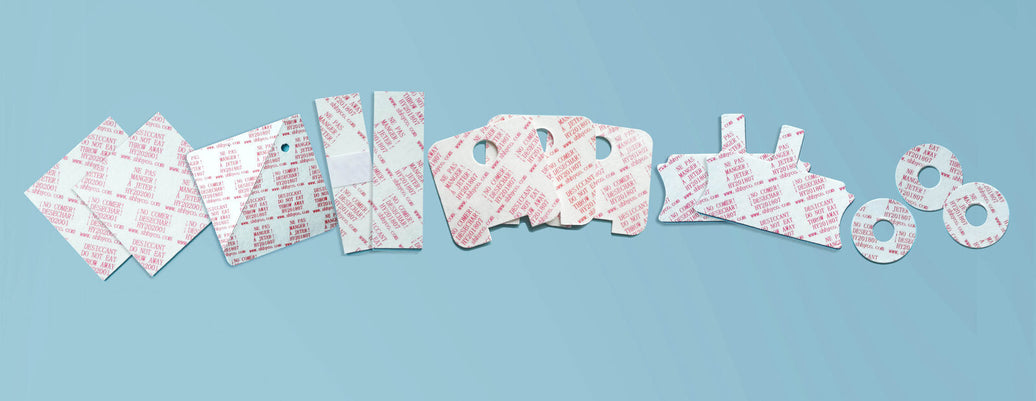
Caliper is the field that decides whether the insert physically fits your pack. A 1.45 mm board will not go into a blister cavity or a cassette well that a 0.5 mm card clears easily. Formats are compared in desiccant sheets, rolls or die-cut cards.
Watch for datasheets that advertise a choice of thicknesses and then publish neither value. That is common, and it is a reason to ask before you design around it.
Field 3: percent desiccant by weight
This is the single most revealing field. If a datasheet tells you the product is 65% silica gel, you now know three things: it contains silica gel, the remaining 35% is a carrier that does little adsorbing, and the recyclability conversation will be about mineral content.
Read this field sceptically, because published numbers are not always internally consistent. One widely cited US desiccant paper datasheet states 65% silica gel in its specification table and 67% in the body text on the same page, and gives the thickness as 57 mils in the table and a nominal 54 mils in the text. Those are small discrepancies, but they are in the document your QA team will file as evidence, so ask for a signed version.
Field 4: activation condition
If the datasheet says the product must be baked, and quotes something like one minute at 500 °F or five minutes at 300 °F, it is a silica-impregnated paper. Those temperatures drive water off silica gel. They also mean the material arrives inactive unless you pay for it activated and sealed, and that any exposure on your line starts consuming capacity before the pack is closed.
The field that is usually missing: capacity with test conditions
Capacity is quoted inconsistently or not at all. One grade publishes 0.07 g of water per in², described as calculated, with no test conditions stated. Another well-known cellulose-and-silica product publishes no capacity figure anywhere, no temperature range, no humidity range and no test standard, describing its performance only as exceptional.
A capacity number without a temperature and a relative humidity is not comparable to anything. Insist on both. The method for putting two quotes on the same basis is in how to compare desiccant spec sheets.
What a plant-fiber datasheet looks like instead
For contrast, here is the ATMOSIScience® fiber desiccant stated with its test conditions, all at 25 °C:
| Field | Value |
|---|---|
| Adsorption at 20% RH | more than 10% of own weight |
| Adsorption at 50% RH | more than 35% of own weight |
| Adsorption at 90% RH | more than 70% of own weight |
| Saturated, bagged pouch | over 100% of own weight |
| Loss on drying | under 10% |
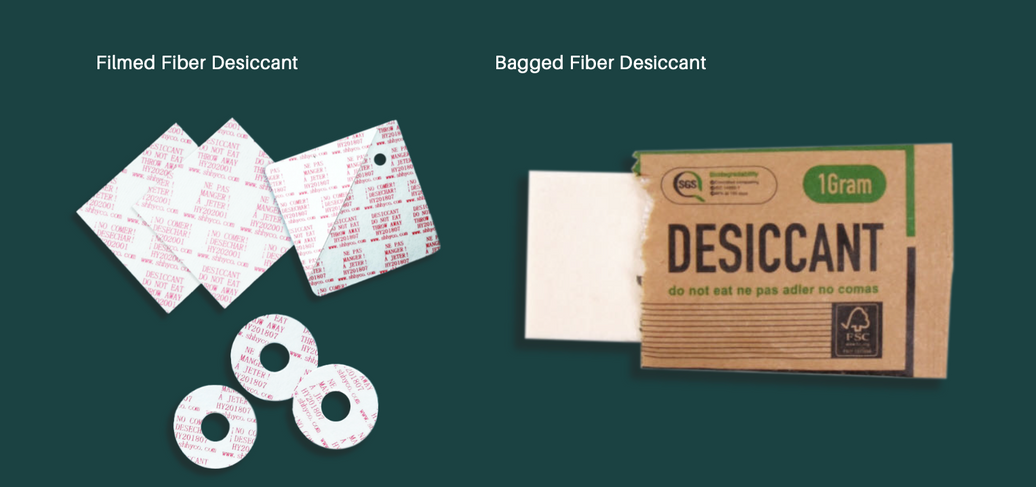
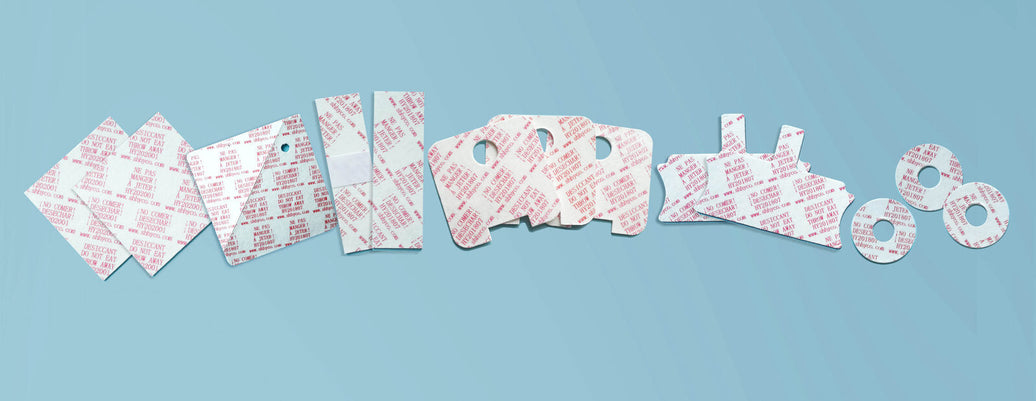
| Card caliper | 0.5 mm or 1.0 mm, die-cut to shape |
| Pouch range | 1 g to 1,000 g |
| Silica gel content | none |
Fiber desiccant technical criteria at 25 °C — ATMOSIScience
On end of life, the figure to ask any supplier for is a recyclability assessment with a report number. SGS report CQMR260700043401, dated 17 July 2026, classifies the plant fiber desiccant as paper and returns a fibre yield of 69.78% with a recyclability score of 100 out of 100. That result covers the fibre layer and not an assembled finished product, which is a limit worth stating plainly rather than hiding. Full specifications sit in the Fiber Card spec guide, and the category overview is in what a paper desiccant is.
Frequently asked questions
Is paper desiccant the same as fiber desiccant?
Usually not. Paper desiccant in US trade usage normally means cellulose paper impregnated with silica gel beads. A fiber desiccant uses the plant fiber itself as the adsorbent and contains no silica gel.
How can I tell without calling the supplier?
Look for a stated percent silica gel and a bake-out activation temperature. Either one present means silica is in the product.
Can silica-impregnated desiccant paper go in paper recycling?
Treat that as unproven unless the supplier gives you a recyclability assessment with a report number and a stated scope. A sheet that is 65% mineral by weight behaves very differently in a pulping test from one that is mostly fiber.
Does a lower silica content mean weaker performance?
Not necessarily, because what matters is grams of water held per gram of insert at your storage humidity, not the percentage of any one ingredient. Compare on capacity at a stated temperature and relative humidity.
Which format should I ask for?
Match caliper to the space you have, then size by capacity. If the pack is tight, start from the 0.5 mm card. If the pack is a carton or a shipper, a pouch is usually simpler to insert.
Send us the datasheet you were given
Paste in the fields you have, or tell us what is missing, and we will tell you what you are actually being quoted and what the equivalent plant-fiber spec would be for your pack.
Bulk and converter enquiries: wholesale or info@atmosiscience.com