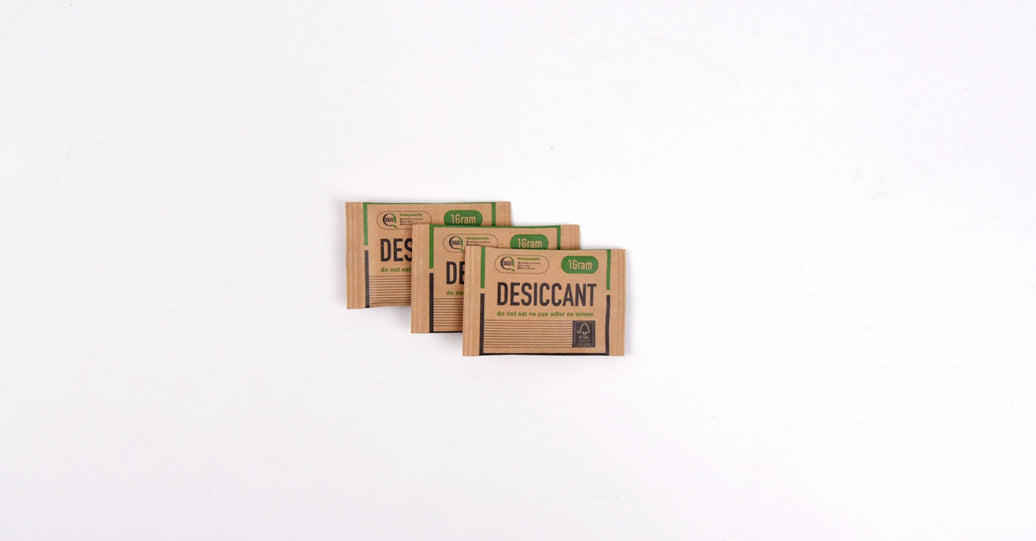
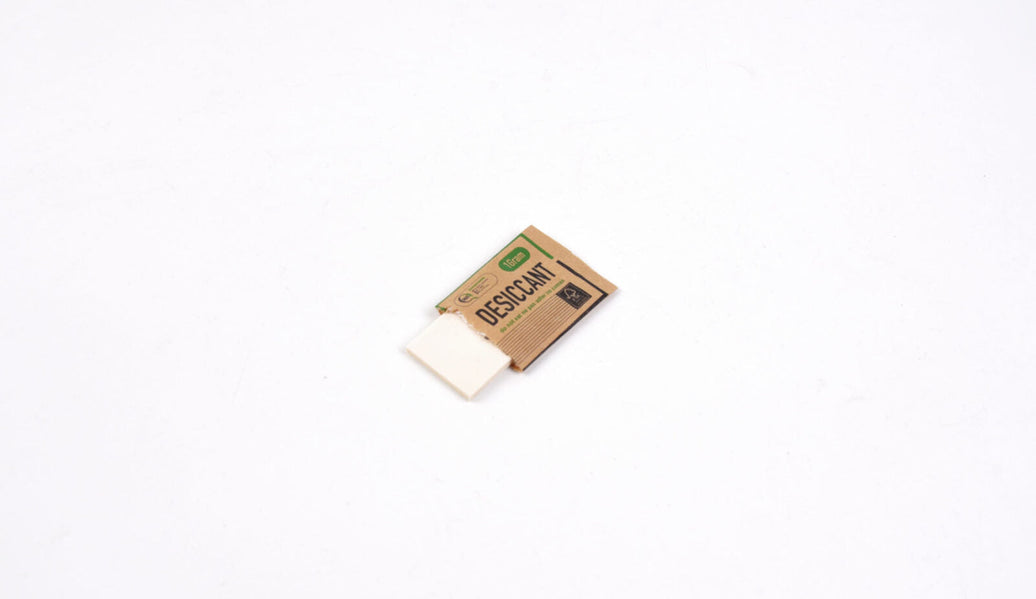
Quick answer: Ask for a product change notification clause requiring written notice before any change to composition, pad grammage, wrapper material, printing, dimensions, manufacturing site or quality system scope, with a defined notice period and a bridging-stock commitment. Without it, the first sign of a change is a batch that cakes, and by then the previous material is gone. The clause costs nothing to agree at qualification and is very difficult to add after a problem.
Desiccant specifications are usually written once and never revisited. Suppliers, meanwhile, improve processes, change wrapper stock, add a second line and requalify raw materials. Most of those changes are harmless. The ones that are not tend to be invisible until a shelf-life failure appears months later.
The changes that actually matter
Not everything needs notification. Four categories do.
Wrapper material
The wrapper controls how fast moisture reaches the sorbent. A nonwoven, a Tyvek face and a paper laminate behave differently at the same dosage, and a change can alter both the adsorption rate and the seal behaviour on your line. Overwrap choices are compared in the wrapper comparison.
Pad grammage or thickness
Capacity scales with mass of active material. A pad specified at a given thickness carries a given capacity; ATMOSIScience Fiber Card paper desiccant, for example, is supplied at 0.5 mm and 1.0 mm, with FF-3, FF-6 and FF-15 corresponding to roughly 0.5 g, 1 g and 2.5 g of silica gel equivalent. A change in thickness is a change in dosage even if the part number stays the same.
Manufacturing site
A second site means a second quality system scope, a second set of certificates and potentially a different environmental classification. If your file references an ISO 9001 certificate or a cleanroom classification, it references a site.
Printing and inks
An ink change affects food contact declarations and, for printed branded inserts, brand consistency. Buyers running custom printed inserts should treat artwork and ink system as separate controlled items.

A clause you can adapt
Wording along these lines covers the ground without being unreasonable to a supplier:
The Supplier shall notify the Buyer in writing not less than 90 days before implementing any change to: the composition or grammage of the desiccant element; the wrapper material, construction or printing; product dimensions or tolerances; the manufacturing site or production line; or the scope of the quality system certification covering the product. On notification the Supplier shall, on request, supply samples from the changed process and maintain availability of the unchanged product for a bridging period of not less than 90 days from notification. Changes affecting food contact status, regulatory declarations or compostability certification shall be notified immediately and supported by revised documentation.
Two details do most of the work. The bridging period means a qualification failure does not become a supply failure. The samples on request clause means you can run a comparison before committing.
What to do when a notification arrives
A notification is not automatically a revalidation. Grade it:
- Administrative — document reissue, address change, certificate renewal. Update the file, no testing.
- Minor — printing, carton quantity, secondary packaging. Visual check on receipt.
- Major — wrapper, grammage, site, composition. Run a comparison against retained samples of the current material and, if the risk justifies it, a shortened stability check. The protocol is set out in the desiccant validation article.
Grading matters because a clause that triggers a full revalidation for every change gets ignored by both parties within a year.
Certificate expiry is its own trigger
Certificates have end dates, and a lapsed certificate is a change even though nothing physical changed. Compostability certification in particular carries validity periods, and buyers relying on ASTM D6400 or EN 13432 in their own claims should diary the renewal rather than discover it during an audit. Scope and validity are covered in certificate scope and validity.
Frequently asked questions
Is 90 days a realistic notice period?
For packaging components, yes. It is short enough that a supplier can plan around it and long enough that a buyer can test.
What if the supplier refuses?
That is itself useful information. A manufacturer that controls its own process can commit to notification; a trader reselling someone else’s product often cannot.
Does the clause need to be in the contract or is a quality agreement enough?
Either works, provided it is signed and referenced from the purchase terms. A quality agreement is usually easier to update.
How does this apply to a distributor rather than a manufacturer?
The distributor must pass the obligation upstream. If it cannot, you are relying on a chain you cannot see, which is the situation the clause exists to prevent.
Set the change-control terms up front
The ATMOSIScience team can review your draft quality agreement and confirm what is committed for the product code you are qualifying.
Prefer email? info@atmosiscience.com