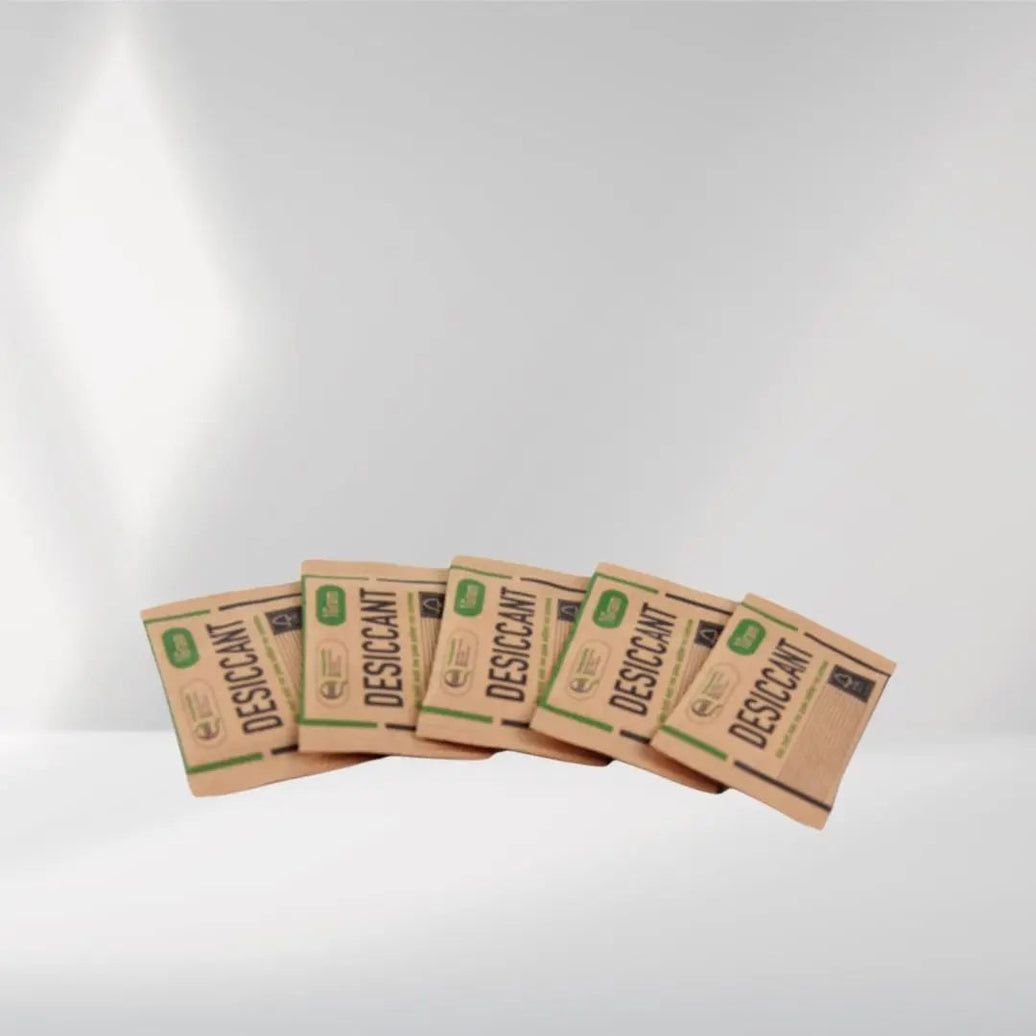
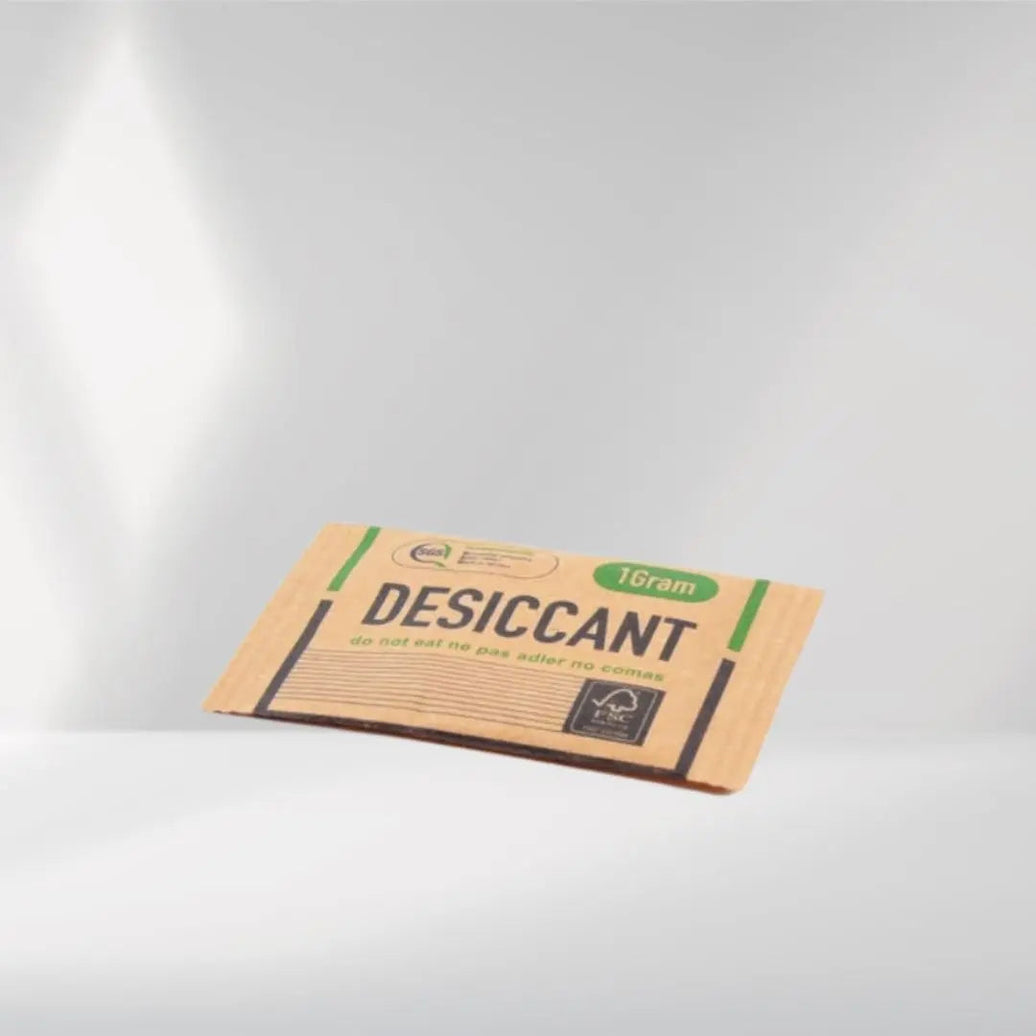
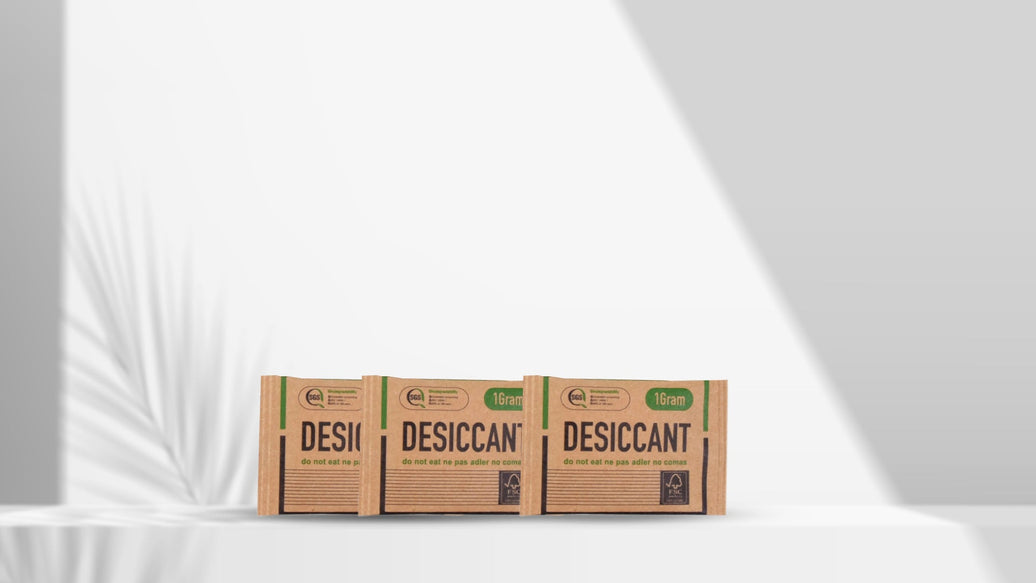
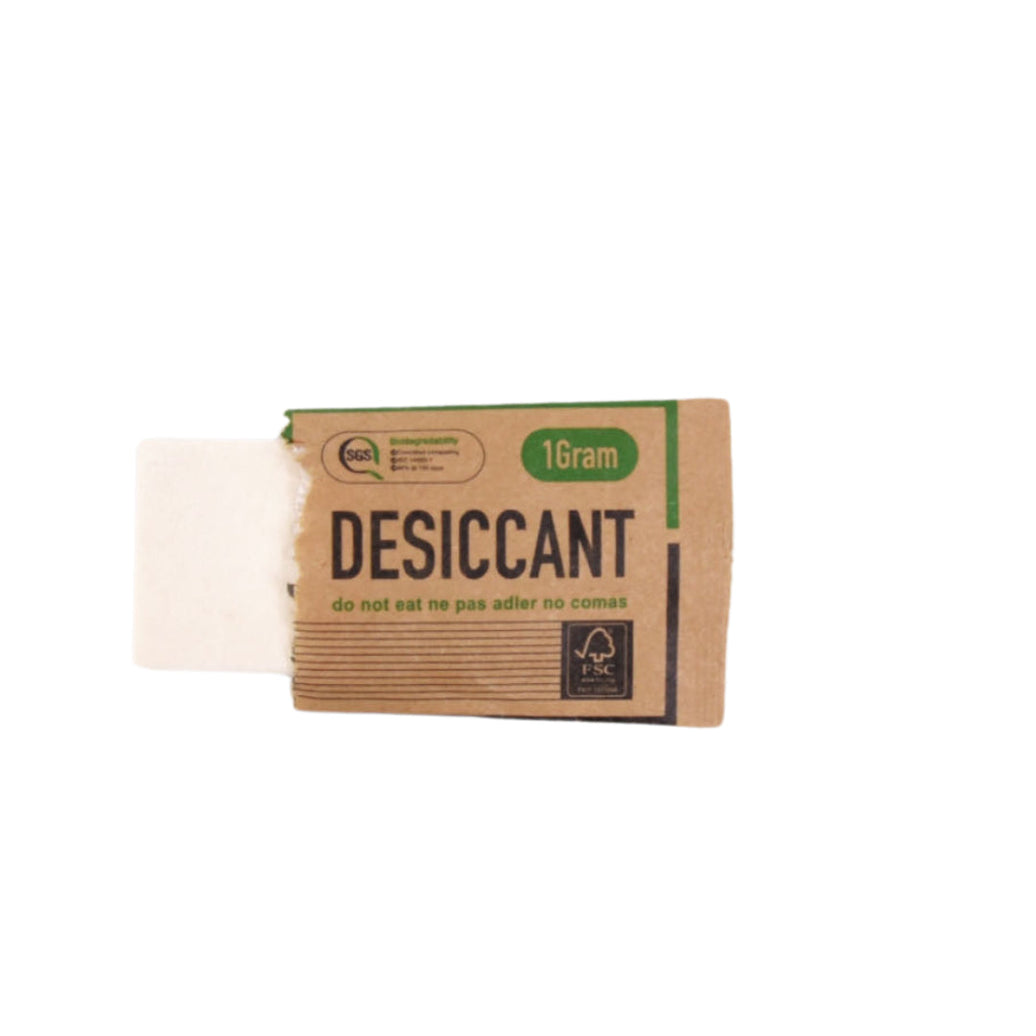
Buyers ask us "is this product FDA certified?" — sometimes because their own national regulator has written that phrase into an import requirement. Others list "certifications (FDA, REACH, compostability, etc.)" as one line item alongside price, or ask for a full technical datasheet with dimensions, material composition and certifications. All reasonable questions.
Almost nobody asks the follow-ups that decide whether the certificate is any use to them. This article is those follow-ups: what each document a desiccant buyer will encounter actually demonstrates, what it explicitly does not cover, and how to write a document request that gets you a qualification pack instead of a folder of logos.
The short answer: A certificate says that one named sample, tested to one version of one standard, by one named body, met stated criteria — and that it expires on a stated date. Four of those five are routinely missing from the email that says "yes, we have it."
Related: Fiber desiccant · Fiber technology
A certificate is not a pass/fail badge
The mental model that causes the trouble is the badge: a product either "has" a certification or it does not. Certificates do not work that way. Each is narrow on purpose — it fixes a sample, a standard, a laboratory, a criterion and a date, and says nothing outside those five. A supplier who answers "yes" without supplying them has answered a different question from the one you asked.
The four questions to ask about any certificate
- What is the scope? Which physical component does it cover — the active fill, the substrate, the wrap, or the finished part? A compostability certificate held against the outer bag says nothing about what is inside it. The most common and most expensive gap.
- Which standard, and which version? Standards get revised, and a report against a superseded edition is not the same evidence. Ask for the designation and the year.
- Who issued it, and what is the certificate number? A logo on a datasheet is not a certificate. Ask for the PDF, the issuing body and a number you can quote back.
- When does it expire, and is the lot you are buying inside that window? Certificates lapse. One that was valid when the sample was sent may not be valid when the PO ships.
What each document proves — and what it does not
| Document | What it genuinely demonstrates | What it does not cover |
|---|---|---|
| FDA 21 CFR 175.300 | A food-contact compliance basis for resinous and polymeric coatings | Not an FDA approval of the article; silent on non-food chemical exposure, PFAS and compostability |
| EN 13432 | Disintegration, biodegradation, ecotoxicity and heavy metals under industrial composting, for the component named on the certificate | Home compostability; any component not named; PPWR presumption of conformity; a US label claim |
| RoHS (EU 2015/863) | Restricted hazardous substances in electrical and electronic equipment | Food contact, PFAS, compostability. Engages only where the part ships inside or with EEE, or a customer's BOM compliance system demands it — not relevant to a food jar |
| REACH SVHC screening | Screening against the candidate list of substances of very high concern | PFAS at PPWR thresholds. It is not a PFAS test |
| ISO 14067 | A quantified product carbon footprint for a defined system boundary | Comparability with another study's figure. It is not ISO 14001 |
| ISO 9001 | The factory runs a certified quality management system | Any property of the product itself |
| Anti-mould testing | The material resists mould growth under the test's conditions | Behaviour in your pack, at your humidity, over your shelf life |
| MIL-D-3464E | Desiccant performance: capacity units, dust class, immersion resistance | Not a certificate — a performance specification. No food or environmental content |
| USP <670> | A pharmaceutical packaging-component chapter with a defined adsorption test | Cellulose and fibre are not named materials in it |
"FDA certified" is not something the FDA does
The FDA does not certify or approve individual packaging components, and there is no register of FDA-certified desiccants. What exists is compliance: an article's materials are demonstrated to comply with the applicable citation in 21 CFR. For coatings and films that is frequently §175.300, resinous and polymeric coatings. Amorphous silica gel is GRAS under §182.90; synthetic zeolites and molecular sieves sit under §177.1520.
Two consequences. First, the FDA distinguishes direct food contact — a packet that may touch the product, so fill and wrapper must both be food-safe — from indirect contact, where the packet sits in a bottle lid, carton or separate compartment. Which you have changes the documentation you need. Second, because some national regulators do write "FDA certified" into their own requirements, a supplier answering "yes, FDA certified" without naming the CFR section has told you nothing you can put in a dossier. Ask which citation, for which component.
EN 13432, and the word "compostable"
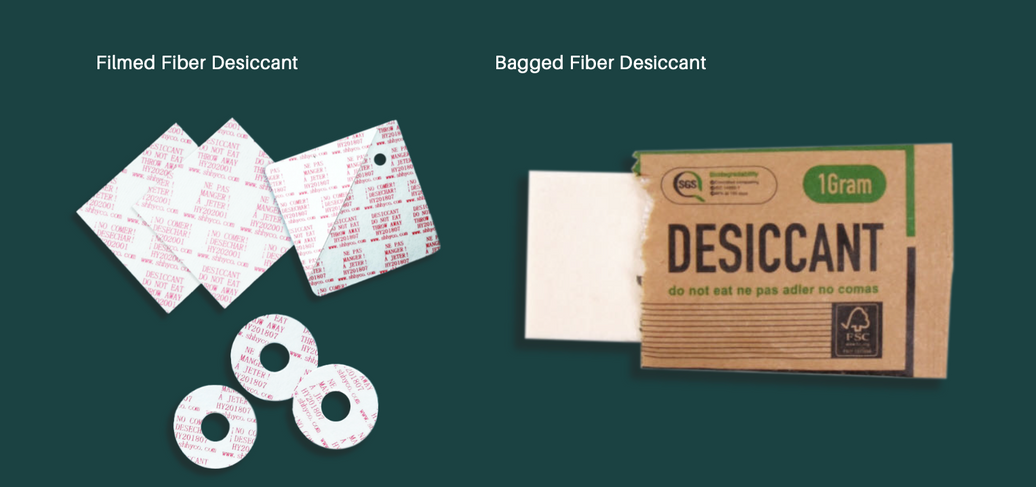
EN 13432 tests disintegration, biodegradation, ecotoxicity and heavy metal content under industrial composting conditions. It is not a home-compostability standard; that is a separate scheme and a separate claim. Scope bites hardest here, because a desiccant is at least two materials — our own testing sits on two SGS certificates, one covering the fibre core at 0.5–5 mm and one the compound paper film. One certificate could not have covered both, so if a supplier sends a single certificate for a two-material part, that is the question to ask.
Three cautions on wording. Under the PPWR, EN 13432 appears only in a recital, and Recital 58 states that the current industrial-composting standard cannot be relied on as a basis for presumption of conformity pending its revision, though it may be used as guidance — so hold the certificate, but do not describe it as conferring PPWR conformity. In the US, California AB 1201 names ASTM D6400 and D6868 specifically, so an EN 13432 certificate does not automatically support a "compostable" label there. And under the FTC Green Guides the honest wording is always "industrially compostable", never a bare "compostable".
A REACH SVHC screening is not a PFAS test
An SVHC screening checks a material against the REACH candidate list. It is a useful document, and it is not the document a PPWR question needs. PPWR Article 5(5) sets 25 ppb for any single targeted PFAS, 250 ppb for the sum of targeted PFAS, and 50 ppm for PFAS including polymeric, applying to food-contact packaging from 12 August 2026. An SVHC screening answers none of the three.
Paper and cellulose substrates are the highest-risk category for PFAS, which makes this a property of the whole fibre-desiccant field rather than of any one supplier. Ask every supplier — including us — for a test report against all three metrics plus a total fluorine screen, and treat "we have REACH" as a non-answer.
ISO 14067 is a number; ISO 14001 is a system
ISO 14067 produces a quantified product carbon footprint. Ours is 1.44 kg CO₂e/kg. That figure is only meaningful beside another if the system boundaries, allocation rules and data vintage match — two PCFs from different studies are not comparable merely because both cite ISO 14067. Ask what is inside the boundary before putting them in the same column. ISO 14001, by contrast, is an environmental management system standard for the organisation and produces no carbon figure at all. The two appear interchangeably on spec sheets, and they are not interchangeable.
USP <670> — a listing question, not a performance verdict
USP <670> names bentonite, calcium chloride, calcium oxide, molecular sieves and silica gel. It does not name cellulose or fibre. For a pharmaceutical buyer that is a structural barrier independent of how the material performs, and it is better heard from a supplier before qualification than discovered during it.
| USP <670> adsorption test | Specification |
|---|---|
| Method | Gravimetric |
| Sample size | 5–10 g |
| Integrated components | Tested unincorporated |
| Conditions | 40% ±5% RH and 80% ±5% RH, both at 25 ±2 °C |
| Equilibrium | Two consecutive weighings within 3 mg/g, the second taken after a further 3 ±1 h |
Acceptance sits roughly at not less than 13–19% at 40% RH and 23–27% at 80% RH depending on material — verify those against the current chapter before quoting them to a customer, including when you are quoting them back to us.
A type certificate and a COA are different objects
| Document | What it proves | Frequency |
|---|---|---|
| Type certificate (FDA basis, EN 13432, RoHS, PCF) | One sample met stated criteria, once | Per certificate cycle, with an expiry date |
| Certificate of analysis | The lot on your purchase order meets stated limits | Every lot |
| Adsorption isotherm | How much water the material holds, at which RH and temperature | Per material, with the method stated |
| WVTR of your pack | How fast moisture gets in — the other half of every sizing | Per pack structure, per test standard |
A type certificate proves a sample once; a per-lot COA proves the lot you are buying. You need both, and the COA must name the test method and conditions or it is a number without a provenance. On first contact a packaging engineer should also ask for the exposure profile or WVTR with its test standard and conditions — ASTM F1249, E96 or D7709 — plus lot traceability, ISO 9001, and how the factory segregates materials between runs.
The document pack request you can paste into an email
- Material composition of the active and of the wrap, named separately.
- The food-contact citation — which section of 21 CFR, and whether the application is direct or indirect contact.
- Compostability certificate: issuing body, certificate number, the component it covers, and the expiry date.
- PFAS test report against all three PPWR Article 5(5) metrics — 25 ppb single, 250 ppb sum, 50 ppm including polymeric — plus a total fluorine screen.
- Heavy metals against the 100 mg/kg limit in PPWR Article 5(4).
- RoHS to EU 2015/863, where the part ships inside or with electrical or electronic equipment.
- ISO 9001 certificate, number and expiry.
- A certificate of analysis from a recent production lot, showing test method and conditions.
- The moisture adsorption isotherm, with the test standard and temperature stated.
Nine items, one email. How a supplier answers tells you as much as what the documents say — one who returns eight of nine with scopes and expiry dates attached is a different proposition from one who returns a folder of logos.
What our own documentation covers, and what it does not
We hold: SGS industrial compostability tested to EN 13432 across two certificates, one for the fibre core at 0.5–5 mm and one for the compound paper film; ISO 14067 product carbon footprint of 1.44 kg CO₂e/kg; SGS RoHS to EU 2015/863; SGS REACH SVHC screening; SGS anti-mould; and ISO 9001. We also run accelerated shelf-life testing.
Two gaps we would rather you heard from us than found later. Our REACH SVHC screening is not a PFAS certificate at PPWR thresholds, and nobody should present it as one. And cellulose is not a USP <670> listed material, which is a listing question for pharmaceutical buyers regardless of measured performance. Being told that before qualification is worth considerably more than being told after.
This article is general information, not legal advice. Verify current obligations against your own products and counsel.
Frequently asked questions
Is your desiccant FDA certified?
The FDA does not certify packaging components, so nobody's is.
Can I print "compostable" on my pack because the desiccant has EN 13432?
No, on three counts. The certificate covers only the component named on it. The correct wording is "industrially compostable". And in California, AB 1201 names ASTM D6400 and D6868, which an EN 13432 certificate does not satisfy.
Does a REACH SVHC screening cover PFAS?
No. PPWR Article 5(5) sets thresholds at 25 ppb, 250 ppb and 50 ppm on different bases, and an SVHC candidate-list screening addresses none of them. You need a dedicated PFAS test report, ideally with a total fluorine screen alongside it.
Do I really need a COA on every lot?
If the desiccant is in a regulated pack, yes — the type certificate proves a sample from the past, and the COA proves what you are receiving now. Make sure it names the test method and the conditions.
Send us the requirement, and we will send the scope
If you are building a qualification pack, tell us the market, the product it sits in and the claims you must support. We will send the certificates with their scopes and expiry dates attached, and say plainly where a document does not reach. Start at fiber desiccant, or email info@atmosiscience.com.
Related reading: The PPWR declaration of conformity for a desiccant · Desiccant supplier due diligence
Tell us the product, not just the part number
Send us what you are packing, the pack format and the humidity or shelf-life target. We will come back with a sizing calculation, the matching format and the certificate pack.