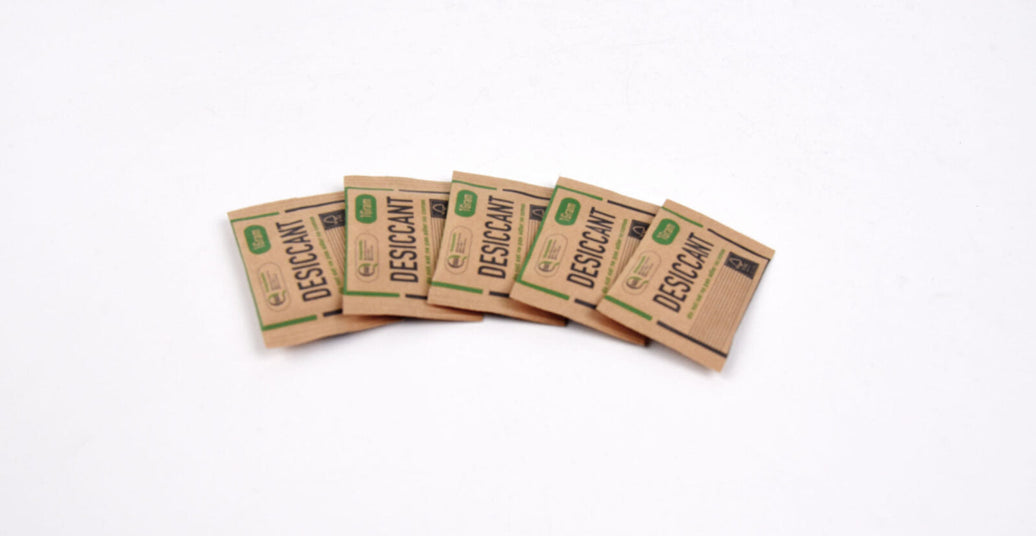
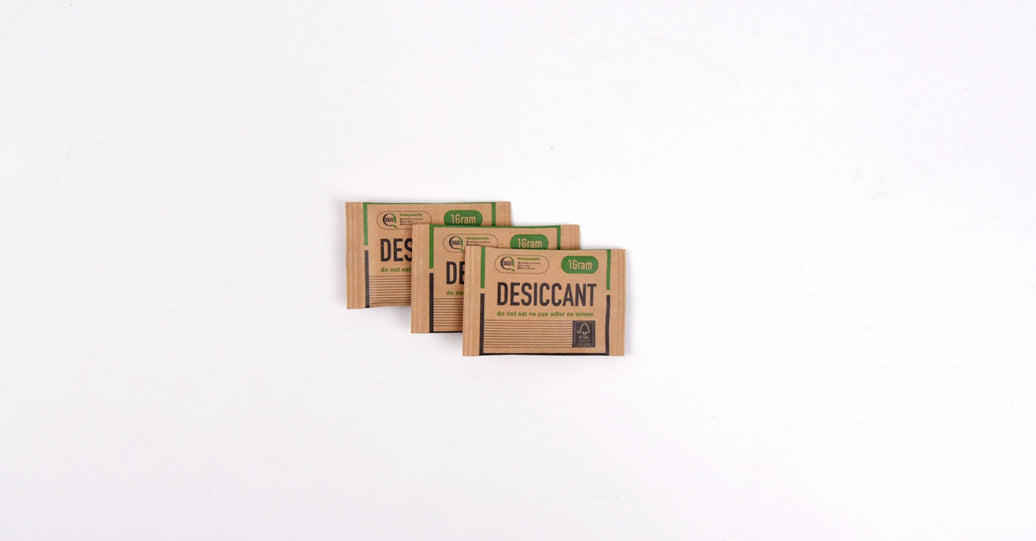
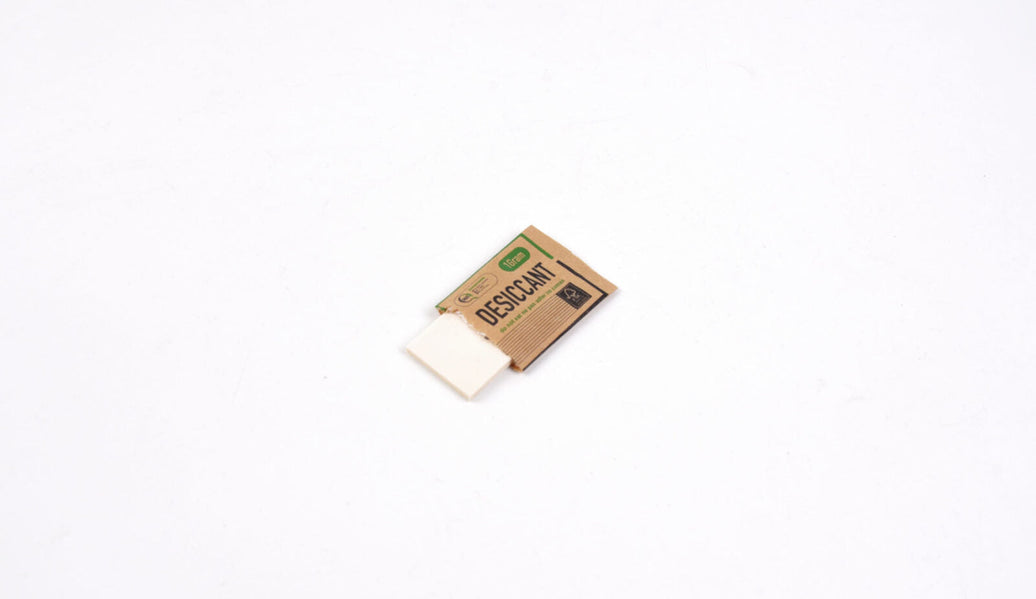
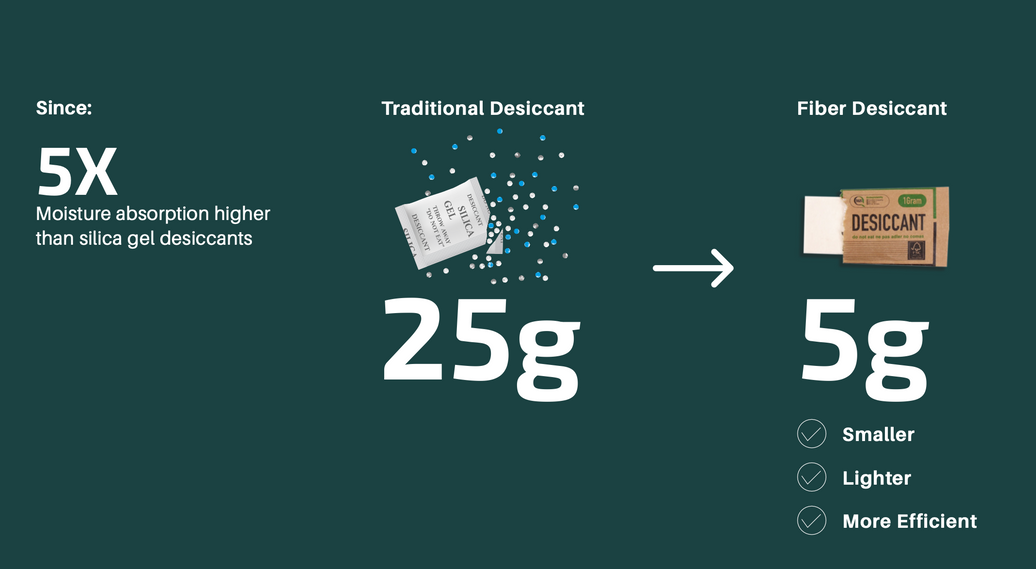
Quick answer: Fiber Card is the ATMOSIScience paper desiccant card: a rigid, card-like sheet with a natural plant-fiber core and calcium chloride bound inside the fibers, enclosed in a printable outer paper. It adsorbs more than 10% of its own weight at 20% RH, more than 35% at 50% RH and more than 70% at 90% RH (25 °C), about 2.3 times common silica gel at 90% RH. Reference sizes are 1.0 mm thick and range from 25 × 12 mm to 60 × 25 mm, and custom die-cut shapes are made to order. It is built for compact, moisture-sensitive packs such as supplement bottles, pouches, blisters and kits.
This page is for the people who have to sign off a desiccant: packaging engineers, QA managers and buyers. It sets out what Fiber Card is made of, what it does at the humidity your product actually sees, what sizes exist, and what documents stand behind it. Where something depends on your pack, we say so.
What Fiber Card is
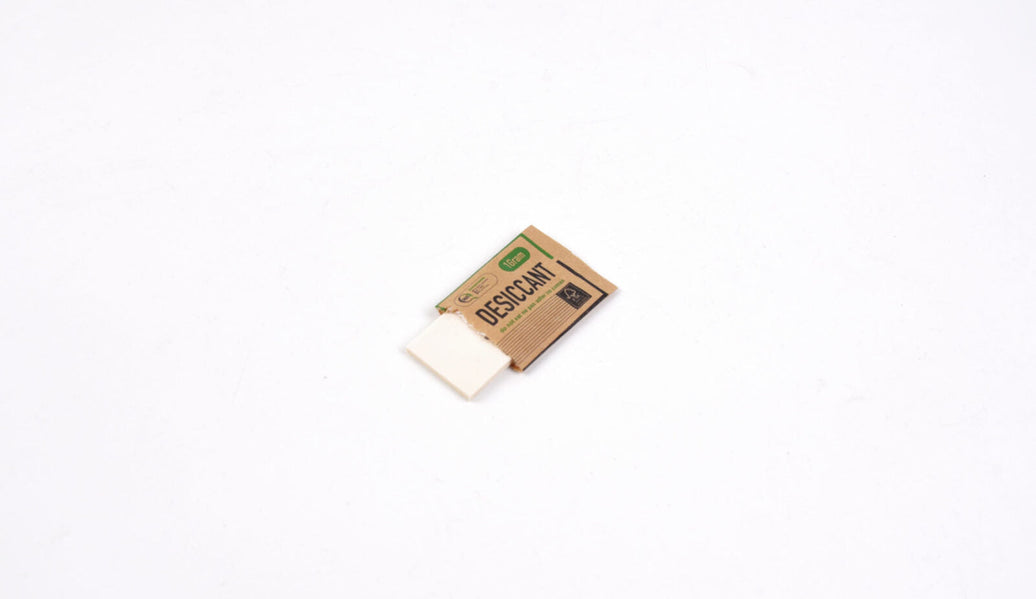
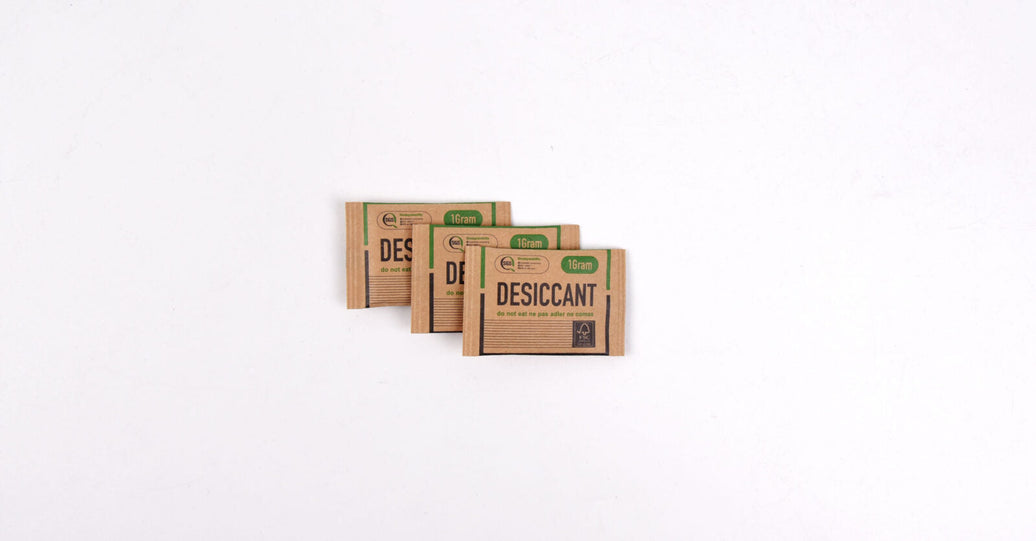
Fiber Card is a fiber desiccant in flat sheet form, engineered to absorb moisture inside sealed packaging. It is also described as a paper desiccant, because the finished card looks and handles like a stiff piece of card stock rather than a pillow-shaped sachet. If you are new to the category, start with our overview of what a paper desiccant is.
It is a one-way desiccant. It takes water vapour out of the pack air and holds it. It does not release moisture back to hold a set humidity point, which is the job of a two-way humidity pack.
Construction
| Layer | Material | Job |
|---|---|---|
| Core | Natural plant fibers combined with polymer materials, with calcium chloride held in the fiber matrix | Adsorbs and binds water vapour |
| Outer layer | Tyvek, non-woven, laminated paper or printable compostable paper | Breathable, dust-proof and leak-resistant; carries print |
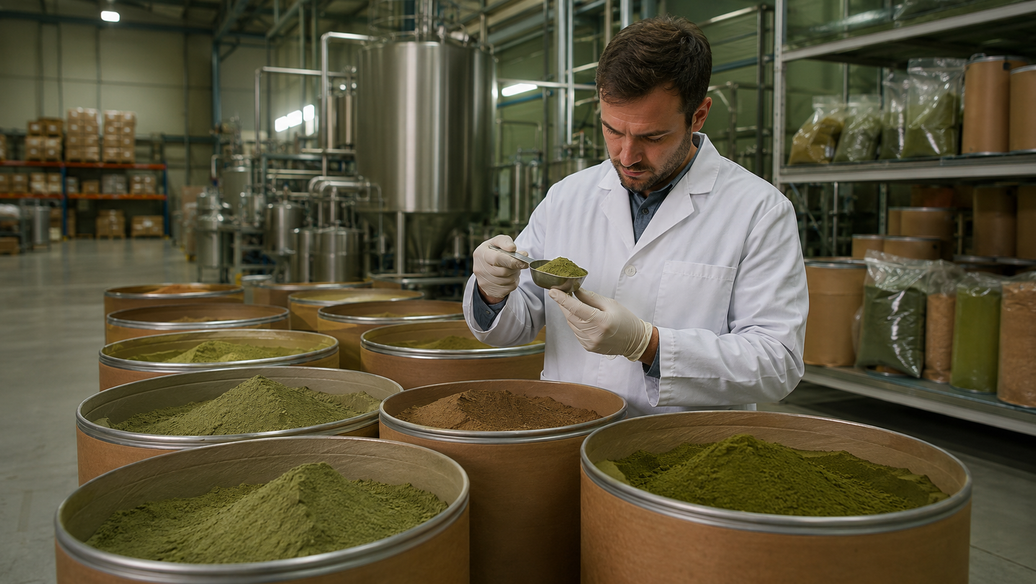
Two mechanisms work together in the core. Porous lignocellulose draws water vapour into micro-channels by capillary action, and calcium chloride binds water inside the fiber matrix. The product documentation reports no brine leakage, dust or corrosion from this construction. The core is documented as non-toxic and food-contact safe. More on the chemistry in how fiber desiccant works and on manufacturing in how a fiber desiccant is made.
Performance at the humidity your product sees
| Condition (25 °C) | Adsorption, share of own weight |
|---|---|
| 20% RH | more than 10% |
| 50% RH | more than 35% |
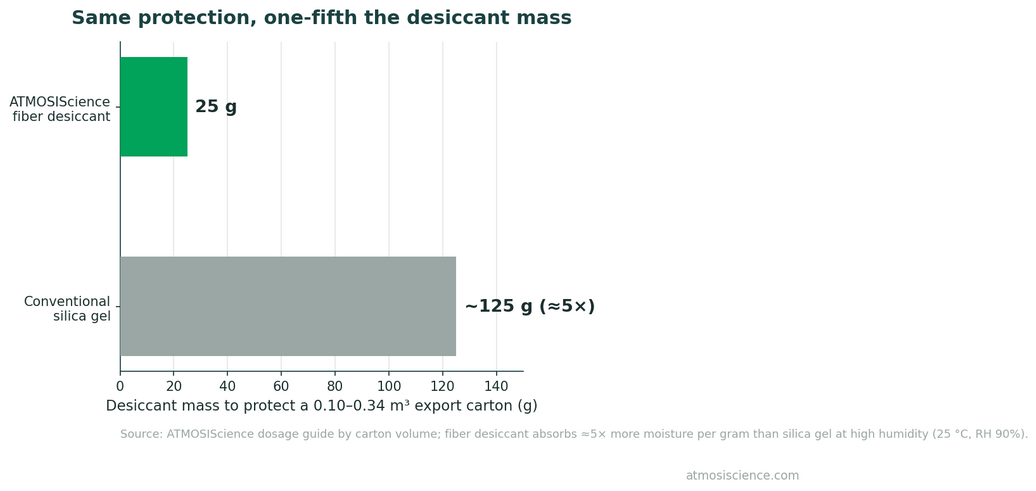
| 90% RH | more than 70% (common silica gel: about 30%) |
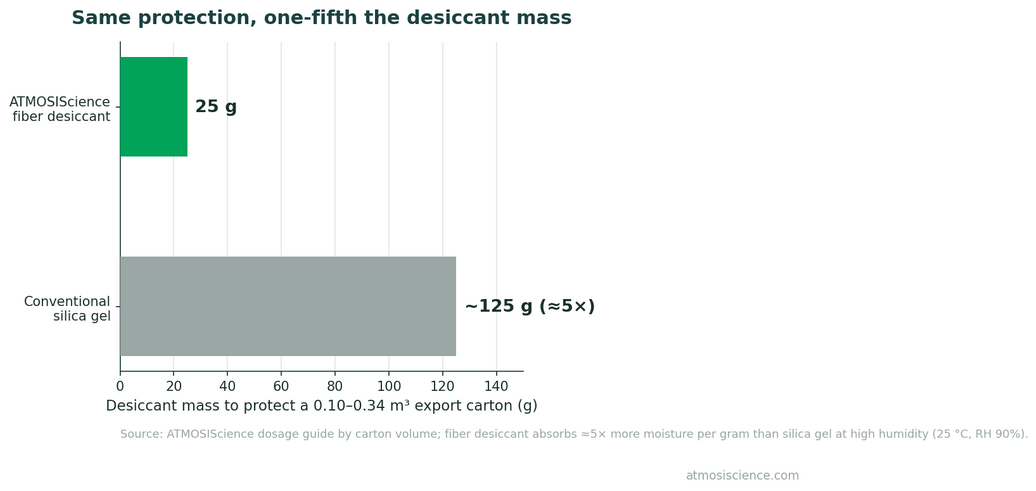
The 90% RH figure is the documented comparison with silica gel, and it works out to roughly 2.3 times the capacity per gram. For most supplement and food powders the 20% and 50% rows matter more, because that is the humidity range a dry pack lives in. Capacity and adsorption speed can also be configured to the application, so treat these as the standard grade rather than a ceiling. The difference between capacity and adsorption rate is explained in moisture capacity is not adsorption rate.
Sizes and formats
| Reference size | L × W × T (mm) | Mass (g) | Silica gel equivalent (g) |
|---|---|---|---|
| FF-3 | 25 × 12 × 1 | 0.15 ± 0.05 | 0.5 |
| FF-6 | 30 × 20 × 1 | 0.35 ± 0.08 | 1 |
| FF-15 | 60 × 25 × 1 | 1.0 ± 0.1 | 2.5 |
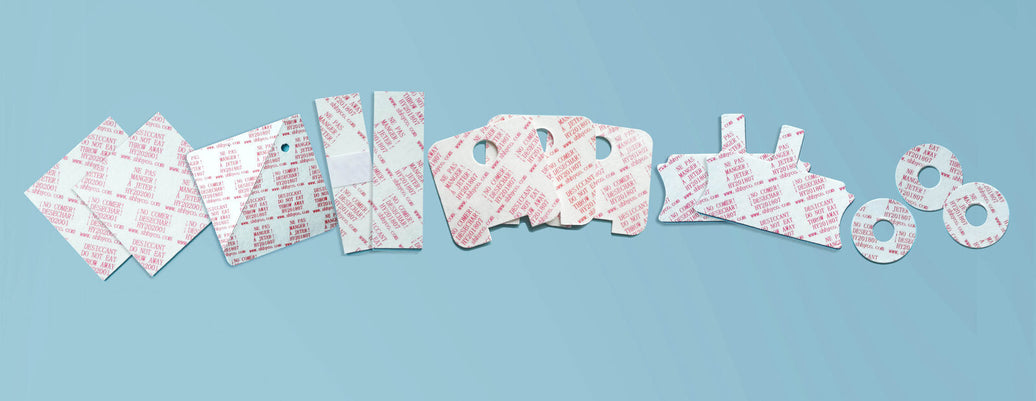
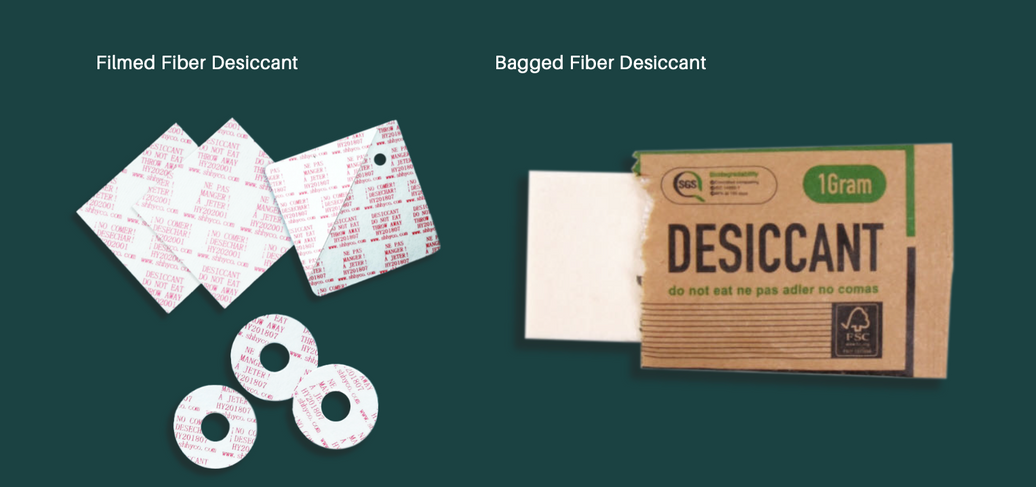
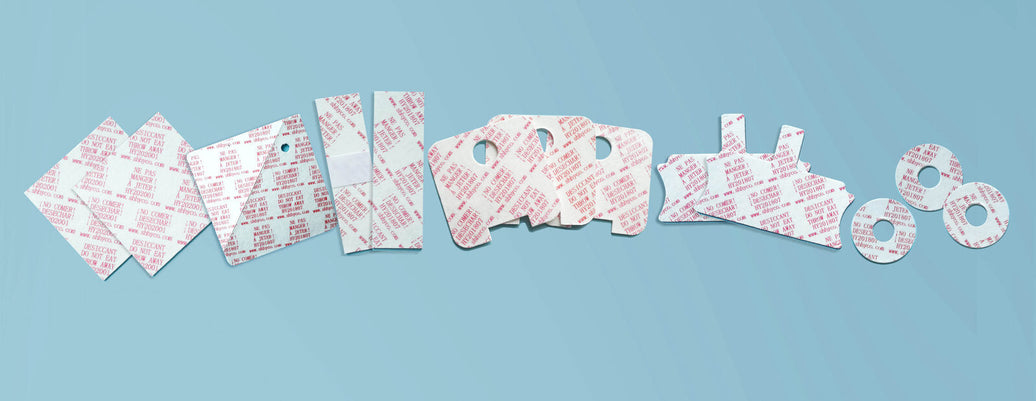
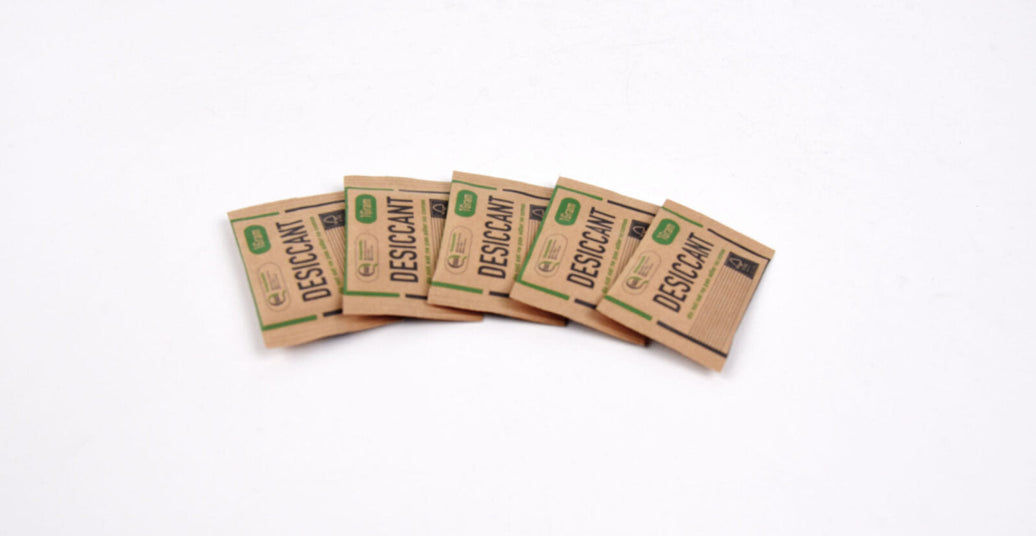
Beyond the reference sizes, shape, thickness, weight, print and packaging integration are specified per application. Cards can be die-cut as squares, circles, discs or a custom outline that matches a cap finish or a cavity. Fiber Card can also be supplied inside sachets or built into an integrated pack component. How thickness changes pack design is covered in desiccant thickness and packaging design.

A worked swap from silica gel
Say a supplement bottle currently ships with a 1 g silica gel sachet dropped on top of the tablets. On paper, the matching Fiber Card is the FF-6 reference size: 30 × 20 × 1 mm and about 0.35 g, rated as equivalent to 1 g of silica gel. That is roughly a 65% cut in desiccant mass, and the card can sit flat against the wall or in the cap instead of rolling loose in the bottle.
On paper is the key phrase. The equivalence comes from capacity at a stated condition. Your bottle wall, induction seal, fill level and how often the customer opens it decide what the product actually sees. Run the swap through an accelerated test before you change the spec, as shown in accelerated shelf-life testing for powders.
Handling before it goes in the pack
Any desiccant starts working the moment its bag is opened. Keep Fiber Card in its sealed outer bag until it is needed, reseal part-used bags straight away, and limit how long cards sit open on the line. A card that has spent a shift in a humid packing room arrives in the pack already partly spent. Our guide to open-bag exposure on a filling line sets out a practical limit.
Print on the card
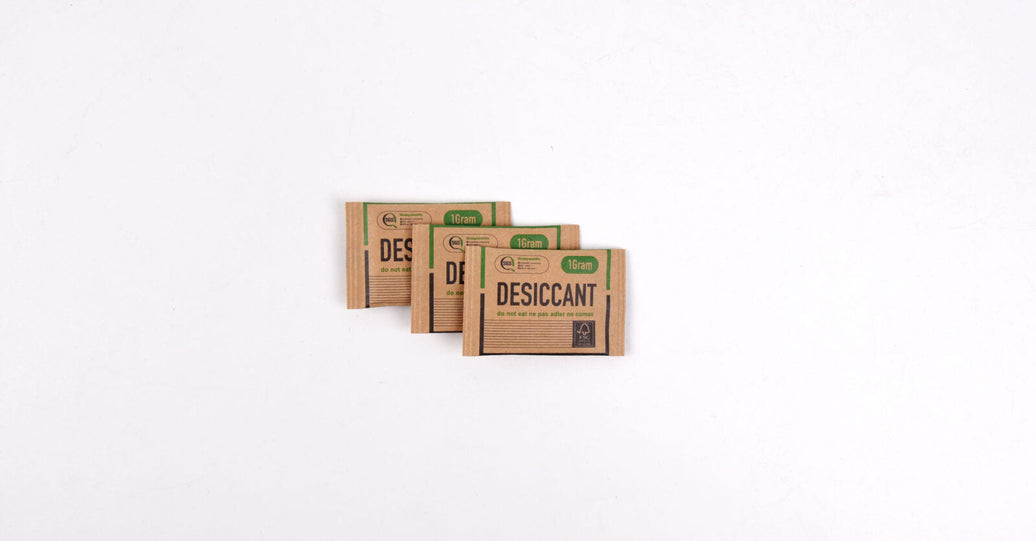
The top surface is printable. Brands use it for a logo, product information or a functional message such as a clear do-not-eat line in one or more languages. A printed card is a component your customer can identify, which turns an unexplained object in the pack into a quality cue. When the card sits in a food or supplement pack, ask how the ink system is qualified for food contact. See printing inks on desiccant and migration risk and custom-printed desiccant cards.
Where it is used
- Food and nutraceutical: supplement bottles, tubs, resealable pouches, stick packs and gummy jars. Start with our dietary supplement desiccant hub.
- Pharmaceutical: bottles, blister formats and diagnostic kits. See pharma desiccant packaging.
- Electronics and semiconductor: slim component packs.
- Garments and footwear: as a printed swing tag or box insert. See desiccant for garments, footwear and leather.
- Wood, toys and instruments: slim inserts in retail boxes.
Documents behind it
ATMOSIScience lists the following for its fiber desiccant materials:
- FDA 21 CFR 175.300 food-contact documentation
- SGS compostability testing to EN 13432 and ASTM D6400
- ISO 14067 product carbon footprint: 1.44 kg CO₂e per kg, reported as 31.25% lower than silica gel per unit mass
- SGS RoHS (EU 2015/863), SGS REACH SVHC screening and an SGS anti-mould test
Certificates are tied to a material, a format and a test date. Ask which ones cover the exact card you are buying, including print and laminate. Our guides to what a desiccant certificate covers and the supplier qualification pack list the questions. The carbon number and its functional unit are explained in fiber desiccant carbon footprint.
What Fiber Card is not
- Not a two-way humidity regulator. If your product must not be over-dried, read two-way liner or one-way desiccant first.
- Not an ultra-low RH desiccant. For headspace targets near 10% RH or lower, molecular sieve is usually the right tool.
- Not a replacement for barrier packaging. A desiccant buys time against moisture that gets in. It cannot fix a pack that leaks.
- Not edible. Like every desiccant, it is not intended to be eaten.
How to get a sample that answers your question
A sample is only useful if it is the right size for your pack. Send the pack type and volume, barrier material, the space where the card will sit, how often the pack is opened, target shelf life and print needs. We then recommend a card size and you can test it with the protocol in how to run a desiccant sample evaluation.
Frequently asked questions
How thick is Fiber Card?
The reference sizes are 1.0 mm thick. Other thicknesses are made to order; capacity falls with material, so the moisture load sets how thin a card can be.
How much silica gel does one Fiber Card replace?
By the reference sizes, FF-3 replaces about 0.5 g, FF-6 about 1 g and FF-15 about 2.5 g of silica gel. Validate the swap on your own pack, as shown in silica gel equivalency.
Can Fiber Card touch the product?
The core is documented as food-contact safe and the outer layer is dust-proof and leak-resistant. Confirm direct-contact scope with the certificate for your exact construction.
Does Fiber Card leak when it is saturated?
The calcium chloride is bound inside the fiber matrix, and the product documentation reports no brine leakage. As with any desiccant, size it so it is not driven far past saturation.
Can it go through an automated line?
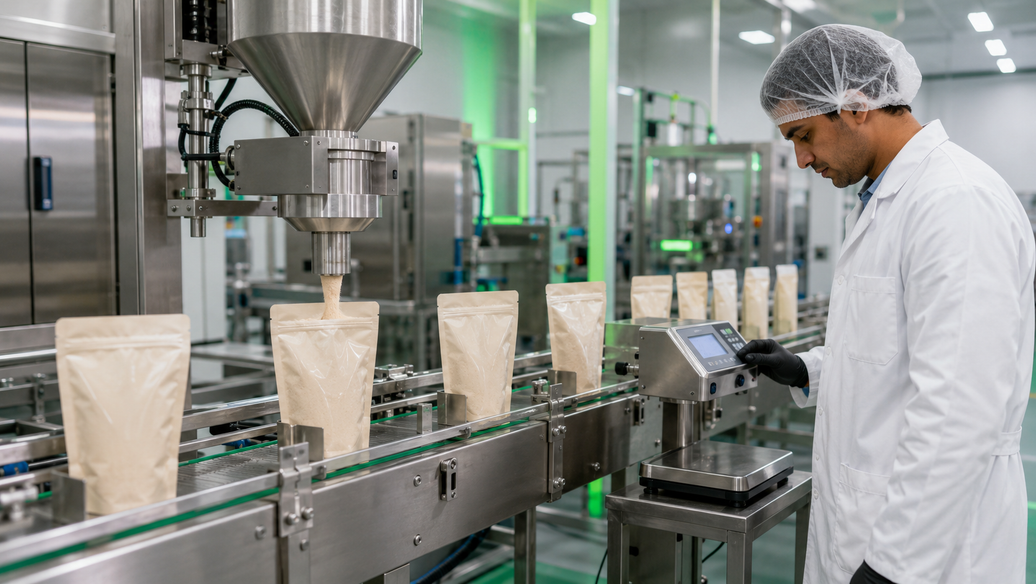
Yes. A rigid card feeds more predictably than a soft sachet. Share your feeder type early; see desiccant dispenser compatibility.
Request a Fiber Card sample and spec sheet
Tell us the pack and the product. ATMOSIScience will recommend a card size, send samples and share the documents your QA team needs.
Prefer email? info@atmosiscience.com