Quick answer: Fiber desiccant is a plant-fiber moisture absorber that comes as cards, sheets and bagged sachets. At 25 °C it holds more than 10%, 35% and 70% of its own weight at 20%, 50% and 90% RH, and at 1.0 mm a Fiber Desiccant Card absorbs three times as much moisture as silica gel at 25 °C and 90% RH, so at that condition 1.0 g of card holds as much as 3.0 g of silica gel. It has no loose beads, is die-cut and printed to your pack, keeps for 12 months sealed, shows when a card is spent with a simple bend test, and the bare plant-fiber sheet, as tested, scored 100 out of 100 for recyclability as paper in an SGS assessment. Below are the questions buyers ask most often before they switch.
These are the questions packaging engineers, QA teams and buyers send us most often when they first look at fiber desiccant. Each answer is short and based on our product documents. If yours is not here, ask it in the form at the bottom and a real person will answer it.
The basics
What is fiber desiccant?
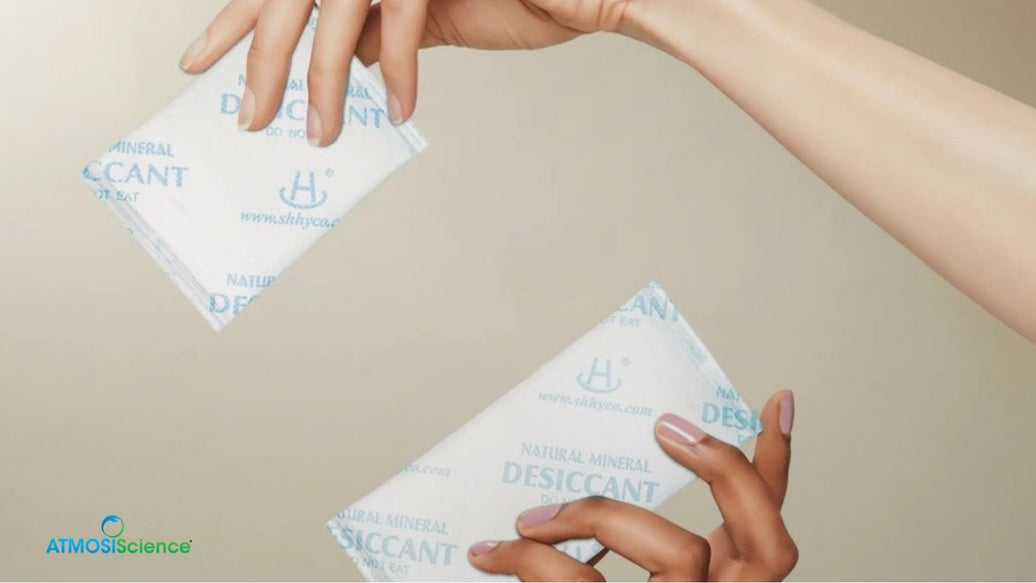
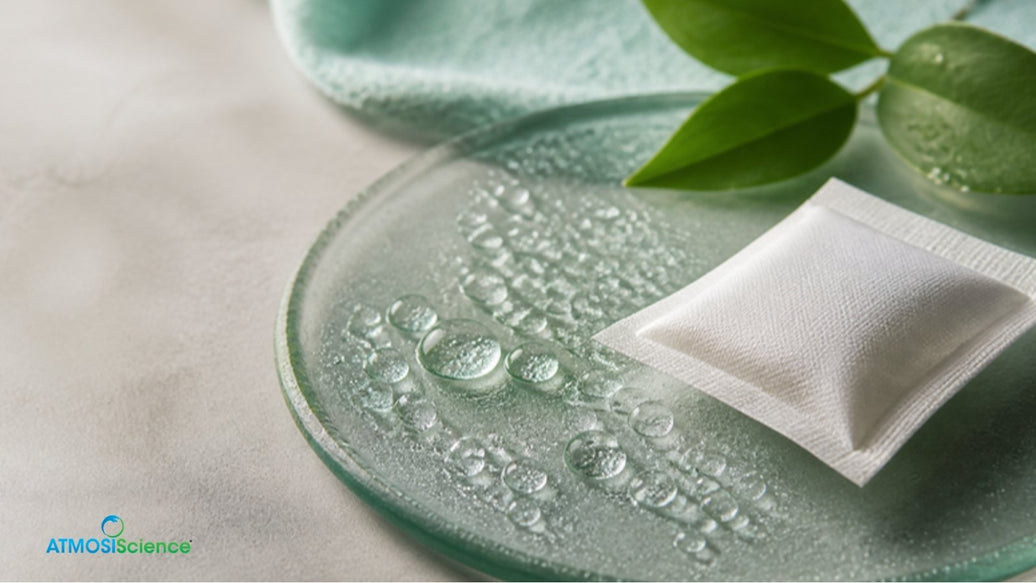
A moisture absorber that uses natural plant fiber as its adsorption substrate, with calcium and sodium salts held in the fiber. It comes as flat sheets, bagged sachets and cards, and it takes water vapour out of a sealed pack and holds it.
How does fiber desiccant work?
Two mechanisms work together. Physical adsorption: porous lignocellulose draws moisture into micro-channels by capillary action. Chemical binding: calcium chloride is held within the fiber matrix, which the product documentation describes as giving high absorption without brine leakage or dust.
Is fiber desiccant the same as paper desiccant?
Yes, in the way that matters for performance: the plant-fiber sheet itself does the absorbing, rather than beads or powder inside a paper wrapper. SGS assessed the bare ATMOSIScience plant-fiber sheet as paper in recyclability report CQMR260700043401 (17 July 2026). Some products sold as paper desiccant are other absorbents inside a paper wrapper, so it is worth asking what the absorbing layer is. Our paper desiccant spec checklist covers that question.
How much moisture does fiber desiccant absorb?
At 25 °C, more than 10% of its own weight at 20% RH, more than 35% at 50% RH and more than 70% at 90% RH. In the bagged format, saturated uptake is more than 100% of its own weight.
How does it compare with silica gel?
At 1.0 mm thickness, Fiber Desiccant Card absorbs three times as much moisture as silica gel under the same test conditions (25 °C / 90% RH), so at that condition 1.0 g of card holds as much as 3.0 g of silica gel. On our measured 25 °C curve, plant-fiber desiccant holds about twice as much as silica gel across the drier 20 to 40% RH band where many packs sit.

Formats, print and lines
Does fiber desiccant shed dust or beads?
There are no loose beads to escape, and the bagged format is dust-free. That makes it a good fit for powders, medicine and health goods, optics and circuit boards.
What formats and sizes are available?
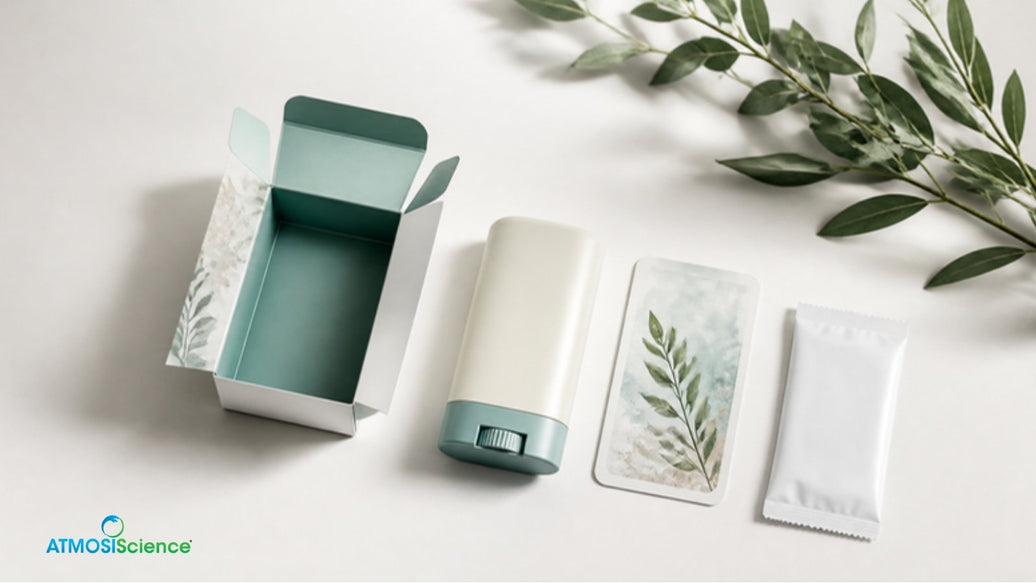
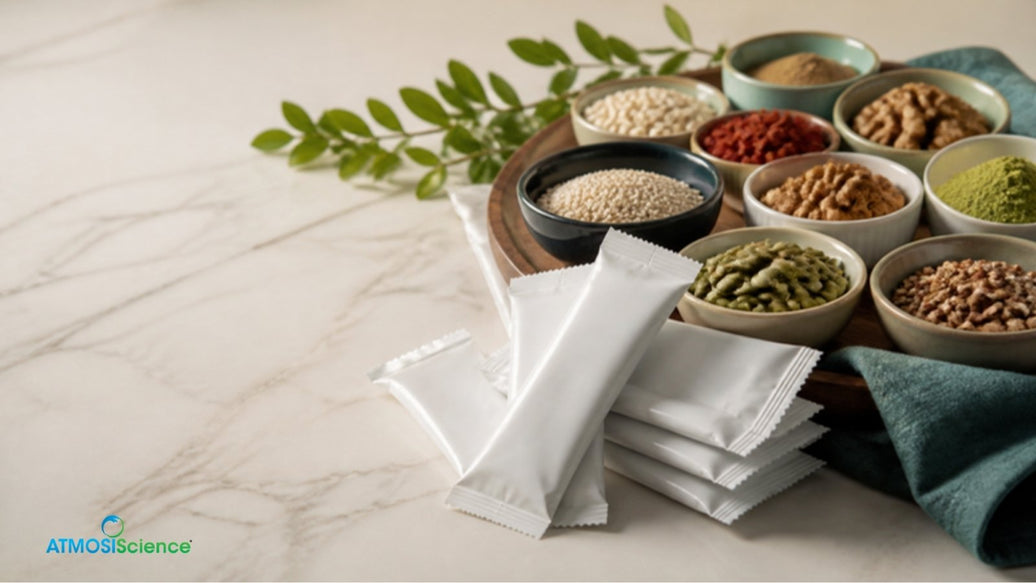
Fiber Desiccant Card at 0.7 mm for compact packaging or 1.0 mm for larger formats, die-cut to your shape; fiber sheets cut square or round; sachets, discs and integrated components; and bagged sachets from 1 to 1,000 g. Adsorption capacity and speed can be configured to the application.
Can it be printed?
Yes. Cards are die-cut to your shape and surface-printed with your logo or product data, so the desiccant looks like part of a premium pack rather than an afterthought, and a do-not-eat line can sit on the piece itself.
Can it run on an automated packing line?
Yes. From custom die-cutting and printing to automated placement, Fiber Desiccant Card is supplied ready for your line. Share your feeder or placement system early so we can match the card to it.

Shelf life, handling and the bend test
How long does fiber desiccant last?
Unopened, 12 months from the manufacturing date in its original sealed packaging. Once opened, the fiber absorbs ambient moisture, so no fixed shelf life applies. Inside your pack, its working life depends on how much moisture the pack lets in, so we size it from your pack's barrier, volume and target shelf life.
Where is the manufacturing date?
The manufacturing date is printed on the carton label, next to the shipping label.
How do I know if a Fiber Desiccant Card is still effective?
Gently bend it. A fresh card feels relatively stiff. If it has gone noticeably soft, it has absorbed moisture and should be swapped out.
How should it be handled on the line?
Keep it sealed until use. Open time is up to 2 hours at 50% RH or below and up to 1 hour above 50% RH; at 80% RH or above, stop packing. Full steps are in how to use fiber desiccant.

Who uses it, and where
Which industries use it?
Electronics and circuit boards, precision instruments and optics, medicine and health goods, bio-kits, dried and vacuum-packed foods such as sea moss and dried fruit, garments, wooden toys and furniture, plastics, cultural relics and artworks, and shipping containers.
Who uses the technology?
ATMOSIScience's patented humidity-control fiber platform is used across industries: Samsung for anti-condensation fiber, Panasonic for packaging desiccant, Shanghai Museum for conservation-grade fiber and Melissa & Doug for toy-box desiccant. The platform is backed by more than 70 patents worldwide and over 25 years of R&D.
Quality, documents and shipping
Is it suitable near food and supplements?
The Fiber Desimat product documentation describes the material as non-toxic and safe for medicine and food use, and the MSDS sets limits of ≤1,000 cfu/cm² total bacteria, ≤100 cfu/cm² fungi and no E. coli detected. Ask us for the documents that match the exact format and wrap you plan to use so your QA team can review them.
How clean is the manufacturing environment?
Cleanroom report 20200266 (2020) recorded 10 production areas at Grade D (static), with 1,432 particles of 0.5 µm or larger per cubic metre against a limit of 3,500,000.
Is it recyclable?
The bare plant-fiber sheet, as tested, scored 100 out of 100 for recyclability as paper in SGS report CQMR260700043401. Ask us about the construction of the SKU you are buying and we will tell you which evidence applies to it.
What documents come with it?
The MSDS, SGS recyclability report CQMR260700043401 and cleanroom report 20200266, plus a product specification for the format you choose.
Is it dangerous to ship?
No. The MSDS classes it as not dangerous cargo, and the material is not combustible.
Getting started
How do I get samples?
Use the form below with your pack type and product. We will recommend a format and size and send samples to test.
Related reading: the paper desiccant spec checklist and how to use fiber desiccant on the packing line.
Ask your question, or request samples
Tell us what you pack and what you want to know. A real person will answer, and we can send samples sized to your pack.
Prefer email? info@atmosiscience.com
Answers drawn from ATMOSIScience fiber desiccant product documentation and usage instructions, the fiber desiccant MSDS, SGS recyclability assessment CQMR260700043401 (17 July 2026, plant-fiber sheet as tested) and cleanroom report 20200266 (2020).