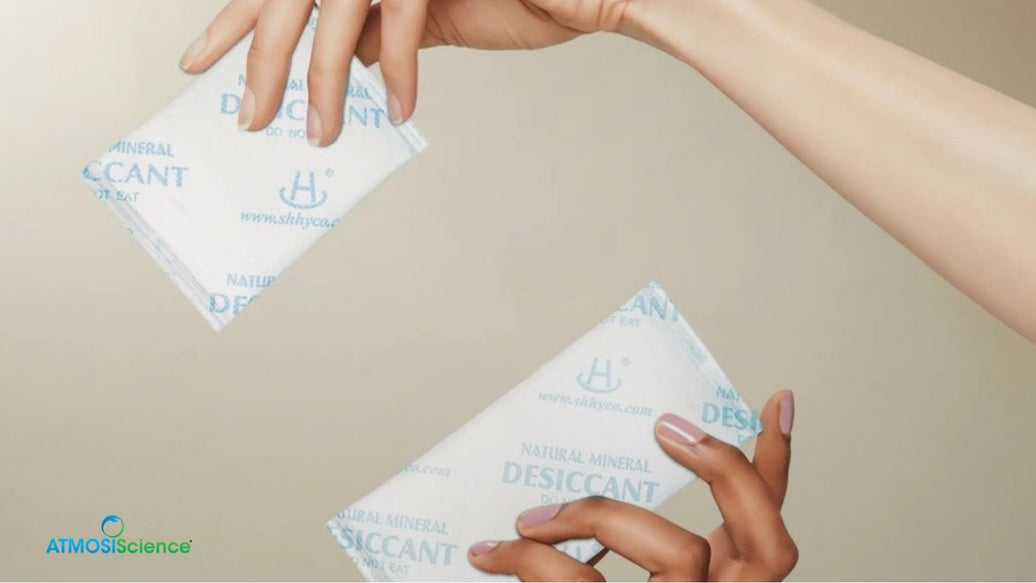
Quick answer: A paper desiccant spec should describe the layer that absorbs water, not the paper around it. Put 15 lines in your RFQ: the absorbing substrate, the active ingredient, adsorption at three humidity points with the temperature stated, the silica gel comparison and its test conditions, saturated capacity, loss on drying, format and thickness, the outer layer, dust behaviour, microbiological and heavy-metal limits, the manufacturing environment, shelf life, open-bag handling, end-of-life evidence and a quick check for when a piece is spent. ATMOSIScience plant-fiber desiccant answers every line from its product documentation: for example, at 1.0 mm a Fiber Desiccant Card absorbs three times as much moisture as silica gel at 25 °C and 90% RH, so at that condition 1.0 g of card holds as much as 3.0 g of silica gel.
"Paper desiccant" is a name, not a specification. Two quotes for the same words can describe a flat sheet that does the absorbing itself or an ordinary sachet with a paper wrapper. The only way to compare them fairly is to ask every supplier the same questions and accept answers with numbers and conditions attached. This checklist is written so you can copy it into an RFQ as it stands.
Why a paper desiccant needs its own spec
A general desiccant RFQ asks for weight and capacity. That is not enough for a paper or fiber format, because three things vary that a sachet spec never asks about: what the sheet itself is made of, how thick it is and how much it weighs per square centimetre, and whether the absorbing layer is the sheet or something sealed inside it. Get those right and the rest of the comparison falls into place.
The 15-line paper desiccant checklist
| # | Specify | Why it matters | ATMOSIScience fiber desiccant answer |
|---|---|---|---|
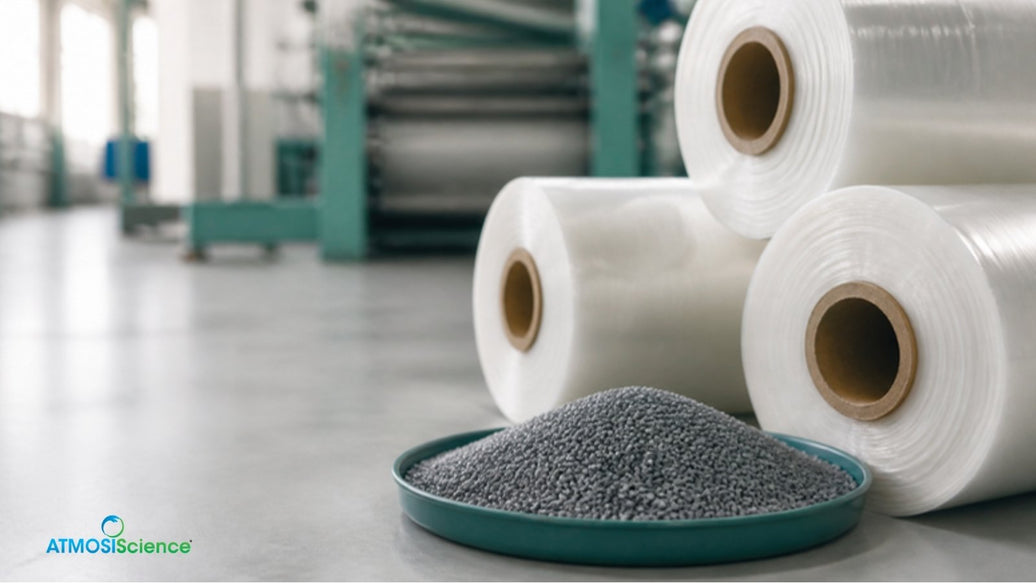
| 1 | Absorbing substrate | Tells you whether the sheet does the work or only wraps it | Natural plant fiber is the adsorption substrate |
| 2 | Active ingredient, named with CAS number | Capacity and behaviour depend on the chemistry | Calcium and sodium salts held in the fiber; CAS 10043-52-4 listed in the fiber desiccant MSDS |
| 3 | Adsorption at 3 RH points, temperature stated | Your pack lives at one humidity, not at 90% | More than 10% at 20% RH, more than 35% at 50% RH, more than 70% at 90% RH, all at 25 °C |
| 4 | Comparison with silica gel, same test conditions | A ratio without conditions cannot be checked | At 1.0 mm thickness, Fiber Desiccant Card absorbs three times as much moisture as silica gel under the same test conditions (25 °C / 90% RH): 1.0 g of card = 3.0 g of silica gel |
| 5 | Saturated capacity | Shows the headroom before the material is full | Bagged format: more than 100% of its own weight |
| 6 | Loss on drying | Shows how dry the material is when it arrives | Below 10% |
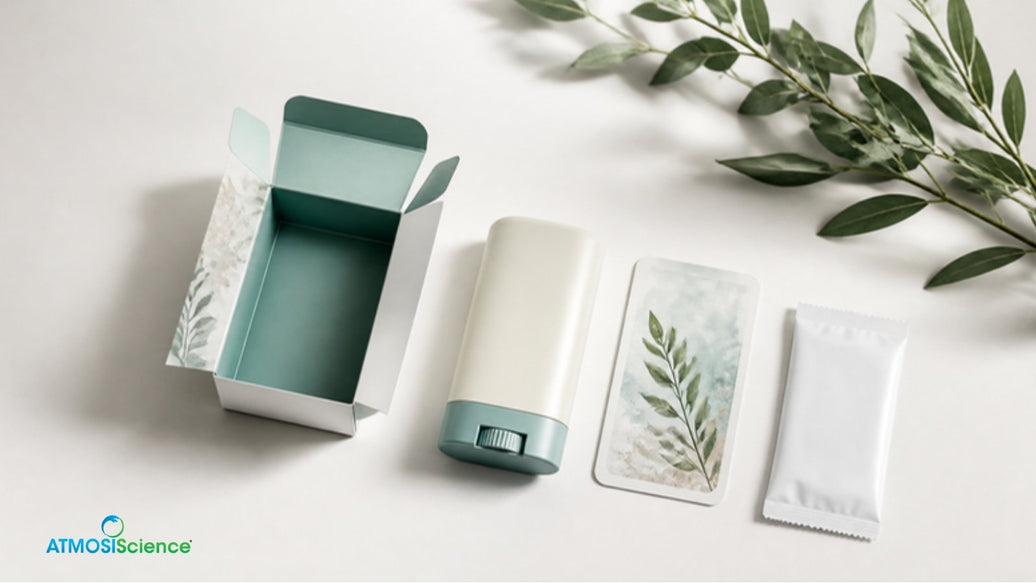
| 7 | Format and dimensions | Decides where it fits and how it is placed | Fiber Desiccant Card at 0.7 mm for compact packs or 1.0 mm for larger formats, die-cut to your shape; sheets cut square or round; bagged pouches from 1 to 1,000 g; sachets, discs or integrated components |
| 8 | Outer layer and print, per SKU | The wrap sets dust, print and pack compatibility | Breathable, dust- and leak-resistant outer layer, stated for each SKU; cards are surface-printed with your logo or product data |
| 9 | Dust and loose media | Loose beads or powder can reach the product or the line | No loose beads. The calcium chloride is bound within the fiber matrix; the product documentation describes no brine leakage or dust in use |
| 10 | Microbiological and heavy-metal limits | Matters for food, supplement and pharma packs | Total bacteria ≤1,000 cfu/cm², fungi ≤100 cfu/cm², E. coli not detected, Pb ≤1 µg/ml, As ≤1 µg/ml (MSDS) |
| 11 | Manufacturing environment | Tells QA where and how clean the material is made | Cleanroom report 20200266 (2020): 10 production areas at Grade D (static), 1,432 particles ≥0.5 µm per m³ against a 3,500,000 limit |
| 12 | Shelf life, unopened | Sets stock rotation | 12 months from the manufacturing date, unopened in the original sealed packaging; the date is printed on the carton label |
| 13 | Open-bag handling limits | Capacity is spent on room air if the bag sits open | Up to 2 hours open at 50% RH or below, up to 1 hour above 50% RH; stop at 80% RH or above |
| 14 | End-of-life evidence, with a report number | A claim without a report number is not evidence | SGS CQMR260700043401 assessed the bare plant-fiber sheet, as tested, as paper: recyclability score 100 out of 100. Ask which evidence covers your SKU's construction |
| 15 | A quick check for a spent piece | Lets the line and QA confirm a piece is still working | Gently bend it. A fresh card feels relatively stiff; one that has gone noticeably soft has absorbed moisture and should be swapped out |

How to read the answers you get back
- Every number needs a condition. "Absorbs 70%" is incomplete. "More than 70% of its own weight at 25 °C and 90% RH" can be checked, and two figures measured at different conditions cannot be ranked against each other.
- Look at the low-humidity points. A supplement bottle or a component pack sits far below 90% RH, so the 20% and 50% RH points on line 3 are the ones that size your desiccant. On our measured 25 °C curve, plant-fiber desiccant holds about twice as much as silica gel across 20 to 40% RH.
- Blank lines are answers too. If a supplier cannot fill a line, ask why before you compare price.
- Ask which documents cover which SKU. A report is tied to the sample tested. Ask the supplier to match each report to the exact format and wrap you are buying.
Copy-ready RFQ block
Paper or fiber desiccant: information required with quotation
- Absorbing substrate material
- Active ingredient(s), with CAS numbers
- Adsorption as % of own weight at 20%, 50% and 90% RH, temperature stated
- Comparison with silica gel, if claimed, with the shared test conditions
- Saturated capacity
- Loss on drying
- Format, dimensions, thickness and mass per piece
- Outer layer material and print method
- Dust and loose-media behaviour
- Microbiological and heavy-metal limits
- Manufacturing environment and report reference
- Unopened shelf life and storage conditions
- Maximum open-bag exposure time by room humidity
- End-of-life evidence with report number and the scope of the sample tested
- A simple check that shows when a piece is spent
Please give one value per line with its test condition and source document.
Add your usual commercial lines around this block: annual volume, delivery schedule, packaging per carton and how the supplier notifies you of any change. Then send the same block to every supplier you are comparing.
Sizing: the line the checklist cannot fill for you
The checklist tells you what a paper desiccant is. How much of it your pack needs depends on the pack: its volume, barrier, how often it is opened, the shelf life you want and the humidity your product tolerates. Send us those details and we will size the format with you. It is a short calculation we run from your pack's barrier, surface area and target shelf life, then confirm with samples in your own pack. For handling once it arrives, see how to use fiber desiccant on the packing line, and for quick answers, the fiber desiccant FAQ.

Frequently asked questions
What is the most important line in a paper desiccant spec?
Line 3, adsorption at three humidity points with the temperature stated. It is the number that sizes the desiccant for your pack.
Is a paper desiccant the same as a fiber desiccant?
They overlap. ATMOSIScience fiber desiccant is a plant-fiber sheet that absorbs moisture itself, and SGS assessed that sheet as paper in report CQMR260700043401. Some products sold as paper desiccant are other absorbents inside a paper wrapper, which is why line 1 of the checklist matters.
Which documents should come with a paper desiccant quote?
An MSDS, a third-party report behind any end-of-life statement, and a manufacturing environment report. ATMOSIScience supplies the fiber desiccant MSDS, SGS report CQMR260700043401 and cleanroom report 20200266.
How long does a paper desiccant keep in storage?
Fiber Desiccant Card keeps for 12 months from the manufacturing date, unopened in its original sealed packaging and stored cool and dry. Once opened, the fiber starts absorbing room moisture, so no fixed shelf life applies.
How do I know a paper desiccant is still working?
For Fiber Desiccant Card, gently bend it. A fresh card feels relatively stiff. If it has gone noticeably soft, it has absorbed moisture and should be replaced.
Can I get the checklist filled in for my pack?
Yes. Use the form below and we will return all 15 lines for the format that suits your pack, with the supporting document for each figure.
Get the 15 lines filled in for your pack
Tell us what you pack and where the desiccant has to sit. We will return the checklist completed for the format that fits, with the document behind every figure, and send samples to test.
Prefer email? info@atmosiscience.com
Figures from ATMOSIScience fiber desiccant product documentation, the fiber desiccant MSDS, SGS recyclability assessment CQMR260700043401 (17 July 2026, plant-fiber sheet as tested) and cleanroom report 20200266 (2020).