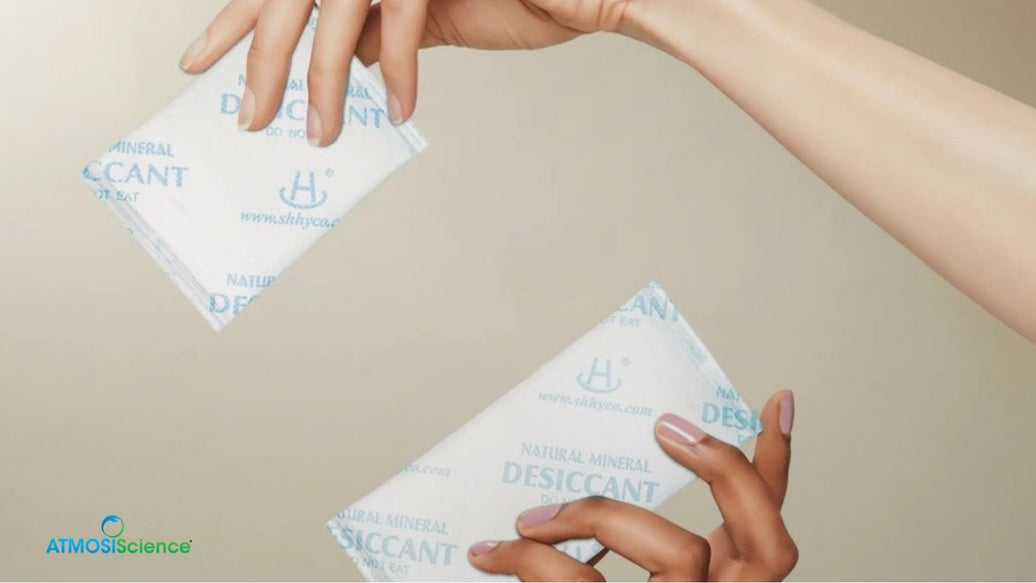
Quick answer: To use fiber desiccant, keep it in its sealed bag until the moment you pack, open the bag at the line, and place each piece in a pack that is sealed straight away. In a room at 50% RH or below, a piece can sit open to air for up to 2 hours; above 50% RH, up to 1 hour; at 80% RH or above, stop packing until the room is drier. If you pause for more than 30 minutes, reseal the remaining pieces in a sealed bag. Unopened, fiber desiccant keeps for 12 months from manufacture.
Fiber desiccant starts working the moment it meets air. That is exactly what you want inside your pack and exactly what you do not want on the packing table. Much of a desiccant's performance is decided in the minutes before the pack is sealed. This guide walks through handling from goods-in to the sealed pack, using the limits in the ATMOSIScience Fiber Desiccant Usage Instructions.
1. Pick the format that fits the job
| Format | Best for | How it is placed |
|---|---|---|
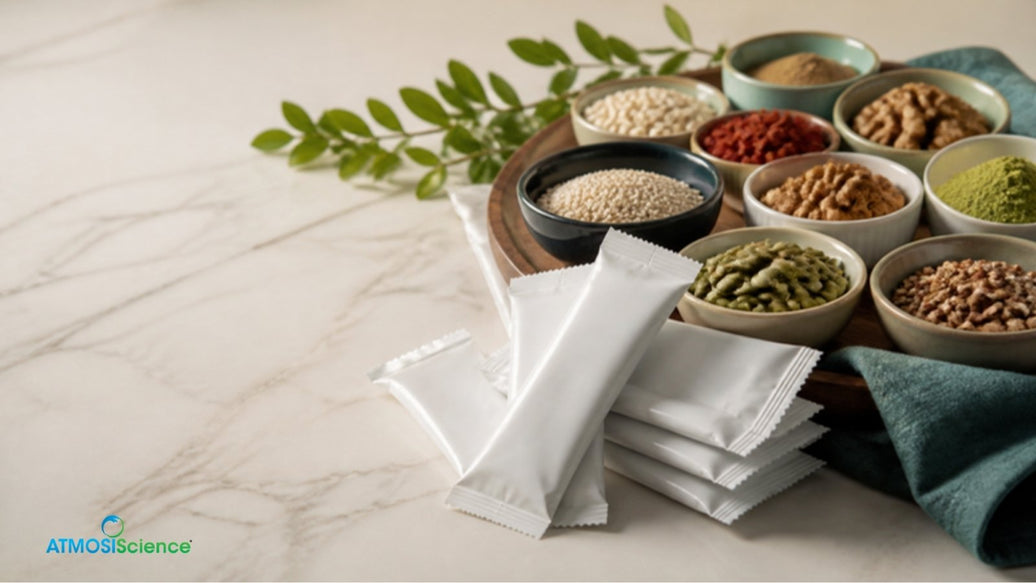
| Bagged sachet, 1 to 1,000 g | Cartons, tubs, drums, export boxes, larger enclosures | Dropped or laid in the pack |
| Fiber sheet, 0.5 or 1.0 mm, cut to shape | Bottle caps, diagnostic kits, garment tags, slim packs | Laid flat, set in a closure or fixed to a wall |
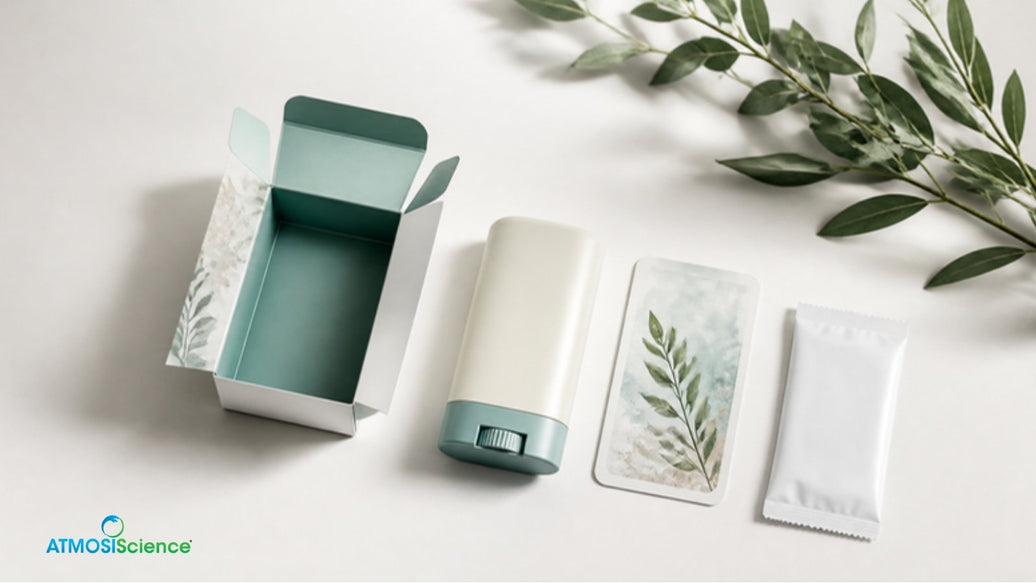
| Fiber Desiccant Card, 0.7 or 1.0 mm | Wellness, food and pharmaceutical packs, and lines that place inserts by machine | Die-cut to your shape, printed, and supplied ready for automated placement |
Not sure which one suits your pack? Tell us the pack and the line and we will recommend a format.
2. Size it before it reaches the line
A fiber desiccant holds more than 10% of its own weight at 20% RH, more than 35% at 50% RH and more than 70% at 90% RH (25 °C). The humidity your product needs decides which of those figures you size on. Pack volume, barrier and shelf life decide how much water has to be held. We size it with you from your pack details and confirm it with samples in your own pack.

3. Receive and store it sealed
- Check that every inner bag is intact on arrival. Do not use any product whose inner packaging is damaged.
- Store sealed bags in a cool, dry place, away from humid areas and heat.
- Use stock in date order. Shelf life is 12 months from the manufacturing date, unopened in the original sealed packaging. The manufacturing date is printed on the carton label, next to the shipping label.
- Keep bags closed in the warehouse. Opening a bag to count or inspect it starts using its capacity.
4. Open at the point of use, and watch the clock
Open the pack only when you are ready to feed the line. Once it is opened the fiber starts absorbing room moisture, so no fixed shelf life applies to an opened bag: use the pieces as soon as possible and put them into a relatively sealed space. How long they can sit open depends on the humidity of the packing room:

| Packing room humidity | Maximum time open to air | What to do |
|---|---|---|
| 50% RH or below | Up to 2 hours | Open one bag at a time and pack steadily |
| Between 50% and 60% RH | Use the 1-hour limit | Treat it as the more humid band to be safe |
| 60% RH or above | Up to 1 hour | Open smaller quantities, more often |
| 80% RH or above | Stop | Pause packing until the room is drier |
If you do not know the room humidity, put a hygrometer at the packing station and read it at the start of each shift.
5. Place it where it works
On automated lines, Fiber Desiccant Cards feed from a stack and are placed by machine, so the open-air clock runs from the moment the magazine is loaded. Load only what the line will use within the time limit for your room.

- Inside the sealed space, never outside the barrier. A desiccant in an outer carton protects the carton, not the pouch inside it.
- Clear of the seal. Keep sachets and sheets away from heat-seal and induction-seal areas so the seal closes cleanly.
- Flat formats against a wall or in the closure, where they take no product space and stay put when the pack is opened and closed.
- At least one correctly sized piece in every sealed space. Several small packs inside one carton each need their own desiccant if each is sealed.
More placement detail by pack type is in where to place a desiccant in a package.
6. Check a piece: the bend test
For Fiber Desiccant Card, you do not need a lab to see whether a card is still working. Gently bend it. A fresh card feels relatively stiff. If it has gone noticeably soft, it has absorbed moisture and should be swapped out. It is a useful check at the start of a shift on any opened bag, and on returned or held stock before it goes back to the line.

7. Seal the pack promptly
The minutes between placing the desiccant and sealing the pack are the minutes it spends drying the room instead of your product. Place it as the last step before sealing wherever the line allows.
8. Reseal what you do not use
If packing stops or pauses for more than 30 minutes, gather the opened but unused pieces and put them in a sealed bag straight away. Label the bag with the time it was opened so the next shift knows how much exposure it has already had.
9. Tell the end customer what it is
Keep it out of reach of children and make sure it is not eaten. Cards are surface-printed, so a do-not-eat line can sit on the piece itself, in more than one language if you sell across markets.
A one-page line rule you can post
- Keep inner bags sealed until the packing step.
- Check room humidity at the start of each shift.
- At 50% RH or below: open time up to 2 hours. Above 50% RH: up to 1 hour. At 80% RH or above: stop.
- Place the desiccant inside the sealed space, clear of the seal, and seal promptly.
- Paused more than 30 minutes? Reseal the remaining pieces and write the open time on the bag.
- Never use pieces from a damaged inner bag.
- Unsure about an opened card? Bend it. Noticeably soft means swap it out.
Frequently asked questions
How do you use fiber desiccant?
Keep it sealed until you pack, open the bag at the line, place each piece inside the sealed space of your pack and seal promptly. Follow the open-air time limits for your room humidity.
How long can fiber desiccant be left open?
Up to 2 hours in a room at 50% RH or below, and up to 1 hour above that. At 80% RH or above, stop packing until the room is drier.
What is the shelf life of fiber desiccant?
12 months from the manufacturing date, unopened in its original sealed packaging and stored cool and dry. The date is on the carton label. Once opened, no fixed shelf life applies.
How do I know if a fiber desiccant card is still effective?
Gently bend it. A fresh card feels relatively stiff. If it has gone noticeably soft, it has absorbed moisture and should be replaced.
Where should fiber desiccant go in a package?
Inside the sealed barrier, clear of the seal area. Flat sheets work well against a wall or inside a closure.
What should I do with opened pieces I did not use?
If packing pauses for more than 30 minutes, put them back into a sealed bag at once and note when the bag was opened.
Get a handling SOP for your line
Tell us your format, packing room conditions and line speed. We will send a one-page handling rule written for your line, and samples if you want to trial it.
Prefer email? info@atmosiscience.com
Handling limits and shelf life from the ATMOSIScience Fiber Desiccant Usage Instructions. Adsorption figures from ATMOSIScience fiber desiccant product documentation, 25 °C minimum specification.