Quick answer: The best fiber desiccant for a pack is the one whose capacity has been measured at your conditions, not the one with the largest number on the listing. Before comparing, every claim needs five things: temperature, relative humidity, duration or equilibrium, the basis (per gram of desiccant or per square centimetre of sheet) and a named test method or report. A claim without its humidity cannot be compared at all. For reference, ATMOSIScience publishes its fiber card at three times silica gel's uptake at 25 °C and 90% RH, and about two times across 20 to 40% RH, from a measured curve.
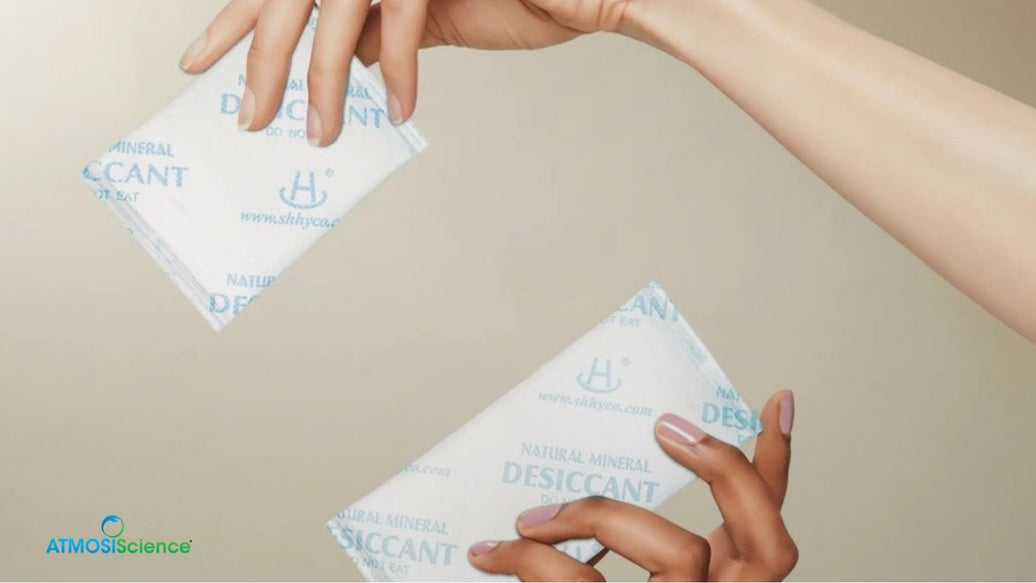
Fiber desiccant sheets and packs are now sold by several suppliers in the US, often on marketplaces, and the listings look similar: natural plant fiber, calcium chloride, "absorbs more than silica gel". The numbers underneath them are not similar at all, because each one is measured differently. This guide shows how to put them on one footing.
The four claim formats you will meet
| Claim format seen on listings | What is missing | What to ask |
|---|---|---|
| "Absorbs over 50% of its weight at 25 °C, 90% RH" | Duration and method. Is that at 24 hours, 48 hours or equilibrium? | The uptake curve over time, and the figure at your RH |
| "Absorbs 50% in 48 hours, 3x silica gel" | Whether the silica sample was tested side by side, at the same condition | Both curves from the same test |
| "10 cm² equals 1 g of silica gel" | Sheet thickness, humidity and duration behind the equivalence | Mass per cm² and the condition of the equivalence |
| A certification or approval named with no document | The regulation or standard, the report number, the scope | A copy of the report, with the sample description and date |
None of these formats is wrong in itself. Each one is incomplete, and two incomplete numbers cannot be ranked against each other. That is the whole problem.
Why humidity changes the answer
Fiber and silica gel respond to humidity differently. Silica gel's uptake flattens out above about 60% RH; a calcium chloride fiber keeps climbing. So the ratio between them depends on where you measure.

On this measured curve, fiber takes up about 1.8 times as much as silica gel at 20% RH, about 2.0 times at 40% RH, 3.1 times at 90% RH and 3.4 times at 100% RH. A supplier quoting only the 90% figure is not lying, but if your product is stored dry, the figure that applies to you is the 20 to 40% band. Read more in capacity vs equilibrium adsorption by RH band.
A five-line checklist for any fiber desiccant claim
- Temperature. Usually 25 °C. If it is missing, the number is not comparable.
- Relative humidity. Ask for at least three points, for example 20, 50 and 90% RH.
- Duration or equilibrium. A 48-hour figure and an equilibrium figure answer different questions.
- Basis. Per gram of desiccant, per gram of finished sachet including the wrap, or per square centimetre of sheet. Convert them all to the same basis before comparing.
- Evidence. A test method and a report you can read, with the sample described.
The same logic applies to any desiccant, not only fiber. Our longer guide to comparing desiccant spec sheets works through silica, clay and molecular sieve too.
What ATMOSIScience publishes, against that checklist
| Format | Figure | Condition and basis |
|---|---|---|
| Bagged fiber desiccant | More than 10%, 35% and 70% of own weight | 20%, 50% and 90% RH at 25 °C; minimum specification; saturated uptake above 100%; LOD below 10% |
| Fiber Desiccant Card, 1.0 mm | Three times silica gel's uptake | 25 °C / 90% RH, same test conditions for both; about two times at 20 to 40% RH |
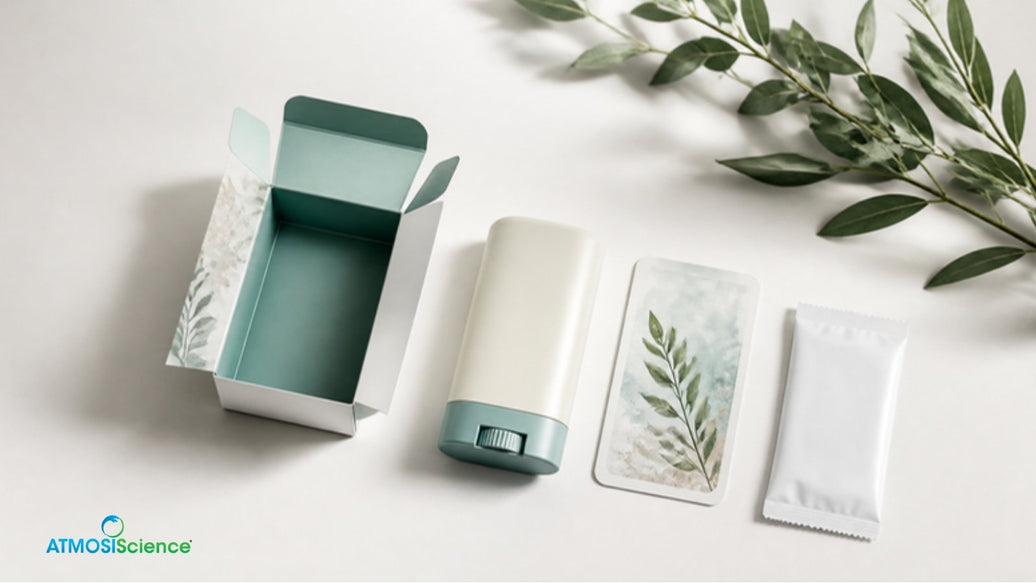
| Filmed fiber sheet, FF-6 | 30 x 20 x 1 mm, about 0.35 g, maximum uptake 0.3 g | Listed as corresponding to 1 g of silica gel in the product specification (reference values) |
The sheet sizes and their silica equivalents are in the Fiber Card spec guide and silica gel equivalency in grams. For recyclability, the fiber sheet has a third-party document with a number: SGS assessment CQMR260700043401 (17 July 2026) evaluated the bare plant-fiber sheet as paper and scored it 100 out of 100. That score applies to the sheet as tested, not to sachets assembled with other wraps.

Run your own side-by-side test
The most reliable comparison is one you run. Seal equal masses (or equal areas, if you are buying sheets) of each candidate into identical jars or pouches with a humidity logger, hold them at your storage condition, and read the humidity curve over the time your product sits on a shelf. Include a jar with no desiccant as a control. A worst-case version of this test is described in sample evaluation under worst-case conditions.
Frequently asked questions
What is the best fiber desiccant?
The one that holds your pack at its target humidity for its shelf life, at the lowest cost per pack, with documents you can verify. That is a measurement, not a brand.
Are all fiber desiccants the same material?
Most combine plant fiber with calcium chloride, but fiber type, salt loading, thickness and wrap differ. Those differences show up in the uptake curve and in dust and leak behaviour.
Is a per-cm² claim better than a per-gram claim?
Neither is better. For sheets, per cm² is practical for design; per gram is better for comparing materials. Ask for both, with the sheet's mass per cm².
Why does the multiple over silica gel change?
Because silica gel levels off at higher humidity while calcium chloride fiber keeps taking up water. The multiple is about 2 in dry air and above 3 near saturation.
Get our curve at your conditions
Tell ATMOSIScience the humidity and temperature your pack sees. We will send the matching adsorption data and samples so you can test against any other fiber desiccant side by side.
Prefer email? info@atmosiscience.com