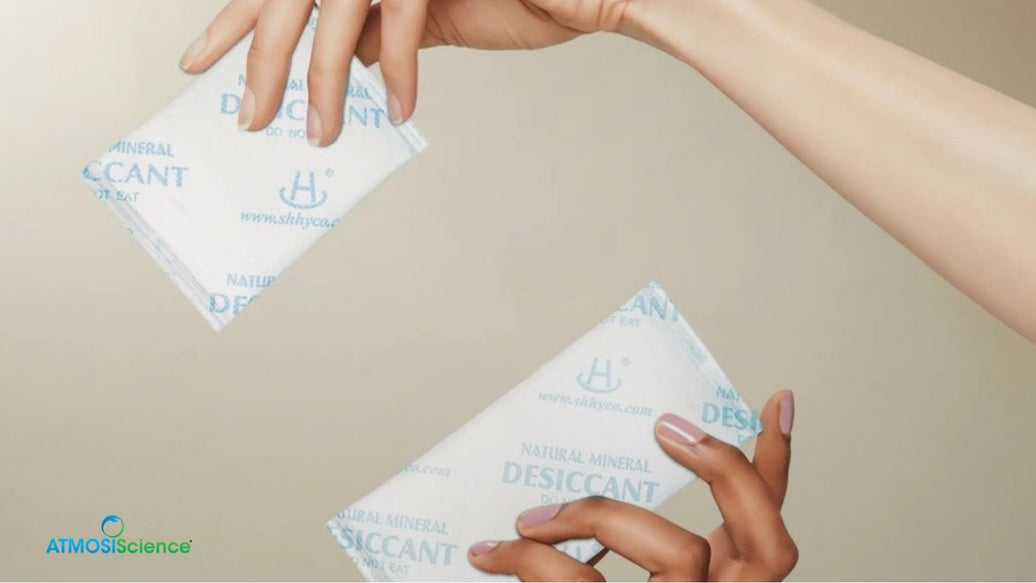
Quick answer: Paper desiccant is a format: a flat desiccant that looks and handles like paper or card. Fiber desiccant is a material: a plant-fiber sheet that does the absorbing itself. ATMOSIScience fiber desiccant is both, a paper-like plant-fiber sheet holding calcium chloride in its fiber matrix, with no silica gel. Some products sold as paper desiccant use a paper or cellulose carrier with silica gel or another absorbent. To compare them, ask what the absorbing layer is and for capacity at several humidity points. At 1.0 mm thickness, Fiber Desiccant Card absorbs three times as much moisture as silica gel under the same test conditions (25 °C / 90% RH).
Search "paper desiccant" and "fiber desiccant" and you will see many of the same flat white sheets. The two terms overlap, which is why spec sheets, quotes and supplier emails often use them as if they meant the same thing. They do not quite, and the difference changes how you compare quotes.
Two words, two questions
| Term | What it describes | The question it answers |
|---|---|---|
| Paper desiccant | A flat format that looks and handles like paper or card | What shape is it, and will it fit my pack? |
| Fiber desiccant | A material whose plant-fiber sheet does the absorbing | What actually holds the water? |
A buyer needs both answers. The format decides where the desiccant goes. The material decides how much water it holds, at which humidity, and how it behaves in the pack.
What is inside a paper desiccant?
Products sold as paper desiccant are built in different ways. Some pair a paper or cellulose carrier with silica gel or another absorbent. ATMOSIScience fiber desiccant is built differently: natural plant fiber is the absorbing substrate, and calcium chloride is held within the fiber matrix. There is no silica gel in it.
Two mechanisms work together. Porous lignocellulose in the plant fiber draws moisture into micro-channels by capillary action, and calcium chloride binds water within the fiber. The product sheet describes no brine leakage, dust or corrosion, and the outer layer is breathable and dust- and leak-resistant. Cards can be surface-printed.

How ATMOSIScience fiber desiccant performs
- Minimum adsorption: more than 10% of its own weight at 20% RH, and more than 35% at 50% RH and more than 70% at 90% RH at 25 °C.
- Against silica gel at high humidity: At 1.0 mm thickness, Fiber Desiccant Card absorbs three times as much moisture as silica gel under the same test conditions (25 °C / 90% RH).
- Against silica gel in dry storage: Across 20 to 40% RH on our measured 25 °C curve, plant-fiber desiccant holds about twice as much as silica gel.
- Loss on drying: below 10% as supplied.
- Saturated capacity: the bagged format can exceed 100% of its own weight.

The formats it comes in
| Format | Thickness or size | Typical use |
|---|---|---|
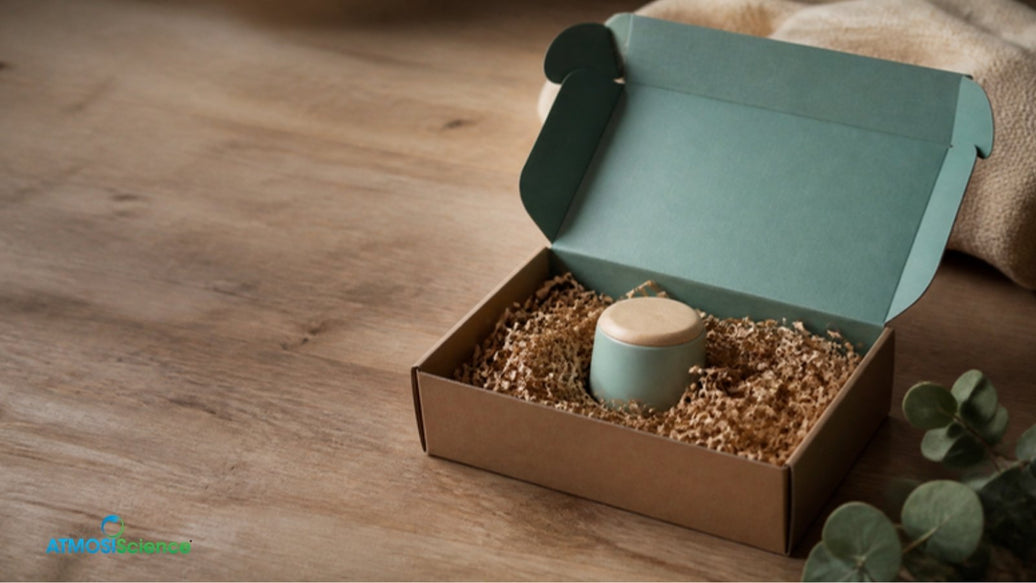
| Fiber Desiccant Card | 0.7 mm or 1.0 mm, die-cut to shape | Jars, pouches, bottle caps, kits and printed brand inserts |
| Fiber sheet | 0.5 mm or 1.0 mm, cut square or round | Cap cushions, garment tags, flat inserts |
| Bagged sachet | 1 to 1,000 g, about 2.5 mm substrate | Cartons, cases, drums and larger enclosures |
Five questions to ask any paper desiccant supplier
- What is the absorbing layer? A plant-fiber sheet, silica gel on a carrier, or something else.
- What is the capacity at 20%, 50% and 90% RH, with the temperature stated?
- If you compare it with silica gel, under which test conditions?
- How long does it keep unopened, and where is the manufacturing date printed?
- How long can it sit open on the packing line before it is used?
For the full list, use the 15-line paper desiccant spec checklist. For a side-by-side with pouches, read fiber desiccant vs silica gel packets.
Where a plant-fiber paper desiccant fits best
- Supplement powders in jars and stand-up pouches, with a flat card in the headspace or under the lid; your QA team decides whether it may touch the product
- Branded packaging, where the card is printed with a logo and a do-not-eat line
- Packing lines that place desiccant by machine: cards are supplied ready for automated placement
- Electronics, optics and instrument packs that need a thin insert
- Garments, footwear and bags, as a tag or flat insert
- Cartons and larger spaces, with the bagged format

Built on a proven fiber platform
ATMOSIScience's patented humidity-control fiber platform is used by Panasonic for packaging desiccant, by Samsung for anti-condensation fiber, by Shanghai Museum for conservation-grade fiber and by Melissa & Doug for toy-box desiccant, backed by more than 70 patents worldwide.
Frequently asked questions
Is paper desiccant the same as fiber desiccant?
Not always. Paper desiccant describes a flat format; fiber desiccant describes a plant-fiber material that does the absorbing. ATMOSIScience fiber desiccant is both.
Does ATMOSIScience paper desiccant contain silica gel?
No. The absorbing layer is natural plant fiber with calcium chloride held in the fiber matrix.
How much moisture does it absorb?
More than 10% of its own weight at 20% RH, and more than 35% at 50% RH and more than 70% at 90% RH at 25 °C.
How does it compare with silica gel?
At 1.0 mm thickness, Fiber Desiccant Card absorbs three times as much moisture as silica gel under the same test conditions (25 °C / 90% RH). Across 20 to 40% RH on our measured 25 °C curve, plant-fiber desiccant holds about twice as much as silica gel.
Can I get samples of both formats?
Yes. Tell us the pack and we will send cards, sheets or bagged sachets to test in it.
Compare it in your own pack
Tell us what you pack and where the desiccant has to sit. We will suggest a format and send samples so you can compare it with what you use today.
Prefer email? info@atmosiscience.com
Figures from ATMOSIScience fiber desiccant product documentation and usage instructions and the Fiber Desiccant Card product sheet.