Quick answer: A silica gel packet is a pouch of beads; a fiber desiccant is a plant-fiber sheet that does the absorbing itself. At 1.0 mm thickness, Fiber Desiccant Card absorbs three times as much moisture as silica gel under the same test conditions (25 °C / 90% RH), so under those conditions 1.0 g of card absorbs as much moisture as 3.0 g of silica gel, and on our measured 25 °C curve, plant-fiber desiccant holds about twice as much as silica gel across the drier 20 to 40% RH band. Fiber desiccant also comes flat at 0.7 or 1.0 mm, die-cut to shape, surface-printed and ready for automated placement, with no loose beads to escape.
Most packaging teams meet fiber desiccant when they are already using silica gel packets and something about them has started to bother them: the pouch will not fit, it rolls around in the product, it jams the feeder, or the brand team wants something better looking in the pack. This page puts the two side by side on the points that decide a switch, with the test condition next to every number.
What each one is
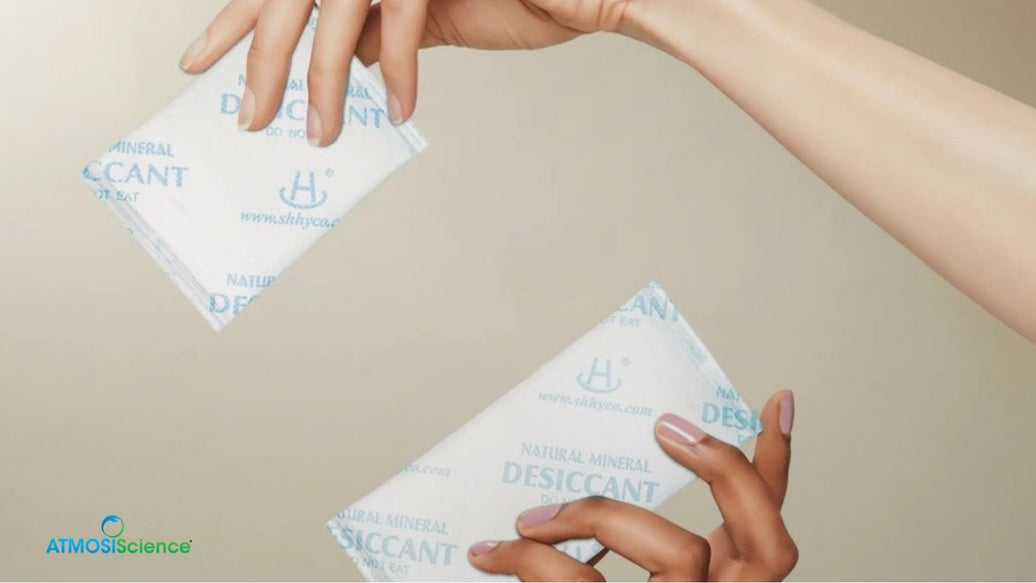
Silica gel packets hold beads or granules of silica gel inside a breathable pouch. Silica gel adsorbs water vapour onto its internal surface, and it is the default desiccant in a huge range of products.
Fiber desiccant uses natural plant fiber as the adsorption substrate, with calcium chloride held in the fiber matrix. Two mechanisms work together: porous lignocellulose draws moisture into micro-channels by capillary action, and the calcium chloride binds water within the fiber. It comes as Fiber Desiccant Cards, fiber sheets and bagged sachets.
Side by side
| Point | Silica gel packet | ATMOSIScience fiber desiccant |
|---|---|---|
| Absorbing material | Silica gel beads or granules | Plant-fiber sheet carrying calcium chloride |
| Capacity at 25 °C, 90% RH | About 30% of its own weight (common silica gel) | More than 70% of its own weight (fiber sheet minimum specification) |
| Card comparison, same test | Reference | At 1.0 mm, three times silica gel (25 °C / 90% RH): 1.0 g card = 3.0 g silica gel |
| Dry band, 20 to 40% RH | Reference | About twice silica gel on our measured 25 °C curve |
| Format | Pillow pouch | Flat card at 0.7 or 1.0 mm, sheet at 0.5 or 1.0 mm, or bagged sachet from 1 to 1,000 g |
| If the outer layer is damaged | Loose beads can escape | No loose beads: the absorbing layer is the sheet itself |
| Printed on the pouch | Card surface-printed with your logo or product data | |
| Line placement | Pouch dispensers | Cards die-cut to your shape and supplied ready for automated placement |
| Unopened shelf life | Per supplier | 12 months from the manufacturing date in the original sealed packaging |
| Spent check | Indicator beads or a separate card, if fitted | Bend the card: noticeably soft means it has absorbed moisture |

Where the fiber card earns its place
- Thin spaces. A 0.7 mm card fits under a cap, against a pouch wall or in a kit cavity where a pillow pouch will not.
- Products you scoop or pour. A flat card stays where you put it and has no beads to end up in the scoop.
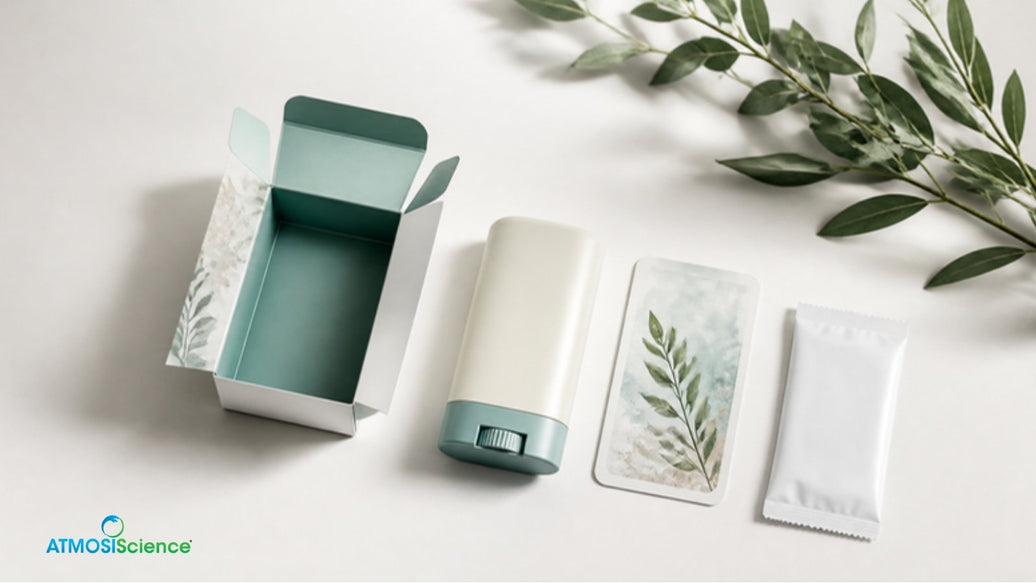
- Premium packs. A die-cut, printed card looks like part of the pack rather than an afterthought.
- Automated lines. A flat card is supplied ready for automated placement.
- Less mass for the same job at high humidity. At 1.0 mm thickness, 1.0 g of Fiber Desiccant Card absorbs as much moisture as 3.0 g of silica gel under the same test conditions (25 °C / 90% RH).

Switching in four steps
- Pick the format. Card for jars, bottles, tubs and machine placement; sheet for caps, kits and tags; bagged sachet for cartons and larger enclosures.
- Size it for your pack. Do not swap gram for gram. Size on the humidity your product needs, using the capacity at that humidity. We do this with you from your pack details.
- Test it in your own pack. Samples cut to your format, run through your own storage or shipping conditions.
- Trial it on the line. Handling rules are in how to use fiber desiccant on the packing line.
If you are writing a quote request, the paper desiccant spec checklist lists the 15 lines to ask every supplier, and the fiber desiccant FAQ answers the common questions in one place.
Frequently asked questions
Is fiber desiccant better than silica gel?
It depends on the job. At 1.0 mm thickness, Fiber Desiccant Card absorbs three times as much moisture as silica gel under the same test conditions (25 °C / 90% RH), and on our measured 25 °C curve, plant-fiber desiccant holds about twice as much as silica gel across the drier 20 to 40% RH band. It also adds flat formats, print and machine placement. For cartons and larger enclosures, bagged fiber desiccant from 1 to 1,000 g covers the job; for thin, premium or machine-fed packs, the card is the stronger fit.
Can I replace a silica gel packet gram for gram?
No. Size on the humidity your product needs. At 1.0 mm thickness, 1.0 g of Fiber Desiccant Card absorbs as much moisture as 3.0 g of silica gel under the same test conditions (25 °C / 90% RH). Across 20 to 40% RH on our measured 25 °C curve, plant-fiber desiccant holds about twice as much as silica gel, so the mass you need depends on your target humidity.
Does fiber desiccant shed dust?
There are no loose beads, and the product documentation describes no brine leakage or dust in use.
How do I know when a fiber card is spent?
Gently bend it. A fresh card feels relatively stiff; one that has gone noticeably soft has absorbed moisture and should be replaced.
Can I get samples to compare in my own pack?
Yes. Tell us your pack and current packet size in the form below and we will send cards sized for a side-by-side test.
Compare in your own pack
Tell us what you pack and which silica gel packet you use today. We will size a fiber card for the same job and send samples so you can test them side by side.
Prefer email? info@atmosiscience.com
Figures from ATMOSIScience fiber desiccant product documentation and usage instructions, the Fiber Desiccant Card product sheet and the fiber desiccant MSDS.