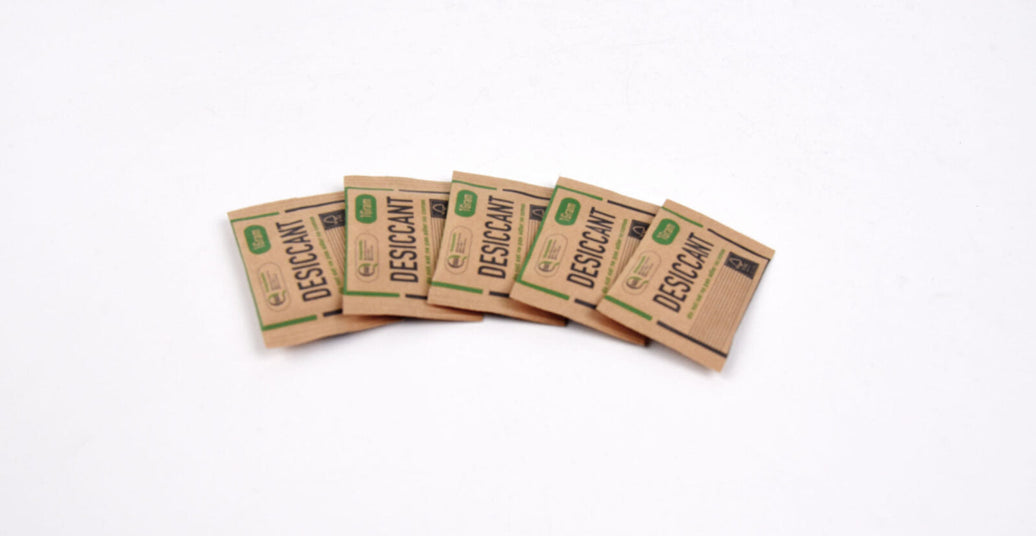
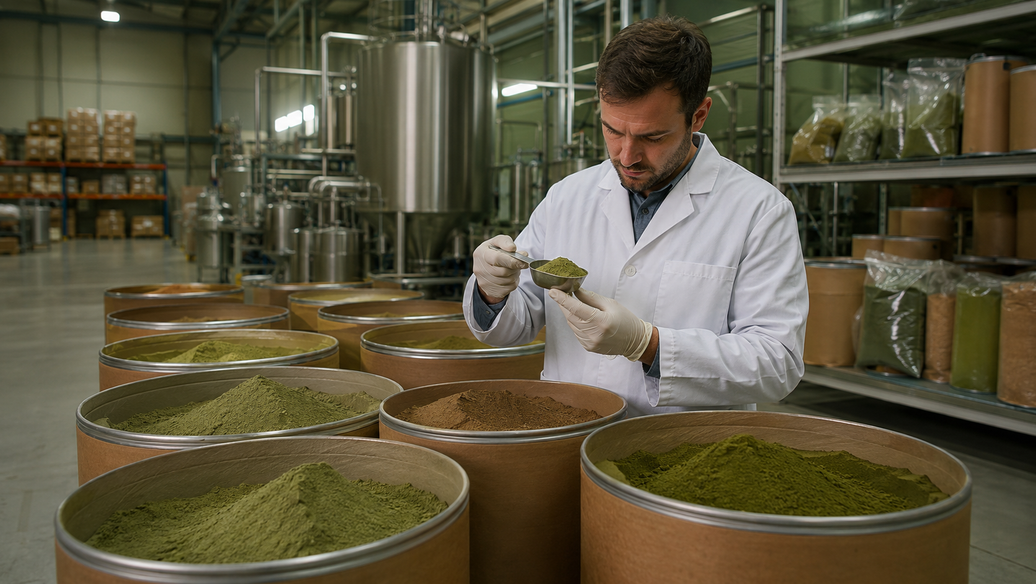
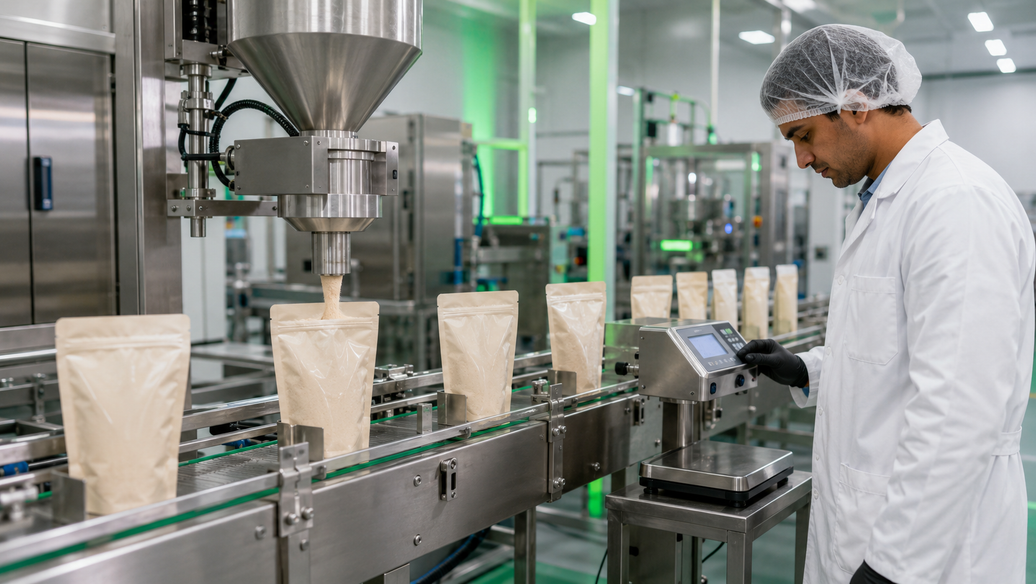
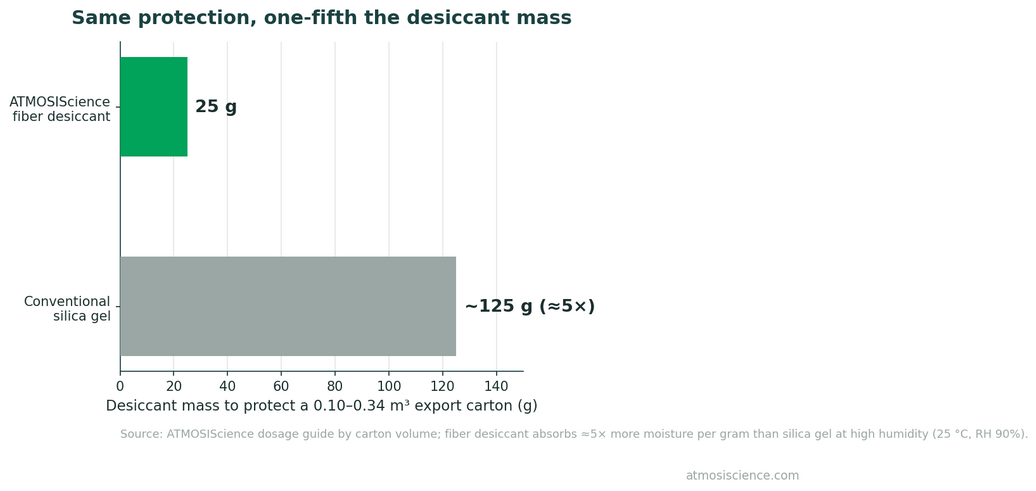
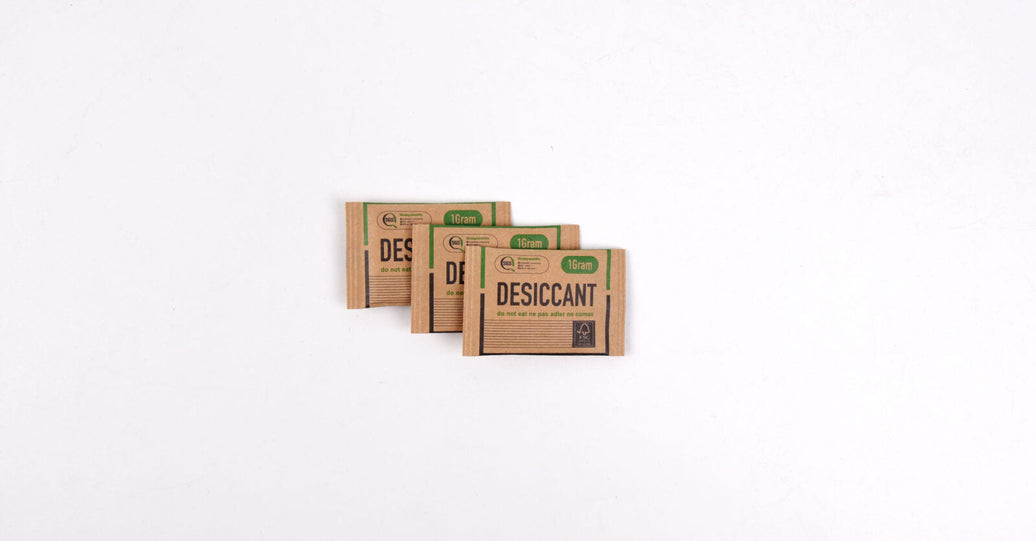
Quick answer: The working rule taught in electronics dry-pack training is that maximum desiccant exposure time depends on environmental humidity, and that at RH below 60%, exposure should be less than half an hour. The half hour is not the rule; the condition is. A desiccant sitting open is adsorbing from your room, and the ceiling it is climbing toward is set by your room’s RH — above 35% of its own weight at RH 50%, above 70% at RH 90%. Every gram it takes from your filling room is a gram it cannot take from your product.
Ask a co-packer how long an opened bag of desiccant sits on the line before the last sachet goes in, and you will usually get one of two answers. Either a confident number nobody can point to a document for, or a puzzled look because nobody has ever asked.
It is worth asking. A desiccant is the only component on your line that starts consuming its own value the moment it is exposed — quietly, invisibly, and at a rate set by a variable most powder plants do not measure.
Where the number comes from
The half-hour figure appears in desiccant training material for electronics assembly, framed as a question and answer: how long is the maximum exposure time for desiccant? Answer: depends on environmental humidity; RH < 60%, less than 0.5 hour.
Two features of that answer matter more than the number.
First, the primary answer is “it depends on humidity”. The half hour is an example condition, not a universal limit.
Second, it is bounded below 60% RH. Above 60%, the guidance does not extend the window — it stops offering one. Most food and supplement filling rooms in summer, in most of the United States, sit above 60% unless they are actively conditioned.
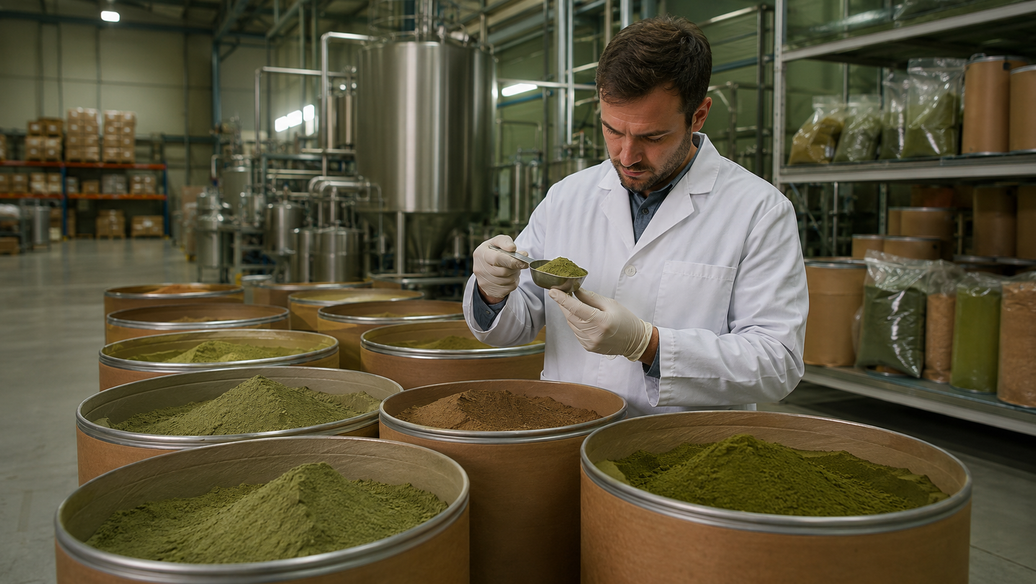
The same discipline appears on the manufacturing side of the product: two of the six in-process controls at the factory are control the relative humidity in the workshop and control the exposure time during packing. It is the same rule applied at the other end of the supply chain, and it is documented in how a fiber desiccant is made. The safety data sheet says the same thing in one line: avoid wet or high-humidity places, and do not leave packed materials in an open state.
What is physically happening on your bench
A desiccant does not adsorb until it is “full”. It adsorbs until it reaches equilibrium with the humidity around it. Change the humidity and you change the destination.
For this material the published technical criteria give the ceiling at three points:
| Ambient RH | Equilibrium uptake (% of own weight) | On a 5 g sachet, that is |
|---|---|---|
| 20% | > 10% | > 0.5 g of water |
| 50% | > 35% | > 1.75 g of water |
| 90% | > 70% | > 3.5 g of water |
Bagged fiber desiccant technical criteria. Loss on drying < 10%. Equilibrium values, not rates.
Read the middle row as a filling room. A sachet left indefinitely in a 50% RH room will eventually hold more than a third of its own weight in water — water taken from your building, before it ever sees your product.
Now look at the top row. A room held at 20% would let it reach only about 10%. The reason a conditioned filling room is worth its running cost is not only the comfort of the operators or the flow of the powder; it is that a dry room raises the effective capacity of every desiccant you insert.
Converting physics into a time budget for your line
The table gives the ceiling, not the climb. Getting from one to the other takes four steps, and none of them requires guessing.
1. Measure your room, over a shift. Not the weather app, not the plaque on the wall from 2019. A logged RH trace across a working shift at the point where the sachets sit. Filling rooms swing with door openings, steam, washdown and shift changes. The humidity mapping protocol covers how.
2. Decide your acceptable loss. How much of the desiccant’s capacity are you willing to spend on the room? Most sizing calculations assume the desiccant enters the pack essentially fresh. If yours has no margin written into it, the honest answer is a low single-digit percentage. Check what your sizing calculation actually assumed.
3. Get the uptake-versus-time curve at your room RH. This is the piece only the supplier can give you, and it is a reasonable thing to ask for. Equilibrium figures are on the datasheet; kinetics at a stated RH usually are not.
4. Read the minutes off the curve. Your acceptable loss, on that curve, at your room’s RH, is your exposure limit. Write it into the SOP as a number, not as “promptly”.
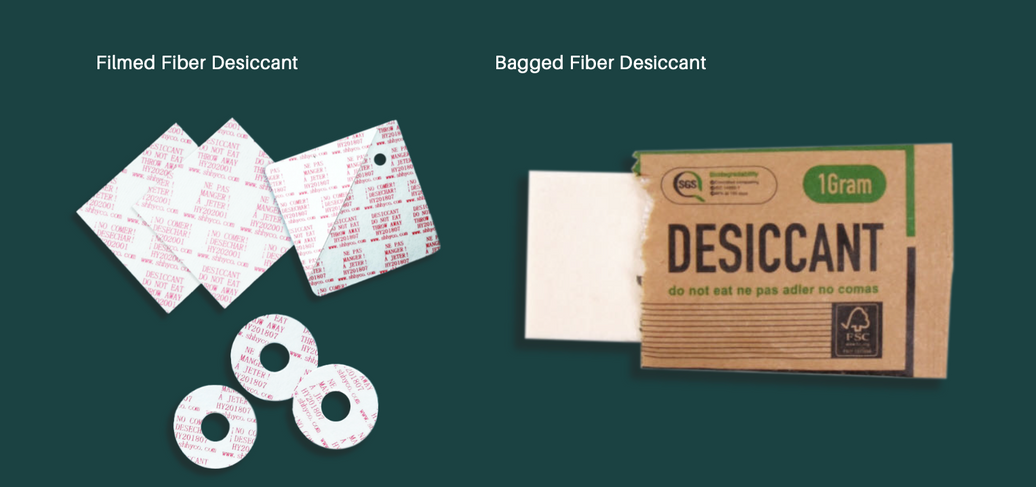
One caveat that saves arguments later: in a wrapped format, the rate is governed largely by the wrapper’s air permeability rather than by the substrate. Two sachets with identical fill and different wrappers have different exposure budgets. Ask for the curve on the format you actually buy — the reasons are in how the wrapper decides performance.
The master bag clock starts at sealing, not at receipt
A second timer runs alongside the first, and it is the one most people misread.
The standard dry-pack convention is a shelf life of a minimum of twelve months from the bag seal date — the date the manufacturer sealed the master bag, not the date it landed on your dock. A shipment that spent three months at sea and two in a distributor’s warehouse arrives with five months already gone.
So: require the seal date on the carton, not just the production month, and manage stock against it. If your ordering pattern means desiccant sits in your own warehouse for long periods, the trade-off between order quantity and freshness is a real one — see MOQ and lead times and does desiccant expire.
Verify, don’t assume
Two cheap checks close the loop.
Loss on drying on receipt. The specification is ≤ 10%. A lot arriving near that limit has spent part of its capacity somewhere between the factory and you, and LOD is the only incoming test that catches it. Full detail in loss on drying.
A humidity indicator card in the pack. The conventional way to know whether a desiccant is still fresh is to read an HIC inside the packing. It tells you what the headspace actually did, rather than what your model said it would do. Which RH points to specify, and how to write them into an SOP, is covered in humidity indicator cards.
The quiet budget-eater: everything else in the pack
Dry-pack guidance carries a warning that transfers directly to food and supplement packing, and it catches people out constantly: no moisture-absorbing material should be placed in the dry bag without being dried first. In electronics that means trays, tubes, reels and foam end caps.
In a supplement pack it means the scoop, the cotton or fibre coil, the paper insert, the label liner, the tub itself if it has been sitting in a humid store. Every one of those arrives at its own equilibrium with the room, and every one of them unloads into the headspace after sealing.
If your desiccant is sized only against the barrier film’s moisture ingress, and you also enclose a room-conditioned scoop and a paper leaflet, your calculation is short before the pack leaves the line. This is one of the more common entries in the seven failure modes.
The SOP, written out
Desiccant handling at the fill point
1. Record room RH at the fill point at start of shift and at each break. If RH exceeds [your limit], stop and escalate.
2. Open only one master bag at a time. Record the open time on the bag.
3. Decant no more than [X] minutes’ consumption into the hopper.
4. Reseal the master bag immediately after decanting.
5. Any sachets exposed longer than [your exposure limit] are quarantined, not used.
6. Any partially used master bag left at end of shift is resealed and identified; it is not returned to general stock.
7. Verify the seal date on receipt and rotate stock by seal date, not by receipt date.
Two brackets to fill in, one measurement to take, and a rule that most lines currently run without. On automated inserters the same limits apply to the magazine as to the hopper — see automated desiccant insertion.
Frequently asked questions
Is half an hour a hard limit for every desiccant?
No. It is a working figure quoted for conditions below 60% RH, in a context where the pack must reach a very low interior humidity. Your limit depends on your room, your format and how much capacity margin your sizing left you. The half hour is a good default to hold yourself to until you have measured your own.
Our room runs at 65–70% RH in summer. What then?
Two options, and they are not equivalent. Shorten the exposure window sharply and verify with LOD and an indicator card, or condition the room. Conditioning has a second payoff: it improves fill-weight stability and powder flow at the same time — see how in-plant humidity taxes powder packing lines.
Can an over-exposed desiccant be recovered?
A fiber desiccant softens as it takes up water and hardens again as it dries, and can be air-dried and reused in some applications. Whether that is appropriate for a regulated food or pharmaceutical pack is a different question, and the answer is usually no — the conditions are covered in can you reuse or recharge desiccant. Do not improvise it on a production line.
Does the same limit apply in the warehouse?
Sealed master bags are protected; opened ones are not. The exposure rule is about the open state. Storage guidance is simply to avoid wet or high-humidity places and not to leave packed material open.
How do I prove to an auditor that we control this?
Three records: a logged RH trace for the fill point, a written exposure limit with the basis for the number, and a deviation log. Any auditor asking about moisture control will accept that; none will accept “we work quickly”.
Ask for the uptake curve at your room’s humidity
Tell us your fill-point RH and the format you use. We will send adsorption-versus-time data at that condition so you can set an exposure limit from measurement rather than habit.
Prefer email? info@atmosiscience.com