Quick answer: The three "biotics" react to moisture in different ways. Probiotics are live microorganisms, and in dry powders their survival is closely tied to water activity: in one study, viability loss was minimal at 0.11 aw, while all powders stored at 0.52 aw lost viability within 22 days. Prebiotics such as inulin, FOS and GOS are carbohydrates, so their risk is physical: they absorb water, soften and cake once their glass transition temperature drops below the storage temperature. Postbiotics are inanimate by definition, so there is no viability to protect, but the powder can still clump. In a blend, the most sensitive ingredient sets the pack target, and the water activity target for live cultures should come from the culture supplier's stability data.
Gut-health powders are one of the most moisture-sensitive categories a supplement brand can sell. They often combine live cultures with prebiotic fibers, sweeteners and flavors in a jar or bag that is opened every day. This guide separates the three ingredient types, explains what moisture does to each, and shows how that should shape the pack and any desiccant inside it.
First, get the definitions right
The International Scientific Association for Probiotics and Prebiotics (ISAPP) has published consensus definitions (2014 to 2021) that are now widely used. All four are summarized in the ISAPP postbiotics consensus (Nature Reviews Gastroenterology & Hepatology, 2021):
| Term | ISAPP definition | Main moisture concern in a powder |
|---|---|---|
| Probiotic | Live microorganisms that, when administered in adequate amounts, confer a health benefit on the host | Loss of viable count over shelf life |
| Prebiotic | A substrate that is selectively utilized by host microorganisms conferring a health benefit | Water uptake, stickiness and caking |
| Synbiotic | A mixture of live microorganisms and substrates selectively utilized by host microorganisms that confers a health benefit on the host | Both of the above, in one pack |
| Postbiotic | A preparation of inanimate microorganisms and/or their components that confers a health benefit on the host | Physical stability of the powder |
Examples of prebiotics include inulin, galactooligosaccharides (GOS) and fructooligosaccharides (FOS) (Today's Dietitian). All three are carbohydrates, which is why the sugar and glass transition principles in why sugar-containing powders pick up moisture apply to them directly.
Probiotics: viability follows water activity
For live cultures, the question is not whether the powder looks fine but whether the count on the label is still there at the end of shelf life. Water activity is one of the strongest levers.
- In a Massey University study, Lactobacillus paracasei in milk-powder matrices was stored at 25 °C at three water activities for 105 days. At 0.11 aw cell viability loss was minimal, while at 0.52 aw viability was lost in all powders within 22 days. At the intermediate 0.33 aw, results differed markedly between powders made by different drying methods (Massey University thesis).
- A European patent on storage-stable probiotic tablets sets water activity at or below 0.2, which it equates to 20% RH, as one of its stability conditions (EP 1 699 474).
The takeaway for a brand or a manufacturer: there is no single universal number. Targets depend on the strain, how it was dried and protected, what it is blended with, the pack and the storage temperature. Use the water activity range in your culture supplier's stability data, confirm it on your own finished blend, and design the pack to hold it.
Prebiotic fibers: a physical problem, not a survival problem
Inulin and oligosaccharides do not die, but they do change. Research on inulin from the University of Liège is a good guide to what happens:
- Caking occurred when the glass transition temperature of the amorphous part of the inulin dropped below the storage temperature (Ronkart et al., Food Biophysics, 2009).
- Amorphous inulin powder caked during storage between 59 and 75% RH, while partially crystalline inulin agglomerated but stayed friable (Ronkart et al.).
- Surprisingly, at very low humidity (0 to 12% RH) the semi-crystalline inulin was more hygroscopic than the amorphous one. Supplier grade matters, and assumptions should be tested.
- Structural change in inulin was seen once water activity rose above 0.56 at 20 °C (Carbohydrate Polymers, 2006).
Short-chain FOS and GOS are smaller molecules than long-chain inulin, closer in size to ordinary sugars, so do not assume they behave like inulin. Ask for the supplier's sorption data for the exact grade you buy.
Postbiotics: inanimate, but still a powder
A postbiotic is made of inactivated microorganisms or their components, so there is no live count to protect. The physical side remains: the carrier, any sugars and the flavor system can still pick up moisture and cake. Treat a postbiotic powder like any other sweetened powder and design around the blend's critical humidity.
In a blend, the most sensitive ingredient sets the target
Water moves inside a closed pack until every ingredient is at the same water activity. A hygroscopic ingredient can buffer some water, but it cannot keep cultures drier than itself: everything ends at the same water activity. That has three consequences for synbiotic and multi-ingredient powders:
- Every ingredient's starting water activity counts. A prebiotic or flavor delivered at a higher water activity than the culture will share that water with the culture after filling.
- The pack target is the lowest one in the formula, usually the probiotic's, provided the other ingredients are physically stable at it.
- Daily opening matters more than for most powders. A jar opened every morning lets humid air in dozens of times over its life. Test in use, not only sealed.
What this means for the pack and the desiccant
- Barrier first. Low-humidity targets need a pack that admits very little water vapor. A desiccant extends a good barrier; it does not replace one.
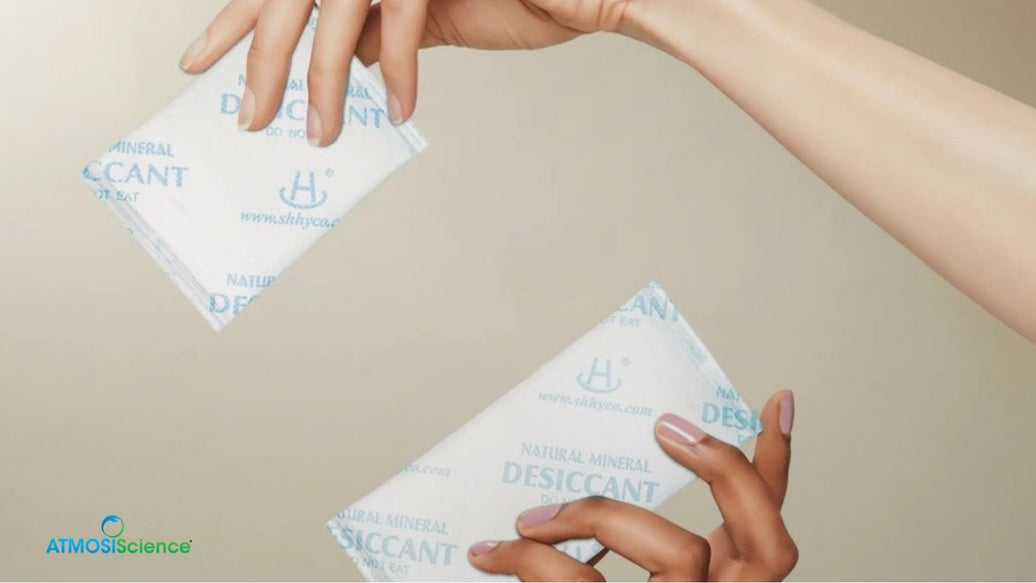
- Size on low-humidity capacity. If the target is around 20% RH, the desiccant's capacity at 20% RH is the number that matters. Our plant-fiber (paper) desiccant's minimum moisture adsorption rate is more than 10% of its own weight at 20% RH, more than 35% at 50% RH and more than 70% at 90% RH, per its technical criteria. Our specification does not state a figure below 20% RH, so for very dry targets the size must be confirmed by testing in your pack.
- Keep the desiccant sealed until it goes in. The fiber desiccant's safety data sheet advises against leaving packed material in an open state. A desiccant that has been sitting in room air on the line arrives in the pack partly used.
- Pick a format that suits the pack. A thin card cut to a round or square shape for the cap or lid, apart from the powder, or a bagged pouch from 1 to 1,000 g for bags and larger packs. Confirm placement with your QA team.

A quick plan for a new gut-health powder
- Get the water activity target for each culture from the supplier's stability data.
- Get sorption data for the prebiotic grade and the flavor system.
- Set the pack target at the lowest safe water activity across ingredients, at the warmest realistic storage temperature.
- Choose the barrier, then size the desiccant at that target. The method is in desiccant sizing for sugar-containing powders.
- Run real-time and accelerated storage on the final pack, tracking viable count, water activity and flow, including an in-use opening test for jars.
Frequently asked questions
What water activity do probiotic powders need?
It depends on the strain, the formulation and the pack. Published work points to low water activity for good survival: in one study viability loss was minimal at 0.11 aw, while viability was lost in all powders within 22 days at 0.52 aw. Some culture suppliers also set a minimum. Use your culture supplier's stability data as the starting point.
Why does my inulin or prebiotic fiber powder clump?
Inulin and oligosaccharides are carbohydrates. As they absorb water, their glass transition temperature falls; once it drops below the storage temperature, particles soften and fuse. Amorphous inulin has been shown to cake between 59 and 75% RH.
Do postbiotics need desiccant?
There is no live count to protect, but the powder can still cake. Whether it needs a desiccant depends on the blend's critical humidity, the barrier and the shelf life.
Can a desiccant over-dry a probiotic?
A desiccant pulls the headspace toward a low humidity, and the product follows over time. If your culture supplier specifies a minimum as well as a maximum water activity, size and test so the pack stays inside that window.
Can you help us test a desiccant in our probiotic pack?
Yes. Send us the pack, fill weight, water activity target and storage conditions and we will size a fiber desiccant and send samples for your stability test.
Test a desiccant in your gut-health pack
Share your water activity target and pack. We will size a fiber desiccant and send samples cut to your format for your stability study.
Prefer email? info@atmosiscience.com
Product figures from the ATMOSIScience fiber desiccant product introductions and safety data. External sources are linked in the text.