Quick answer: For a contract manufacturer that packs in-house, the reliable way to size desiccant for sugar-containing powders is a water budget at the right humidity. First, place each formula in a moisture risk tier (crystalline sugars only, sugar blends with acids, amorphous carbohydrates, live cultures). Second, set the headspace target from the blend's critical humidity. Third, add up the water the desiccant must hold over the shelf life: pack ingress, initial headspace, any water the product gives up, and openings for jars. Fourth, divide by the desiccant's capacity at the target humidity, not its saturated capacity. Fifth, confirm in the final pack. A standard method like this lets one approved desiccant specification serve many client SKUs.
Contract manufacturers with their own packaging lines make the desiccant decision for many brands at once. You source the raw materials, co-develop the formula, choose or approve the pack and decide whether a desiccant goes in. When a client's flavored collagen cakes on a customer's shelf, the question usually lands back on your QA team. This guide sets out a repeatable method for sugar-containing powders that a technical team can apply across a whole client list.
Step 1: place every formula in a moisture risk tier
Sugar-containing powders do not all need the same protection. The tiers below follow the mechanisms in why sugar-containing powders pick up moisture and glass transition and caking.
| Tier | Typical formulas | What sets the limit | Default approach |
|---|---|---|---|
| 1. Crystalline only | Unflavored protein or collagen, crystalline sucrose or dextrose, no acid | Deliquescence point of the main ingredient, fine-particle caking | Barrier first; desiccant decided by the storage test |
| 2. Deliquescent blends | Sugar plus citric or malic acid, several sugars, fructose, sorbitol | The blend's deliquescence point, lower than any single ingredient | Desiccant sized to the blend's critical humidity |
| 3. Amorphous carbohydrates | Spray-dried fruit powders, flavor carriers, maltodextrin, freeze-dried inclusions, inulin | Glass transition at the warmest storage temperature | Low headspace target, desiccant plus a good barrier |
| 4. Live cultures | Probiotic and synbiotic powders | The culture supplier's water activity range | Lowest target, desiccant standard, stability test on viable count |
The reasons behind each tier are well documented. Mixtures of deliquescent ingredients always deliquesce at a lower humidity than their ingredients (Allan, Purdue University); sucrose with citric acid started at 64% RH, against 86% and 77% for the two alone (Salameh, Mauer and Taylor). Amorphous carbohydrate powders cake once water lowers their glass transition temperature below the storage temperature (Journal of Applied Glycoscience). Probiotic viability in dry powders is strongly tied to water activity (Massey University). Details for that tier are in probiotic, prebiotic and postbiotic powders.
Step 2: set the headspace target
For each SKU, record:
- Water activity at filling, per batch.
- The critical water activity of the finished blend, from a sorption isotherm or dynamic dewpoint isotherm, and for Tier 3 the glass transition data.
- The warmest realistic product temperature from plant to end customer, from the client's route.
- For Tier 4, the culture supplier's water activity range.
The headspace target is the lowest critical value at the warmest temperature, minus a safety margin your QA team is comfortable defending. Write it on the SKU's packaging specification as a humidity, because that is the number the desiccant is sized against.
Step 3: build the water budget
The desiccant has to hold all the water that would otherwise push the headspace above target, for the whole shelf life. Add up four terms:
| Term | How to estimate it |
|---|---|
| A. Ingress through the pack | Water vapor transmission of the finished, sealed pack at the storage condition (from the pack supplier or a weight-gain test), multiplied by days of shelf life |
| B. Initial headspace water | The water in the air trapped at sealing. Usually small for bags, larger for jars filled in a humid room |
| C. Water released by the product | If the powder is filled above the target, the desiccant will draw it down. Estimate from the isotherm: fill weight times the moisture difference between fill and target |
| D. Openings | For jars and resealable bags, an allowance for in-use openings, best measured with an opening test |
Term C is the one most often forgotten. A desiccant does not know the difference between water from outside and water from the powder; any powder sitting above the target humidity becomes part of its load.
Step 4: divide by capacity at the target humidity
Minimum desiccant mass = total water budget ÷ capacity per gram at the target humidity.
The capacity must be the one at the target. Our plant-fiber (paper) desiccant is specified at three bands: a minimum moisture adsorption rate of more than 10% of its own weight at 20% RH, more than 35% at 50% RH and more than 70% at 90% RH, per its technical criteria, with loss on drying below 10%. Using the 90% RH figure for a pack that must stay at 20% RH would undersize the desiccant several times over.

Worked example (illustrative numbers only)
Suppose a jar of flavored powder has a measured ingress of 2 mg of water per day at the storage condition, a 365-day shelf life, and the product will give up about 0.2 g of water moving from its fill point to target. Ignoring openings for simplicity, the budget is 0.73 g + 0.2 g, roughly 0.93 g of water.
- If the target is 50% RH, at more than 35% capacity the minimum is about 0.93 ÷ 0.35 = 2.7 g of fiber desiccant.
- If the target is 20% RH, at more than 10% capacity the minimum is about 0.93 ÷ 0.10 = 9.3 g.
The same pack needs about 9.3 g instead of 2.7 g for the drier target. In practice a drier target also increases ingress and the water drawn from the product, so the real gap is larger. When the answer is large, improve the barrier before adding grams. These numbers are examples to show the method, not a recommendation for any real pack; confirm every size with a test in the final pack.
Step 5: confirm in the final pack
- Pack samples on the real line with the chosen desiccant and a control without it.
- Store at the warmest and most humid condition the client's route can reach, alongside normal storage.
- Track water activity, flow or caking, appearance and, for Tier 4, viable count.
- For jars, add an in-use test with repeated openings.
- Record the result against the SKU so the next flavor in the same family can start from it.
Choosing the format on a contract line
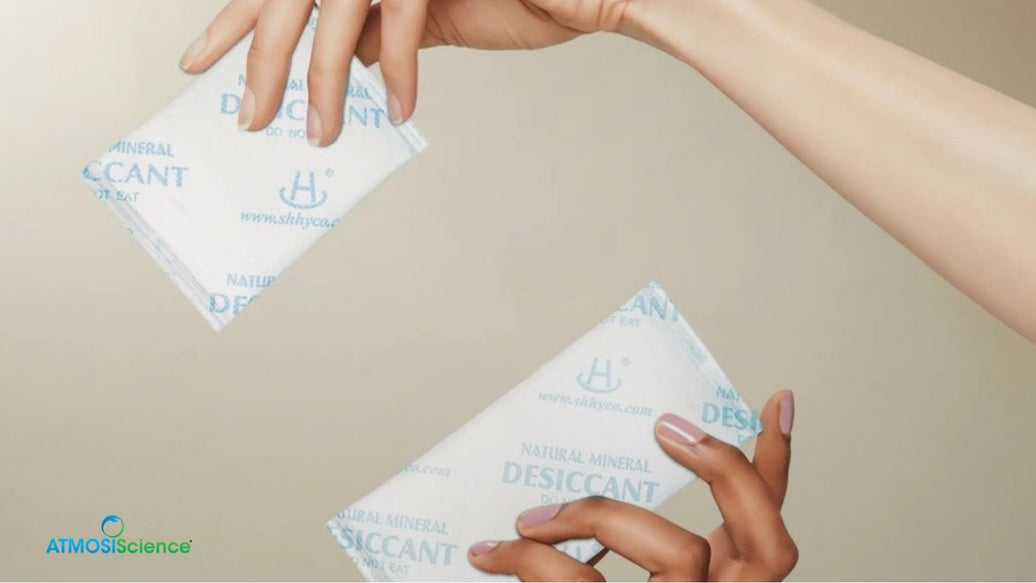
- Jars, tubs and bottles: a thin fiber desiccant card, cut to a round or square shape and placed in the cap or lid, apart from the powder; the product documentation lists use as a cushion in a bottle cap. Agree placement with the brand's QA team.
- Stand-up bags and larger packs: bagged fiber desiccant from 1 to 1,000 g per pouch, with a substrate about 2.5 mm thick and no dust.
- Handling on the line: keep the desiccant in its sealed packaging until use. The fiber desiccant's safety data sheet advises against leaving packed material in an open state and against storage in wet or very humid places. Line handling is covered in how to use fiber desiccant.

Supplier qualification
Tell us which documents your supplier qualification needs and we will go through them with your QA team. The lines worth putting in any desiccant specification are listed in the paper desiccant spec checklist.
One specification, many clients
A contract manufacturer that standardizes this method gains more than one good pack. One qualified desiccant, in two formats, can cover many sugar-containing powders across the client list, with the size set per SKU from the water budget. Purchasing deals with one supplier, QA keeps one set of documents, and when a brand client asks to change or upgrade the desiccant in an existing product, the qualification work is already done. If you would like to set up that standard with us, we can size the first SKUs with your team and supply samples cut to your formats.
Frequently asked questions
How much desiccant does a powder jar need?
There is no fixed grams-per-jar rule. It depends on the pack's ingress, the shelf life, how far the powder must be pulled down, openings, and above all the target humidity. Build the water budget and divide by the capacity at that humidity.
Can I use one desiccant size for every flavor in a range?
Only if every flavor sits in the same risk tier and has a similar critical humidity. A berry flavor with fruit powder and citric acid often needs a lower target than a chocolate flavor in the same jar.
Why not size on saturated capacity?
Because a sugar-containing powder would be ruined long before the desiccant saturated. The capacity that matters is the one at the humidity the product must not exceed.
Can you work with our QA team on several client SKUs?
Yes. Send the pack types, fill weights and target humidities for the SKUs you want to start with, and we will size and sample them.
Set up a desiccant standard with us
Send the first SKUs you want to cover. We will work through the water budget with your team and send samples in your formats.
Prefer email? info@atmosiscience.com
Product figures from the ATMOSIScience fiber desiccant product introductions (bagged and sheet) and safety data. External sources are linked in the text.