Quick answer: Amorphous sugars and carbohydrate carriers in spray-dried and freeze-dried powders are glasses. Water acts as a plasticizer and lowers their glass transition temperature (Tg). When Tg falls to the storage temperature, the powder turns rubbery; stickiness usually develops when the product is roughly 10 to 20 °C above Tg, and the further above Tg it sits, the faster it cakes. That is why a sweetened powder can flow freely in a cool warehouse and cake in a hot truck at the same moisture content. The control is to keep water activity low enough that Tg stays above the warmest temperature the pack will see, with margin, and to size barrier and desiccant to hold that water activity.
If a powder cakes in summer and not in winter, with the same formula and the same pack, the cause is often a glass transition rather than deliquescence. It is the mechanism behind sticky fruit powders, hardened flavor sachets and drink mixes that set like brick. Brand R&D teams and contract manufacturers both benefit from understanding it, because it changes what "dry enough" means for each formula.
What glass transition means for a powder
An amorphous solid has no crystal lattice. Below its glass transition temperature it is a rigid glass: molecules barely move and particles stay separate. Above Tg it becomes rubbery: viscosity drops, particle surfaces soften and touching particles start to fuse. In food powders this transition is associated with sticking, crystallization and agglomeration (Molecules, 2022).
Water is the plasticizer
Water sorption reduces the Tg of amorphous carbohydrate powders, and caking occurs when Tg drops below the storage temperature (Journal of Applied Glycoscience). This is the crucial link to packaging. A powder does not have one Tg. It has a Tg for every moisture content, and therefore for every humidity it equilibrates with. Each bit of water that enters the pack lowers the temperature at which that powder becomes sticky.
Two routes lead to caking, and both are common in distribution:
- Same temperature, more water: the pack lets in moisture, Tg falls to the storage temperature, the powder goes rubbery.
- Same water, higher temperature: the pack is unchanged, but a hot warehouse, trailer or delivery van pushes the product above its Tg.
The sticky point and the T minus Tg rule
Stickiness does not switch on exactly at Tg. Studies link the critical viscosity for stickiness to temperatures about 10 to 20 °C above Tg (Roos and Karel, as summarized in a review of powder stickiness methods). Above that, speed matters: in work on skim milk powder, the time to reach a critical cake strength fell sharply as the gap between storage temperature and Tg grew, and with storage pressure, which is the load from stacked cases (caking of dairy powders, conference presentation).
The useful mental model for a pack is the gap between the product temperature and its Tg at the product's current moisture. Keep that gap negative, with margin, across the whole supply chain.
The sugar system sets the starting point
Small sugars such as fructose and glucose have low glass transition temperatures, so powders rich in them become sticky easily. Fruit powders are a known example: they have a low Tg and are very hygroscopic in their amorphous state, which is why high-Tg ingredients such as maltodextrin and anti-caking agents are added (Jaya and Das, fruit powders). Spray drying of fruit juices is often affected by the same stickiness (Acta Horticulturae).
Not all maltodextrin is equal. Its Tg falls as dextrose equivalent (DE) rises; one published approximation for anhydrous maltodextrin is Tg (K) = 449.5 minus 1.4 times DE (Busin et al., 1996, as cited in a Food and Applied Bioscience Journal study). A switch from a low-DE to a high-DE carrier, made for cost or sweetness, can lower the Tg of the finished powder without anyone touching the sugar content on the label.
Mixtures matter as well. The Tg of a blend sits between those of its components (the Gordon-Taylor model is the usual way to estimate it), and mixing crystalline sugars into amorphous carriers can both raise water uptake and lower the blend's Tg. In fructose and maltodextrin blends, the measured Tg was significantly reduced compared with maltodextrin alone at every storage humidity tested (Journal of Food Science, 2017).
Crystallization releases water and can start a chain reaction
Above Tg, amorphous sugars are mobile enough to crystallize. Crystals hold less water than the amorphous form, so crystallization pushes water out. Amorphous lactose converting to its crystalline hydrate at 55% RH released practically all the moisture it had absorbed (PDA Journal, 2000). In a sealed jar, that water raises the headspace humidity, which lowers the Tg of the neighboring powder, which can then crystallize in turn. Caking that seems to spread through a container from one spot can follow this pattern.
Chemistry follows the same physics
Glass transition is also relevant to color and flavor. In whey protein and carbohydrate systems, the progress of Maillard reactions during storage depended mainly on the relationship between storage temperature and Tg (International Dairy Journal, 2026). Keeping the product glassy protects texture and appearance together.
Build a simple state diagram for each formula
You do not need a research lab to use this. Two curves per formula are enough to set a pack target.
| Measurement | What it tells you | Usually done by |
|---|---|---|
| Moisture sorption isotherm (moisture content vs water activity) | How much water the powder holds at each humidity, and where uptake suddenly accelerates | Manufacturer QC lab or an outside lab |
| Tg at several moisture contents (DSC) | How fast Tg falls as the powder takes up water | Outside lab or ingredient supplier |
| Water activity at filling | Where each batch starts | Manufacturer QC, every batch |
| Warmest realistic product temperature | The temperature Tg must stay above | Brand and logistics team, from the real route |
Combine the two curves and read off the critical water activity: the highest water activity at which Tg is still safely above the warmest product temperature. That critical value, minus a margin, is the humidity your pack has to hold. Fruit powder researchers present exactly this as a stability or mobility diagram for finding safe storage conditions (Jaya and Das).
From critical water activity to pack design
- Fill below the critical value. If the powder leaves the dryer or blender too wet, packaging cannot save it.
- Pick a barrier that limits ingress for the length of the shelf life and the warmest storage conditions.
- Add desiccant sized at the target humidity. In a low-humidity design, use the desiccant's capacity at a low humidity band, not its saturated figure.
- Remember the powder takes part. A desiccant will draw water from any powder sitting above the target, so that water counts toward the desiccant's load.
- Verify with a warm, humid storage test in the final pack, checking flow and water activity over time.
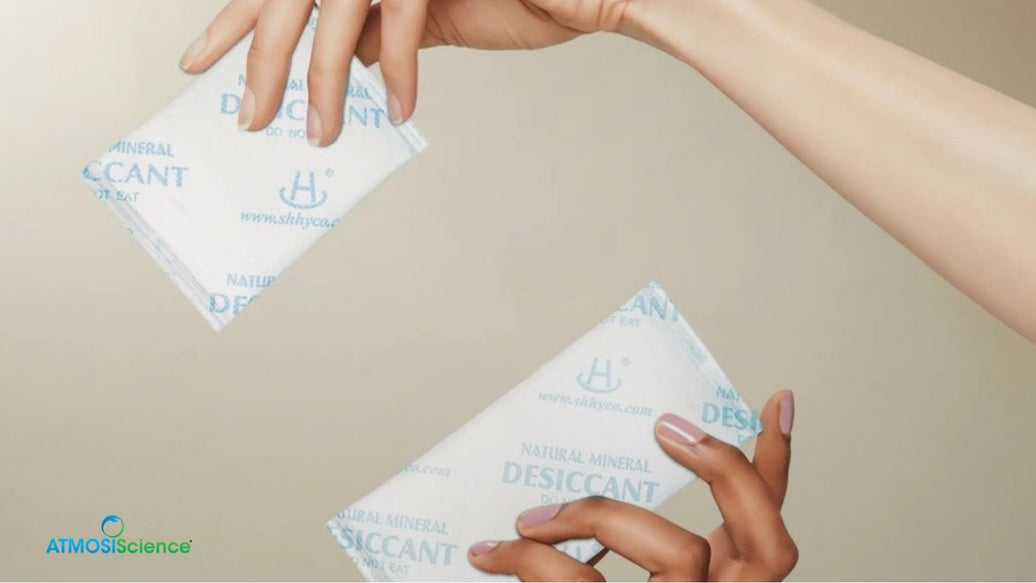
For step 3, our plant-fiber (paper) desiccant is specified at three humidity bands. Its minimum moisture adsorption rate is more than 10% of its own weight at 20% RH, more than 35% at 50% RH and more than 70% at 90% RH, per its technical criteria. For powders whose critical humidity is low, the 20% RH figure is the one to size on.

The worked method for turning a target humidity into a desiccant mass is in desiccant sizing for sugar-containing powders. The background on why sugars behave so differently from one another is in why sugar-containing powders pick up moisture.
Frequently asked questions
Is caking from glass transition the same as caking from deliquescence?
No. Deliquescence is a crystalline ingredient dissolving at a critical humidity. Glass transition is an amorphous ingredient softening once its Tg drops to the product temperature. Many sweetened powders contain both crystalline and amorphous parts, so both can happen in the same product.
Why does my powder cake in summer but not in winter?
At the same moisture content, the product is warmer in summer, so it sits closer to or above its Tg. Warmer air also tends to carry more water vapor into the pack. Both push the powder toward the sticky region.
Does adding maltodextrin always help?
Low-DE maltodextrin raises the Tg of sugar-rich powders and is widely used for this. Higher-DE grades have a lower Tg, and maltodextrin is itself amorphous and absorbs water, so the grade and the amount both matter.
Can a desiccant rescue a sticky powder?
It can stop a borderline powder from getting worse and slowly pull water out of a powder sitting just above the target. It will not reverse caking that has already formed, and it cannot substitute for filling at the right water activity.
Turn your critical water activity into a pack
Send us the target humidity your formula needs and how it is packed and shipped. We will size a fiber desiccant and send samples for your storage test.
Prefer email? info@atmosiscience.com
Product figures from the ATMOSIScience fiber desiccant product introductions. External sources are linked in the text.