Quick answer: Sugars are hydrophilic, so they attract water, but a sugar-containing powder does not automatically pick up moisture faster. What decides it is the type of sugar, whether it is crystalline or amorphous, what else is in the blend, the temperature and the humidity. Crystalline sucrose takes on very little water until the air reaches about 84 to 86% RH at 25 °C. The same sucrose in an amorphous, spray-dried or freeze-dried form absorbs water across the whole humidity range and can start to change at far lower humidity. Blends are the real trap: mixing sugars, acids and carriers lowers the humidity at which the powder starts to dissolve and cake, often below the point of any single ingredient. Design the pack, and any desiccant, around the lowest critical humidity of the finished blend.
Anyone who has opened a flavored drink mix, a sweetened protein or a fruit powder after a humid month knows the result: lumps, a hard crust, or a scoop that no longer flows. The usual explanation is "it has sugar in it." That is half right. Sugar is part of the story, but two powders with the same amount of sugar can behave completely differently. This guide explains why, in terms a brand team and a manufacturing team can both use, and how it connects to choosing the right moisture protection for the pack.
Hydrophilic does not mean fast-absorbing
Sugars carry many hydroxyl groups that form hydrogen bonds with water, which is why they dissolve so readily. In a dry powder, though, water uptake follows one of two very different patterns, depending on the physical state of the sugar.
- Crystalline sugars behave as deliquescent solids. They adsorb only a little water on their surfaces until the humidity reaches a critical point, called the deliquescence point (RH0). At that point the crystal starts to dissolve in the water it has gathered. Researchers at Purdue describe it plainly: deliquescent solids adsorb little moisture before RH0, while amorphous solids absorb moisture across a range of humidities (Marrs, Purdue University).
- Amorphous sugars have no ordered crystal lattice. They take up water gradually at every humidity, and that water softens them (more on this in our guide to glass transition and caking).
So the question is never just "does it contain sugar?" It is "which sugar, in which form, next to which other ingredients?"
Crystalline sugars: each has its own critical humidity
The deliquescence point of a crystalline ingredient equals the water activity of its saturated solution. That makes it easy to compare sugars and polyols on one scale. The values below are the saturated-solution water activities at 25 °C published in a Tate & Lyle technical sheet; multiply by 100 to read them as % RH.
| Ingredient (crystalline) | Saturated solution aw at 25 °C | What it means |
|---|---|---|
| Fructose | 0.634 | Starts dissolving in ordinary humid air |
| Sorbitol | 0.725 | Sensitive in humid seasons |
| Sucrose | 0.844 | Stable in most indoor air on its own |
| Dextrose | 0.891 | High on its own, but see the caking note below |
| Lactose | 0.931 | Crystalline lactose is relatively robust |
| Maltose | 0.952 | High |
| Mannitol | 0.977 | Very high |

Two cautions. First, measured values move a little with the method: Purdue researchers report sucrose deliquescing at 86% RH, for example (Salameh, Mauer and Taylor, AIChE 2005). Second, uptake can begin below the deliquescence point. Tate & Lyle's own specification for crystalline fructose says it begins to absorb moisture at 56% RH at room temperature and recommends storage below 50% RH (KRYSTAR 450 specification).
Amorphous sugar: the same molecule, a different risk
Spray drying, freeze drying, milling and rapid cooling can all leave sugars in an amorphous, glassy state. That is common in supplement and food powders: spray-dried fruit and juice powders, flavor powders on carbohydrate carriers, maltodextrin, and freeze-dried inclusions.
The difference is large. In one study of lyophilization bulking agents, crystalline sucrose and anhydrous lactose were "relatively nonhygroscopic", but once freeze-dried into the amorphous form they "sorbed moisture rapidly" as humidity rose (PDA Journal of Pharmaceutical Science and Technology, 2000). The same work shows a second effect that matters for packs: amorphous lactose converted to a crystalline hydrate at 55% RH and, in doing so, released practically all the moisture it had absorbed. In a closed pack, that released water does not disappear. It moves into the headspace and the surrounding powder.
Amorphous sucrose made by freeze drying, spray drying or ball milling showed moisture-induced crystallization from 30% RH upward at 25 °C (Morrow, University of Illinois). In other words, an amorphous sugar can start changing at humidity levels where its crystalline twin would sit untouched.
Blends start to dissolve at lower humidity than their ingredients
This is the point most often missed. When two or more deliquescent ingredients touch, the deliquescence point of the mixture is always lower than that of each ingredient alone (Allan, Purdue University, 2014).
- Sugar plus acid. Sucrose deliquesces at 86% RH and citric acid monohydrate at 77% RH, yet their mixture started at 64% RH (Salameh, Mauer and Taylor). Citric acid is a common flavor acid, so many fruit-flavored powders sit in exactly this position.
- Crystalline sugar plus amorphous carrier. In blends of crystalline sucrose with amorphous maltodextrin, the sucrose dissolved at humidities below its own deliquescence point, and the blend took up more water than either ingredient predicted (Pharmaceutical Development and Technology, 2014). Fructose and maltodextrin blends showed the same synergy, and warmer storage lowered the humidity at which it began (Journal of Food Science, 2017).
The practical message: the flavor system, with its sugar, acid and carrier, can set a lower critical humidity than the sugar on its own. A spec sheet value for one ingredient is not the number to design the pack around.
Caking can start before anything dissolves
Deliquescence is not the only route to lumps. Fine particles hold water in the tiny gaps between them, and that capillary water can bridge particles well below the deliquescence point. In a University of Illinois study, glucose monohydrate, with a literature deliquescence point of about 91% RH, caked at 53% RH at 25 °C, and a blend with sucrose caked faster (University of Illinois, glucose caking study). Earlier handling advice was storage at or below 55% RH at 30 °C; this work found caking at 53% RH at 25 °C.
Temperature and humidity swings do the rest
Deliquescence points are not fixed: they usually fall as temperature rises. Sugar gum pastes, for example, showed lower deliquescence points at 40 °C than at 25 °C (Food Chemistry, 2010). A pack that is safe in a cool warehouse can cross the line in a hot trailer.
Swings are worse than steady conditions. When humidity rises past the threshold, liquid bridges form between sugar particles; when it drops again, those bridges recrystallize into solid bridges and the powder sets into a cake (Samain et al., 2017). Glucose and citric acid mixtures cycled above and below their mixture deliquescence point caked, and finer powders formed harder cakes (Salameh, Mauer and Taylor). Every day-night cycle, every container crossing and every time a consumer opens a jar is a small cycle.
What this means for the pack
- Find the lowest critical humidity of the finished blend, not of the main sugar. A moisture sorption isotherm or dynamic dewpoint isotherm on the final formula, plus water activity at filling, gives you the number.
- Set a headspace target below it, with margin, at the warmest temperature the product is likely to see in storage and shipping.
- Choose the barrier first. A desiccant deals with the water that gets in; the pack decides how much gets in.
- Size the desiccant at the target humidity, not at its saturated capacity. A desiccant's capacity at 90% RH says little about how it performs in a pack that has to stay at 30% RH.
- Test in the final pack under warm, humid conditions, including repeated opening if it is a jar or a resealable bag.
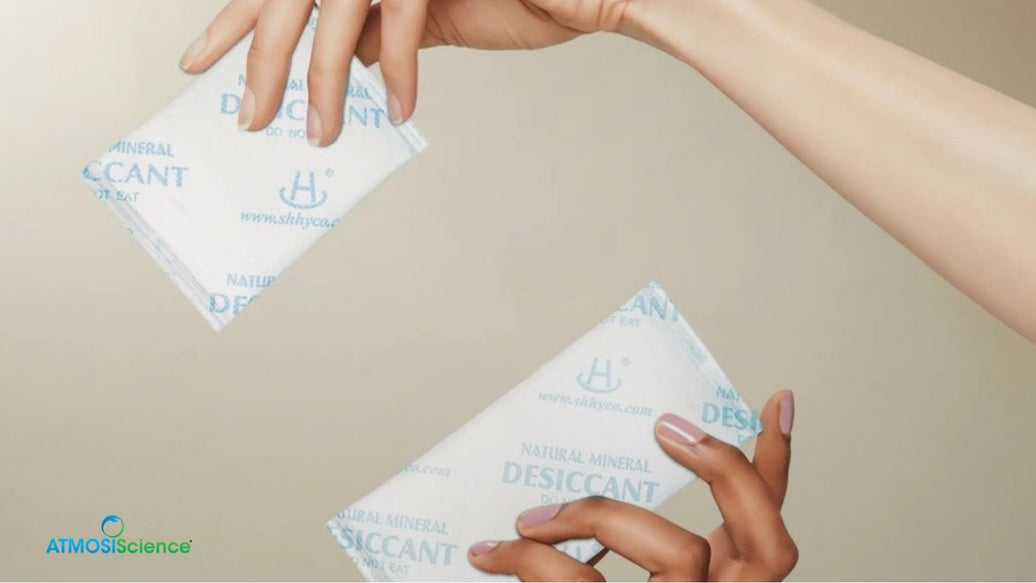
Our plant-fiber desiccant, the material behind what many buyers search for as paper desiccant, is specified by humidity band for this reason. Its minimum moisture adsorption rate is more than 10% of its own weight at 20% RH, more than 35% at 50% RH and more than 70% at 90% RH, per its technical criteria, with loss on drying below 10%.

What a desiccant can and cannot do
A desiccant lowers the humidity in the headspace and soaks up the water vapor that passes through the pack wall and seal over time. It cannot fix a powder that was filled above its own critical water activity. In that case the desiccant will slowly pull water out of the product, which uses up its capacity and may still be too slow to prevent the first lumps. Get the moisture right at drying and filling, then use the desiccant to hold it there.
Choosing a format for sugar-containing powders
- Jars and tubs: a thin fiber desiccant card, cut to a round or square shape, placed in the cap or lid so it sits apart from the powder. The product documentation lists use as a cushion in a bottle cap as one application. Confirm placement with your QA team.
- Stand-up bags and larger packs: bagged fiber desiccant, available from 1 to 1,000 g per pouch, with no dust.
- Bulk and cartons: larger bagged sizes, sized on the carton's own moisture budget.
Where to put it is covered in where to place desiccant in a package, and the questions to ask any supplier are in the paper desiccant spec checklist.

Keep reading in this series
- Glass transition and caking: why spray-dried sweetened powders turn sticky
- Why flavored protein and collagen powders clump: the sweetener system decides
- Probiotic, prebiotic and postbiotic powders: what moisture does to each
- Desiccant sizing for sugar-containing powders: a method for contract manufacturers
Frequently asked questions
Does every product that contains sugar absorb moisture faster?
No. Crystalline sucrose, dextrose and lactose take up little water until humidity is high. The risk rises sharply when sugars are amorphous (spray-dried or freeze-dried), when they are blended with acids or carriers, when particles are fine, and when temperature and humidity swing.
Why does my powder cake even though the humidity never reached the sugar's deliquescence point?
Because the blend's critical point is lower than the single ingredient's, because capillary water between fine particles can bridge them first, and because humidity cycling turns liquid bridges into solid ones. All three can happen below the published value for one sugar.
Is a sugar-free powder automatically safe?
Not automatically. Some polyols are themselves hygroscopic: sorbitol's saturated-solution water activity is 0.725 at 25 °C, lower than sucrose's 0.844. Others, such as mannitol, are very resistant. Check the actual sweetener system.
Which humidity should I design the pack for?
The lowest critical humidity of the finished blend at the warmest likely storage temperature, minus a safety margin. Measure it on the real formula.
Can you help size desiccant for a sugar-containing formula?
Yes. Send us the pack, the fill weight, the target humidity and how the product is stored and shipped, and we will size a fiber desiccant for it and send samples to test.
Size desiccant for your formula
Tell us what the powder contains and how it is packed. We will size a fiber desiccant for its critical humidity and send samples to test.
Prefer email? info@atmosiscience.com
Product figures from the ATMOSIScience fiber desiccant product introductions (bagged and sheet). External sources are linked in the text.