Quick answer: When one flavor of a protein or collagen powder clumps and another does not, the protein is rarely the main difference. The sweetener system is. At the same humidity, fructose and sorbitol hold many times more water than sucrose or dextrose; carriers such as maltodextrin and spray-dried fruit powders are amorphous and absorb water at low humidity; and acids such as citric acid lower the humidity at which a sugar blend starts to dissolve. Any change to flavor, sweetener or carrier should trigger a fresh check of the moisture spec, the pack and the desiccant, not just a taste panel.
Brand teams usually discover this from reviews: "the chocolate is fine, the berry one turned into a brick." The base protein, the jar and the warehouse are the same. What changed is everything that was added to make it taste good. This guide is for brand owners who sell collagen, whey or plant protein powders in jars and bags and who make, or approve, the formulation and packaging decisions.
Unflavored and flavored are different moisture problems
An unflavored collagen peptide or protein isolate is mostly protein. It is not immune to moisture: peptide powders can become sticky, agglomerate and eventually liquefy as they take up water, as a shrimp protein hydrolysate study in Foods (2021) showed. But a flavored version adds three kinds of ingredient that tend to dominate how the powder behaves in humid air:
- Bulk sweeteners such as sucrose, dextrose, fructose or polyols.
- Carriers and inclusions such as maltodextrin, flavor powders and spray-dried fruit powders, which are often amorphous.
- Acids such as citric or malic acid for fruit flavors.
Sweeteners: same humidity, very different water uptake
Comparing sweeteners at one fixed condition makes the differences obvious. At 78% RH and 20 °C, reported equilibrium moisture contents are 45% for fructose, 33% for sorbitol, 7% for xylitol, 5% for dextrose and 3% for sucrose (US patent 5,545,415; xylitol from US patent 4,931,294).

| Sweetener | Moisture behavior | What to watch in a protein or collagen powder |
|---|---|---|
| Fructose | Starts dissolving at about 63% RH (25 °C) and holds a lot of water above it | High risk in humid seasons and after opening |
| Sorbitol | Hygroscopic; saturated solution aw 0.725 at 25 °C | "Sugar-free" does not mean moisture-safe |
| Xylitol | Gradual uptake to about 80% RH, then a sharp rise | Watch very humid storage and shipping |
| Sucrose, dextrose (crystalline) | Low uptake on their own until high humidity | Risk comes from blending with acids and carriers, and from fine particles |
| Erythritol | Very low hygroscopicity, per supplier data | Often the more stable polyol choice |
| High-intensity sweeteners | Used at tiny doses, so the sweetener itself adds little bulk | Check what it is carried on: a maltodextrin or dextrose base carries its own moisture behavior |
Sources for the table: fructose and sorbitol saturated-solution values from a Tate & Lyle technical sheet; xylitol behavior from US 4,931,294; erythritol from an Ingredion product listing that rates its hygroscopicity "very low".
Carriers and fruit powders are often the hidden culprit
Many flavor and fruit ingredients are spray-dried onto a carbohydrate carrier. In that state they are amorphous, absorb water at every humidity and soften as they do. Fruit powders in particular have a low glass transition temperature and are very hygroscopic in their amorphous state (Jaya and Das). A berry flavor that relies on a real fruit powder can therefore be far more sensitive than a chocolate flavor built on cocoa and a crystalline sweetener. The mechanism is explained in glass transition and caking.
Acids lower the danger point of the whole blend
Fruit flavors almost always need acid. On their own, sucrose deliquesces at 86% RH and citric acid monohydrate at 77% RH; mixed, they started to deliquesce at 64% RH (Salameh, Mauer and Taylor, AIChE 2005). The same study found significant sucrose hydrolysis in sucrose and citric acid mixtures stored above 54% RH. Hydrolysis splits sucrose into glucose and fructose, and a solution saturated with sucrose, citric acid, glucose and fructose had a water activity of only about 0.46. Put simply, a humid spell can make the blend more moisture-sensitive than it was on the day it was filled.
Whey adds browning to the picture
Whey-based powders contain some lactose, and lactose with milk protein can undergo Maillard browning in storage. Published work notes that this early Maillard reaction can progress at a very high rate in powders at intermediate water activity, roughly 0.3 to 0.7 (Morgan et al., Lait, 2005). Keeping water activity low helps texture and color together.
Jars versus bags
- Jars and tubs have a large headspace and are opened many times. Each opening exchanges some of the dry headspace for room air, and the scoop brings in humid air too. A desiccant in a jar has to cope with the barrier's ingress plus the consumer's openings, so test it under real use, not only sealed.
- Stand-up bags usually have a better barrier but a zipper that is not always closed fully. Fine powder in the zipper track also weakens the reseal over time.
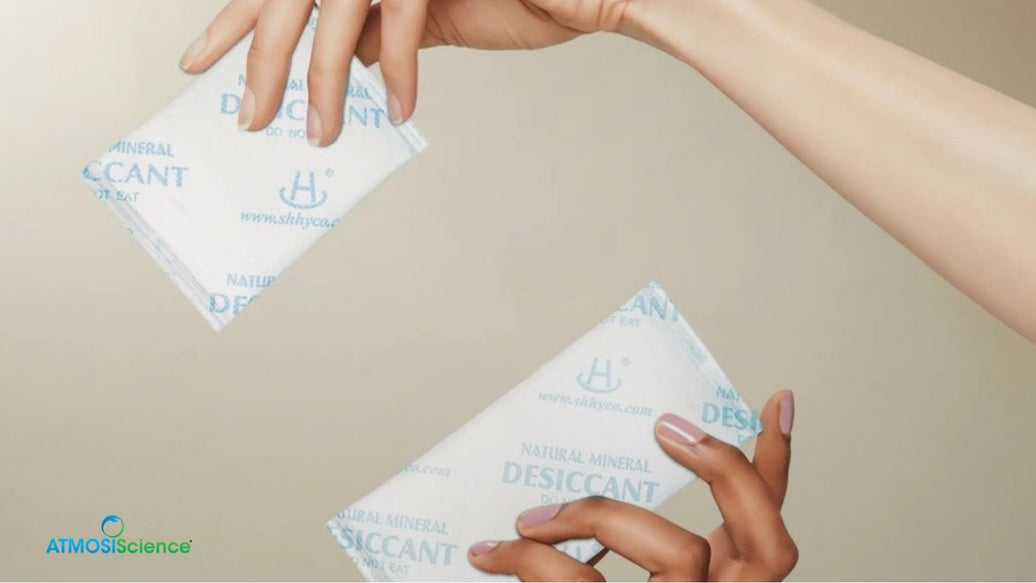
For jars, a thin fiber desiccant card cut to a round or square shape can sit in the cap or lid, apart from the powder; the product documentation lists use as a cushion in a bottle cap. Confirm placement with your QA team. For bags, bagged fiber desiccant from 1 to 1,000 g per pouch is dust-free. Placement options are in where to place desiccant in a package.

A checklist for brand owners before any flavor or sweetener change
Most brand owners do not run their own moisture lab. The questions below are the ones to send to your manufacturer or formulation partner, and to expect clear answers to.
- What is the water activity of the new flavor at filling, and what is our release limit?
- Has a moisture sorption isotherm been run on the finished blend, and at what water activity does uptake start to accelerate?
- Is there an acid in the blend, and has its effect on the blend's critical humidity been checked?
- Are any of the carriers or fruit powders amorphous, and what is their maltodextrin grade?
- What is the warmest temperature the product will see between the plant and the customer's kitchen?
- Does the current jar or bag still hold the target humidity for the full shelf life with the new flavor?
- Is the desiccant sized at the new target humidity, using the supplier's capacity at that humidity rather than a saturated figure?
- Has the final pack been stored warm and humid, and opened repeatedly, before launch?
How our fiber desiccant is specified
Many sweetened protein powders need a headspace target below 50% RH, so the capacity at low humidity is what counts. Our plant-fiber (paper) desiccant's minimum moisture adsorption rate is more than 10% of its own weight at 20% RH, more than 35% at 50% RH and more than 70% at 90% RH, per its technical criteria. Ask any supplier for the figure at your target humidity, and compare like with like.
Keep reading
- Why sugar-containing powders pick up moisture
- Probiotic, prebiotic and postbiotic powders: what moisture does to each
- Paper desiccant spec checklist
Frequently asked questions
Why does my collagen powder clump after opening?
Every opening lets in room air and the scoop brings in more. If the flavor system contains fructose, a polyol such as sorbitol, an acid or an amorphous carrier, the powder can reach its critical humidity much sooner than an unflavored version would.
Is a sugar-free protein powder protected from clumping?
Not necessarily. Sorbitol is itself hygroscopic, and many high-intensity sweeteners are supplied on a carbohydrate carrier. Erythritol has very low hygroscopicity, but the rest of the blend still matters.
Do I need desiccant in every flavor?
Not always. Decide flavor by flavor from the blend's critical humidity, the pack barrier and the shelf life. Flavors with fruit powders, acids or hygroscopic sweeteners are the usual candidates.
Will a desiccant change the taste or smell?
The fiber desiccant has no odor. Place it in the cap or lid, apart from the powder, mark it clearly as not to be eaten, and run your normal sensory check during the pack test.
Can you size desiccant for our jar or bag?
Yes. Tell us the pack, fill weight, flavor and target humidity and we will size a fiber desiccant and send samples to test.
Stop the clumping flavor
Tell us which flavor is causing trouble and how it is packed. We will size a fiber desiccant for it and send samples you can test next to your current pack.
Prefer email? info@atmosiscience.com
Product figures from the ATMOSIScience fiber desiccant product introductions and safety data. External sources are linked in the text.