Most enquiries about desiccant ask for a product. A few — from materials and packaging engineers — ask for the inputs instead: sheet or strip stock to test on the bench, the uncompressed density of the material, and water capacity plotted against relative humidity at a stated temperature. Those buyers are not shopping. They are doing the arithmetic themselves and want the numbers to put into it.
This article supplies them: the JEDEC J-STD-033 calculation term by term, the MIL-D-3464E desiccant unit, one pack worked through three barriers, the measured 25 °C curve for fibre and silica gel, and a straight answer on density — which for a sheet means areal density, not bulk density.
The short answer: nobody can tell you how much desiccant you need until you tell them the pack's WVTR, its internal surface area and the shelf life you have to hit — because service life is a property of your package, not of the desiccant inside it.
Related: Fiber desiccant · Fiber technology
Three numbers, or it is a guess
"How much desiccant do I need?" has no answer on its own. It has an answer the moment three numbers exist.
- The pack's water-vapour transmission rate (WVTR), with the test standard and conditions attached. ASTM F1249, ASTM E96 and ASTM D7709 are not interchangeable, and a WVTR quoted without its temperature and humidity is not a number.
- The internal surface area of the pack — both faces of a bag, or the wall area of a bottle. This is the area water crosses.
- The required shelf life in months, the real one, including distribution and time on shelf.
Most suppliers answer without asking for any of them, because a rule of thumb closes an enquiry faster than a question does. That is how a pack ends up with a desiccant sized for a foil laminate and hopeless in the metallised film that replaced it.
The desiccant unit: MIL-D-3464E
Grams are a poor way to buy desiccant, because a gram of one material and a gram of another do different amounts of work. MIL-D-3464E settled this by defining a unit by performance instead of by mass.
One unit adsorbs at least 3.00 g of water at 20% RH and at least 6.00 g at 40% RH, both at 25 °C (inspection tolerances 2.85 g and 5.70 g). It also fixes a rate — 0.25 g at 40% RH and 0.70 g at 80% RH over seven hours — caps a unit at 50.0 g or 45.0 mL, and defines Type I general, Type II non-dusting (≤0.5 mg dust) and Type III water-immersion resistant. Because the definition is performance-based, the mass needed for one unit differs by material.
| Material | Grams of material per MIL-D-3464E unit | Relative mass |
|---|---|---|
| Plant-fibre desiccant | 18 g | 1.00× |
| Silica gel | 30 g | 1.67× |
| Clay (montmorillonite) | 35 g | 1.94× |
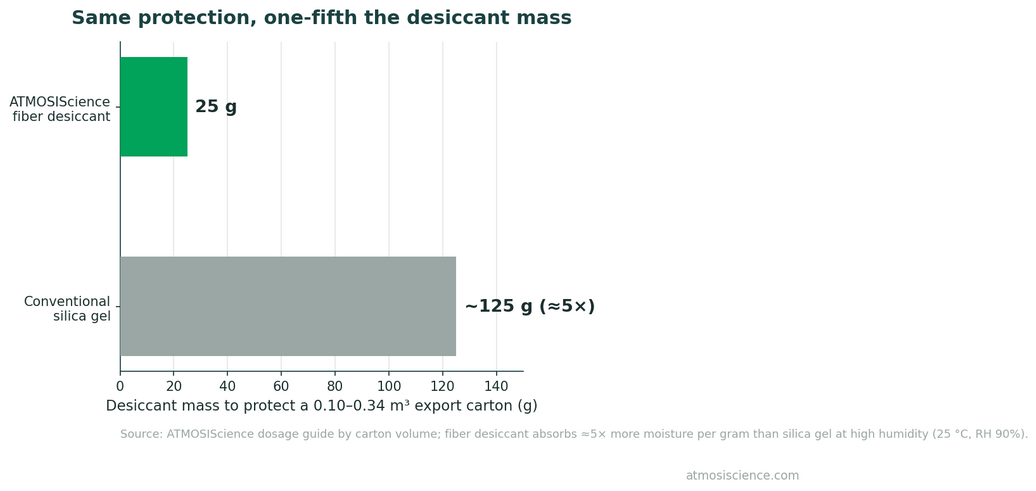
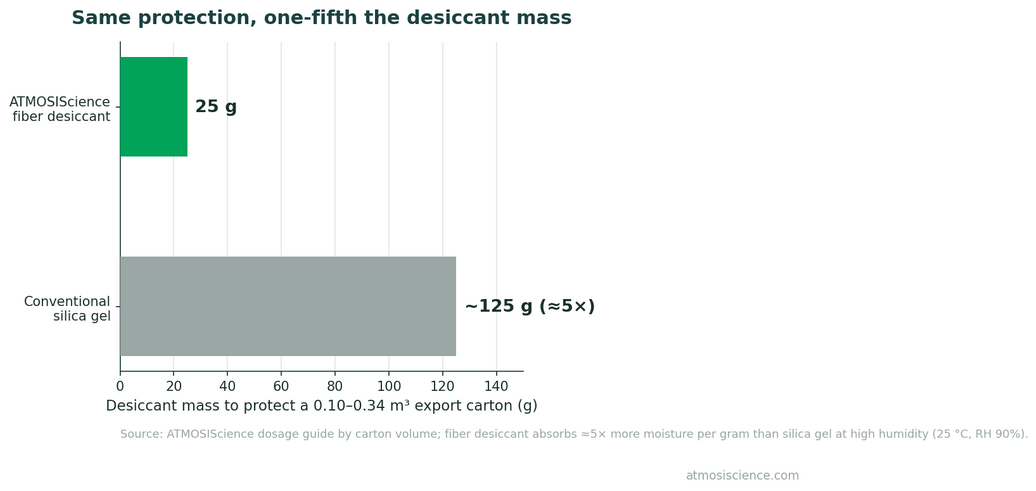
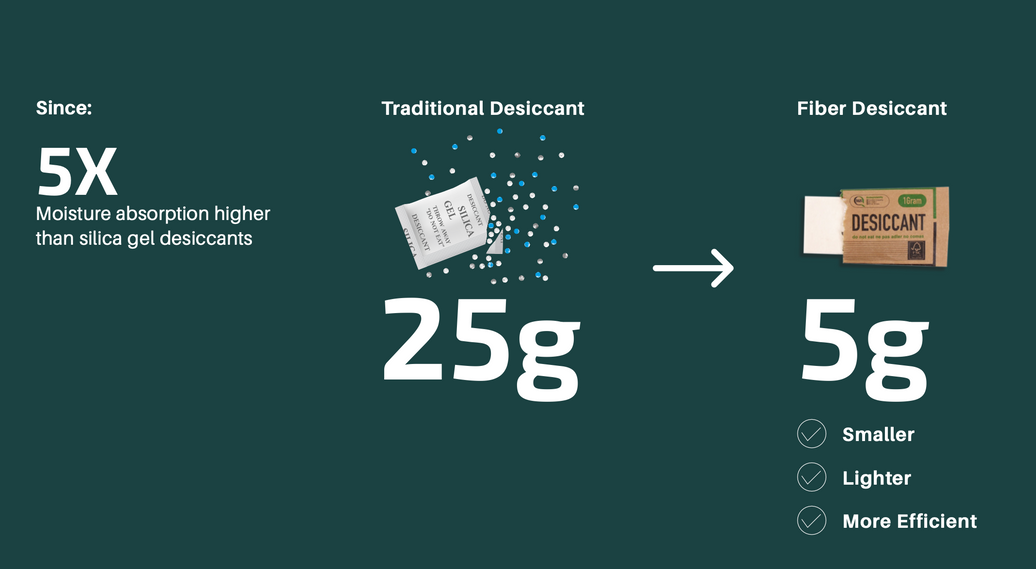
That is the honest version of "how much better is fibre than silica gel": 18 g of fibre does what 30 g of silica gel does, and across the measured curve the advantage runs about 2–3× by weight, not the 5× that circulates in trade copy. Quote the unit, not the multiple — see fibre desiccant versus silica gel.
The JEDEC J-STD-033 calculation
J-STD-033 §3.3.2.2 gives the sizing equation used for moisture-barrier bags:
U = (0.304 × M × WVTR × A) / D
- U — desiccant units to enclose.
- M — required shelf life, in months.
- WVTR — the laminate's transmission rate, grams per 100 square inches per 24 hours, at stated conditions.
- A — total bag surface area, square inches, both faces.
- D — water capacity of one unit, in grams of water: 3.00 g at 20% RH or 6.00 g at 40% RH.
- 0.304 — the conversion constant: 30.4 days per average month divided by the 100 square inches the WVTR is quoted over. The numerator therefore resolves to grams of water admitted across the whole shelf life.
Read that way it is not mysterious: total water in, divided by capacity per unit.
The most common mistake in this calculation: restatements of the formula often call D "grams per unit", which reads as grams of desiccant. It is grams of water that one unit adsorbs — 3.00 g at 20% RH or 6.00 g at 40% RH. Substituting the mass of desiccant instead under-sizes the pack by a factor of roughly 3 to 12, depending on the material and which capacity basis you use.
A simplified form, U = 5 × 10⁻³ A with A in square inches, is a sanity check only: a barrier grade and a shelf life are frozen into that constant, so a worse bag gets under-sized. The target throughout is an interior humidity below 10% RH at 25 °C. Older sizing material still in circulation cites Rev B.1; the current revision is Rev D, April 2018.
Worked calculation. A bag 300 × 400 mm, both faces, so A ≈ 372 in². Assume the laminate tests at 0.02 g per 100 in² per 24 h — illustrative; substitute your supplier's figure. Shelf life 12 months, interior below 10% RH, so D = 3.00 g.
U = (0.304 × 12 × 0.02 × 372) / 3.00 = 9.0 units, rounded up to 10. In fibre that is 180 g; silica gel 300 g; clay 350 g. The simplified form returns 1.9 units for the same bag. That gap is the argument for doing the calculation.
One pack, three barriers
A 2.0 g fibre card holds roughly 0.9 g of usable water up to a 45% RH interior ceiling. To make that last 36 months the pack must admit less than 0.82 mg of water per day. Everything follows from that division.
One thing to be explicit about: the 0.9 g figure is the card's usable capacity up to an interior ceiling of roughly 45% RH, which is the right basis for a food, supplement or general consumer pack. If the pack has to be held below 10% RH — a moisture-barrier bag for semiconductors, for example — the same card carries closer to 0.2 g, and every month figure below falls by roughly the same factor. That is the whole point: capacity is always quoted against a humidity ceiling, and a service-life figure quoted without one is not a specification.
| Pack barrier | Water in, mg/day | Days to use 0.9 g | Service life | What actually limits you |
|---|---|---|---|---|
| Foil laminate, well sealed | ~0.1 | ~9,000 | 24 years on capacity | Not capacity — seal integrity, closure, and the desiccant's own 12-month shelf life from bag seal date |
| Metallised PET | ~6 | ~150 | ~5 months | Capacity. Roughly seven times the desiccant, or a better film |
| HDPE bottle | ~2–10 (derived) | ~90–450 | 3–15 months | Wall thickness, resin, closure liner, headspace |
Same desiccant, same 0.9 g, three answers spanning two orders of magnitude. If you need 36 months the film has to be foil-grade: no quantity of desiccant rescues metallised PET across three years, because you would be sizing for roughly 6.6 g of ingress.
Reading the isotherm: the measured curve at 25 °C
An isotherm is capacity at constant temperature plotted against the humidity the material sits in. It is not a single number, and a figure quoted at 90% RH says little about a pack that runs dry. Below is the measured adsorption ratio for ATMOSIScience plant-fibre desiccant and for silica gel, as a percentage of own weight, at 25 °C.
| Relative humidity | Fibre, % own weight | Silica gel, % own weight | Ratio |
|---|---|---|---|
| 10% | 10 | 4.5 | 2.2× |
| 20% | 17 | 9.2 | 1.9× |
| 30% | 29 | 13.8 | 2.1× |
| 40% | 39 | 19.5 | 2.0× |
| 50% | 60 | 25.0 | 2.4× |
| 60% | 71 | 30.2 | 2.4× |
| 70% | 81 | 32.5 | 2.5× |
| 80% | 102 | 33.8 | 3.0× |
| 90% | 108 | 35.3 | 3.1× |
| 100% | 120 | 35.8 | 3.4× |
Three things to take from it. Read at your working humidity, not at the peak: a barrier bag under 10% RH sits at the far left, where fibre holds 10% of its weight and the margin is narrowest. Shape matters as much as height: silica gel flattens above 60% RH while fibre keeps climbing. And read it backwards — a known loading corresponds to a known humidity, which is how you predict where a sealed headspace settles.
Density: for a sheet, ask for areal density
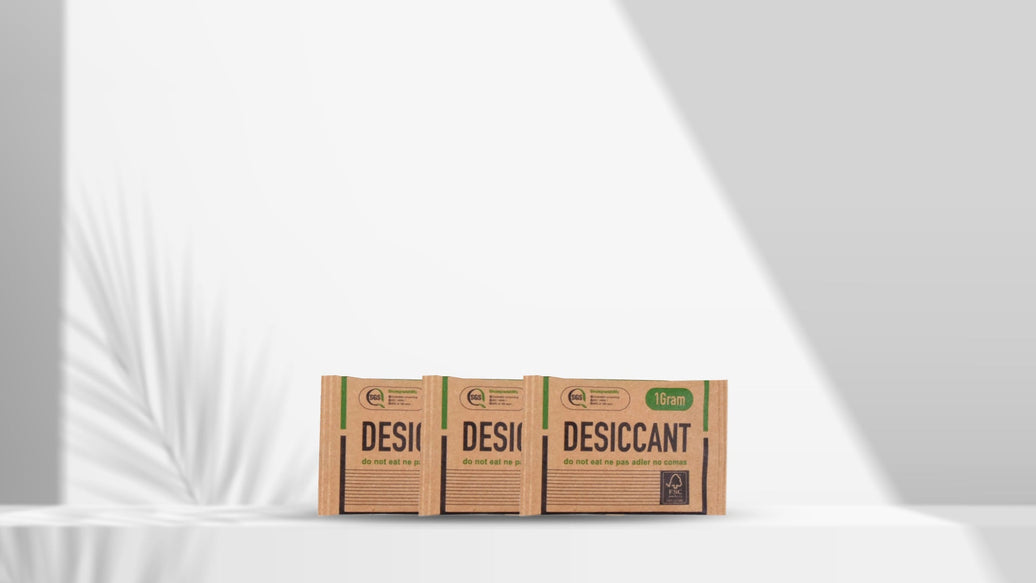
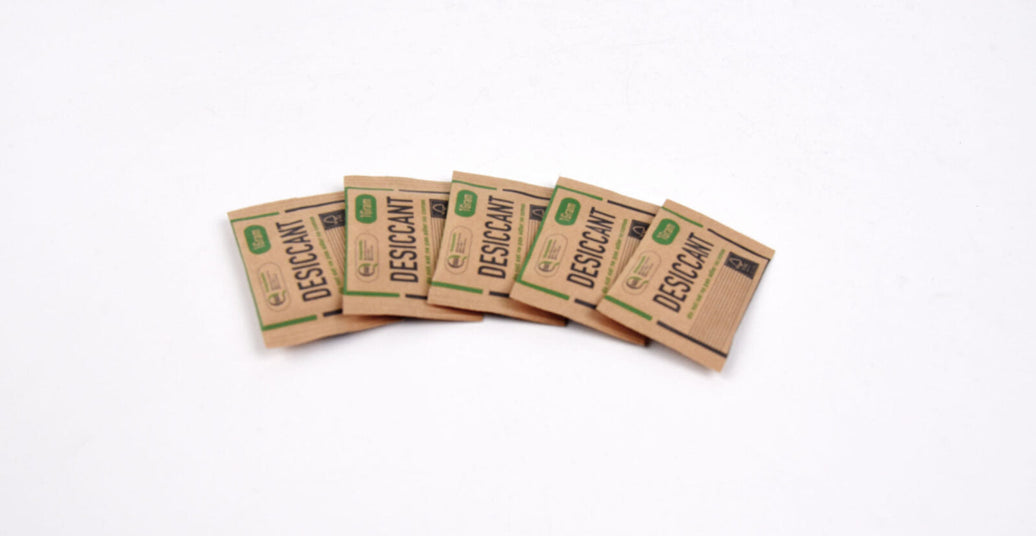
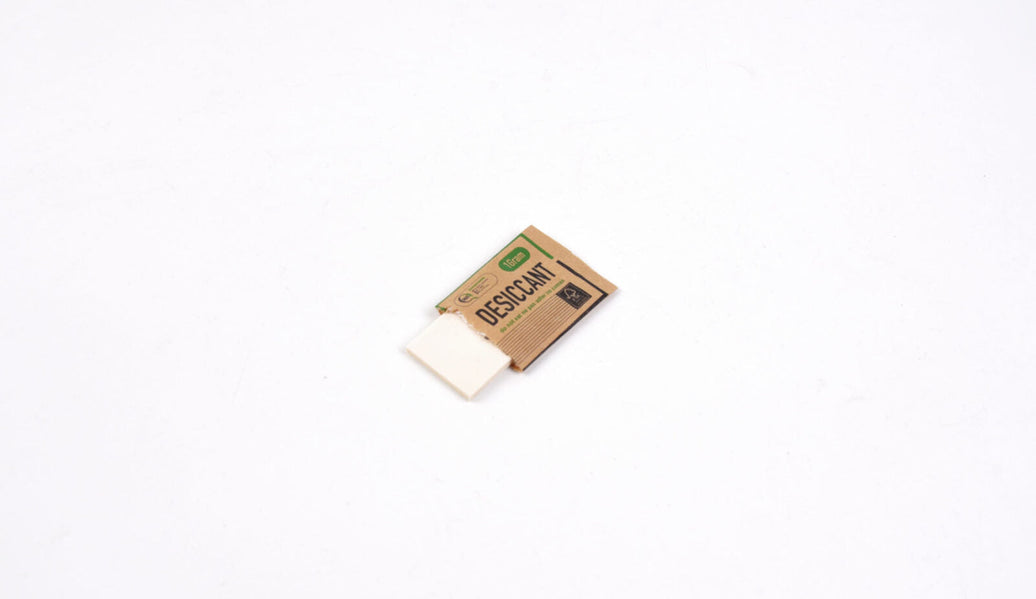
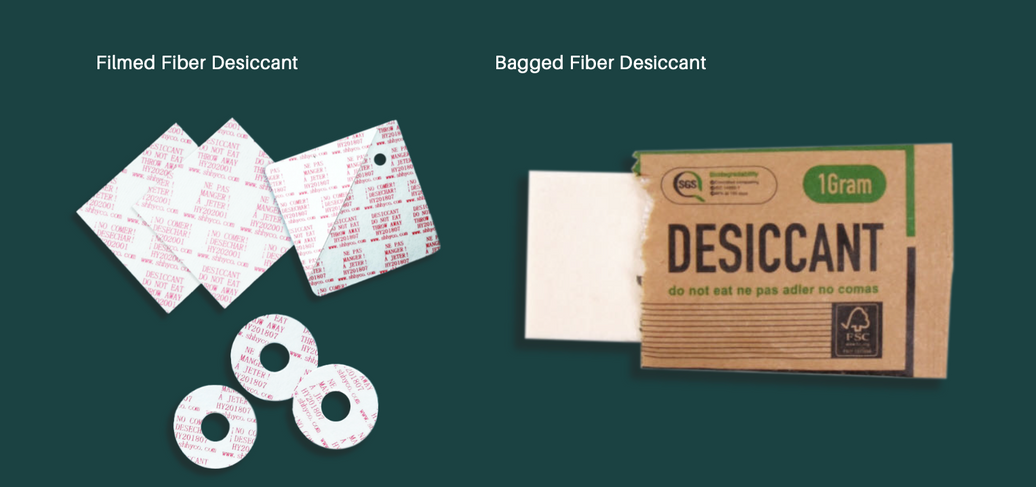
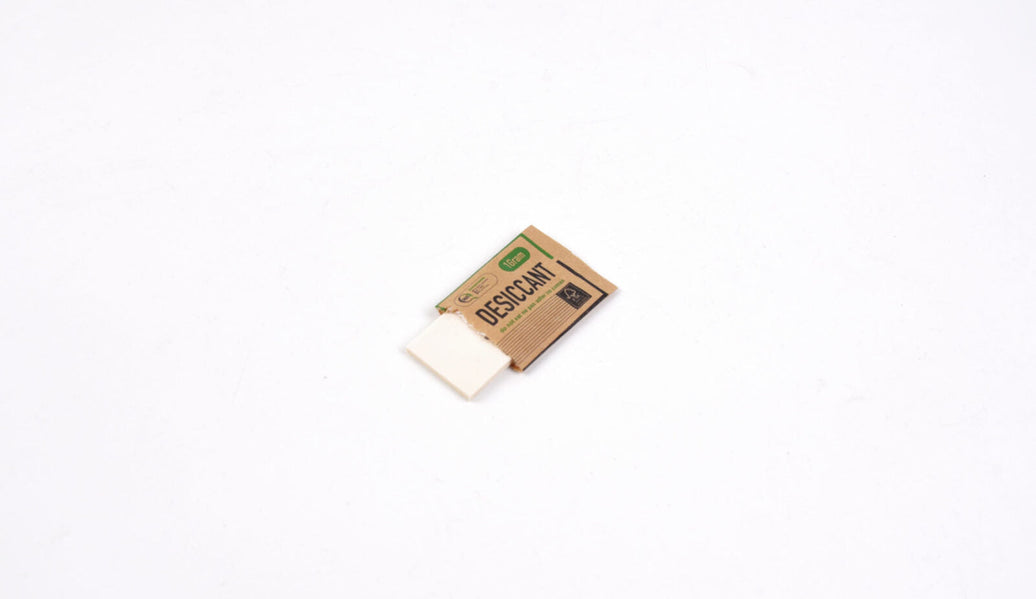
"Uncompressed bulk density" is the right question for a granular fill and the wrong one for a sheet. Fiber Card, our paper desiccant, is supplied as a filmed fibre card at 0.5 mm (ultra-thin) or 1.0 mm (maximum capacity) and is freely die-cut. For material supplied at a controlled thickness the specifying number is areal density — grams per square centimetre or per square metre, at a stated thickness. Bulk density is then derived, not an input. The Fiber Card SKU number is the piece area in square centimetres, which makes the catalogue directly convertible.
| SKU | Size, mm | Area, cm² | Mass, g | Areal density, g/m² (derived) | Absorbs, g | Water per cm², g (derived) | = silica gel, g |
|---|---|---|---|---|---|---|---|
| FF-3 | 25 × 12 × 1 | 3 | 0.15 | ~500 | 0.15 | 0.05 | 0.5 |
| FF-6 | 30 × 20 × 1 | 6 | 0.35 | ~583 | 0.30 | 0.05 | 1.0 |
| FF-15 | 60 × 25 × 1 | 15 | 1.00 | ~667 | 0.75 | 0.05 | 2.5 |
Two derived planning numbers fall out. At 1.0 mm the sheet is worth roughly 0.05 g of water capacity per cm² across all three SKUs, so a 52 mm disc of about 21 cm² is worth roughly 1 g; and the implied bulk density is about 0.50–0.67 g/cm³. Both are derived from catalogue figures, and the spread across rows is rounding plus lamination, not a material change.
To answer the original question directly: uncompressed bulk density is available on request, per lot, because it moves with substrate batch and film weight and one published figure would mislead. What fully specifies the material is areal density, stated thickness and the isotherm — with those three you can compute mass, capacity and volume for any geometry you cut. Fiber Card is specified at more than 70% of own weight at 25 °C and 90% RH; bagged FPH-1 absorbs more than 100%.
Why we will not quote a shelf life in months without your WVTR
This is the difference between selling a sachet and selling a calculation. A months figure is an output of your package, fill, closure and climate. A supplier who states one without seeing your WVTR is making a claim about a package they have never measured — and when it fails, the desiccant gets blamed for a film decision. ATMOSIScience sizes a pack as soon as the three inputs arrive, and where the WVTR does not exist yet, ATMOSIScience offers accelerated shelf-life testing so it can be generated rather than assumed. The same reasoning in everyday formats: how much desiccant per package.
Bench evaluation versus a production part
For a bench evaluation, request sheet or strip stock in your intended thickness, the thickness tolerance, areal density, the isotherm at your working temperature and the lot certificate of analysis. That set lets you verify capacity gravimetrically and scale it to any geometry.
Moving to a die-cut production part changes four things, all to be re-qualified rather than assumed. The cut edge is exposed substrate, so edge uptake differs from a filmed face. Mass tolerance appears, because a die tolerance becomes a capacity tolerance. Handling and static change at line speed. And the pack becomes part of the result: a disc under a closure sees a different exposed area than one loose on a bench. Bench numbers are the ceiling.
Frequently asked questions
Q. Can you just tell me how many grams for a 500 ml bottle?
Not honestly. Two 500 ml HDPE bottles from different moulders, with different wall thicknesses and closure liners, can differ several-fold in daily ingress. Send the WVTR, internal area and target months; the answer takes minutes.
Q. Is fibre desiccant five times better than silica gel?
No. The measured ratio at 25 °C runs 1.9× at 20% RH to 3.4× at 100% RH — call it 2–3×. On the MIL-D-3464E basis it is 18 g of fibre against 30 g of silica gel per unit.
Q. Does fibre desiccant meet every desiccant specification?
No. FPH-1 absorbs more than 100% of its own weight, so it does not meet container-desiccant specifications requiring more than 200%. And USP <670> names bentonite, calcium chloride, calcium oxide, molecular sieves and silica gel — not cellulose or plant fibre — which matters if your specification calls that chapter out.
Q. Can you supply strip or sheet stock rather than finished sachets?
Yes. Fiber Card paper desiccant comes as filmed stock at 0.5 mm or 1.0 mm, freely die-cut into discs, squares, blister inserts, cap liners and tags, and printable on the film. Tell us thickness and area; areal density and isotherm come with it.
Send the inputs, get the calculation
If you are sizing a pack rather than shopping for a sachet, send the three numbers and let the arithmetic settle it. Formats and specifications: fibre desiccant. Requirements to info@atmosiscience.com.
Related reading: Is fibre desiccant really comparable to silica gel? · How much desiccant per package?
Tell us the product, not just the part number
Send us what you are packing, the pack format and the humidity or shelf-life target. We will come back with a sizing calculation, the matching format and the certificate pack.