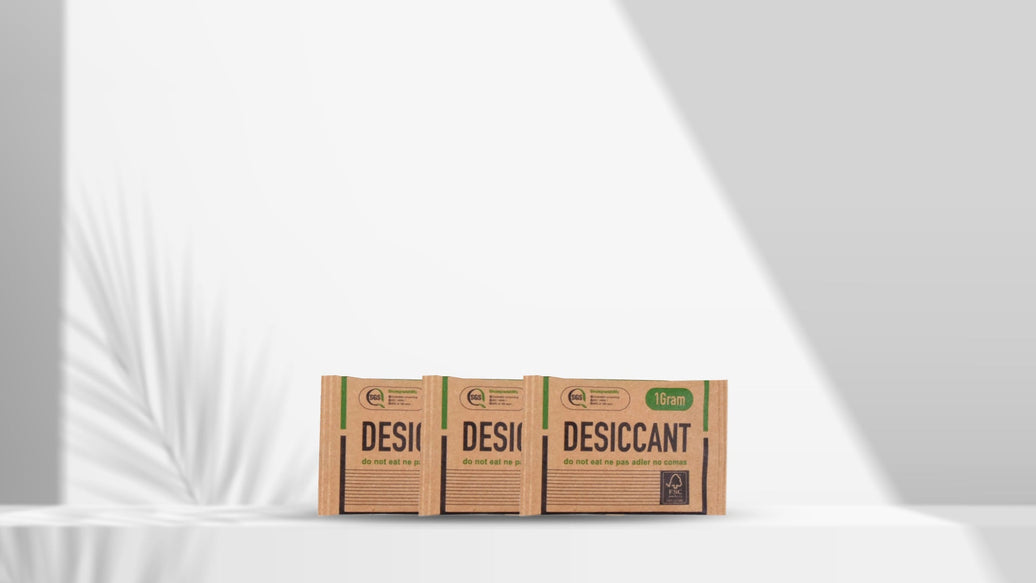
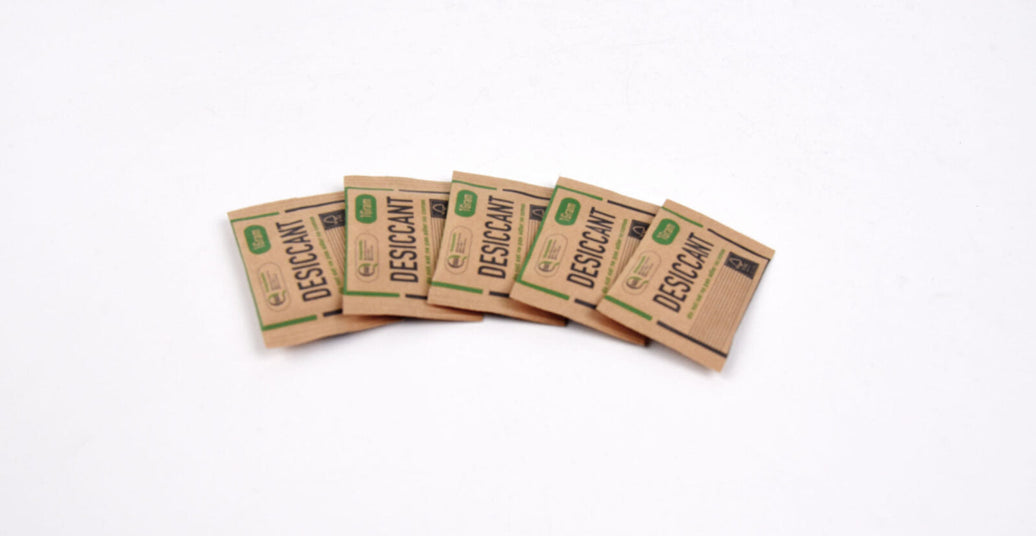
Quick answer: Divide the delivered cost of a sachet by the grams of water it will actually adsorb at the relative humidity your pack operates at — not at saturation. Two quotes that look 20% apart on price per piece often invert once dosage is normalised, because a lower-capacity desiccant needs more mass to do the same job. Then add the three costs that sit outside the quote: freight on the extra mass, packaging EPR fees charged by weight, and line downtime from dispenser jams.
Desiccant is a small line item, which is exactly why it gets bought on unit price. The problem is that a sachet is not a unit of anything useful. It is a container for a quantity of sorbent with a capacity that depends on the humidity band it operates in.
Step one: normalise on water removed
Take the humidity your pack actually holds. For a dry powder in a good barrier film that is often somewhere in the 20–40% RH range, not 90%. Capacity at that band is the number that matters.
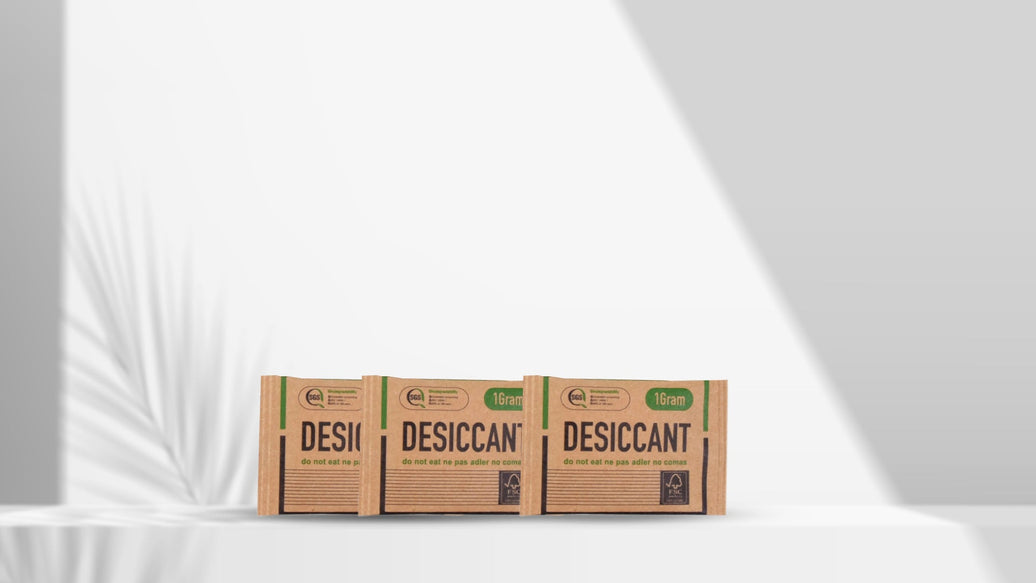
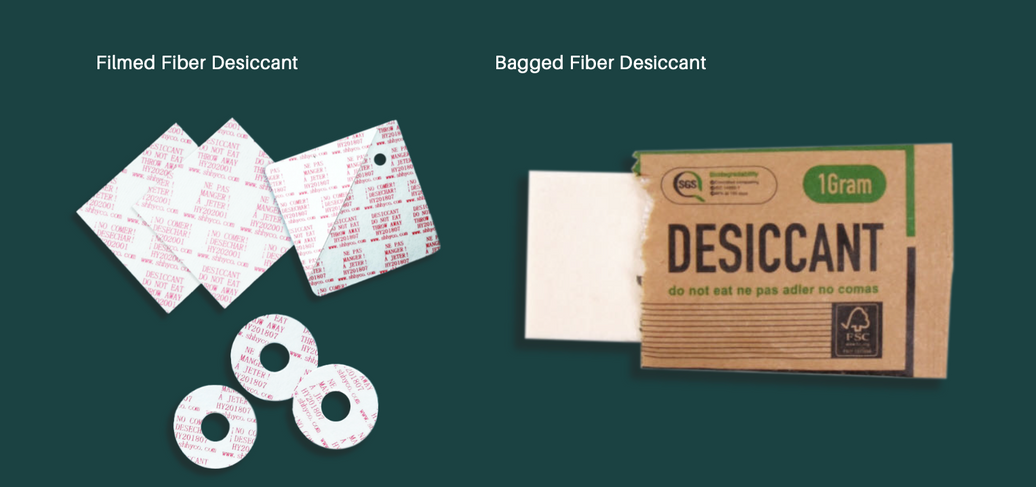
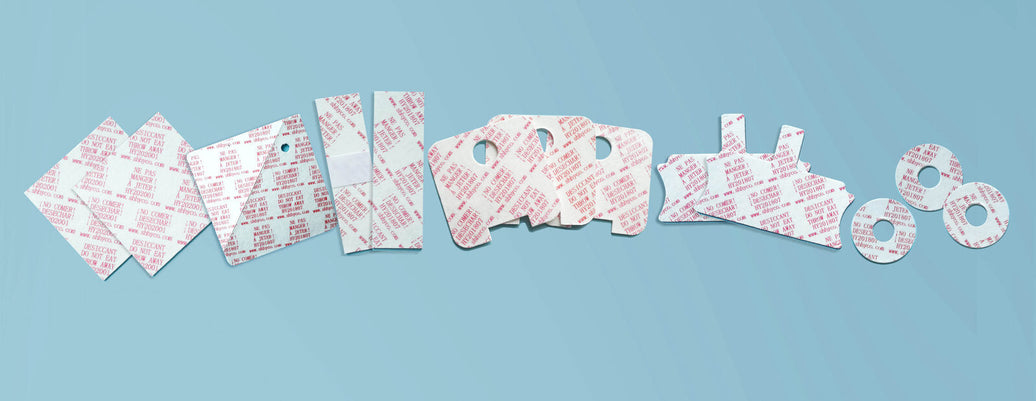
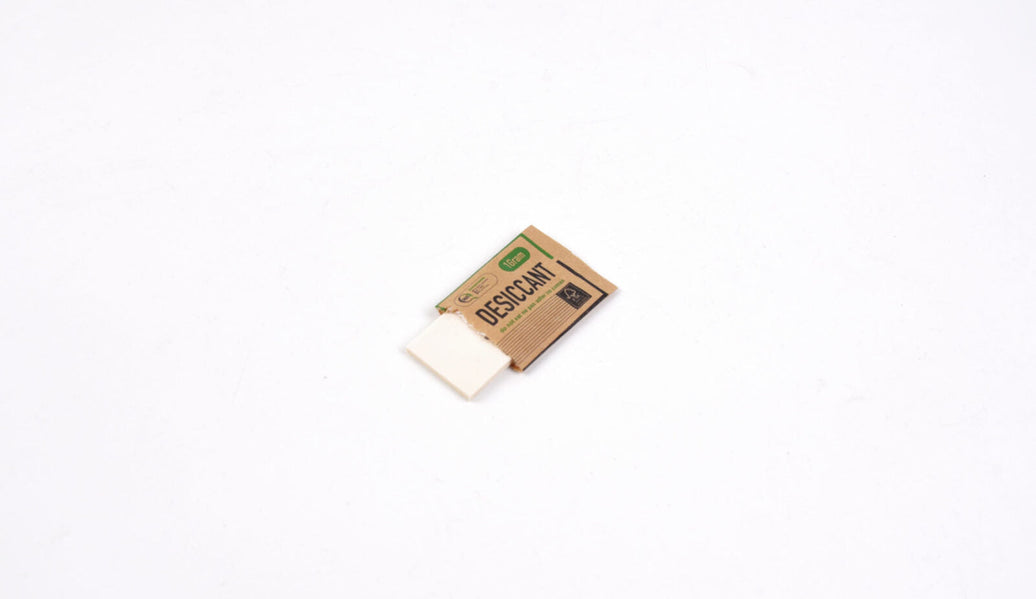
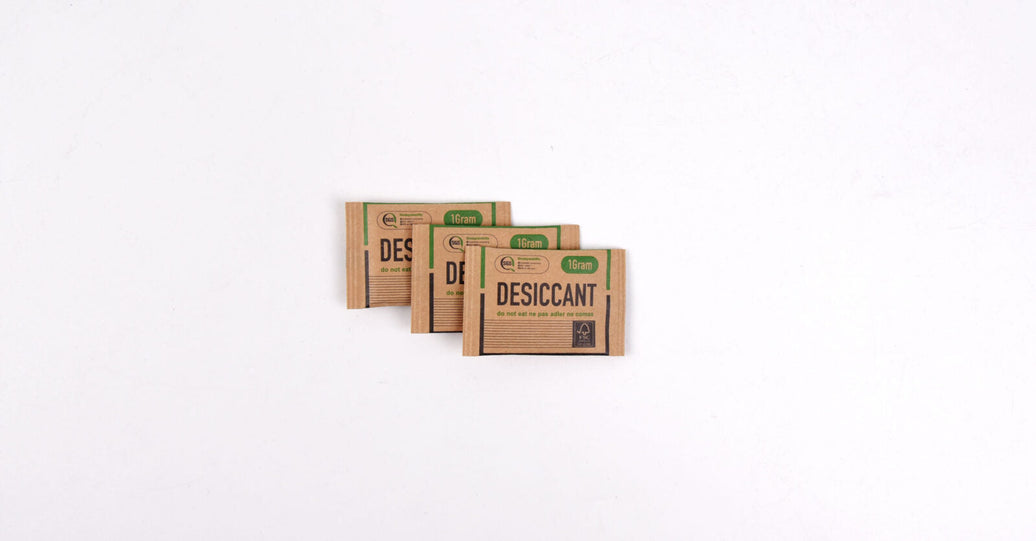
ATMOSIScience fiber desiccant adsorbs more than 10% of its own weight at 20% RH, more than 35% at 50% RH and more than 70% at 90% RH, all at 25 °C. Note how steeply the number moves. A desiccant quoted on its saturation figure and used at 25% RH is being sold on a number it will never reach in service.
The arithmetic is simple once the band is fixed:
Cost per gram of water = (delivered cost per sachet) ÷ (sachet mass in grams × capacity fraction at your RH band)
Run it for every quote using the same band. Any supplier unwilling to state capacity at a defined relative humidity, rather than a single headline percentage, has answered a different question.

Step two: add freight on the difference
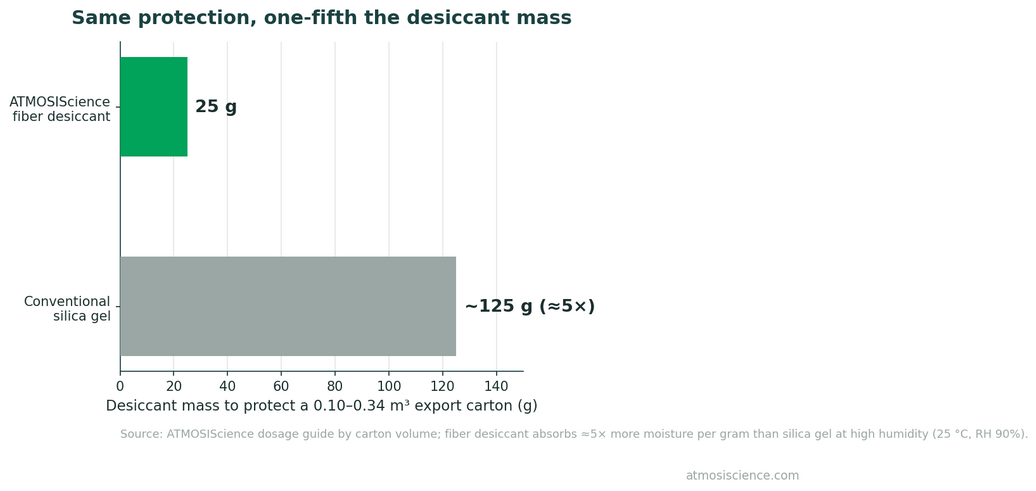
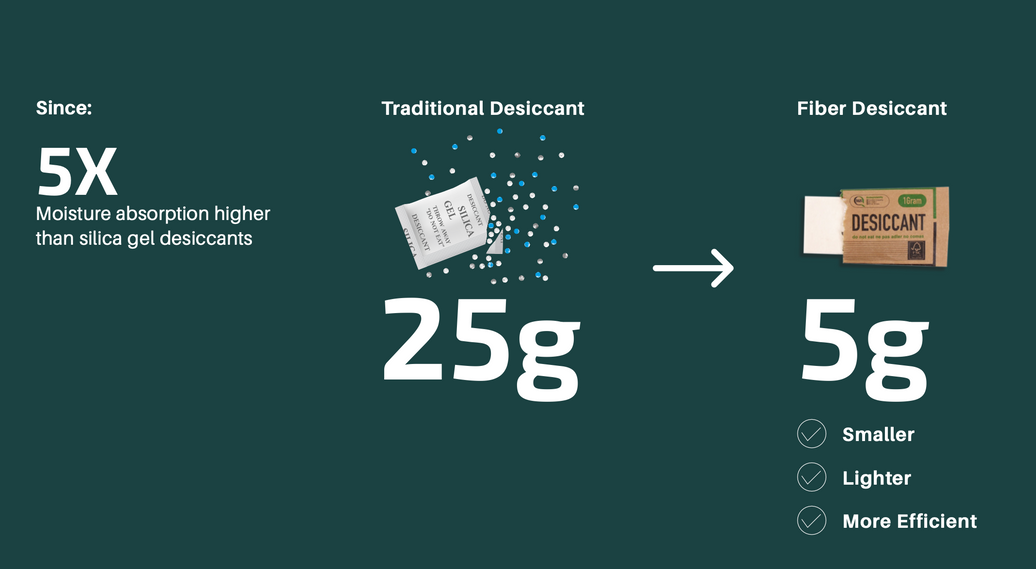
Desiccant is dense and travels a long way. If option A needs 30 g per carton and option B needs 12 g for the same protection, the freight difference on a full container is not a rounding error. For sea-freighted goods it can exceed the unit-price difference entirely. The mass comparison across desiccant chemistries is set out in the capacity comparison, and the full freight and footprint picture in the true cost of silica gel.
Step three: add packaging EPR
This is the cost line that changed most recently. Extended producer responsibility fees for packaging are charged by material and by weight, so the desiccant mass you ship into a regulated market is a recurring per-unit fee, not a one-off. Laminate and plastic categories attract substantially higher rates than fibre-based ones, which means the format decision and the fee decision are the same decision. US state schemes are covered in the US EPR fee article.
The practical effect: reducing desiccant mass reduces three costs at once — material, freight and fee.
Step four: add downtime
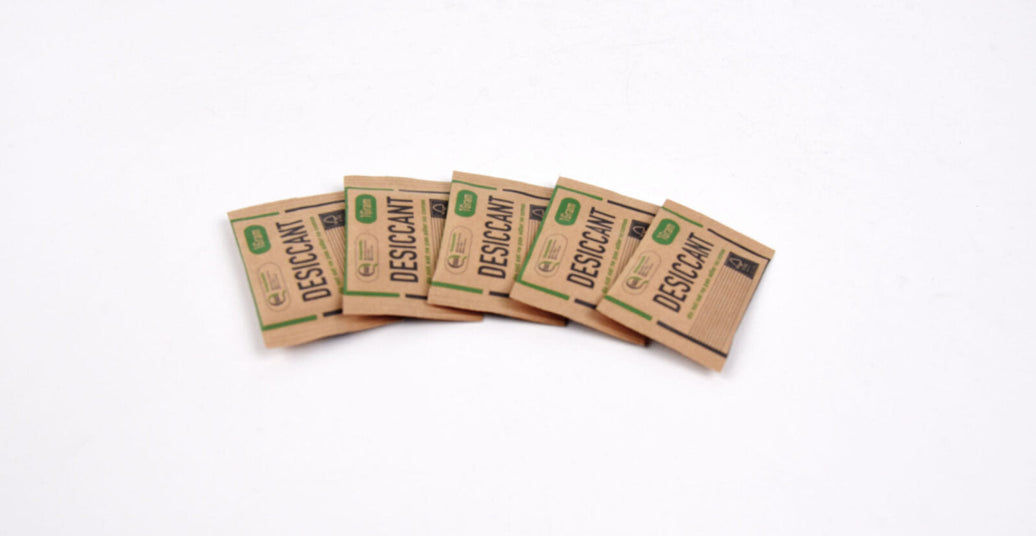
A dispenser jam costs more per minute than the sachets cost per thousand. If a cheaper sachet jams once a shift, the arithmetic is over before it starts. Ask for jam-rate data from the line trial rather than accepting a specification sheet; the trial protocol is in the validation article.
A worked comparison structure
| Line | Where it comes from |
|---|---|
| Grams of water to remove over shelf life | Film MVTR × area × time, plus initial headspace |
| Capacity at operating RH | Supplier data at a stated RH, not saturation |
| Desiccant mass required | Water to remove ÷ capacity fraction, plus safety margin |
| Delivered material cost | Quote plus inbound freight and duty |
| Outbound freight on desiccant mass | Mass per pack × packs per container |
| EPR fee | Mass × material category rate per market |
| Downtime allowance | Observed jam rate × cost per line minute |
The order matters. Dosage is derived, not quoted, so it has to be calculated before any price is compared. The method for the first row is in dosage by package volume.
Frequently asked questions
Why not just compare price per gram of desiccant?
Because a gram of one desiccant does not remove the same water as a gram of another at the same humidity. Price per gram is one step better than price per sachet and still misleading.
Should the safety margin go in the calculation?
Yes, and it should be the same margin for every option. Applying a generous margin to one and a tight one to another is the most common way a comparison gets distorted.
What if the supplier will not give capacity at a specific RH?
Request it in writing as part of the RFQ. Adsorption at defined humidity points is a standard characterisation and its absence is informative.
Does volume pricing change the ranking?
It can change the material line but rarely the freight and EPR lines, which scale with mass regardless of price. Volume pricing at tiers is covered in unit cost at volume.
Get the numbers for your own comparison
Send the pack details and the ATMOSIScience team will return capacity at your operating humidity, required mass and a delivered cost so you can complete the table.
Prefer email? info@atmosiscience.com