A tiered quote request — say 10,000, 50,000 and 100,000 units, with a target price per piece — is a completely reasonable thing for a buyer to ask for. It is also, on its own, unanswerable, because at least half of the cost of the part has not been specified yet.
This article sets out the five independent cost layers inside a desiccant quote, which of them volume actually compresses, why price per piece is usually the wrong first comparison, and what a supplier needs from you before a tiered quote means anything. No ATMOSIScience prices, minimums or lead times appear below; none of that is published. Every illustrative figure here is generic.
The short version: Volume compresses tooling, print plates and freight per unit. It does not change the capacity your product needs, the certificates you have to buy, or the duty rate — so a quantity on its own can only ever price about half the part.
Related: Fiber desiccant · Fiber technology
A quantity is not a specification
When a quantity and a reference price arrive together, the reference price almost always came from a comparable part bought somewhere else. The word doing all the work there is comparable. Two desiccant parts at the same quantity can differ by a factor of three or four in unit cost without either supplier being wrong, because they are different parts: different capacity, different conversion process, different wrap, different paperwork.
It is more useful to read a desiccant quote as layers stacked on each other, each with its own driver. Only two of them respond strongly to volume.
| Cost layer | What actually drives it | Behaviour as volume rises |
|---|---|---|
| Active material and substrate | Capacity required per pack, which is the output of a sizing calculation — not of the order quantity | Close to linear. Volume buys modest raw-material purchasing gains and nothing more |
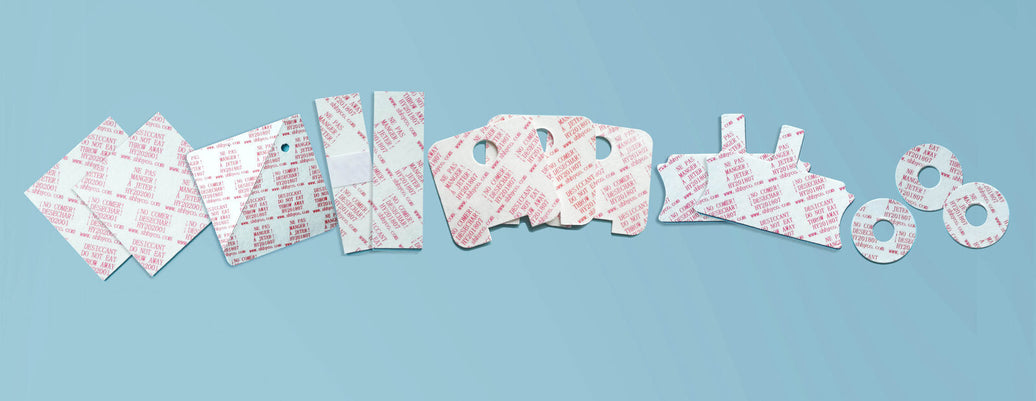
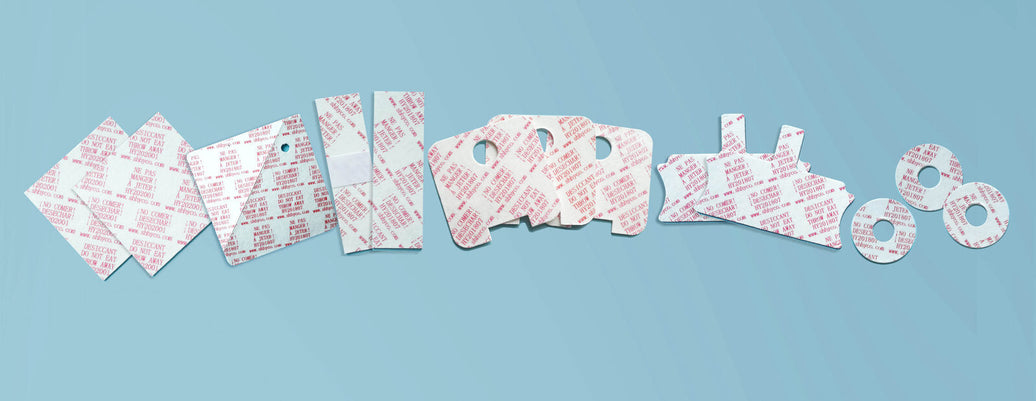
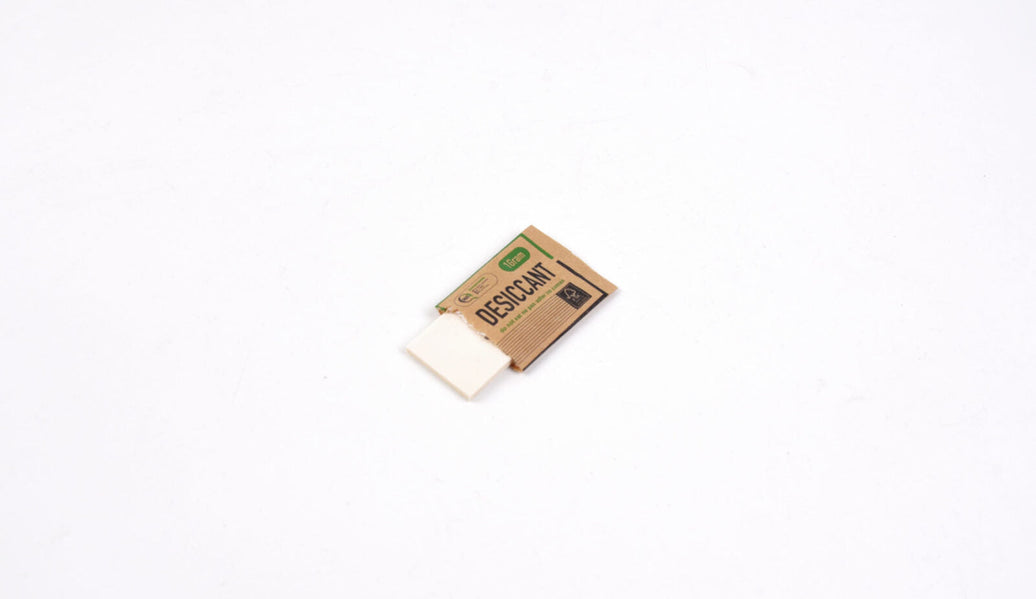
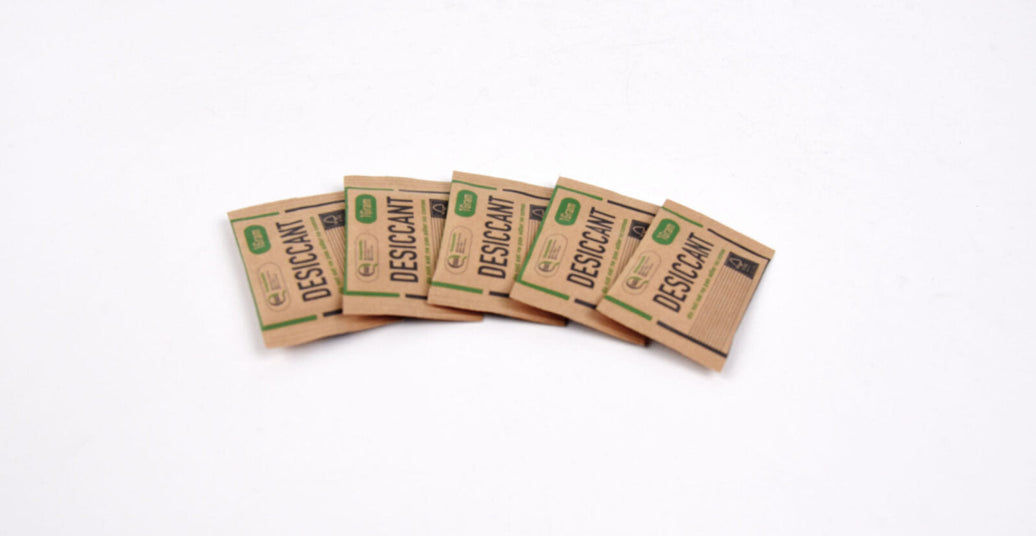
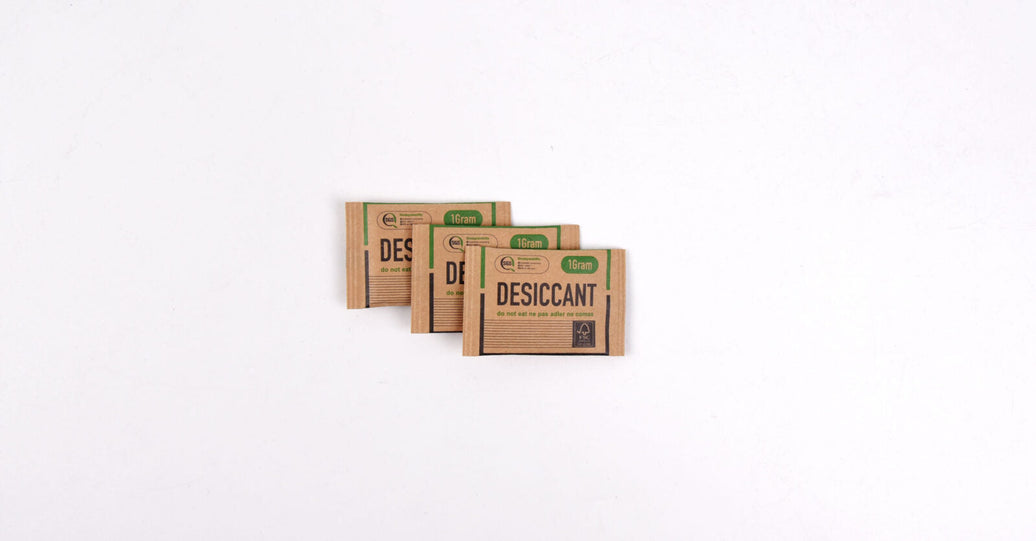
| Format and conversion | A bagged sachet, a die-cut sheet, a printed disc and a strip of stock are four different processes. Die-cut parts carry tooling, a fixed cost | Steep fall from 10k to 50k as tooling amortises; much flatter from 50k to 100k |
| Printing and branding | Number of colours, plate or cylinder cost, and whether the print sits on the wrap or on a laminated film | Amortised like tooling — the same steep-then-flat shape |
| Packaging, wrap and inner packing | Wrap specification (industrially compostable nonwoven versus food-safe flash-spun polyethylene is a real cost gap), and whether parts arrive loose, in reels or in counted inner packs | Mild. Inner-pack format usually affects your line speed more than your unit price |
| Documentation and qualification | Certificates, per-lot certificates of analysis, isotherm work, accelerated shelf-life testing | Largely fixed per programme, so proportionally heaviest at low volume |
| Logistics and duty | Freight per unit falls with container fill; duty is a rate applied to customs value | Freight falls. Duty is a percentage, so it never amortises at all |
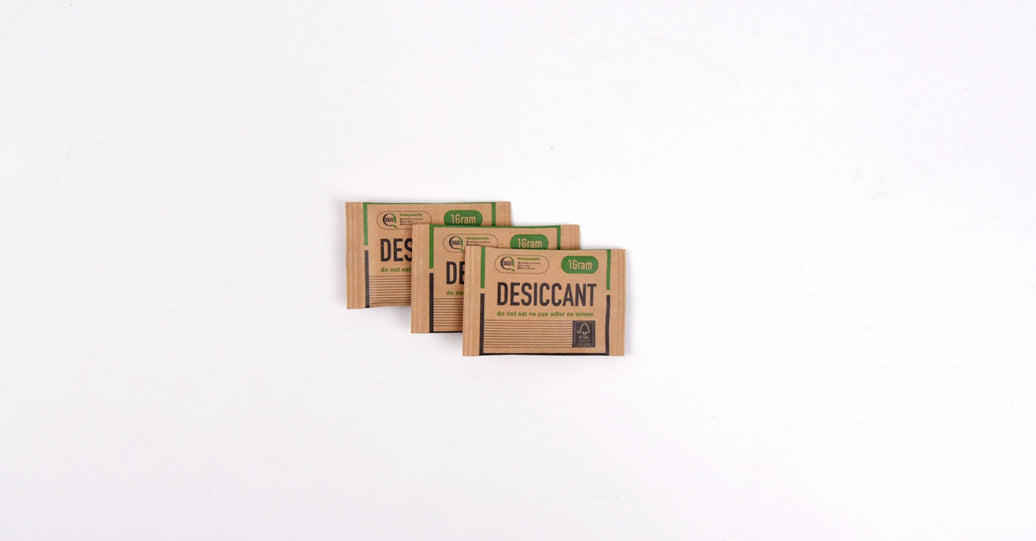
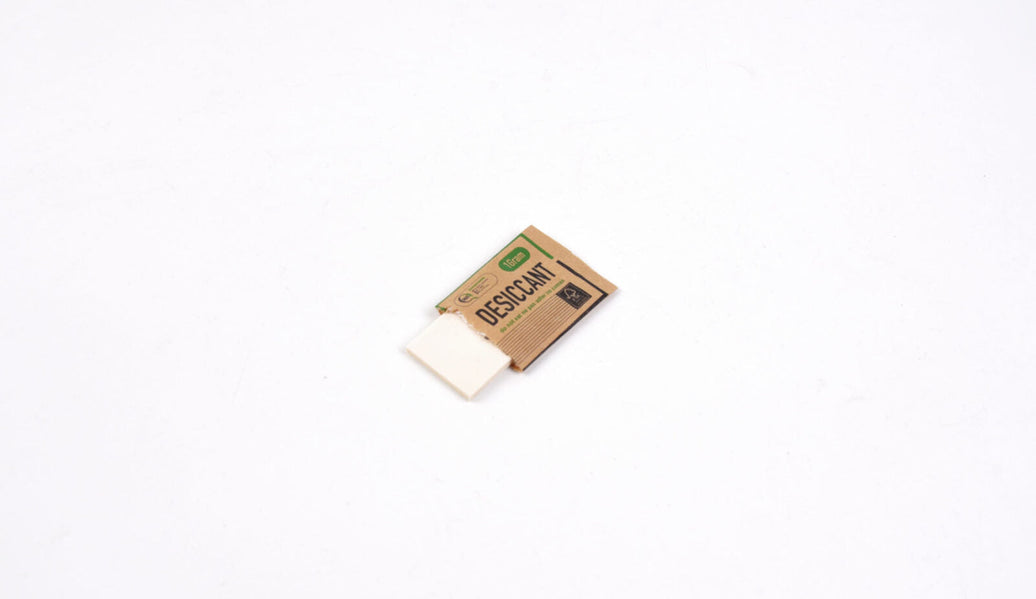
Tooling is the single biggest reason a unit cost drops steeply between 10,000 and 50,000 and then flattens. A die is bought once and its cost is spread across the run. Divide it by five times as many pieces and the per-piece share collapses; divide it by ten times as many and you have already taken most of the benefit. One clarification, because it comes up often: a custom diameter is a tooling decision, not an R&D one. Asking for a non-catalogue disc does not open a development project. It opens a die.
Why "price per piece" is usually the wrong first metric
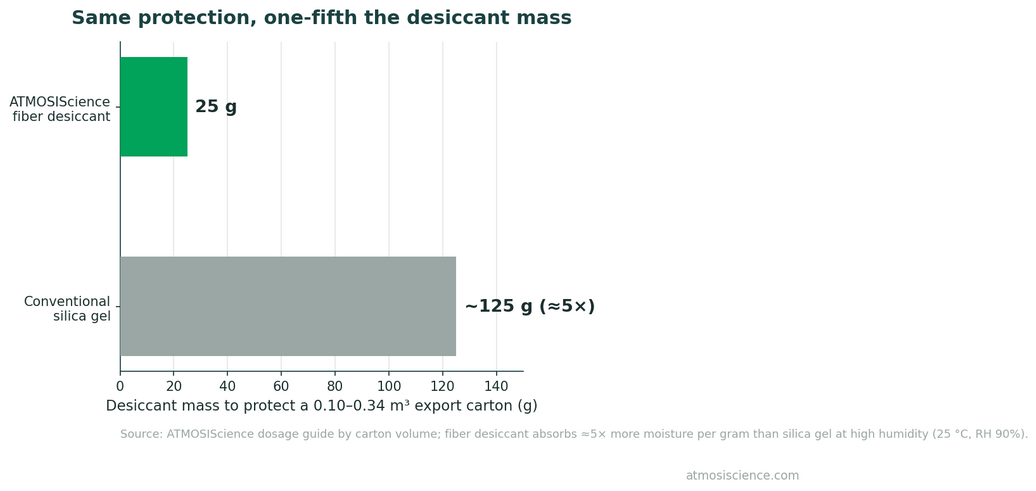
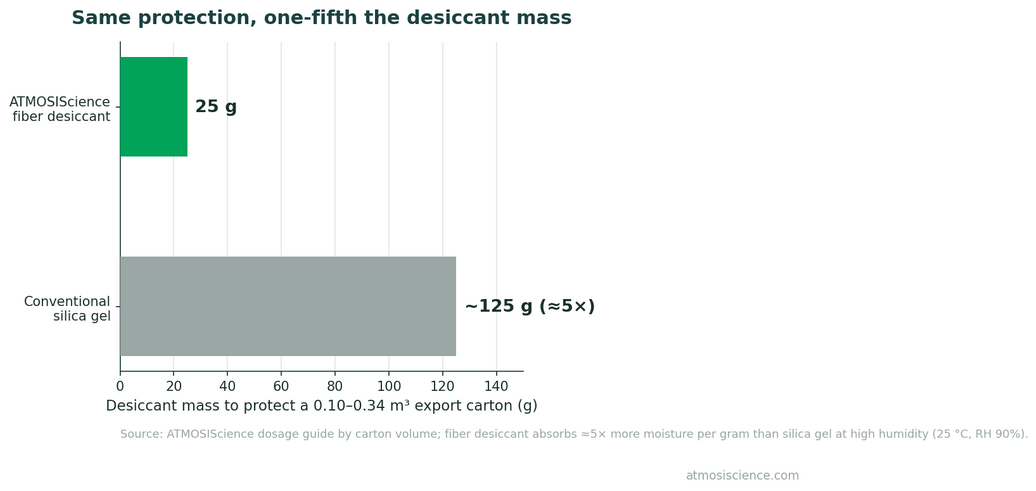
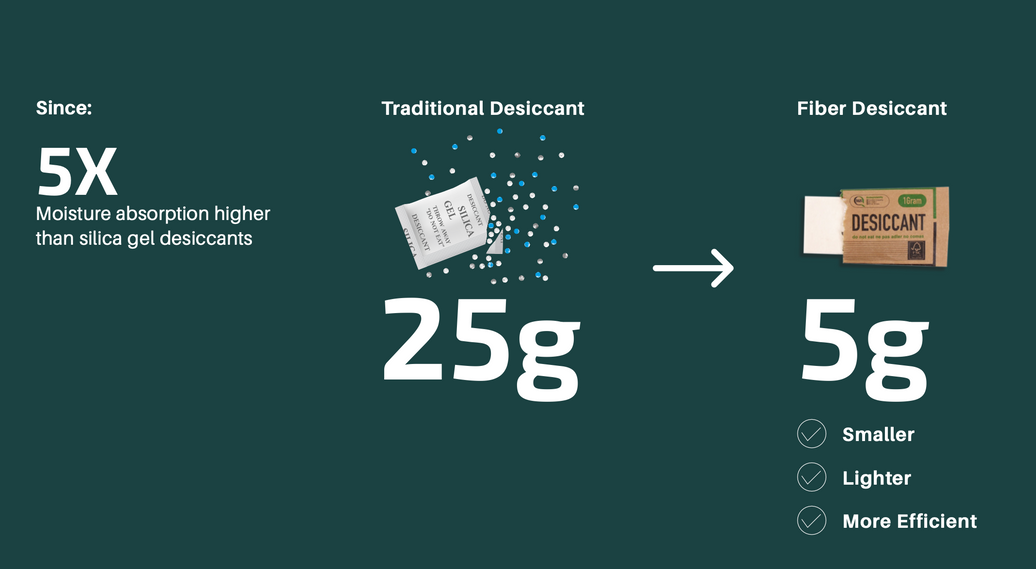
Price per piece silently assumes the two pieces do the same job. Often they do not. If a correctly sized fibre part replaces a heavier silica gel sachet, the honest comparison is not part against part — it is cost per protected pack.
A currency for that comparison already exists. MIL-D-3464E defines a desiccant unit by performance, not mass: one unit adsorbs at least 3.00 g of water at 20% RH and at least 6.00 g at 40% RH, both at 25 °C. Different materials therefore need different masses to deliver one.
| Material | Grams to deliver one MIL-D-3464E desiccant unit | Relative mass for the same protection |
|---|---|---|
| Plant-fibre desiccant | 18 g | 1.00× |
| Silica gel | 30 g | 1.67× |
| Clay | 35 g | 1.94× |
Read that table as a warning about quotes priced per gram or per fixed-mass sachet: those quotes are pricing packages, not protection. A cheaper gram that you need twice as many of is not cheaper.
Three second-order effects go missing from almost every comparison. Pack size and headspace: the part has to fit, and in a small pack the space it occupies was already paid for when you tooled the pack. Insertion equipment: a sachet dropped by a feeder and a die-cut disc placed by a pick-and-place head are not interchangeable on an existing line, and the retrofit is a one-off cost that belongs in the comparison rather than in a later surprise. And an oversized desiccant costs you twice — once in material you did not need, and again in volume inside a pack you are already paying to make and ship.
Incoterms and payment terms, for the person comparing two quotes
Most quote comparisons that go wrong go wrong here, and the failure is arithmetic, not judgement: two prices compared as if they covered the same scope when they do not.
| Term | Seller's cost ends at | Risk transfers at | What the buyer must still add |
|---|---|---|---|
| EXW | Goods available at the seller's premises | Collection, at the seller's premises | Export clearance, inland haulage, main freight, insurance, import clearance and duty, final delivery |
| FOB | Goods loaded on board at the named port of shipment | When goods are on board | Main freight, insurance, import clearance and duty, final delivery |
| CIF | Named destination port, including freight and minimum insurance | On board at origin — cost and risk transfer at different points | Import clearance and duty, final delivery, any insurance cover above the minimum |
| DDP | Named place of delivery, import duties paid | On arrival at the named place | Little or nothing — but the duty line is invisible inside the price |
So comparing an EXW price against an FOB price is comparing two different scopes, and the gap between them is not margin, it is freight and clearance you have not costed yet. Insist on one Incoterm across every quote you compare. CIF deserves particular care because cost and risk part company: the seller pays freight to the destination port while you carry the risk from the moment the goods are loaded at origin.
Payment terms belong in a separate conversation. Cash against documents, a deposit against telegraphic transfer, a letter of credit, open account at 30 or 60 days — these are risk-allocation instruments, not price mechanisms. A supplier who accepts a longer term is financing you, and that financing has a cost which reappears somewhere in the number. Negotiate terms as their own line item, and be sceptical of a price improvement that is really a term change wearing a disguise.
Duty is the unpriced variable in every US quote
For imports into the United States there is a published starting point. CBP binding ruling NY N292791 classified desiccant bags of 80% calcium chloride and 20% starch under HTSUS 3824.99.9295 at 5% ad valorem. Chinese origin in that heading also carries Section 301 List 1 at an additional 25%, plus a temporary Section 122 surcharge of a further 10% under Chapter 99 heading 9903.03.01 — roughly 35% stacked. There is no antidumping or countervailing duty order and no safeguard in force on desiccants, so at least that category of surprise is absent.
| Layer | Basis | Effect on customs value |
|---|---|---|
| HTSUS 3824.99.9295 (per ruling NY N292791) | Classification | 5% ad valorem |
| Section 301 List 1 | Chinese origin in this heading | +25% |
| Section 122 surcharge, heading 9903.03.01 | Origin, temporary measure | +10% |
| AD/CVD order or safeguard | — | None in force on desiccants |
| Illustrative stacked total | ≈35% |
Now the useful part, which almost nobody raises: no CBP ruling exists for a fibre, cellulose or paper desiccant sheet. A filmed fibre sheet could plausibly be classified in Chapter 38 as a chemical preparation, following the logic of the calcium chloride ruling, or in Chapter 48 as an article of paper or cellulose. The duty consequences of those two readings are materially different. Until somebody requests a binding ruling on the specific article, classification is a real unpriced variable sitting underneath every US quote for this format.
The practical move costs nothing: ask each supplier, in writing, which heading they classify under and on what basis. A supplier who cannot answer has not thought about your landed cost. Note the structural point too — duty is a rate, not a fixed charge. Thirty-five percent at 100,000 units is thirty-five percent at 10,000. It is the one line in the stack volume cannot touch.
A regulatory cost buyers are now starting to feel
Extended producer responsibility for packaging is now enacted in California, Washington, Oregon, Maine and Colorado. The detail that matters for a desiccant is structural. California SB 54's implementing regulation at 14 CCR §18980.1(a)(4)(B) counts each detachable component individually, and the de minimis carve-out at §18980.2.2 requires that the component not be independent or detachable.
The consequence for cost is direct: a die-cut sheet bonded into a pack can qualify for that carve-out, where a loose sachet inside the same pack never can. That is decided at specification stage, on a drawing, and it carries a recurring fee consequence for as long as the SKU exists. We do not publish a fee rate here — the schedules are not settled, and quoting one would be worse than useless.
This article is general information, not legal advice. Verify current obligations against your own products and counsel.
What a supplier needs from you to quote properly
- The product and its target water activity or target interior relative humidity. This is what sets capacity, and capacity sets material cost.
- The pack and its WVTR, with the test standard and conditions. ASTM F1249, ASTM E96 and ASTM D7709 are the usual routes. A WVTR quoted without its conditions is a number without meaning.
- The calculated capacity required, or enough information for us to calculate it. For moisture-barrier bags the standard route is JEDEC J-STD-033, U = (0.304 × M × WVTR × A) / D.
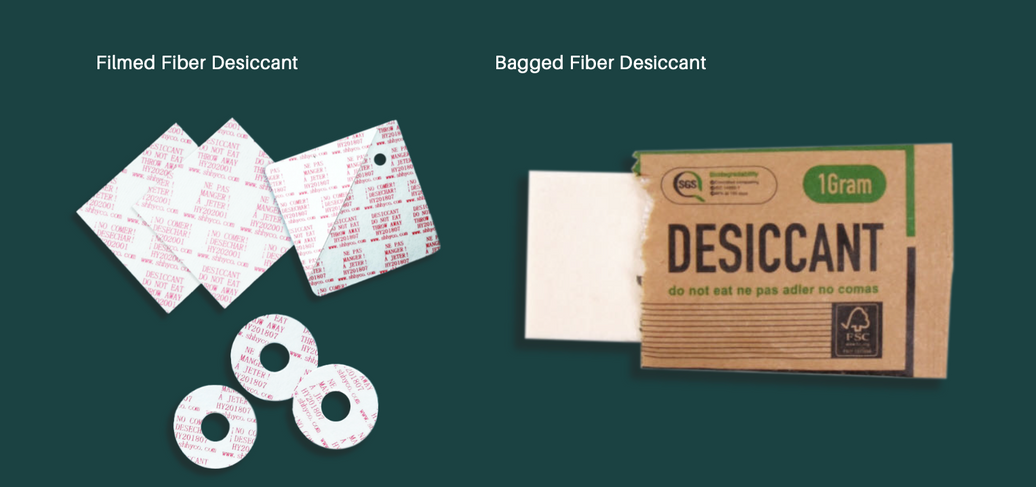
- The format and dimensions — sachet, die-cut disc, sheet, cap liner or tag; thickness; and whether the diameter is already fixed by an existing closure.
- Whether printing is needed, in how many colours, and whether it sits on the wrap or on a laminated film.
- Annual volume and call-off pattern, not a single number. 100,000 pieces in one shipment and 100,000 across twelve monthly call-offs are different costs to produce and to hold.
- Destination and Incoterm — and the same Incoterm on every quote you intend to compare.
- The documentation set required: which certificates, whether per-lot certificates of analysis are needed, and whether accelerated shelf-life testing is in scope.
What genuinely changes between 10k, 50k and 100k
| Compressed by volume | Unmoved by volume |
|---|---|
| Tooling and print-plate amortisation — steeply from 10k to 50k, far less from 50k to 100k | The capacity the product needs, which comes from the sizing calculation |
| Run length and changeover efficiency: fewer setups per thousand pieces | The certificates and the qualification testing behind them |
| Raw-material purchasing, in modest single-digit steps | The duty rate, which is a percentage of value |
| Freight per unit, through better container fill | The open classification question on fibre sheet formats |
Which is why a tiered quote is worth asking for — the tiers are real — but only once the part exists on paper. Send the specification first and the tiers arrive with it. Send the quantity alone and any number that comes back is a guess with a decimal point.
Frequently asked questions
Can you not give me a ballpark before I have a full spec?
We can tell you which cost layer will dominate your part, which is often the more useful answer. What we will not do is quote against a capacity, a format and a wrap nobody has agreed — that number will be wrong in one direction and you will build a budget on it.
Does a custom diameter mean development cost?
No. It is a tooling decision. A die is a fixed cost amortised across the run, which is why a bespoke size looks expensive at 10,000 and unremarkable at 100,000.
Why is 50,000 so much better than 10,000, but 100,000 barely better than 50,000?
Because the fixed costs — tooling, plates, setup — are mostly absorbed by 50,000. Beyond that you are buying material purchasing and run efficiency, which move in single-digit percentages, not step changes.
One supplier quoted FOB and another quoted EXW. Which is cheaper?
Unanswerable as stated. The EXW price excludes export clearance, inland haulage and loading. Ask both to requote on the same term before you compare anything.
Who actually pays the Section 301 tariff?
The importer of record pays CBP. Under FOB or CIF that is you; under DDP it is the seller, priced invisibly into the unit cost. Either way somebody pays it, it is calculated on customs value, and it does not get cheaper at volume.
Send the part, not just the number
The fastest route to a real tiered quote is to send the product, the pack and its WVTR, the format and the destination. We will come back with a sizing calculation, the matching format and the certificate pack — and tiers that mean something.
Start on the fiber desiccant page, or email info@atmosiscience.com.
Related reading: Desiccant qualification: from sample to PO · How to spec a jar-lid disc: diameter, cap finish and attachment
Tell us the product, not just the part number
Send us what you are packing, the pack format and the humidity or shelf-life target. We will come back with a sizing calculation, the matching format and the certificate pack.