Quick answer: A humidity-control panel is a porous mineral board — vermiculite in a fibre-reinforced calcium silicate substrate — coated with the same precision humidity-control chemistry used in fiber packs. In R&D trials it delivered four times the moisture-regulating capacity of the national-standard reference, held relative humidity uniform across a room and stable over time, and sharply reduced how long the room’s conditioning equipment had to run. Optimal coating weight was established at 600–800 g/m² and substrate moisture content at below 10%. It does not replace HVAC. It stops HVAC from having to react to every swing.
There is a limit to what an in-pack solution can do, and most powder and supplement operations meet it in the same place: the room.
A desiccant sized correctly for a sealed pouch is doing its job. It is not doing anything for the drum sitting open on the mezzanine, the tote waiting for its turn on the blender, the sachets in the hopper, the pallets staged overnight in a warehouse that runs at 68% RH in July.
Those are room problems, and they need a room answer.
Three layers, three owners
Moisture risk in a facility sits in three layers, and confusing them wastes money in both directions.
| Layer | Owns | Typical tool |
|---|---|---|
| Room | Open material, staged pallets, exposed line time, operator conditions | HVAC, dehumidification, passive buffering |
| Process | Blend uniformity, flow, fill weight, static | Local conditioning, enclosure, exposure limits |
| Package | Everything after the seal | Barrier film, desiccant, two-way pack |
Adding desiccant to compensate for an uncontrolled room is the most common mis-assignment, and it is expensive because it treats a recurring cause with a per-unit consumable. The layer framework is worked through in room, process or package — which layer owns which risk.
What a humidity-control panel actually is
Take the same chemistry that sets a target humidity in a fiber pack — a two-component salt system whose equilibrium RH is governed by ion concentration in solution, described in designing to a target humidity — and put it on a different carrier.
Instead of a plant-fibre sheet, the carrier is a porous mineral board: fibre-reinforced calcium silicate with vermiculite added, coated so the humidity-control composition is held throughout the porous structure. The result is a building material rather than a packaging component: a tile you install on a wall or ceiling and leave for a decade.
Against national-standard reference data for humidity-control building materials, the coated board delivered four times the moisture-regulating capacity.
Three findings that decide how it is built
Thickness works against uptake. Moisture uptake declines as the thickness of the inorganic porous board increases — the same relationship found in the plant-fibre material, where thinner substrate means greater specific surface area and faster, more reversible response. A thicker panel is not a better panel; surface area does the work, not bulk.
Coating weight has an optimum, not a maximum. Trials across a range of coating weights established 600–800 g/m² as the optimum. Below it there is not enough active chemistry; above it the coating starts to occlude the porous structure it depends on.
Substrate moisture must be below 10% before coating. A damp board takes up less solution and lands at a different equilibrium than intended — which means the finished panel misses its target humidity. This is the same control that governs the plant-fibre line, where raw-fibre water content is one of the six in-process checks described in how a fiber desiccant is made.
Application method was also studied and specified, because coating technique affects appearance quality on a surface that will be visible for its whole service life.
What it did in the trial room
The application study used a model storeroom, and it produced two distinct results worth separating.
The functional result. Relative humidity inside the storeroom became uniform in space and stable in time. Both halves matter. Most rooms are not uniform — near a door, near a wall, high on a rack and low on a pallet are different microclimates, which is why mapping a room before specifying anything is worth the fortnight it takes. And most rooms are not stable, because conditioning equipment works in a cycle: sense a deviation, run, overshoot, stop, drift back.
The energy result. The panels greatly reduced the running time of the room’s power system, delivering long-term energy saving.
The mechanism is the interesting part. A passive buffer does not do the dehumidification. It flattens the swings the equipment would otherwise have to chase. Absorb a rise before the sensor sees it, release into a fall before the humidifier starts — and the equipment duty cycle collapses. The room does less work because the walls are doing some of it.
From research to installed product
The commercial form of this is Humigic: lightweight, easy-to-assemble tiles of vermiculite and attapulgite blended with hydrophilic composites and anti-condensation fibre technology, with a stated lifespan of 10+ years and mould resistance built in.
Paired with a microclimate control system that integrates with existing HVAC or humidifiers, the reported outcome is that HVAC remains off 80% of the time. That figure carries its scope with it, and it should always be quoted with it: it is based on data from museums in China using Humigic over the past decade, and actual energy savings vary by facility — a cultivation room, a warehouse and a gallery are not the same thermal problem.
Museums are where the technology matured, for a reason that transfers directly to warehousing: a collection needs a stable value, not a low one, and the cost of getting there with equipment alone is enormous. The conservation background is in desiccant for museums and fine art.
The control system side is the newer half: integration with existing HVAC, a coordination strategy across equipment, and cloud collection of the resulting data. Which means a passive buffer stops being invisible — you can see what it absorbed and what the equipment did not have to do.
The lighter option: mats rather than panels
Not every space justifies a fit-out. A humidity-control mat puts the same principle in a flexible, cuttable form: dry fibres from recycled wood and bamboo, no single-use plastics and no corrosive saltwater, supplied with a dotted tear line every 30 cm so it can be split by hand, hung on racks, or dropped into barrels and containers. Shape, size and the fibre’s target relative humidity are all specifiable.
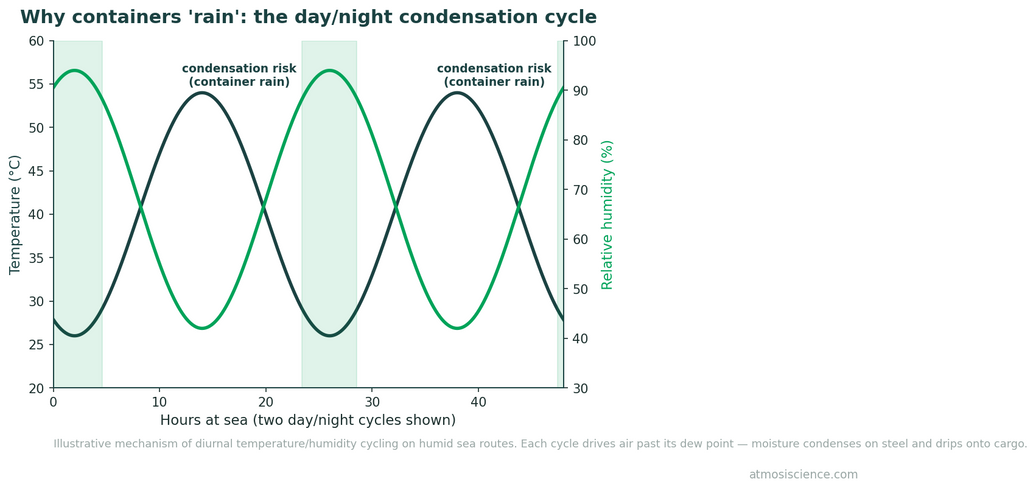
That makes it a sensible answer for enclosed volumes that are not rooms: a shipping container, a bulk store, a rack bay, a staging cage. For containers specifically, the sizing and failure modes are in stopping container rain; for bulk formats, FIBC bulk bags and drums.
Where this earns its keep in a powder operation
The filling room. A stable room raises the effective capacity of every desiccant you insert and extends how long an opened bag can sit out — the arithmetic is in the 30-minute rule. It also stabilises fill weights, which is a yield question before it is a quality question: how in-plant humidity taxes powder packing lines.
The blending area. Humidity drives segregation, static and assay variance, and those effects are set before the pack exists. See how humidity wrecks blend uniformity.
Staging and warehousing. Finished goods waiting on pallets, and inventory sitting in third-party warehouses whose conditions you do not control — the problem described in desiccant for FBA and 3PL inventory.
Anywhere cold meets warm. A buffered room damps the humidity spike that follows product coming out of chilled storage, before it becomes surface condensation — see why products sweat after cold storage.
Establish these five things before specifying
- Your target RH and tolerance. A buffer is designed around a set point. “As dry as possible” is not a specification, and for most powders it is not even desirable — see why ‘drier is better’ is wrong.
- A logged RH map of the space. Multiple points, across a full operating cycle including shift changes and door events. Without it you cannot size anything or prove an improvement afterwards.
- The moisture load. Air changes, door openings, wet processes, people, product coming in and out. A buffer absorbs swings; it does not absorb a continuous load that exceeds it.
- Surface area available. Panels work through exposed surface. Walls behind racking are not participating.
- What the HVAC currently does. If you cannot state the present duty cycle, you will not be able to demonstrate the saving — and the energy case is usually what funds the project.
Frequently asked questions
Does this replace dehumidification?
No, and any supplier telling you otherwise is overselling. A passive buffer smooths swings and reduces equipment run time. A continuous moisture load — a wet process, high air change rate, a leaky envelope — still needs active removal. The panels change the duty cycle, not the physics.
How long does it last, and does it need recharging?
Stated lifespan is 10+ years. Because the material is two-way, it releases moisture back during dry periods rather than saturating permanently — the room’s own daily cycle is what regenerates it. That is the structural difference between a buffer and a consumable desiccant.
Is the 80% HVAC reduction transferable to my warehouse?
Treat it as evidence that the mechanism works at scale over a long period, not as a number to put in your own business case. It comes from museum installations in China over a decade, and the source explicitly notes that savings vary in other facility types. Model your own from your current duty cycle.
What about mould on the panels themselves?
Mould resistance is a stated property, and the underlying fibre chemistry has been tested to a standard fungal challenge method — the methodology and grading are in the 28-day mould growth test. Ask for the test on the panel product specifically, not only on the fibre.
Can I start smaller than a full room?
Usually the right move. Buffer one enclosure — a staging cage, a container, a single bay — with mats, log the RH before and after, and use the result to size a room installation. It is a cheap way to find out whether your problem is really a swing problem or a load problem.
Have a room problem, not a pack problem?
Send us your RH log, the room dimensions and what the space is used for. We will tell you honestly whether passive buffering will help, or whether what you have is a load your equipment has to handle.
Prefer email? info@atmosiscience.com