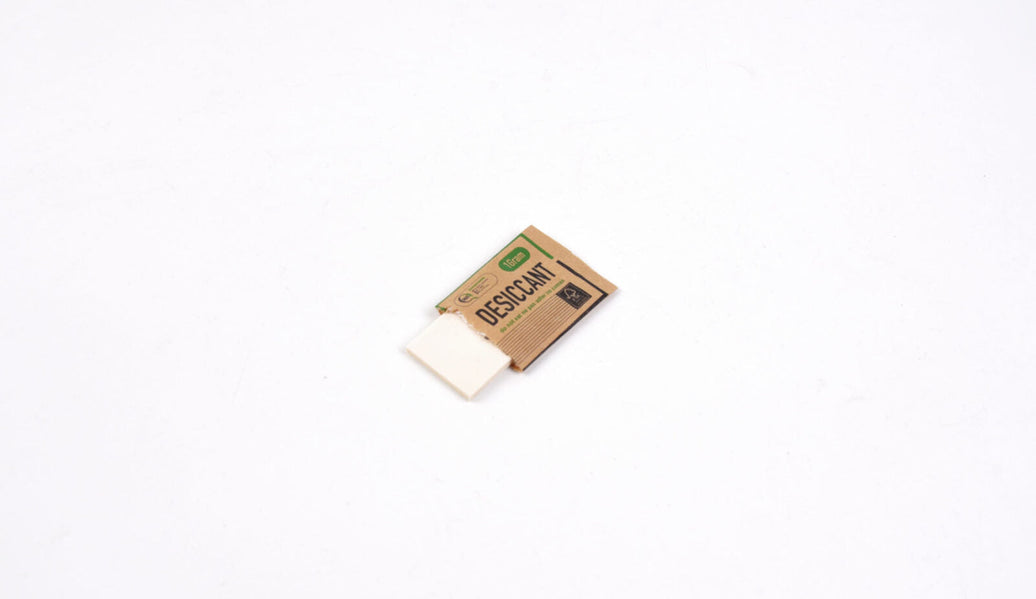
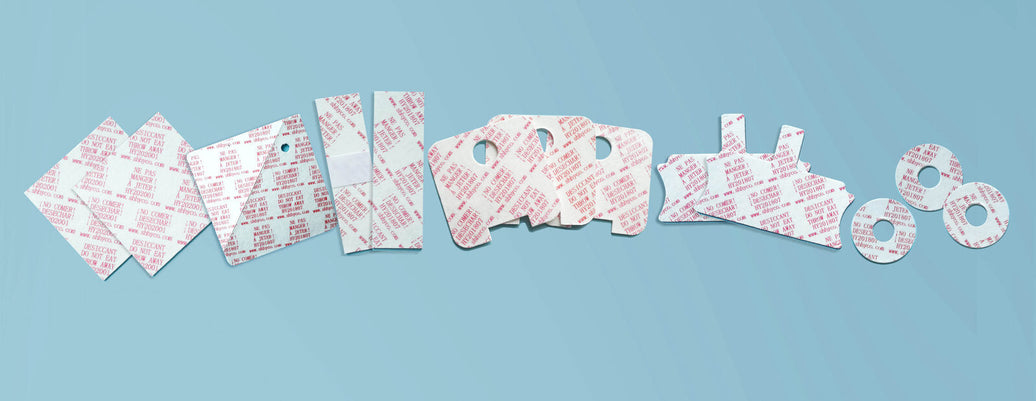
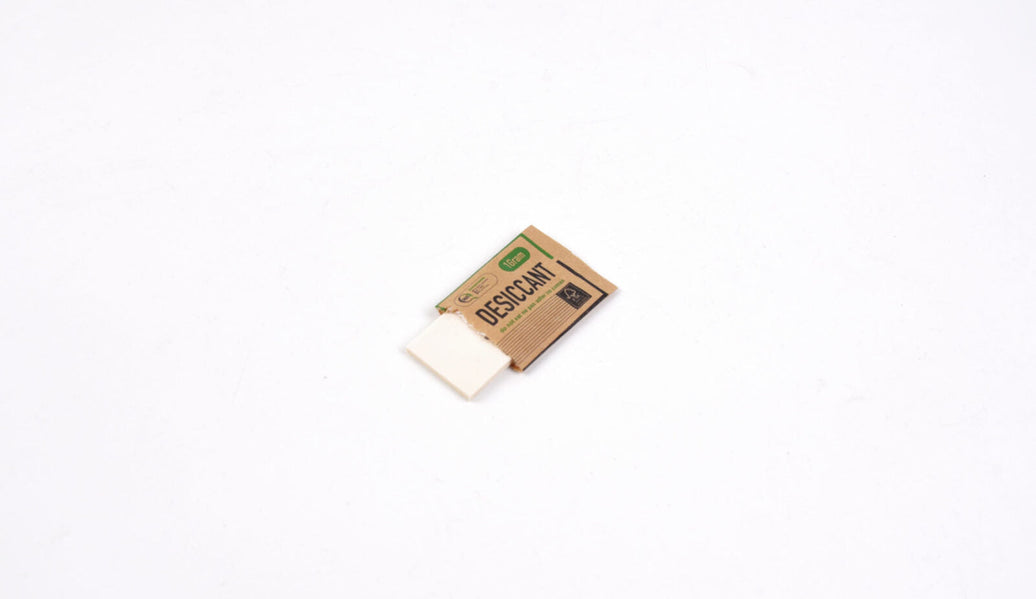
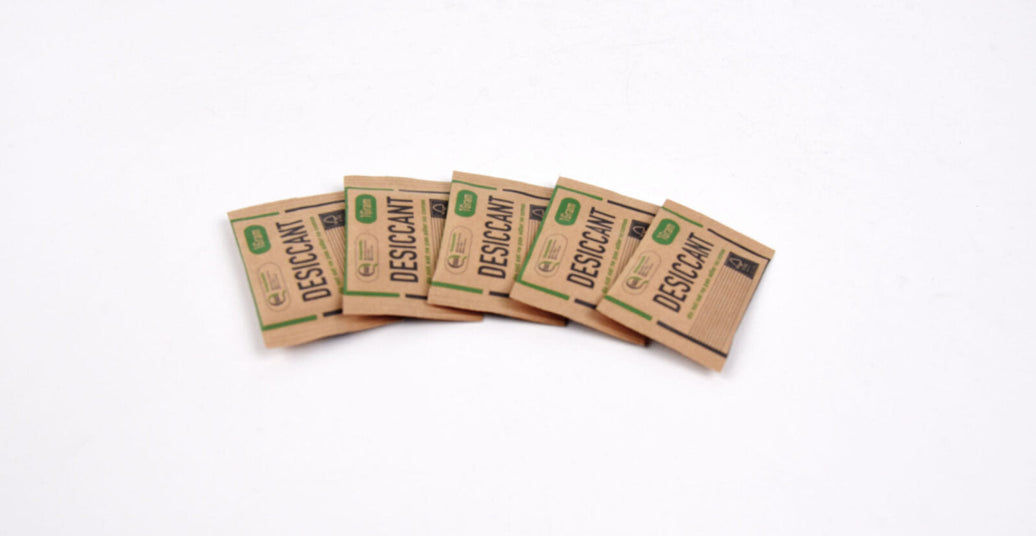
Quick answer: In SGS test report SHAHG2107860101 (29 April 2021), a white fiber desiccant sheet was analysed for halogens with reference to EN 14582:2016, determined by ion chromatography. Fluorine, bromine and iodine were not detected at a method detection limit of 50 mg/kg. Chlorine came back at 159 mg/kg — 0.0159% by weight. That trace of chloride is intrinsic to the calcium and sodium salt chemistry that makes the sheet adsorb, and it is roughly three orders of magnitude below what you would measure on a calcium-chloride desiccant, where chloride is the active ingredient.
Halogen testing on a desiccant is one of those requests that arrives from a customer’s compliance team, lands on a packaging buyer’s desk, and gets forwarded to a supplier with no accompanying explanation of what would count as a good answer.
So before the numbers: why does anyone ask a moisture absorber about halogens at all?
Three separate reasons, and they are not interchangeable
Corrosion. This is the one that matters most in food, pharmaceutical and powder packing. Halides — chloride above all — drive pitting corrosion on stainless steel and attack aluminium, brass and magnesium alloys. That is a concern for metal closures, foil laminates, induction-seal liners, aerosol and can formats, and for the stainless contact surfaces on your own filling line.
Electronics and assembly. Halogen content is a standing question in electronics supply chains, where residual halides on any material entering a moisture-barrier bag are treated as a reliability risk. If your desiccant supplier also serves electronics customers, the halogen report usually exists because of them.
End-of-life. Halogenated material behaves differently in incineration and in recycling streams. A buyer building an environmental file may want the halogen figure alongside the recyclability assessment and the composition data.
The three questions have different thresholds and different evidence needs. Find out which one you are actually being asked before you go looking for a number.
What the test does
The report references EN 14582:2016 and states that analysis was performed by IC — ion chromatography. In outline, the halogens bound in the sample are liberated by combustion in a closed system, captured in an absorbing solution, and the resulting halide ions separated and quantified chromatographically.
Two things follow from that, and both matter when you read the result.
First, it measures total halogen, not free or extractable halide. A chloride ion locked into a salt and a chloride atom bonded into a polymer both report. The number tells you what is present, not what is mobile.
Second, the answer is bounded by a detection limit, not by zero.
The results
| Test item | Unit | MDL | Result |
|---|---|---|---|
| Fluorine (F) | mg/kg | 50 | ND |
| Chlorine (Cl) | mg/kg | 50 | 159 |
| Bromine (Br) | mg/kg | 50 | ND |
| Iodine (I) | mg/kg | 50 | ND |
SGS SHAHG2107860101, sample described as white fiber sheet. ND = not detected, below the method detection limit. 1 mg/kg = 0.0001%.
Reading “ND” honestly
Not detected does not mean absent. It means below 50 mg/kg by this method. For fluorine, bromine and iodine, that is a meaningful statement — none of them has any business being in a plant-fiber sheet, and none showed up — but the correct way to write it in a specification is < 50 mg/kg, not zero.
Buyers who write “halogen-free” into a purchase specification without defining a threshold create a problem for themselves later, because no material is halogen-free at infinite sensitivity. Define the number and the method, or the clause is unenforceable. This is the same discipline that applies to every other line on a supplier certificate — see what a desiccant certificate actually covers.
Why chlorine is there — and why 159 mg/kg is small
The chloride is not contamination. It is chemistry.
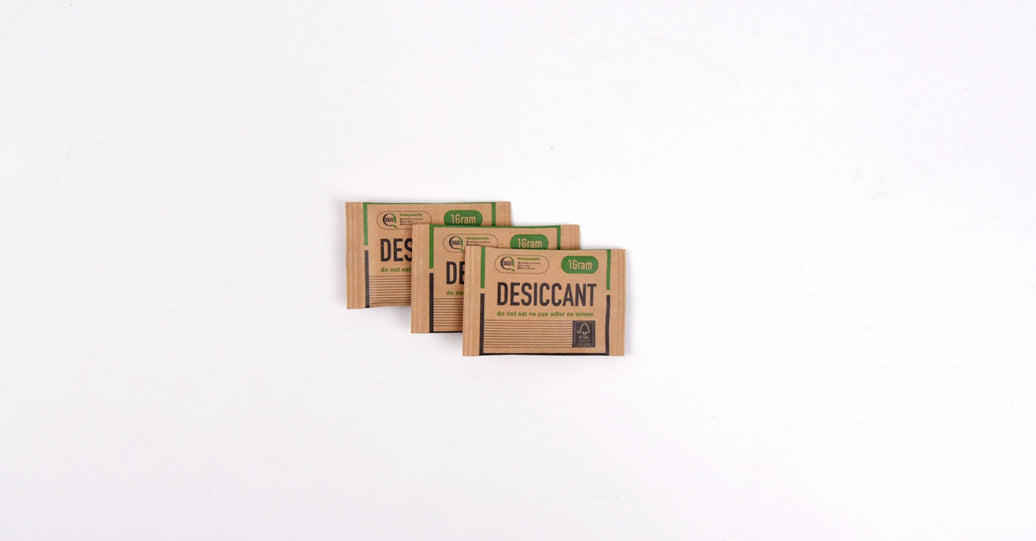
The safety data sheet describes the product as natural plant fiber steeped in a drying solution comprising calcium and sodium salts, with plant fiber above 90% by weight and the salts below 10%. Those salts are what give the sheet its affinity for water vapour. A chloride signal is the expected consequence of that formulation, and 159 mg/kg — 0.0159% — is the scale you would expect from a minority salt fraction in which chloride is one component among several.
Now put that next to the alternative. A calcium chloride desiccant is chloride by design; the halide is the active ingredient, present at percentage rather than parts-per-million concentrations, and it arrives in a form that deliquesces into brine as it works. That is a genuinely different risk profile from a bound trace in a solid fiber matrix, and it is the reason the two products cannot be compared on capacity alone.
The corrosion question needs its own evidence
Here is a trap worth naming. A low halogen number is supporting evidence for non-corrosiveness. It is not proof of it, and a buyer who accepts one in place of the other has skipped a step.
Corrosiveness is a behaviour, and it is demonstrated against named metals. ATMOSIScience states its anti-condensation fiber as halogen-free and non-corrosive in contact with steel, brass, magnesium and aluminium alloys — four metals, named, because that is what a corrosion claim has to look like to be checkable.
The electronics world formalised this a long time ago. MIL-D-3464, Type II requires that a desiccant be dustless and non-corrosive, and treats those as distinct qualifying properties alongside adsorption capacity. Food and pharmaceutical buyers rarely invoke that standard, but the logic transfers cleanly: capacity, dust and corrosion are three separate acceptance criteria and each needs its own line of evidence.
Where this actually bites in food, pharma and powder packing
Metal closures and foil seals. A sachet resting against an aluminium induction-seal liner or a lithographed metal lid for eighteen months is a long, quiet exposure test. Chloride at percentage level in a leaking format is the classic cause of a pitted closure at the end of a shipment.
Stainless contact on your own line. Sachets travelling through hoppers, chutes and inserters shed whatever is on their surface onto your equipment. A dust-free format with a bound trace halide is a very different housekeeping proposition from a granular product that sheds fines — the practical side of which is covered in making desiccant line-safe on a powder filling line.
Chemically sensitive actives. For effervescent formats, mineral premixes and anything where a stray ion can catalyse a reaction, the composition of the desiccant is part of the formulation conversation, not just the packaging conversation.
Metal-part exports. If you also ship components or hardware, the halide question is central to the choice between a desiccant and a vapour-phase inhibitor — see VCI or desiccant.
How to write the requirement
Supplier shall provide total halogen content (F, Cl, Br, I) determined with reference to EN 14582:2016 by ion chromatography, stating the method detection limit and the sample configuration tested. Supplier shall separately provide evidence of non-corrosiveness against the metals in contact with the desiccant in this pack, named individually.
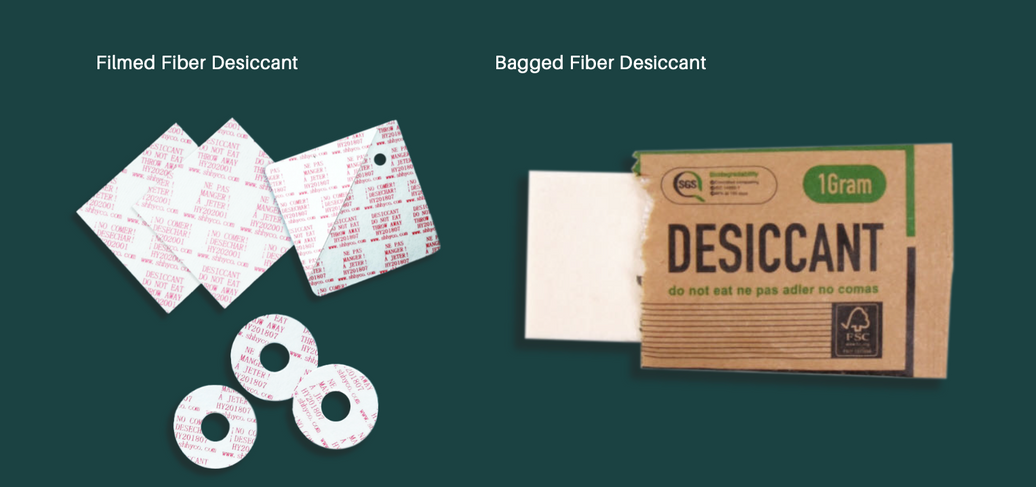
Three clauses, three jobs. The method makes results comparable between suppliers. The detection limit makes “not detected” mean something. The sample configuration stops a report on bare substrate being offered for a wrapped, printed sachet — the wrapper and any print or adhesive are part of what enters your pack, and they are exactly where an unexpected bromine or chlorine number tends to come from.
Pair it with the heavy-metal and restricted-substance file, which answers a related but separate set of questions: Prop 65, heavy metals and cobalt chloride.
Frequently asked questions
Is 159 mg/kg of chlorine a pass or a fail?
It depends entirely on the threshold your customer applies, which is why you should ask for it in writing before you ask a supplier for a number. What the figure establishes on its own is scale: a bound trace at hundredths of a percent, not a chloride-based active.
Why test with an electronics-oriented method for a food pack?
EN 14582 measures total halogen in a material regardless of application. The method is agnostic; only the acceptance threshold is industry-specific.
Does the halogen result change as the desiccant adsorbs water?
Total halogen is a composition measurement on a mass basis. Adsorbing water adds mass, which dilutes the concentration; it does not add or remove halide. Report and compare results on a consistent basis, and note the sample condition.
Should I ask for halogen data on the wrapper as well as the fill?
Yes, if you are buying a wrapped format. Wrapper choice drives more than halogen content — it also decides adsorption speed, dust behaviour and durability, which is the subject of Tyvek, non-woven, paper or film.
What else should be in the chemical file for a food-contact desiccant?
At minimum: the safety data sheet with its purity and microbiological limits, a food-contact status statement, a restricted-substances screen, and this halogen report. Each covers a different question; none substitutes for another.
Get the halogen and corrosion data for your format
Tell us which metals the desiccant will sit against and which threshold your customer applies. We will send the report that matches your format, with its detection limits and scope stated.
Prefer email? info@atmosiscience.com