Quick answer: Mould resistance of a desiccant is measured by a fungal challenge test — Test J of IEC 60068-2-10:2005, adopted in China as GB/T 2423.16-2008. The sample is inoculated with a mixed spore suspension of eight fungal species at 1.0 × 10⁶ spores/mL, incubated for 28 days, then graded from 0 to 3. ATMOSIScience fiber desiccant was tested by SGS to this method and returned Grade 0 — no growth apparent under 50× magnification. That is a statement about the desiccant, not about your product: it means the sachet does not become a mould substrate, not that it prevents mould elsewhere in the pack.
It is one of the sharpest questions a supplements or food QA reviewer asks, and one that most desiccant datasheets ignore entirely.
Think about what a desiccant does for a living. It sits inside a sealed pack, in a warehouse that may run warm, for twelve or eighteen months. Its entire job is to hold water. In a plant-fiber desiccant, it holds that water in a cellulose substrate. Cellulose plus water plus warmth is, in almost every other context in a food plant, the beginning of a microbiological problem.
So the question is fair: does the thing you dropped in to protect the powder quietly become the worst object in the pack?
The test that actually answers it
There is a standardised answer, and it does not come from the food world. It comes from electronics.
IEC 60068-2-10:2005 — Environmental testing, Part 2-10: Tests, Test J and guidance: Mould growth — was written for electrical and electronic products destined for tropical service. China adopted it as GB/T 2423.16-2008. It is the method used to establish whether a material supports fungal colonisation under conditions deliberately chosen to be favourable to fungi.
The procedure, in outline: the specimen is inoculated with a mixed spore suspension, held at elevated temperature and near-saturation humidity for 28 days, then examined and graded. Nothing about the test is gentle. It is designed so that a material that can support growth will show it.
Method 1 — the variant used here — assesses the material itself rather than a finished assembly, which is the right choice when what you want to know is whether the substrate is nutritive.
Eight organisms, not one
A single-organism challenge proves very little. Test J uses a consortium, chosen because between them they attack cellulose, hydrocarbons, plasticisers, and the residues left behind by processing. The panel used in the ATMOSIScience test:
| Organism | Strain | Why it is in the panel |
|---|---|---|
| Aspergillus niger | ATCC 6275 | The classic storage mould; tolerates low water activity |
| Aspergillus terreus | AS 3.3935 | Broad organic-substrate coloniser |
| Chaetomium globosum | ATCC 6205 | Strongly cellulolytic — the direct test of a paper substrate |
| Hormoconis resinae | NBRC 100535 | Attacks hydrocarbon and resin residues |
| Paecilomyces varioti | AS 3.4253 | Heat-tolerant; survives thermal processing |
| Penicillium funiculosum | AS 3.3875 | Cellulose and coating degrader |
| Scopulariopsis brevicaulis | AS 3.3985 | Grows on protein and mineral-rich surfaces |
| Trichoderma viride | AS 3.2942 | Aggressive cellulase producer |
Note the presence of Chaetomium globosum and Trichoderma viride. Both are chosen specifically because they eat cellulose. On a plant-fiber substrate, those two are the ones that matter, and they were in the inoculum at the same concentration as everything else: 1.0 × 10⁶ spores per millilitre.
The grading scale — and why 0 is a real number
After 28 days the specimen is graded. The scale is defined in the standard itself, and it is worth reading because “pass” is a much weaker word than the actual grades:
| Grade | Definition |
|---|---|
| 0 | No growth apparent under a nominal magnification of 50× |
| 1 | Traces of growth plainly visible under the microscope |
| 2a | Sparse growth, scattered or localised, covering not more than 5% of the test surface |
| 2b | Growth distributed more or less homogeneously, covering not more than 25% of the test surface |
| 3 | Growth plainly visible to the naked eye, covering more than 25% of the test surface |
Grade 1 is already invisible to the naked eye. Grade 0 sits a step below that: nothing found at fifty times magnification, after four weeks, under conditions engineered for fungal growth, with two dedicated cellulose eaters in the inoculum.
That is the result the fiber desiccant returned.
Why a cellulose desiccant does not behave like wet cardboard
The intuition that says “paper plus water equals mould” is not wrong; it is incomplete. Fungi do not respond to water content. They respond to water activity — the availability of that water, not its quantity.
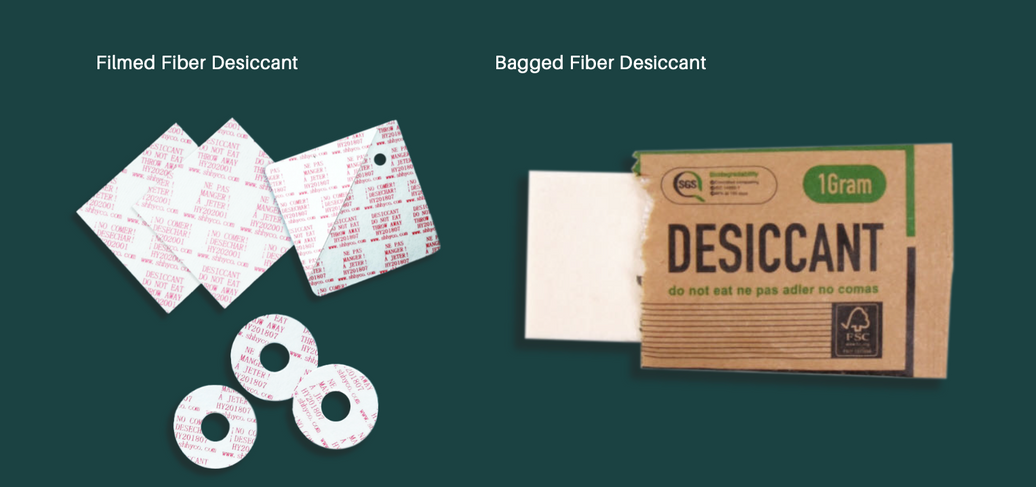
A fiber desiccant is a plant-fiber substrate carrying a minority fraction of calcium and sodium salts. Those salts are the reason the material adsorbs. They are also the reason the adsorbed water is not freely available: dissolved ions bind water and depress water activity in exactly the way a high-salt or high-sugar preserve resists spoilage. The sheet can be holding a great deal of water by mass and still present very little of it to a spore.
Two further points from the material’s own documentation reinforce it. The safety data sheet describes the fiber as sterilised at high temperature during manufacture, which sets the starting bioburden low. And the production environment is a Grade D cleanroom with settle-plate counts below the limit throughout — the material is not being seeded on the way out of the factory.
Pair the challenge test with the bioburden numbers
A mould-growth grade and a microbiological specification answer different questions, and a serious supplier document pack contains both.
- The challenge test answers: can this material support growth over time?
- The bioburden limits answer: what is on it the day it ships?
For this material the safety data sheet specifies total bacteria ≤ 1,000 cfu/cm², fungi ≤ 100 cfu/cm², and Escherichia coli not detected. Those, plus heavy metals as Pb ≤ 1 µg/mL and arsenic ≤ 1 µg/mL, are covered in more detail in the purity limits buyers miss on a desiccant SDS.
If a supplier offers you one and not the other, you have half an answer.
What the result does not license you to claim
This is where technically literate suppliers and marketing departments most often part company, so be plain about it.
It is not an antimicrobial claim. Grade 0 means the material does not support growth. It does not mean the material kills anything, inhibits anything nearby, or acts as a preservative. A desiccant is not an antimicrobial agent and should never be registered, labelled or sold as one.
It does not protect your product from mould. What protects your product is holding headspace humidity below the threshold at which your product’s own water activity permits growth. That is a sizing calculation, not a materials property. A correctly specified desiccant contributes to it; a Grade 0 result on the sachet itself contributes nothing to it directly.
The result belongs to the sample tested. A challenge test on an unpackaged fiber sheet does not automatically extend to a finished sachet with a different wrapper, an adhesive, or a print layer. If your format differs materially, say so and ask what was actually tested.
How to write it into a specification
If mould resistance matters to your category — and for botanical and mushroom powders, supplements and high-water-activity foods it usually does — write it as a testable line rather than an adjective:
Desiccant material shall achieve Grade 0 (no growth apparent at 50× magnification) when tested to IEC 60068-2-10:2005 Test J, Method 1, 28-day exposure, using the standard eight-organism inoculum at 1.0 × 10⁶ spores/mL. Supplier to provide the test report, including a description of the sample configuration tested. Microbiological limits per supplier SDS to be confirmed on the certificate of analysis for each lot.
Two details make that line do real work. Requiring the sample configuration stops a supplier submitting a report on bare substrate when you are buying a wrapped sachet. Requiring lot-level microbiological confirmation on the certificate of analysis stops a one-off type-test standing in for ongoing control.
Then file it where an auditor will look. If you are documenting moisture control as a food-safety measure, this evidence sits naturally alongside it in your HACCP plan.
Frequently asked questions
Is IEC 60068-2-10 the right standard for a food or supplement pack?
It is an electronics environmental-testing standard, and that is worth stating openly. It is used here because it is the recognised international method for establishing whether a material supports fungal growth, and no food-specific equivalent tests that question as directly. Use it for what it is: a materials property, evidenced by a recognised method.
Does a saturated desiccant behave differently from a fresh one?
The challenge test is run under near-saturation humidity for 28 days, so the specimen is not dry during the test. That is the point of the conditions. If your concern is specifically end-of-service-life behaviour, ask the supplier what state the sample was in when submitted.
Do silica gel and clay desiccants pass the same test?
Inorganic desiccants are not nutritive substrates, so mould growth on the bead itself is not usually the concern. The concern shifts to the wrapper and to any organic sizing or adhesive on it. Ask for the test on the format you are buying, whatever the fill material.
What if I see mould in a pack that contained a desiccant?
Almost always a sizing or barrier problem rather than a desiccant-material problem — the headspace never got below the product’s growth threshold, or the desiccant saturated early. Work through the common failure modes before suspecting the sachet.
Can I get the report?
Yes, direct from ATMOSIScience on request, subject to the issuing laboratory’s terms of use. Tell us the format you are qualifying so we send the report that matches it rather than the one that flatters it.
Ask for the microbiological evidence pack
Tell us your product category and pack format. The ATMOSIScience team will send the mould-growth and bioburden data that applies to it, with the scope of each test stated plainly.
Prefer email? info@atmosiscience.com