Quick answer: The most useful part of a desiccant safety data sheet is not the hazard section — for a well-formulated desiccant that section is usually empty. It is section 11. The ATMOSIScience fiber desiccant SDS publishes loss on drying at 10% or less, lead at 1 µg/ml or less, arsenic at 1 µg/ml or less, total bacteria at 1,000 CFU/cm² or less, fungi at 100 CFU/cm² or less, and Escherichia coli not detected. Those six numbers tell a QA reviewer more about suitability for a food or pharmaceutical pack than any marketing sheet will.
Safety data sheets get filed, not read. A procurement team requests one because a checklist demands it, the supplier emails a PDF, and it goes into a folder. That is a missed opportunity, because for a desiccant the SDS is frequently the only document that states composition, purity and microbiological limits in one place.
Here is how to read one properly, using published figures from the ATMOSIScience fiber desiccant SDS as the worked example.
Section 4: composition, and the question it raises
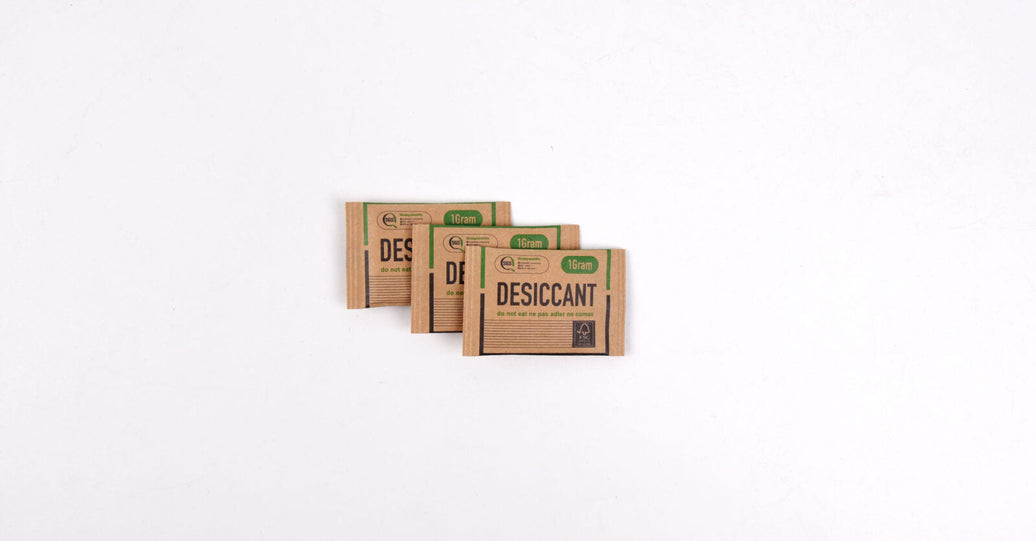
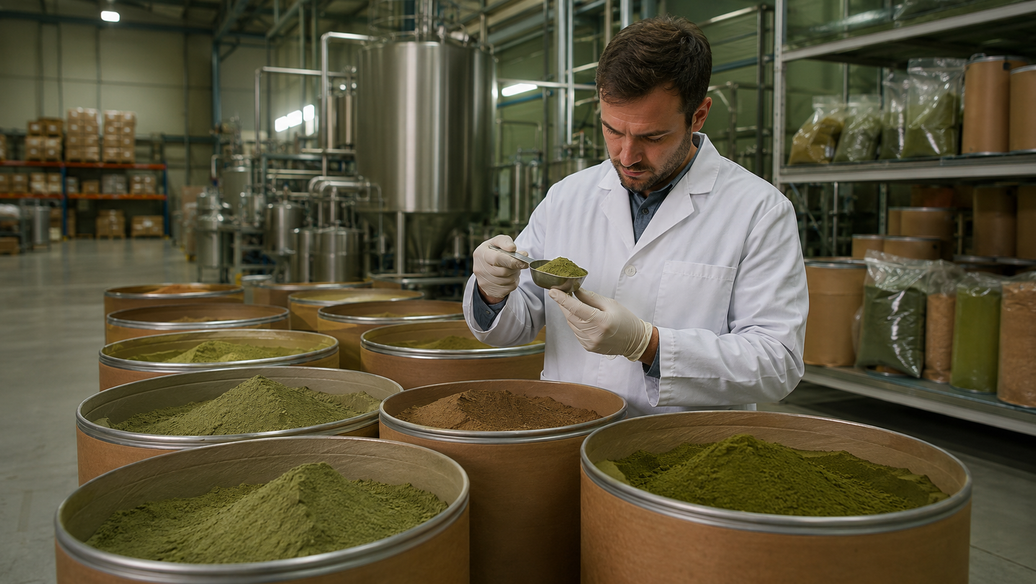
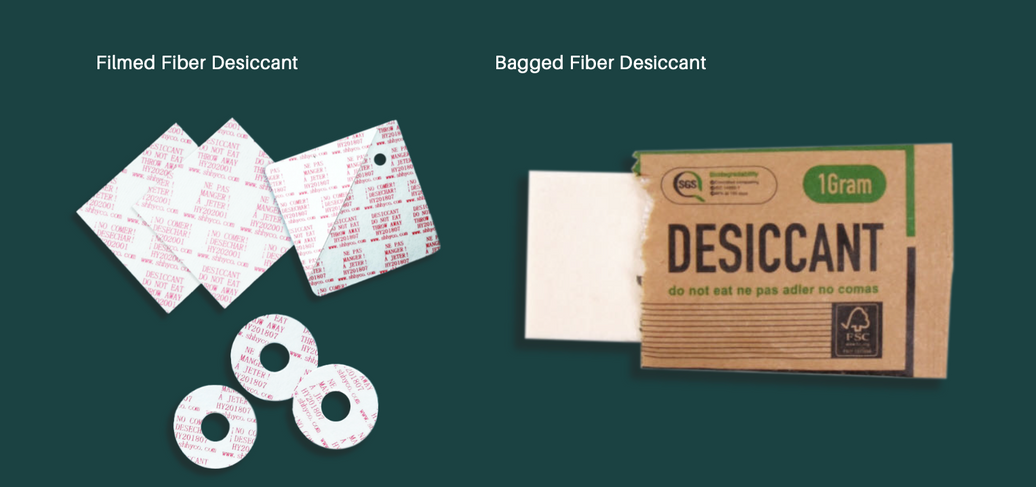
The fiber desiccant SDS describes the material as a humidity absorbent using specially processed natural plant fibre steeped in a drying solution comprising calcium and sodium salts, then sterilised at high temperature. It states plant fibre at greater than 90% by weight and calcium and sodium salts at less than 10% by weight, with CAS number 10043-52-4.
Two things a reviewer should do with that paragraph:
- Note that it is a composition, not a purity certificate. A composition statement on an SDS describes the substrate. If you need the composition of a finished product — sheet plus overwrap plus print — that is a different document and you should ask for it explicitly. This distinction becomes critical for European packaging compliance, which assesses the assembled article rather than one component. See the PPWR compliance hub.
- Look up the CAS number rather than trusting the trade name. A CAS number is checkable against your own restricted-substance list. A product name is not.
Section 11: the six numbers that matter

Section 11 of this SDS is unusually rich. Alongside the physical description — a sheet in its unpacked form, odourless — it publishes:
- Adsorption rate: at least 100% of its own weight at 25 °C and 90% RH, at least 35% at 25 °C and 50% RH.
- Loss on drying: 10% or less.
- Oxidizable matter: not more than 1 ml of 0.02 mol/L potassium permanganate volumetric solution.
- Heavy metals (as lead): 1 µg/ml or less.
- Arsenic: 1 µg/ml or less.
- Microbiological: total bacteria 1,000 CFU/cm² or less, fungi 100 CFU/cm² or less, E. coli not detected.
The microbiological limits are the ones almost nobody asks for. If a desiccant sachet sits inside a protein powder tub or a bottle of capsules for eighteen months, its bioburden is part of the pack’s bioburden. A supplier who cannot state a fungal limit is asking you to take that on trust.
The oxidizable matter test is also worth understanding. It is a permanganate-consumption method — a broad indicator of organic residues. It does not identify a specific contaminant, but a tight limit constrains the whole class.
Note the unit trap
Two units on that list are not comparable to one another and get confused constantly.
Heavy metals in µg/ml refers to a prepared test solution, not to the dry mass of the sachet. Microbiological counts in CFU/cm² refer to surface area, not to mass or volume. When a customer’s specification asks for heavy metals in mg/kg or microbial counts in CFU/g, those are different measurement bases and require either a conversion agreed with the laboratory or a fresh test on the stated basis. Do not silently map one onto the other in a supplier questionnaire.
The same discipline applies when comparing adsorption figures across spec sheets — a percentage is meaningless without its temperature and humidity condition.
Sections 9, 14 and 16: handling, transport and regulatory status
Section 9 gives one instruction that operations teams routinely break: avoid wet or high-humidity locations, and do not leave packed material in an open state. A desiccant left open on a filling line is adsorbing room air, not product moisture.
Section 14 states the material is not dangerous cargo, with an instruction to keep it separated from foodstuffs in transit. Section 16 adds that no labelling is required under the relevant EEC directives, references TRGS 900 for atmospheric threshold values, and gives a water pollution class indicating the material is not harmful to water. These lines matter for freight forwarders, warehouse permits and end-of-life questions — covered in more detail in our guide to desiccant transport and labelling status.
What an SDS does not tell you
Four things, all of which need separate documents:
- Food-contact compliance. An SDS is a safety document, not a food-contact declaration. Ask for the food-contact documentation separately — see FDA 21 CFR food contact for desiccants.
- Batch data. An SDS states limits. A certificate of analysis states what a specific lot actually measured.
- The overwrap. Most SDSs describe the adsorbent, not the sachet material, print or adhesive.
- Recyclability or compostability. Separate test reports, on the assembled article. See the sustainable desiccant guide.
Frequently asked questions
Is a desiccant classified as hazardous?
A well-formulated fibre desiccant is generally not. This SDS records no applicable hazard description, states the product is not combustible, and classifies it as not dangerous cargo. Formulations built on other chemistries may differ — read the actual sheet rather than generalising.
Why does the SDS list a first-aid measure if it is not hazardous?
Because first-aid sections are written for foreseeable misuse, not just for hazards. This one advises rinsing eyes and skin with clean water and, if swallowed, inducing vomiting and seeking medical attention — which is why every sachet carries a do-not-eat warning.
How often should we re-request an SDS?
At requalification, on any change of formulation or manufacturing site, and whenever the regulatory framework in your market moves. Diary it rather than assuming the version in your folder is current.
Does the SDS prove the desiccant is food safe?
No. It supports the case — particularly the heavy metal and microbiological limits — but food-contact status is established by separate documentation.
Can we use SDS figures in a customer specification?
Yes, provided you carry the measurement conditions across with the numbers. An adsorption figure without its temperature and RH, or a microbial count without its unit basis, will fail at the first audit.
Get the SDS, CoA template and specification in one pack
Tell us your product category and destination market. The ATMOSIScience team will send the documentation set your QA reviewer will ask for.
Prefer email? info@atmosiscience.com