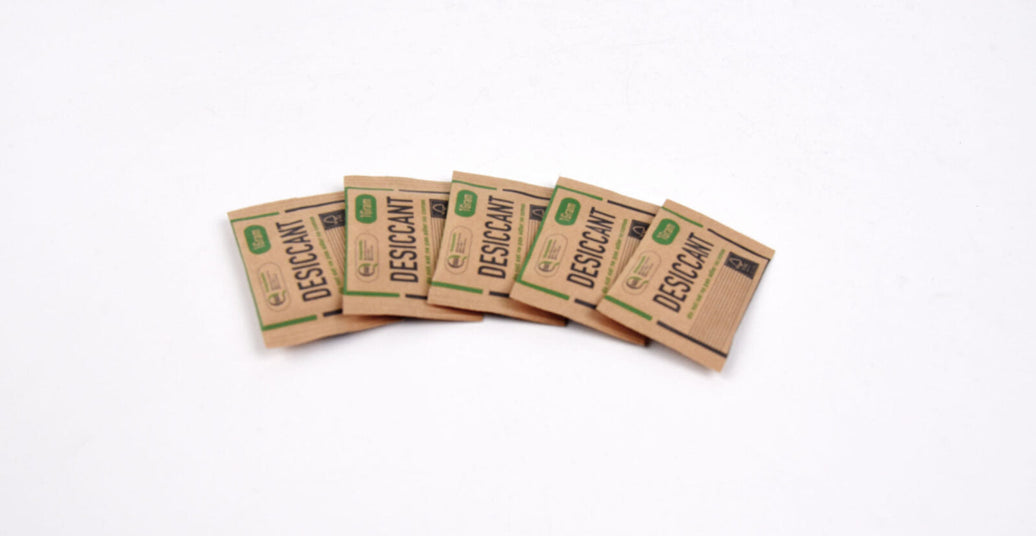
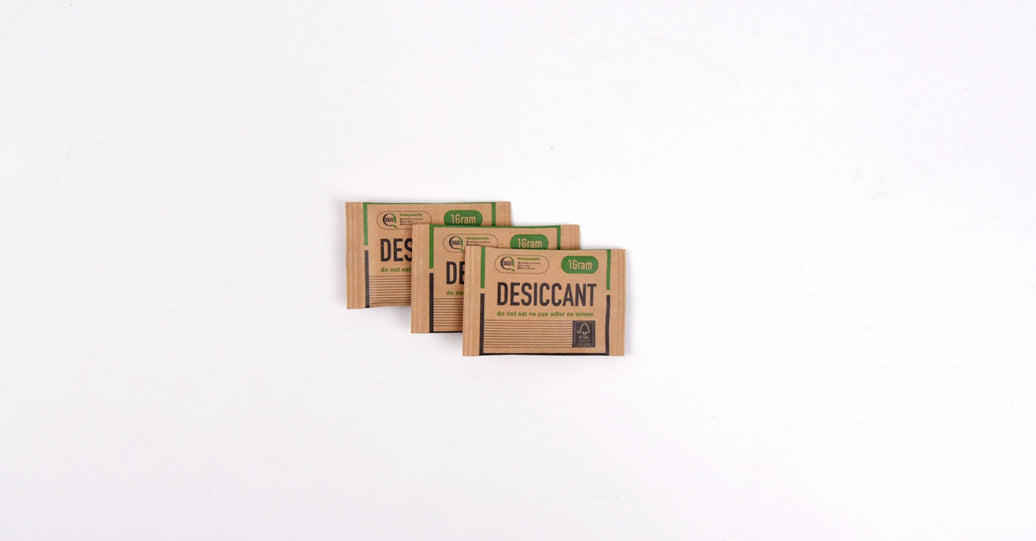
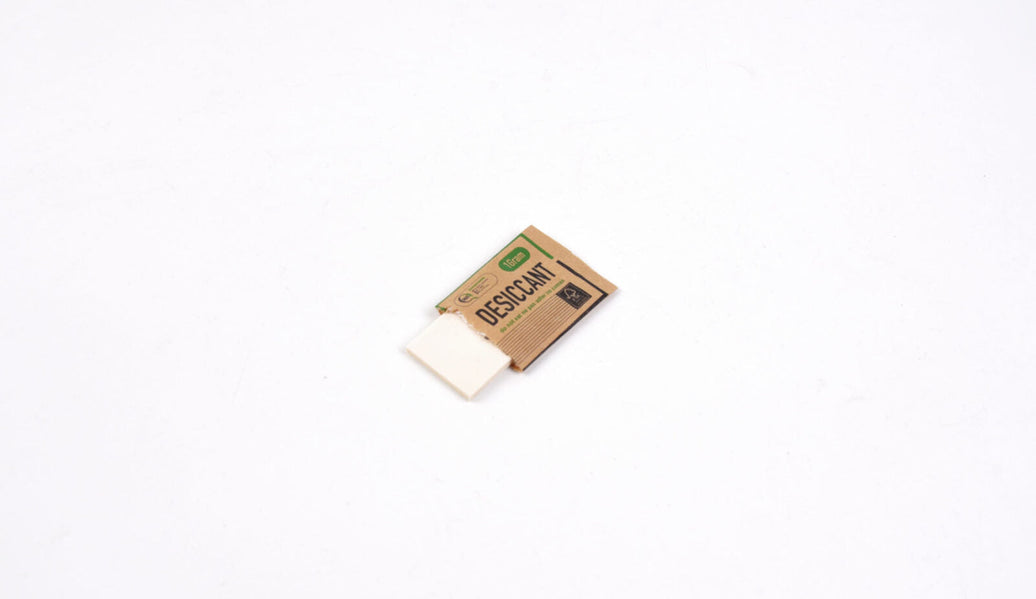
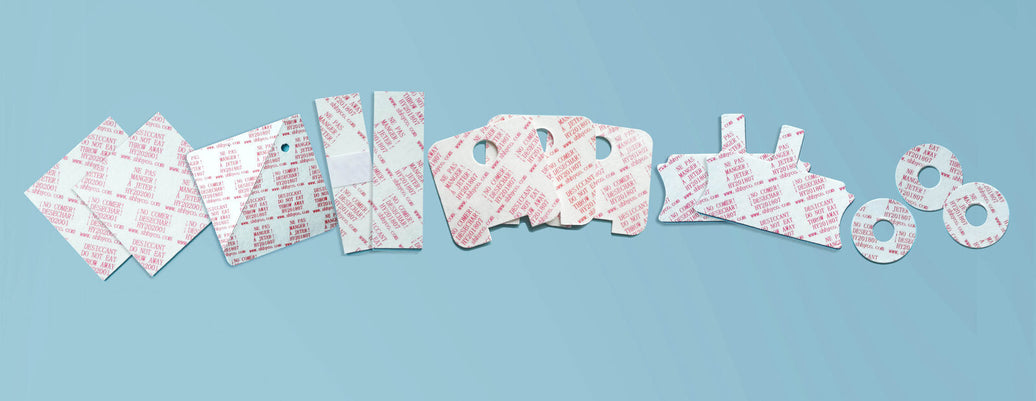
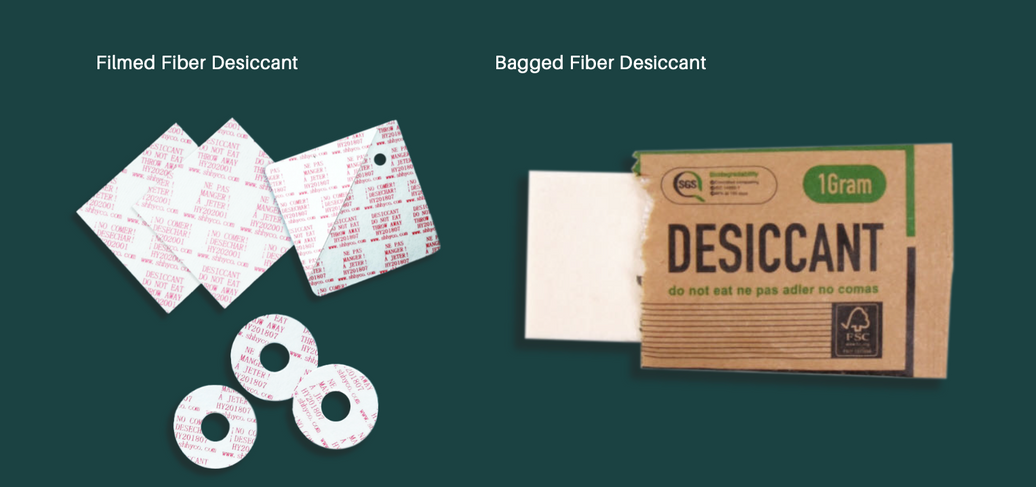
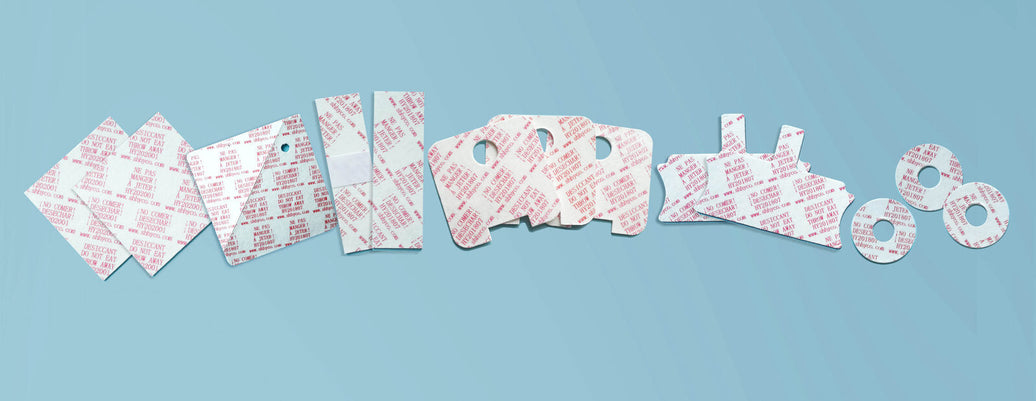
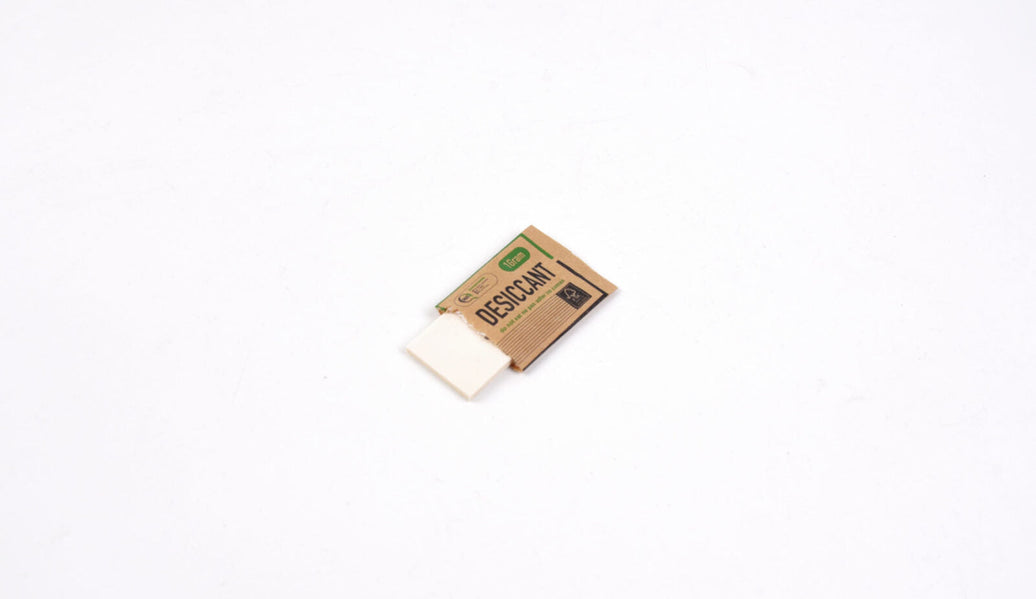
Quick answer: "Desiccant paper", "desiccant sheet", "desiccant board" and "desiccant card" all describe the same idea: an adsorbent held in a flat, cuttable substrate instead of a filled pouch. A flat format changes where the desiccant can sit and how a line handles it — under a cap, inside a blister, as a liner, as a tag — not how much moisture a given mass holds. ATMOSIScience supplies the flat construction as Fiber Card, a paper desiccant in 0.5 mm and 1.0 mm thicknesses, die-cut to square or circular shapes and printable, against a bagged sachet whose substrate is around 2.5 mm.
Buyers arrive at this search from two directions. Some have a pouch that physically will not fit. Others have an automated line that jams on loose sachets. The flat family solves both, and the terminology is confusing enough that suppliers and buyers frequently talk past each other.
The vocabulary
- Desiccant paper / sheet. An adsorbent substrate produced as a continuous web, supplied in rolls or sheets and converted by the customer or the supplier.
- Desiccant board. Usually a thicker or stiffer version of the same, used where a structural element is wanted.
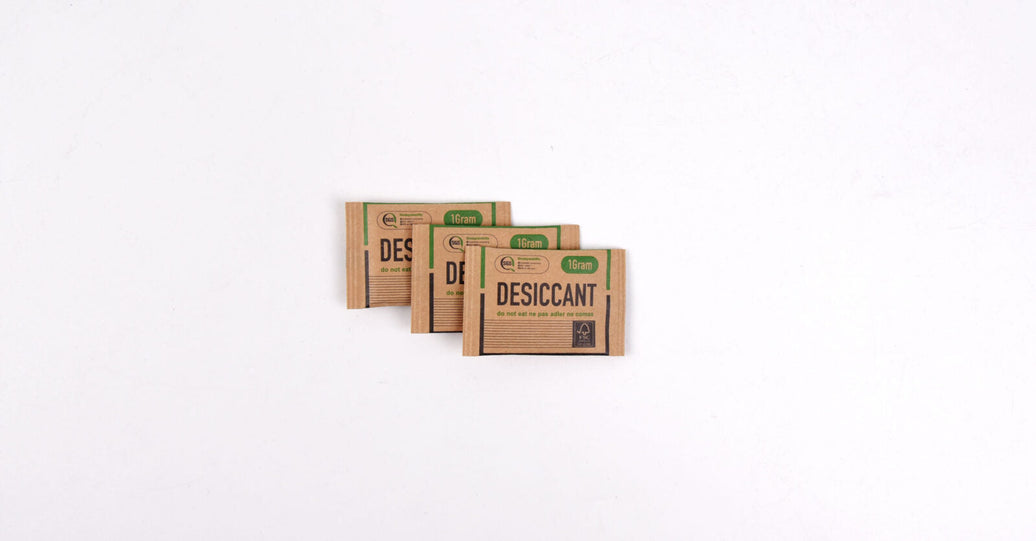
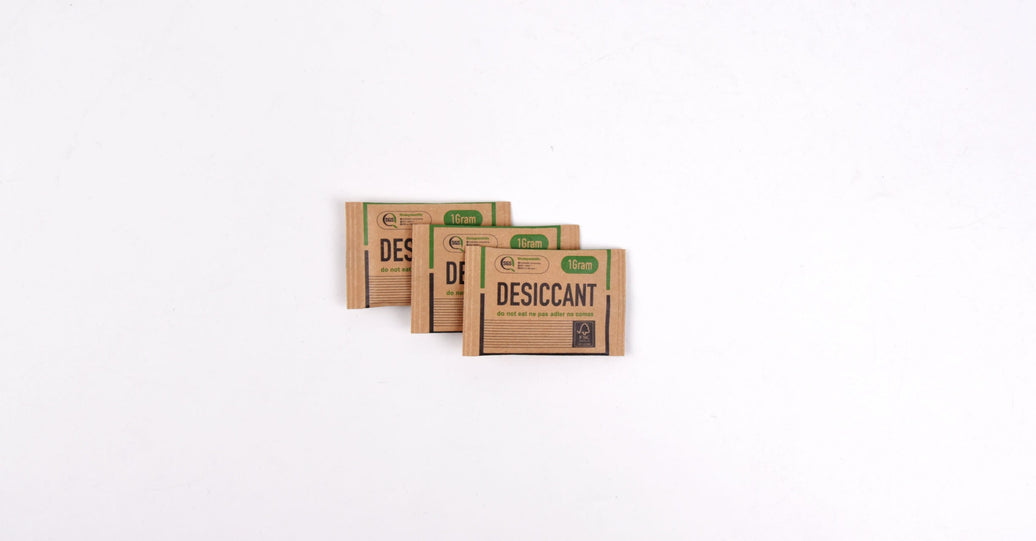
- Desiccant card. A converted, finished piece — typically the sheet laminated with a film and die-cut to a shape. On ATMOSIScience material the card is paper-wrapped, credit-card stiff, and carries a printed logo on its face.
- Liner or cap insert. A card cut to a container's cap finish and seated inside the closure.
What changes and what does not

What changes: where the desiccant can physically go, how a machine picks and places it, whether it can carry print, and how much headspace it consumes. A 0.5 mm card under a cap costs almost nothing in fill volume; a pouch in the same position may make the closure unseatable.
What does not change: the adsorption chemistry. A gram of the same substrate holds the same amount of water whether it is in a pouch or a card. Anyone promising more capacity purely from a format change should be asked which number changed and under what test conditions — a discipline we set out in how to compare desiccant spec sheets.
Reference sizes
The published Fiber Card reference specifications give a sense of what a flat piece delivers. All three reference sizes are 1 mm thick; the 0.5 mm construction is die-cut to order.
| Spec | Size (L×W×T, mm) | Mass (g) | Silica gel equivalent (g) |
|---|---|---|---|
| FF-3 | 25 × 12 × 1 | 0.15 ± 0.05 | 0.5 |
| FF-6 | 30 × 20 × 1 | 0.35 ± 0.08 | 1 |
| FF-15 | 60 × 25 × 1 | 1.0 ± 0.1 | 2.5 |
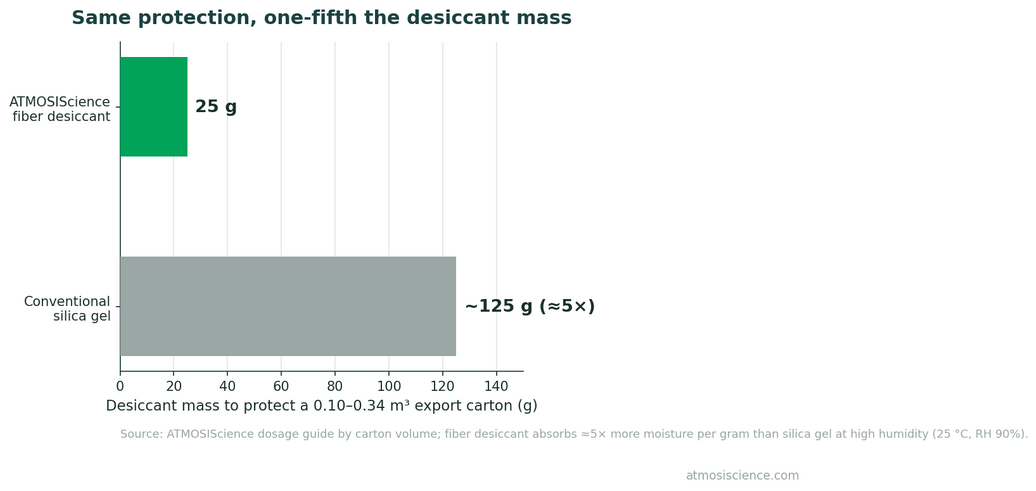
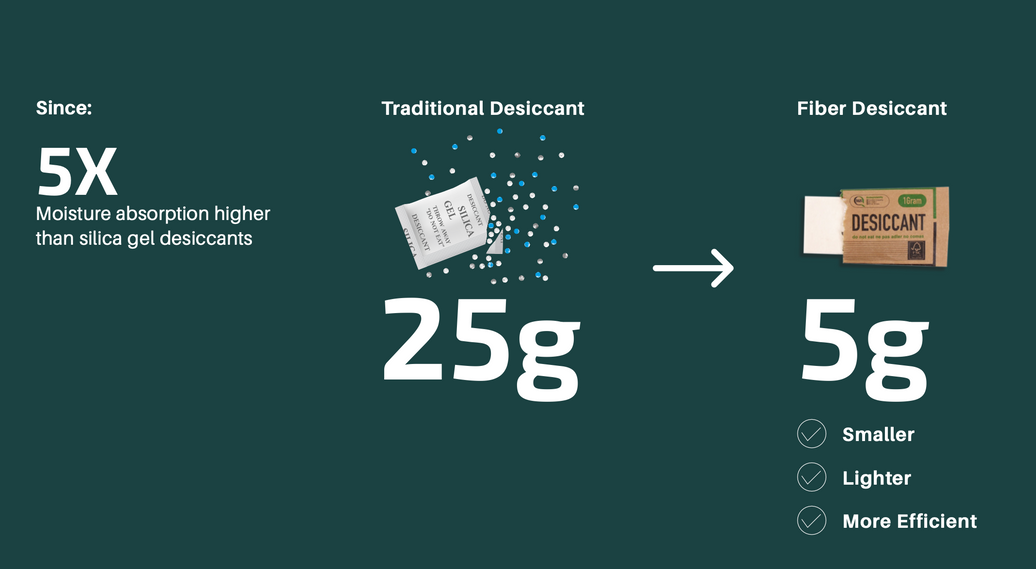
The silica-gel equivalence column is the one procurement teams use for a like-for-like swap; the reasoning behind it is in how many grams of silica one fiber desiccant replaces.
When a flat format is the right call
- No room for a pouch. Blisters, thin flow-wrap packs, cap cavities, small-format diagnostics.
- Automated insertion. A stiff card feeds and places predictably; a loose pouch does not. Card stiffness is the variable that decides line speed, as covered in the co-packer's guide to automated insertion.
- The desiccant should not be removable. Consumers pull sachets out of tubs. A seated cap insert removes that decision.
- You want the surface. A printable face turns a required insert into brand real estate — see custom-printed desiccant cards.
- Dust is unacceptable. A bound substrate does not shed the way a loose-fill format can, which matters on food and pharma lines. See powder and loose-fill desiccant risks.
What to specify when you enquire
A flat-format enquiry that gets a fast, accurate quote contains five things: thickness, outline dimensions or the cap finish it must fit, quantity of moisture the piece has to hold, whether it will be printed, and whether it is a food- or pharma-contact application. Missing any of these turns a quote into a questionnaire.

Frequently asked questions
Is desiccant paper the same as blotting paper?
No. Blotting paper absorbs liquid water by capillary action. A desiccant substrate adsorbs water vapour from the air and holds it against a humidity gradient, which is a different mechanism with a specified capacity.
Can we cut the sheet ourselves?
The material can be cut to size and shape, but converting in-house shifts the food-contact and cleanliness controls onto your site. Most buyers find supplied die-cut pieces cheaper once the qualification work is counted.
Is a card recyclable?
The bare fibre sheet and the laminated, printed finished card are different articles and should be assessed separately. A recyclability result for the sheet does not carry over to a finished card. This scoping distinction is covered in what a recyclability score actually measures.
How thin can it go?
The published Fiber Card thicknesses are 0.5 mm and 1.0 mm. Thinner means less mass, and less mass means less capacity, so the floor is set by the moisture load rather than by the converting process. See how thickness changes packaging design.
Can a card be induction-sealed into a cap?
Fibre-based liners and induction sealing do not combine the way a foil liner does. The attachment question is worked through in how to spec a jar-lid humidity disc.
Send us the cavity and we will send the die-cut spec
Thickness, outline, moisture load and print — give ATMOSIScience those four and we will come back with a flat-format specification and a sample.
Prefer email? info@atmosiscience.com