Quick answer: A humidity-control formulation sets a target RH by exploiting a physical relationship: in an unsaturated solution, relative humidity above the solution is negatively correlated with the molar concentration of dissolved ions. More ions in solution, lower equilibrium humidity. The R&D target for this material was full coverage of RH 30–90% with moisture capacity of at least 10% within ±5% of the target value. Saturated solutions give more stable capacity than unsaturated ones, and a two-component formula lets the same target humidity be delivered with a bias toward either adsorption or release — which is the difference between a pack that dries and a pack that holds.
Most desiccant conversations have exactly one axis: how much water does it hold. It is the axis every datasheet is built around, and for a straightforward drying job it is the right one.
It is the wrong axis for anything that needs to sit at a value. A cigar, a collagen powder that goes chalky when over-dried, a botanical extract that loses volatiles below a threshold, an instrument, an artefact — these do not want dry. They want 45%, or 62%, and they want it in twelve months as much as on day one.
Landing on a number, and staying there, is a formulation problem.
Three axes, and the one nobody publishes
Performance evaluation of humidity-control materials conventionally rests on two indicators: moisture capacity, which reflects how much regulating a material can do, and adsorption/desorption speed, which reflects how sensitive it is to changes in moisture.
In real service conditions there is a third, and the research literature barely addresses it: control precision — how tightly the material actually holds the value it claims.
That omission is not academic. A material with excellent capacity and loose precision will hold your pack somewhere in a range, and if the range straddles your product’s threshold, capacity did not save you. Precision is what turns a claim of “62%” into a specification.
Faster is not better
The second correction is about speed, and it runs against instinct. Many researchers treat adsorption/desorption speed as straightforwardly proportional to performance — quicker is better.
Market requirements say otherwise. Different segments need controllable release rates, not maximum ones. A pack that dumps its entire buffering capacity into a headspace in the first six hours has spent itself on a transient and has nothing left for the slow ingress that arrives over the following year. A pack that releases too slowly never reaches the target at all.
So the design brief is not “maximise”. It is hit this value, hold it this tightly, and get there at this rate — three targets that trade against each other. The related mistake on the drying side is unpacked in why ‘drier is better’ is wrong.
The design target, stated as an engineer would state it
The technical objective set for this material was specific and testable:
Humidity precisely controllable across the range RH 30–90%, with moisture capacity of not less than 10% within ±5% of the target humidity value.
Notice how that is constructed. It does not say “absorbs X% of its weight”. It says: pick any value in a 60-point range; within a narrow window around it, the material must still deliver at least 10% capacity. It is a specification about where the capacity lives, not just how much there is — the same distinction explored in moisture capacity is not adsorption rate.
Meeting it required building rapid production-oriented test methods for all three properties first — capacity, speed and precision. You cannot formulate to a target you cannot measure quickly enough to iterate against.
The physics: ions set the humidity
Here is the mechanism the whole approach rests on.
Above any aqueous solution sits an equilibrium relative humidity. For an unsaturated solution, that equilibrium RH is negatively correlated with the molar concentration of ionic species in the solution. Dissolve more ions, and the water is held more tightly; the vapour pressure above it falls; the equilibrium humidity drops.
This is why a salt-bearing material can be set to a humidity rather than simply drying everything it touches. Choose the solute chemistry and the concentration, and you choose the humidity the material will drive its surroundings toward — both upward and downward. It is the second of the two mechanisms described in the science of fiber desiccant.
The humectants used are drawn from commonly used and safe inorganic salts, organic salts and alcohols. In the finished product, the safety data sheet puts them below 10% by weight against more than 90% plant fiber — the composition detail is in what is actually inside a fiber desiccant.
Why saturation matters more than concentration
Now the finding that separates a durable formulation from a fragile one.
The moisture capacity of a saturated solution is more stable than that of an unsaturated solution.
The reason is worth understanding, because it explains a lot of real-world behaviour. In an unsaturated solution, every gram of water adsorbed dilutes the solution, which raises its equilibrium humidity, which shifts the target. The set point drifts as the material works.
In a saturated solution with undissolved solid present, adsorbed water dissolves more solid rather than diluting the solution. Concentration stays fixed. The equilibrium humidity stays fixed. The material buffers instead of drifting.
That is the difference between a pack that reads 62% on day one and 68% on day two hundred, and one that reads 62% both times. If you are evaluating a two-way product, ask whether the working chemistry is saturated in service. It is a more revealing question than asking for a capacity figure.
Why two components, not one
Single-salt systems can hit a target humidity, but they give you no adjustment. You get whatever balance of adsorption and release that salt happens to offer at that humidity.
Combining two components changes that. By permutation and combination of the available humectants, full formulation coverage across RH 30–90% was achieved. And by adjusting the ratio of the two components, different formulations that share the same target humidity can be biased toward adsorption capacity or toward release capacity.
That is a genuinely useful lever, and it maps onto real packaging problems:
| Your situation | What the formulation should favour |
|---|---|
| Product packed slightly wet; humid supply chain; barrier film with real MVTR | Adsorption priority — most of the working capacity available for taking water in |
| Product packed dry; risk is over-drying, hardening, volatile loss, static | Release priority — capacity available to give water back |
| Pack opened repeatedly; swings in both directions | Balanced, with reversibility as the governing criterion |
Two packs can carry the same “62% RH” label and behave completely differently in service. If your problem is one-directional, say so when you specify — otherwise you get the balanced version by default.
The base-liquid rule
One more result from the same work, useful when you are trying to predict what a mixture will do: the relative humidity of a two-component mixed solution is closer to the relative humidity of the single-component saturated solution that acts as the base liquid in that mixture.
In other words, mixtures do not simply average. One component anchors the set point and the other modulates the balance around it. That is why formulation here is a mapped design space built from measured solubility and mutual-solubility data at different temperatures, rather than a matter of blending to taste.
It also explains why temperature is part of the specification and not a footnote. Solubility moves with temperature, and a formulation designed around a saturated base liquid at 25 °C is doing something different at 45 °C.
Why put it on fiber at all
Everything above describes a liquid. Nobody wants a liquid inside a supplement tub.
The substrate is what converts the chemistry into a usable object, and the requirements list that drove the whole programme makes the reasoning explicit. A humidity-control product has to deliver on control performance and on safety (no leakage risk, harmless in contact, resistant to mould and corrosion), environmental performance (degradable), and applicability (easy to use, available in multiple forms, freely cuttable, long-lasting).
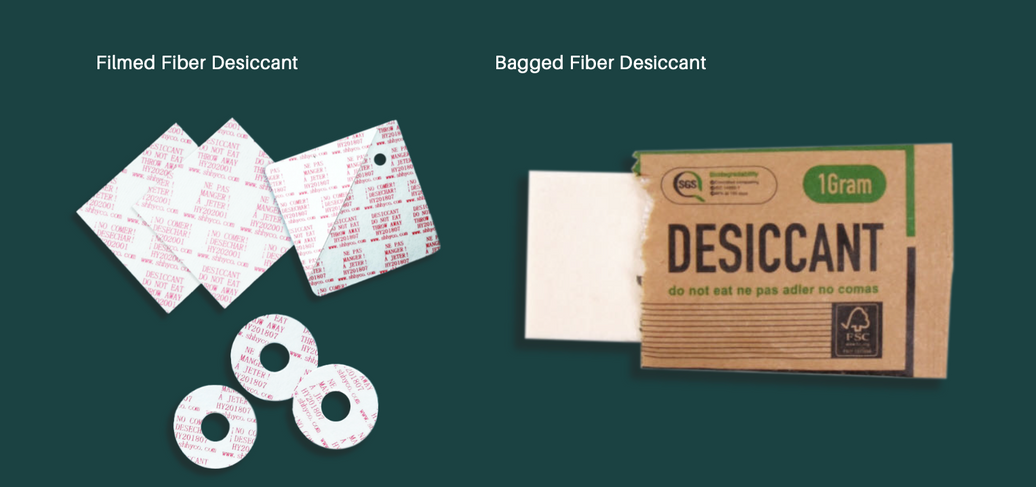
A plant-fiber sheet delivers all four. It immobilises the chemistry so there is nothing to leak — the failure mode that makes loose-fill and granular formats a hazard in food packing. It can be die-cut to any shape. And it can be dosed by area, which is what makes the manufacturing controls in how a fiber desiccant is made matter so much.
One practical corollary that catches people out: because the wrapper’s air permeability governs rate in service, the release-rate half of your specification is met by wrapper choice as much as by formulation. Formulation sets where it goes; the wrapper sets how fast.
Five questions to ask about any two-way pack
- What target RH, and at what temperature? A set point without a temperature is incomplete.
- What control precision? ±3% and ±5% are different products. Ask for the number, not the adjective.
- Is the working chemistry saturated in service? This is what determines whether the set point drifts as the pack ages.
- Is the formulation biased toward adsorption or release? And can it be biased the other way if my problem is the other way?
- What is the moisture capacity within ±5% of my target? Not at RH 90%. At my number.
Any supplier who can answer those five is formulating. Any supplier who answers with a single uptake percentage is reselling.
Frequently asked questions
Can any humidity between 30% and 90% be specified?
Full formulation coverage across RH 30–90% was the stated design objective, and two-way packs are offered as customisable within that range. Below RH 30% the product line moves to one-way fiber desiccant, because at that point you want drying rather than buffering.
How is this different from a saturated salt solution in a dish?
Physically it is the same principle — which is why saturated salt solutions are the reference standard for humidity calibration. The differences are engineering ones: no liquid, no spill, a defined and reproducible capacity, a cuttable form factor, and food-contact-appropriate materials.
Does the pack lose its set point as it ages?
That is exactly what the saturated-solution design is intended to prevent. Capacity is finite, so the pack eventually exhausts — but within its working range the set point is buffered rather than drifting. Ask for capacity within your tolerance band to size the service life.
Which powders benefit from a set point rather than maximum dryness?
Anything that hardens, cakes, generates static or loses volatiles when over-dried. Electrolyte blends and pre-workout formulas with deliquescent actives are the clearest cases; typical targets by category are in the RH reference table.
Do I need a two-way pack, or is a plain desiccant enough?
If your product has a lower limit as well as an upper one, you need a set point. If it only has an upper limit, a desiccant is simpler and usually cheaper. The decision is walked through in two-way humidity liner or one-way desiccant.
Specify a target humidity, not a desiccant
Tell us the RH your product needs to hold, the tolerance you can live with, and whether your risk is gaining moisture or losing it. We will come back with a formulation and format rather than a catalogue number.
Prefer email? info@atmosiscience.com