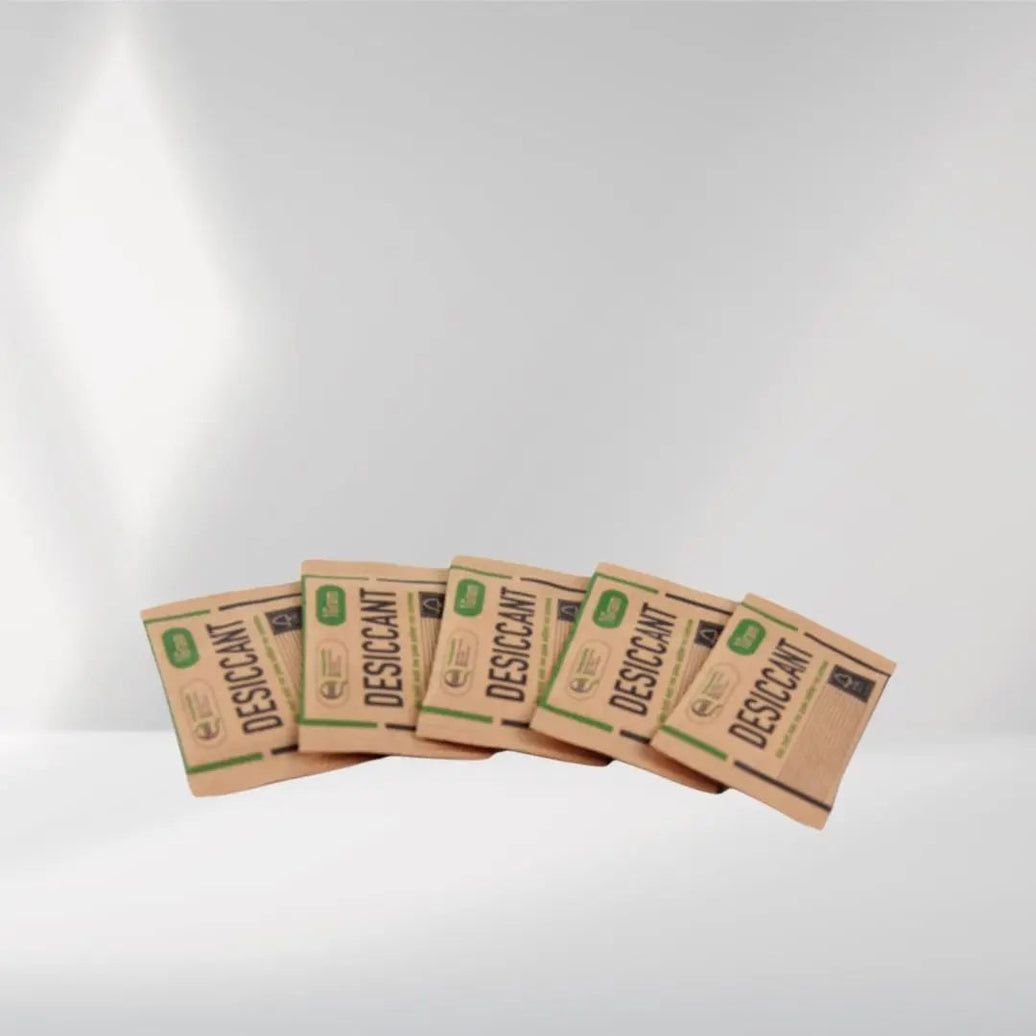
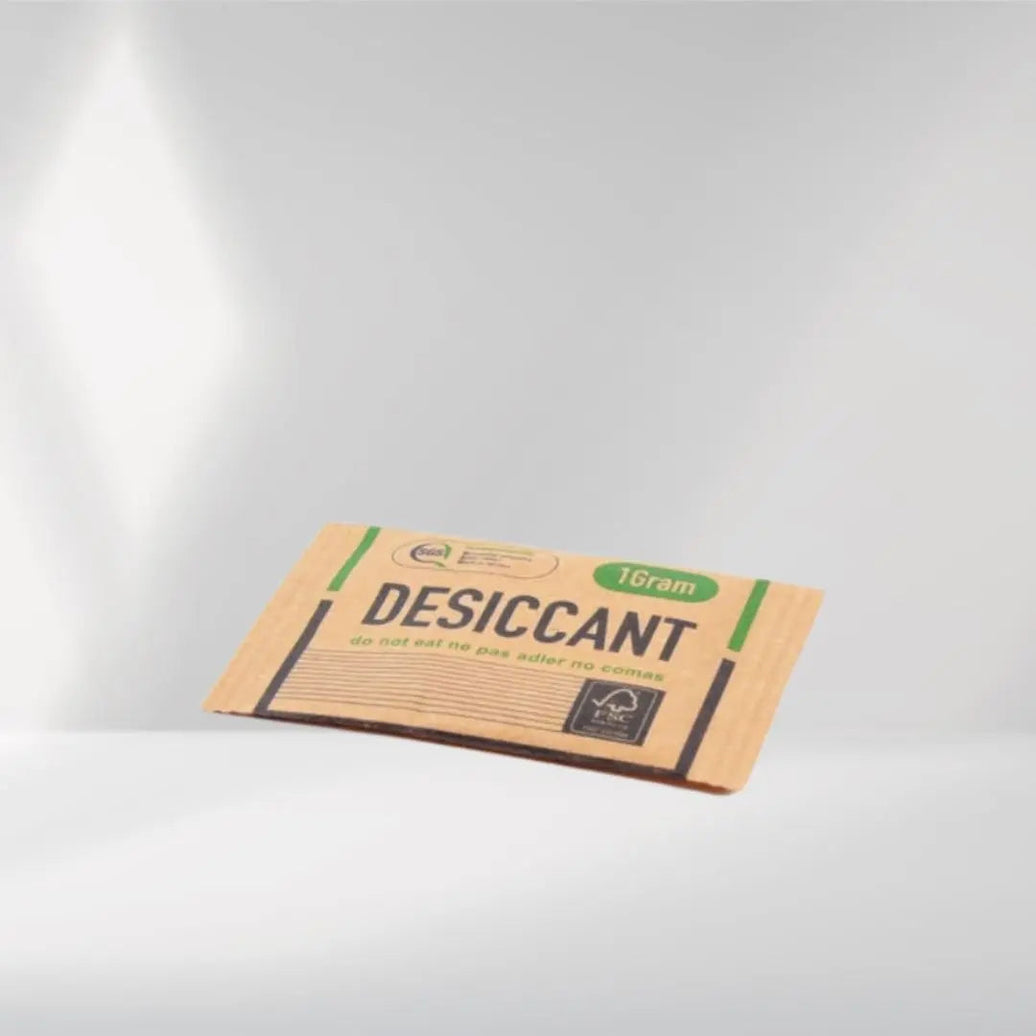
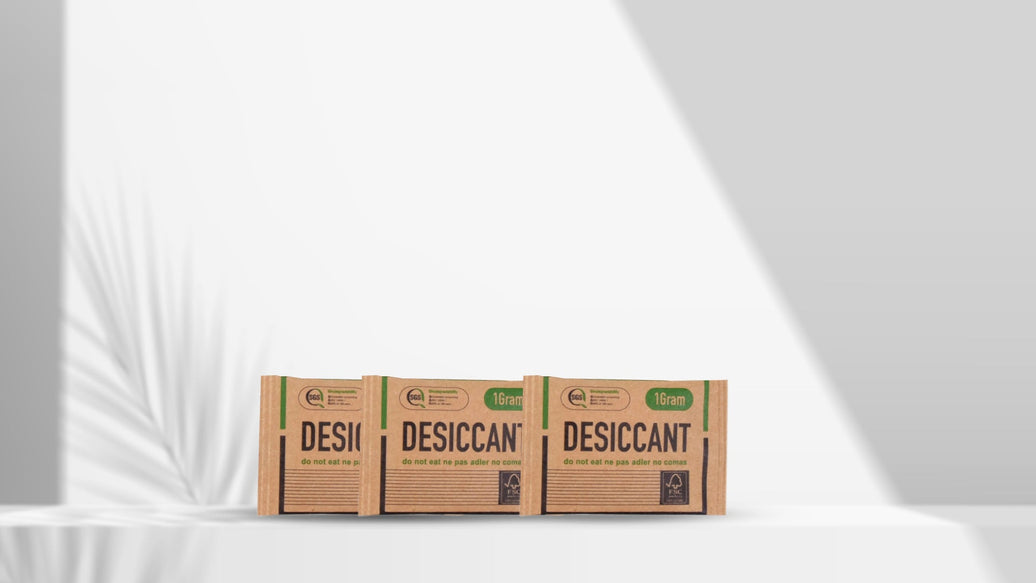
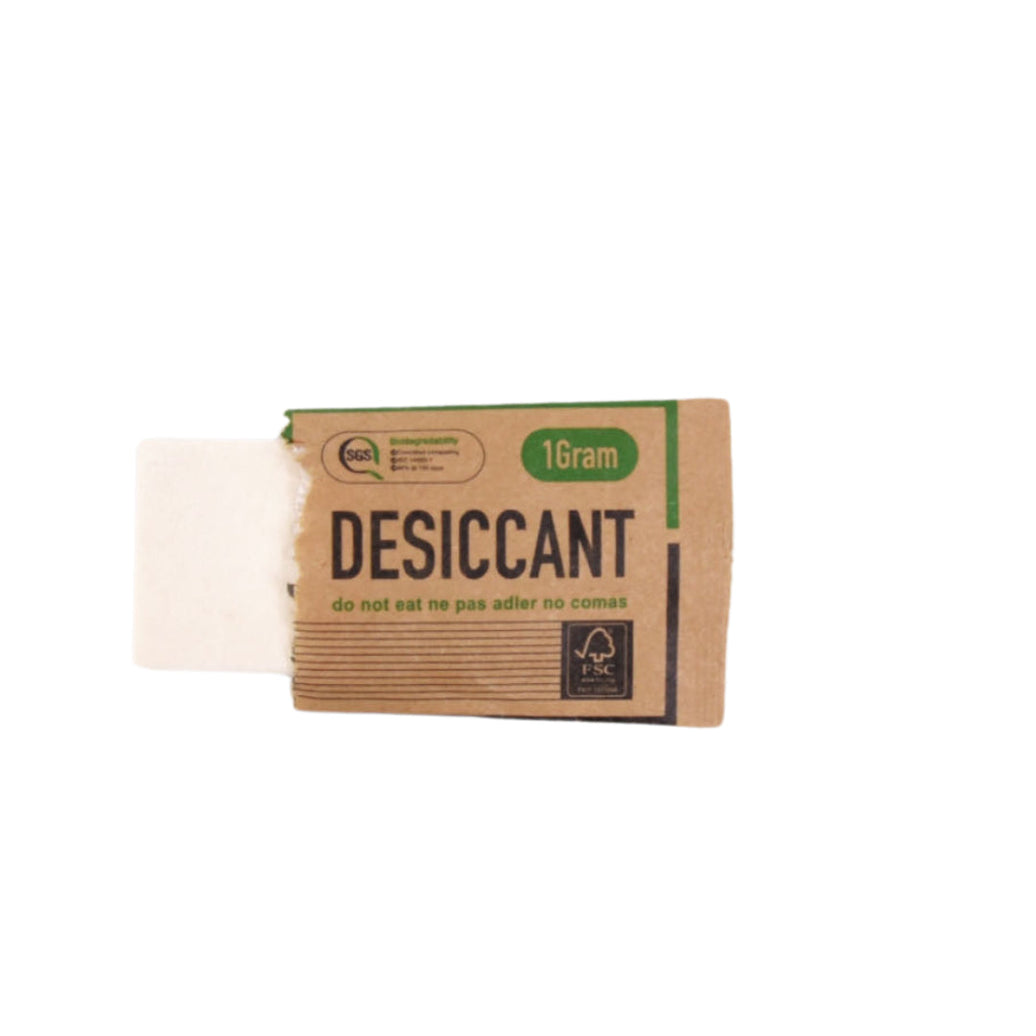
Some enquiries arrive as a single line: where are your products manufactured? No specification, no volume, no application — just that. It is a good question asked with almost no information, and it stands in for a harder one: am I talking to the factory, or to somebody who buys from it?
We sit on the other side of it too. Cold approaches reach our inbox from other desiccant makers whose claim sets are near-identical to ours — high absorption percentages, compostable, FSC kraft, cheaper than calcium chloride. Read as text, they are indistinguishable. Below are eight questions that pull them apart. Ask them of us too.
The fastest single test: ask at what relative humidity and temperature the capacity figure was measured, and ask for the full isotherm. A supplier who has characterised their own material answers in a sentence; a reseller sends the same percentage back again.
Related: Fiber desiccant · Fiber technology
1. Where is it actually made, and can you name the plant?
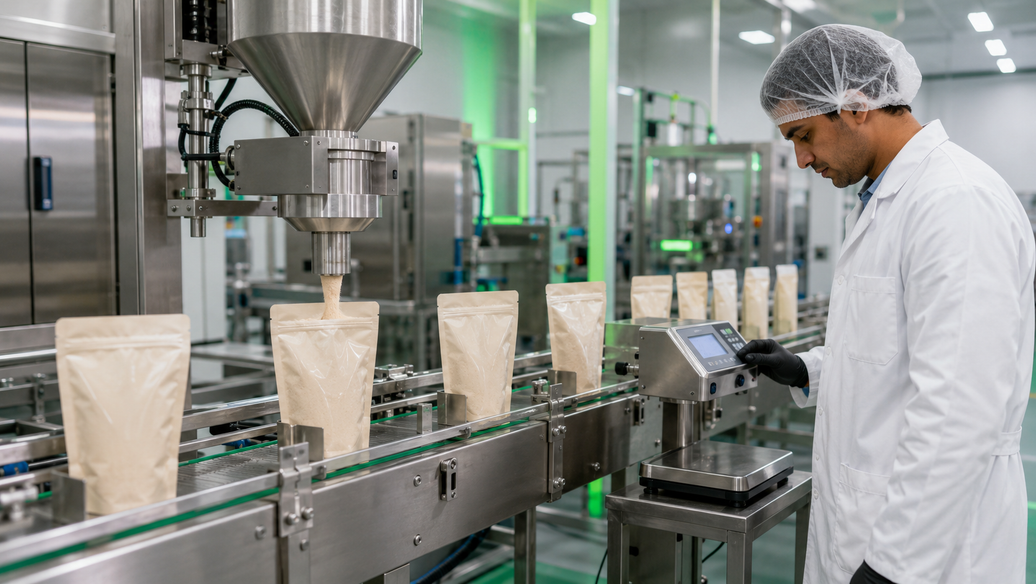
Good: the site is named, the entity operating it is named, an audit is offered, and the supplier separates where the active composition is made, where the substrate is made and where the part is converted — often three different places even at a genuine manufacturer.
Weak: "our partner factory", "several production bases", or photographs of a plant that is never named. A supplier who will not name the site is a trading company — not disqualifying, since traders solve real problems, but price it correctly: you are one relationship away from the people who can change the product. Origin also drives lead time, tariff exposure and audit access.
2. At what RH and temperature was your capacity figure measured, and can I see the full isotherm?
Absorption capacity is not a property of a material. It is a property of a material at a stated humidity and temperature, and a supplier who gives one number without conditions has either not measured it or does not know what it means. A good answer looks like a curve. Here is ours, at 25 °C, as percentage of own weight.
| RH at 25 °C | Fibre desiccant (% own weight) | Silica gel (% own weight) | Ratio |
|---|---|---|---|
| 10% | 10 | 4.5 | 2.2× |
| 20% | 17 | 9.2 | 1.9× |
| 30% | 29 | 13.8 | 2.1× |
| 40% | 39 | 19.5 | 2.0× |
| 50% | 60 | 25.0 | 2.4× |
| 60% | 71 | 30.2 | 2.4× |
| 70% | 81 | 32.5 | 2.5× |
| 80% | 102 | 33.8 | 3.0× |
| 90% | 108 | 35.3 | 3.1× |
| 100% | 120 | 35.8 | 3.4× |
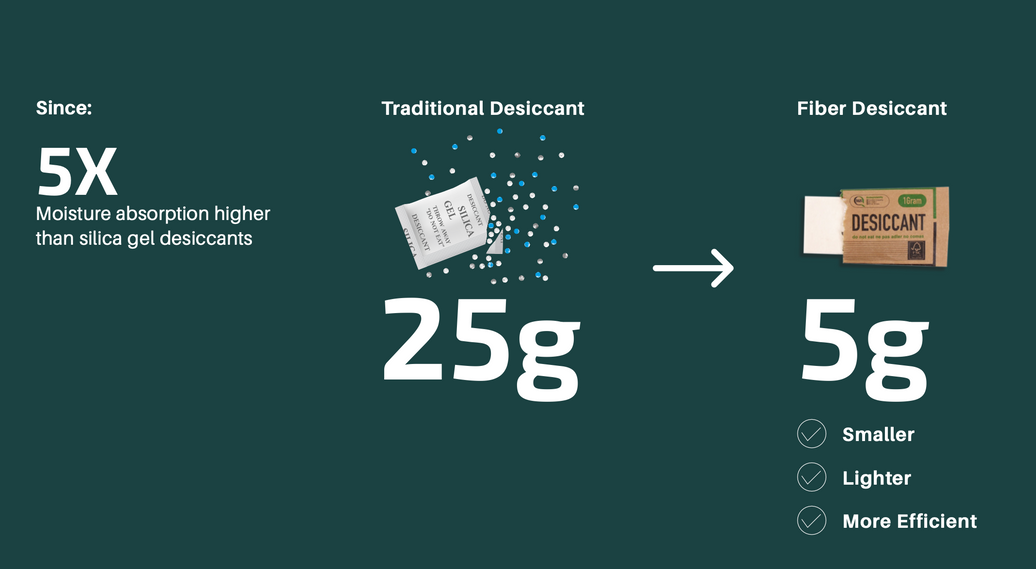
Read across a row and the honest headline is 2–3× silica gel at matched conditions. That is what we publish, and the table is why.
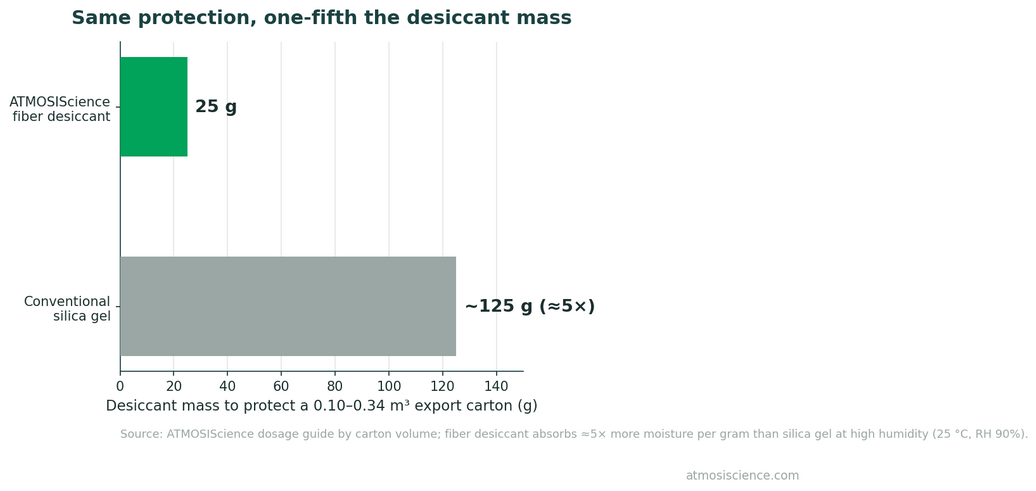
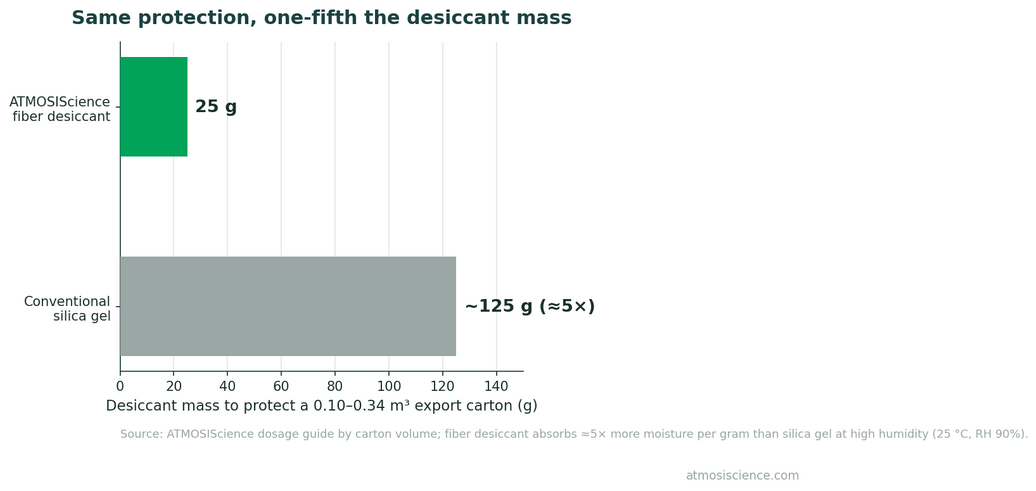
Now watch the same data become a bigger number. Our figure at RH 90 (108%) against silica gel at RH 50 (25%) gives 4.3×; our RH 100 figure against silica gel at RH 20 gives 13×. No individual number is false and both comparisons are meaningless, because the two materials were never in the same environment. A ratio quoted without a single shared condition is a cross-condition ratio, and that is where a genuine 2× becomes a marketing 5×. Ask for both raw figures and both sets of conditions. The proper comparison is in fiber desiccant vs silica gel.
The currency that survives all of this is the MIL-D-3464E desiccant unit: a quantity adsorbing at least 3.00 g of water at 20% RH and 6.00 g at 40% RH, both at 25 °C. Note those conditions — the dry side, where most moisture-sensitive products need protection, so a material characterised only at 80% RH was measured in the wrong regime. Ask how many grams of their material make one unit, and whether it meets the standard's Type II dust limit of 0.5 mg.
| Material | Grams per MIL-D-3464E desiccant unit | Relative mass for the same duty |
|---|---|---|
| Fibre desiccant | 18 g | 1.0 |
| Silica gel | 30 g | 1.7× |
| Clay | 35 g | 1.9× |
3. What does your compostability certificate cover, and when does it expire?
These claims fail on scope far more often than on substance: a certificate covering a fibre core does not cover the film laminated to it, and one covering a raw material does not cover the converted part.
Good: five items unprompted — standard, issuing body, certificate number, exact scope in the certificate's own words, expiry date. Ours is industrial compostability tested to EN 13432, certified by SGS, held as two certificates: one covering the fibre core in the 0.5–5 mm range, one covering the compound paper film. We say "industrially compostable" rather than "compostable" because only the first is what the test demonstrates — an operated facility at controlled temperature, not a garden heap and not landfill.
Weak: "compostable" with no standard named, an expired certificate, one in a different company's name, or a scope covering a material you are not buying. Certificates lapse quietly, so check the date at every re-order — the pattern is set out in desiccant certificates: scope and validity.
4. Can you provide a per-lot certificate of analysis with the test method named?
A type test characterises the design once; a lot test says something about the material in the box in front of you. Suppliers who cannot do the second reissue the first with a new date on it.
Good: per-lot COA confirmed, test method named against each parameter, lot code format stated, and an account of what the code resolves back to — batch of active, batch of substrate, converting line, date. Weak: results with no methods, numbers identical lot after lot, or "we can provide a test report" with the word lot appearing nowhere.
5. How is the product classified for customs, and do you have a ruling?
Almost nobody asks this, and there is real money in it. For a calcium-chloride-based desiccant bag there is a published answer: US Customs and Border Protection binding ruling NY N292791 classifies bags of 80% calcium chloride and 20% starch under HTSUS 3824.99.9295 at 5% ad valorem. Chinese origin in that heading picks up further layers.
| Layer | Basis | Rate |
|---|---|---|
| Base duty | HTSUS 3824.99.9295, per binding ruling NY N292791 | 5% ad valorem |
| Section 301 | List 1, Chinese origin in 3824.99 | +25% |
| Section 122 temporary surcharge | Chapter 99 heading 9903.03.01 | +10% |
| Stacked total | — | Roughly 35% |
| Anti-dumping / countervailing / safeguard | — | None in force on desiccants |
Now the part rarely said out loud: no CBP ruling exists for a fibre, cellulose or paper desiccant sheet. It could be argued into Chapter 38 as a chemical product or Chapter 48 as an article of paper, with materially different duty. Until someone requests a binding ruling, classification is an unpriced variable under every US quote in this category — ours included. Better to know now than at entry.
Good: names the HTS code used, says whether it rests on a ruling or an opinion, states country of origin for marking. Weak: "our forwarder handles that". Your forwarder is not the importer of record; you are.
This article is general information, not legal advice. Verify current obligations against your own products and counsel.
6. What is your quality system, and how is the line segregated?
Good: an ISO 9001 certificate whose scope covers the site and the product you are buying, plus a straight account of what else runs on that line and how changeover is controlled — line clearance, records retained, cleaning validation where the product is food-contact. We hold ISO 9001; the wider stack buyers check is FDA 21 CFR 175.300, SGS RoHS to EU 2015/863, SGS REACH SVHC screening, SGS anti-mould testing, and an ISO 14067 product carbon footprint of 1.44 kg CO₂e per kg.
Weak: "we are ISO certified" with no number, a certificate issued to a trading office rather than a plant, or discomfort at the segregation question. That one matters because contract lines run several customers' formulations, and a desiccant carrying a trace of someone else's chemistry into a food or pharmaceutical pack is a recall, not a complaint.
7. Who owns the technology?
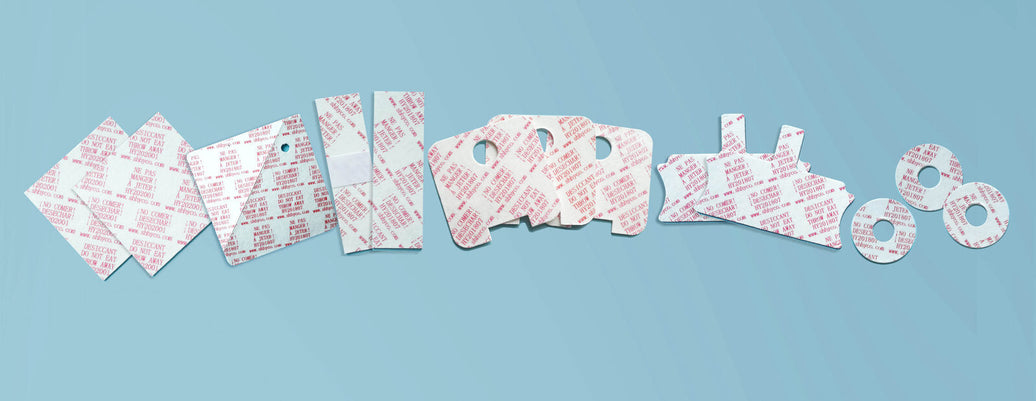
A manufacturer who owns the formulation and the process can change it for you — substrate thickness, specific surface area, wrap permeability — which is how absorption and desorption speed gets tuned to an application rather than merely accepted. A reseller controls none of those and answers a technical request with a different catalogue number.
Ours: second-generation invention patents, four in China and four in the United States, on a lignocellulose plant-fibre substrate carrying a humidity-control composition, developed over around twenty years of R&D. That is the honest size of it. The right follow-up is not how many patents but what do they claim — a supplier who owns their technology answers without reaching for a lawyer.
8. What will you tell me that costs you the sale?
The real test, and the only question here that cannot be prepared for with a document. A supplier who has never told you a limitation has either not looked for one or is not telling you. Ours, three of them:
- No PFAS certificate at PPWR thresholds. Our SGS REACH SVHC screening is not a PFAS test and should not be presented as one. The Packaging and Packaging Waste Regulation thresholds are 25 ppb single substance, 250 ppb sum, and 50 ppm including polymeric fluorinated substances. If your compliance file needs that, we cannot close it today.
- USP <670> does not name cellulose or fibre. The chapter names bentonite, calcium chloride, calcium oxide, molecular sieves and silica gel. That is a listing barrier in pharma, independent of performance — data does not fix a naming problem, and you should know it before spending a qualification cycle.
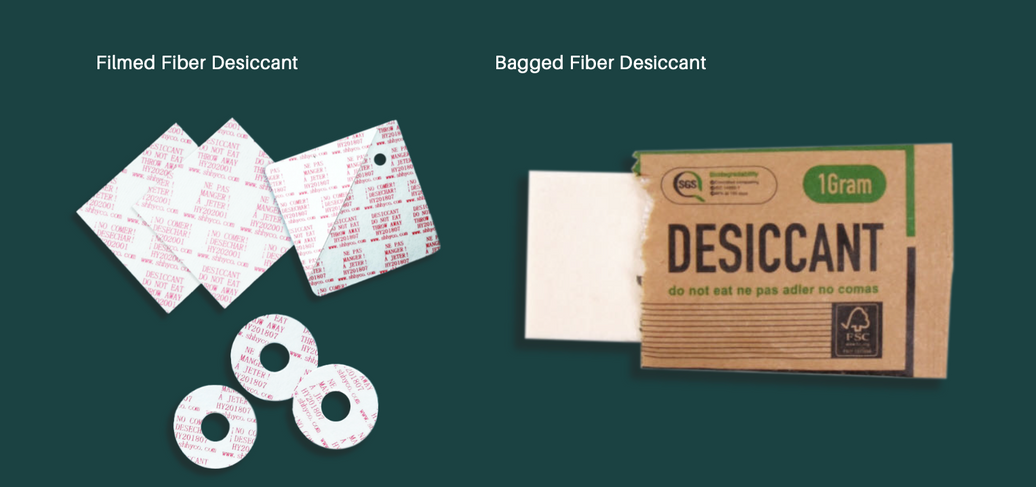
- Our bagged format is wrong for container desiccation. It absorbs over 100% of its own weight; container-desiccant specifications generally require over 200%. If you are hanging bags in a 40-foot container, buy something else.
A note on market-size charts
If a supplier opens with a slide sizing the packaging desiccant market, treat it as a sales artefact rather than information. No credible, methodologically transparent sizing of this market exists publicly; the widely quoted figures trace back to commercial report mills reselling one another's estimates. The anchors that are real — mineral production data, listed-company segment disclosures, container volume statistics, semiconductor billings — do not produce a tidy headline number. A supplier leading with market size is selling; one leading with an isotherm is specifying.
The due-diligence email, ready to send
Copy this into a reply to any supplier, ours included. The answers, and the gaps in them, sort a shortlist faster than a sample will.
- Which site makes this part, what entity operates it, and can we audit it?
- At what RH and temperature is your stated capacity measured, and can you send the full isotherm?
- How many grams of your material equal one MIL-D-3464E desiccant unit, and is it Type I, II or III?
- Compostability: which standard, issuing body, certificate number, exact scope, expiry date?
- Do you supply a per-lot certificate of analysis with the test method named, and what is the lot code format and what does it trace back to?
- What HTS classification do you use, is it supported by a binding ruling, and what is the country of origin for marking?
- Please send the ISO 9001 certificate with its scope, and describe changeover control and segregation on our line.
- Do you own the formulation and process, and what can you change for us — thickness, surface area, wrap permeability?
- What is this product not suitable for, and which certificate do you not hold that buyers in our sector ask for?
Frequently asked questions
A supplier quotes 5× silica gel. Are they lying?
Usually not lying — comparing across conditions. Ask for both raw capacities and the RH and temperature each was measured at. Matched properly, plant-fibre desiccant runs 2–3× silica gel.
Why does customs matter if the supplier ships DDP?
A DDP price contains a duty assumption, and if the classification is wrong the correction lands somewhere — usually a price revision, sometimes a penalty.
Is buying from a trading company always a mistake?
No. Traders consolidate, hold stock and handle volumes factories decline. The mistake is paying manufacturer prices for trader service, or expecting a trader to change a formulation.
Where are ATMOSIScience products made?
We manufacture our own plant-fibre desiccant materials and convert them in-house, and we will name the site, share the ISO 9001 scope and arrange an audit on request.
Ask us the eight questions
We would rather answer these before a sample ships than after a qualification stalls. Send the list and we will answer every line, including the ones without a good answer. Range at fiber desiccant, or info@atmosiscience.com.
Related reading: From sample request to purchase order · Desiccant certificates: scope and validity
Tell us the product, not just the part number
Send us what you are packing, the pack format and the humidity or shelf-life target. We will come back with a sizing calculation, the matching format and the certificate pack.