Quick answer: Standard distribution tests exercise drop, vibration, compression and atmospheric conditioning — but a desiccant only proves itself if the conditioning phase reproduces the humidity and temperature cycling of the real lane, and if you measure in-pack humidity and product moisture rather than only checking whether the box survived. Run the desiccant at end-of-shelf-life capacity, not fresh, and record the result as a signed report so the sizing is defensible later.
Most desiccant recommendations are validated in a sealed jar at a fixed temperature. Real packs are dropped, stacked, vibrated on a truck bed, parked on a hot dock, and then moved into a cold warehouse where they sweat. A sizing calculation that holds in a laboratory can fail in that sequence for reasons the calculation never modelled: a ruptured wrap, a compressed carton with a broken seal, or a temperature cycle that condenses free water onto the product.
Distribution testing is where those failures surface cheaply. The gap in most programmes is not the mechanical testing — that is usually well run — but the fact that moisture is not measured as an outcome.
What the standards cover, and where desiccant fits
Distribution test protocols are built from a common set of elements:
| Element | What it stresses | Desiccant relevance |
|---|---|---|
| Atmospheric conditioning | Temperature and humidity exposure | The core test — this is the moisture load |
| Drop / shock | Impact damage | Wrap rupture, seal failure, insert migration |
| Random vibration | Abrasion, settling | Fines generation from loose-fill formats |
| Compression / stacking | Static load | Seal integrity under load |
| Low pressure (air freight) | Pressure differential | Pouch stress, seal opening |
Conditioning is normally treated as a preparation step before the interesting mechanical work. For moisture validation it is the opposite: conditioning is the test, and the mechanical elements are what determine whether the barrier and the desiccant survive to do their job.
Conditioning: cycle it, do not hold it steady
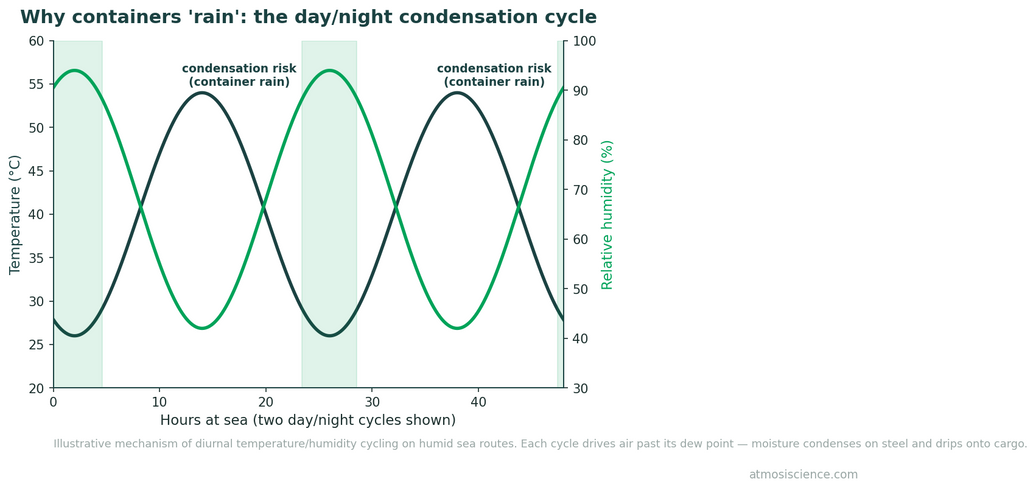
A steady 40°C / 75% RH hold is a useful accelerated storage condition, but it is not what a sea container does. Containers heat during the day and cool at night. As air cools it reaches its dew point and condensation forms on the coldest surface — the container ceiling and walls — then drips onto the cargo. That is container rain, and it is a cycling phenomenon that a constant-humidity chamber will never reproduce.

Build the conditioning profile from the lane, not from a default:
- Number of cycles matched to transit duration — a 30-day Asia–US East Coast route is roughly 30 day-night cycles.
- Temperature range from the season and route, not an annual average.
- Humidity at the top of the cycle from origin-port conditions, since that is the air sealed into the container.
- A cold-arrival step where the route ends in a cool climate or a chilled warehouse.
Why desiccants fail in sea freight covers lane-based sizing, and condensation after cold storage covers the arrival-side sweating problem.
Measure moisture, not just survival
A pass on a mechanical protocol means the pack arrived intact. It says nothing about whether the contents stayed dry. Add these measurements:
- In-pack relative humidity — a small logger inside sample packs, giving the full history rather than an end state.
- Product moisture content or water activity before and after. Water activity is the number that predicts caking and microbial risk; see water activity versus moisture content.
- Desiccant weight gain before and after. This tells you how much of the capacity was consumed and therefore how much margin the sizing has.
- Functional check — flow, dispersion, dose accuracy, appearance. The properties a customer would complain about.
- Wrap and seal inspection for damage and released material.
Desiccant weight gain is the most under-used of the five. If the desiccant returns from a full transit test having used 30% of its capacity, the sizing has real margin. If it comes back near saturation, the pack passed by luck.
Test at end of life, not fresh out of the pouch
A fresh desiccant has its full capacity available. A pack that has been in a warehouse for four months before shipping does not. For a defensible validation, precondition the desiccant to the state it will realistically be in at the start of the shipment — for example after the expected time between packing and dispatch. Testing fresh material overstates the protection.
The same principle applies to dosing. Size for the whole exposure, not the transit leg alone. The service-life calculation sets out the arithmetic.
Dosage and the freight trade-off
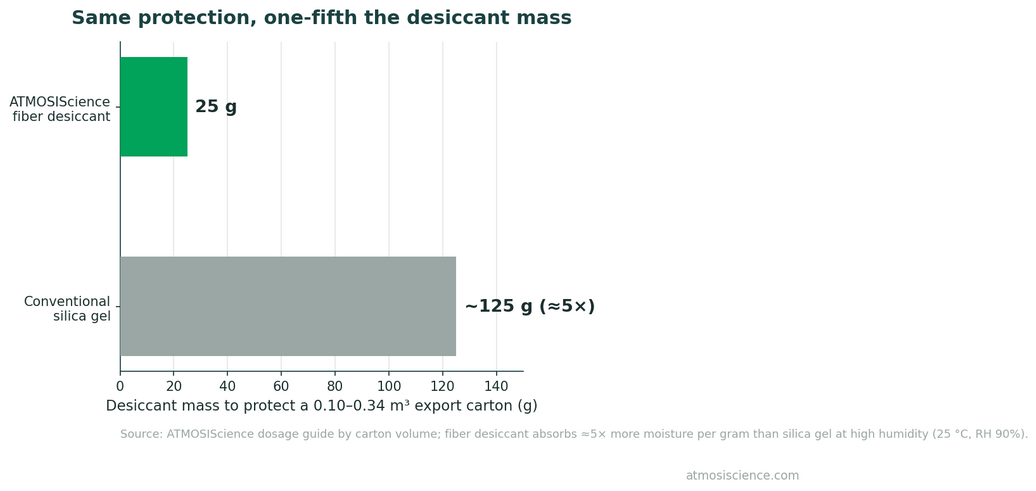
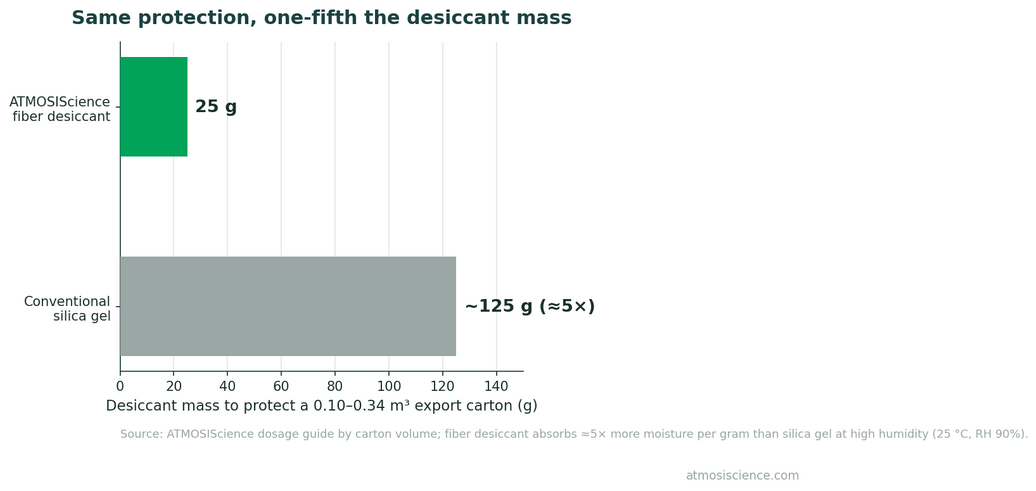
Transit testing often ends with a recommendation to increase dosage. That is where the choice of desiccant type shows up in the shipping cost, because different chemistries need different masses for the same protection.

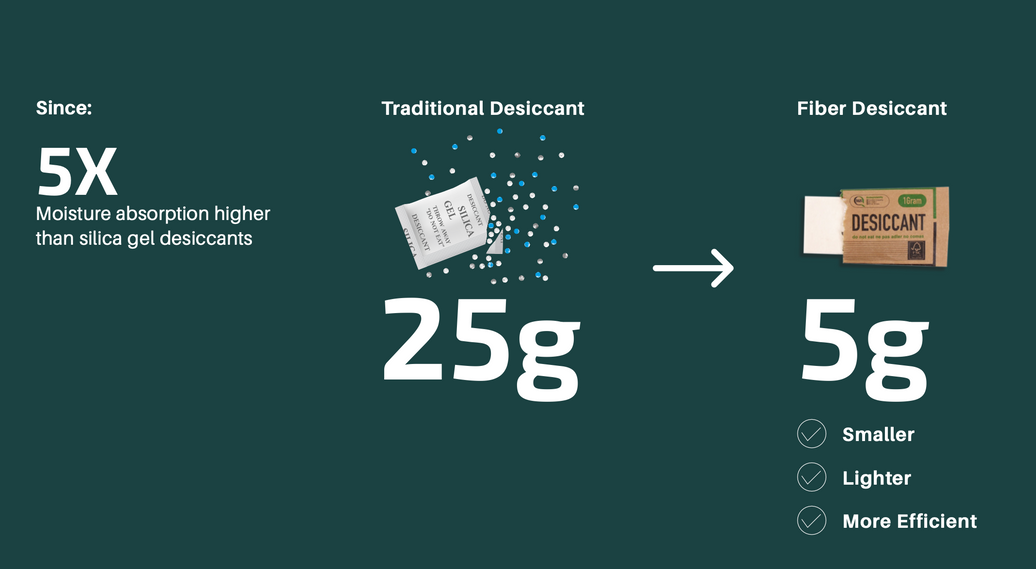
Fiber desiccant adsorbs more than 70% of its own weight at RH 90% (25°C) and exceeds 100% when saturated, against roughly 30% for common silica gel. A dosage increase demanded by a transit test therefore lands very differently depending on the starting material.
Documenting the result
The report is the deliverable. It should record the conditioning profile with its justification, the mechanical sequence, sample sizes, all five measurement sets, the pass criteria set in advance, and the desiccant specification and lot tested. Reference it from the packaging specification so a future dosage question is answered by the report rather than re-litigated. The supplier qualification document pack lists what to hold alongside it.
Frequently asked questions
Can a supplier support transit testing with desiccant in the pack?
A supplier can provide the specification, adsorption data, lot documentation and sizing rationale, and review the conditioning profile against the lane. The test itself is normally run by your packaging lab or a third-party facility.
What RH and temperature conditions should we simulate?
The ones your lane produces. Origin-port humidity at the top of the cycle, seasonal temperature range, one cycle per transit day, and a cold-arrival step if the destination is cool.
Can desiccant performance be validated after drop and vibration?
Yes, and it should be. Run the mechanical sequence first, then inspect and weigh the desiccant. Loose-fill formats are where vibration damage shows up as fines.
Do you have test data for distribution testing?
Adsorption performance is documented at defined humidity points, which is what a sizing calculation needs. Distribution results are pack-specific — the data supports the calculation; your test validates the pack.
Is a passed mechanical test enough for a shelf-life claim?
No. A shelf-life claim needs moisture and product-quality data over the claimed period. Transit testing validates that the pack reaches the customer in the state your stability study assumed.
Get sizing data before you book chamber time
Send the lane, transit duration and pack format. ATMOSIScience will provide the adsorption data and a sizing rationale you can put into the test plan — and review your conditioning profile against the route.
Prefer email? info@atmosiscience.com