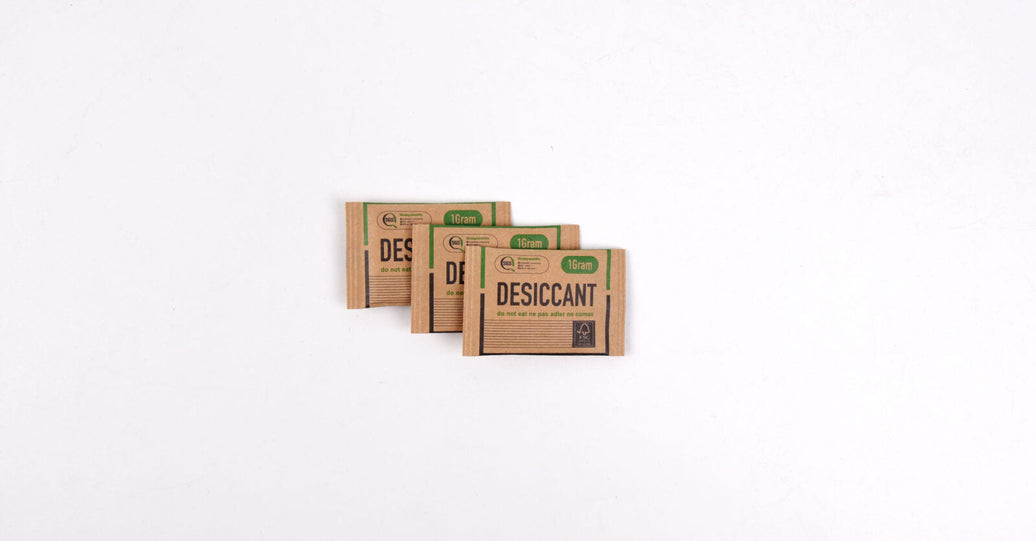
Quick answer: Desiccant dosage is set by four numbers — the package's moisture vapour transmission rate (MVTR/WVTR), its surface area, the shelf life you need to hold, and the desiccant's adsorption capacity at your target humidity. Volume alone tells you almost nothing. A foil laminate at 0.01 g/m²/day and a compostable paper structure at 10 g/m²/day of the same size can differ by three orders of magnitude in how much moisture they let in, which means the same product may need a 1 g sachet in one pack and a 30 g sachet in the other.
Most desiccant sizing conversations start in the wrong place. A buyer asks how many grams go into a 500 g pouch, and the answer arrives as a rule of thumb. Rules of thumb worked when almost every powder pouch was a foil laminate. They stop working the moment a brand moves to mono-material or paper-based structures under recyclability pressure — and in 2026, a lot of brands are moving.
The EU Packaging and Packaging Waste Regulation applies from 12 August 2026, with recyclability-by-design obligations that push exactly this migration. Weaker barriers are the predictable side effect. The desiccant has to absorb the difference.
What MVTR actually measures
MVTR (moisture vapour transmission rate), also written WVTR, is the mass of water vapour that passes through a defined area of material in a defined time, under defined temperature and humidity. The standard shorthand is grams per square metre per day, usually quoted at 38°C / 90% RH.
The phrase "under defined conditions" is doing most of the work in that sentence. An MVTR number with no test condition attached is not a specification — it is marketing. The three methods packaging engineers see most often:
- ASTM F1249 — modulated infrared sensor method, the most common for films and laminates. Fast, sensitive, good for barrier structures.
- ASTM E96/E96M — gravimetric "cup" method. Older, cheaper, less sensitive; adequate for high-permeation materials such as paper and uncoated board, poor for foil.
- ASTM D7709 — designed for unit-dose and pharmaceutical packaging films.
Two suppliers can quote the same material with a 5× difference simply because one tested at 38°C/90% RH and the other at 23°C/50% RH. Always ask which method, which conditions, and whether the number is for the film alone or the converted, sealed package including the seal area.

The four-input sizing method
Sizing a desiccant is a moisture budget. Work through it in this order.
1. Ingress through the walls
Multiply MVTR by the package's external surface area and by the number of days you need to hold the spec. A stand-up pouch measuring roughly 0.05 m² total surface, at an MVTR of 2 g/m²/day, over a 540-day shelf life, admits about 54 g of water vapour. At an MVTR of 0.05 g/m²/day, the same pouch admits about 1.35 g. Same pouch. Same product. Forty times the moisture load.
2. Moisture sealed in at fill
Headspace air carries water. So does the product itself if it comes off the dryer above its target moisture, and so does the packaging material — kraft and paperboard hold meaningful moisture at ambient conditions and release it into the pack after sealing. In low-MVTR packs this term often exceeds wall ingress, which is why a foil pouch can still fail without desiccant.
3. Opening cycles
Only relevant for resealable formats. Each opening exchanges headspace with room air. For a tub opened daily over 60 days, this term can dominate everything else.
4. Desiccant capacity at your working humidity — not at saturation
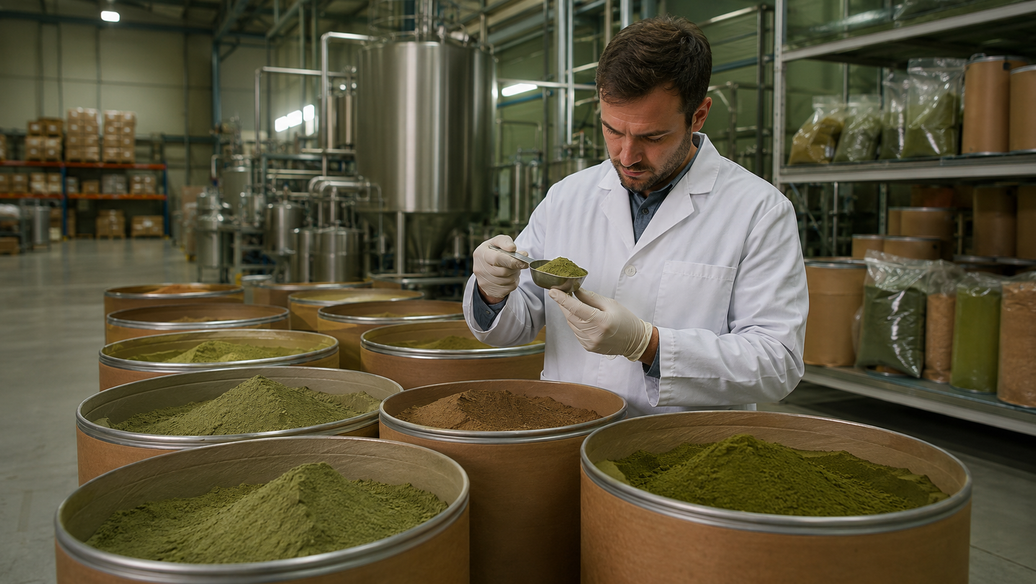
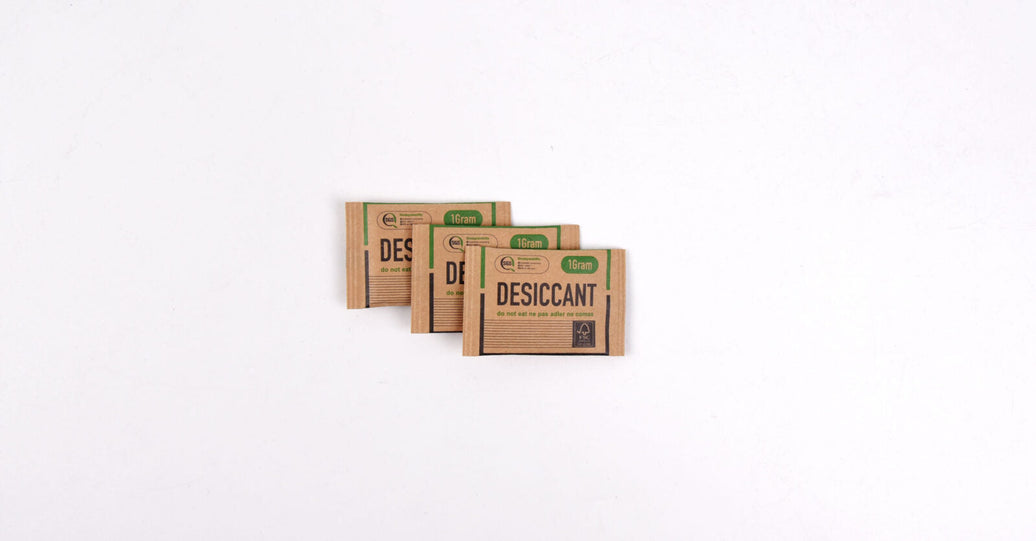
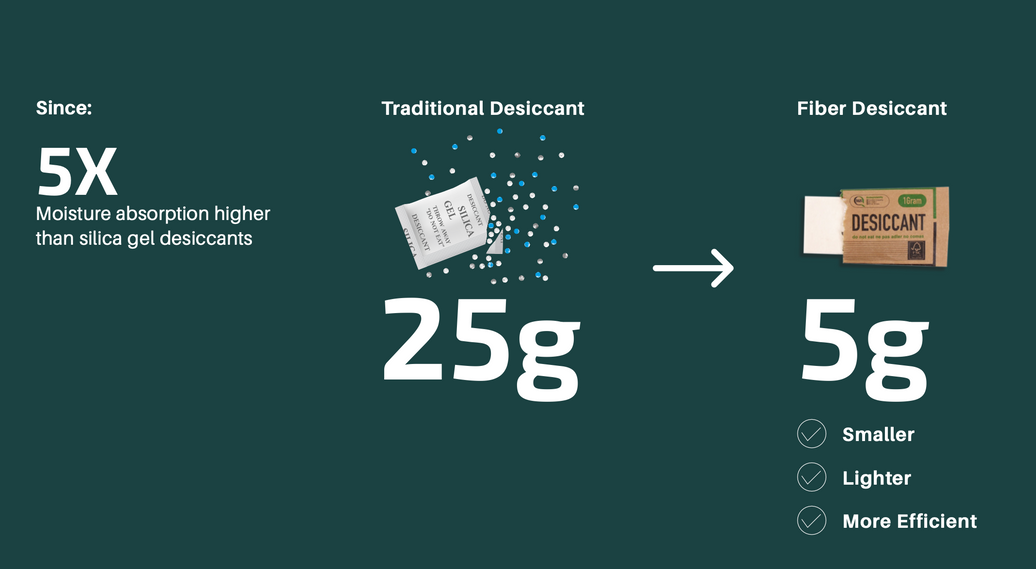
This is where most sizing errors happen. Capacity is a curve, not a constant. ATMOSIScience fiber desiccant adsorbs more than 10% of its own weight at 20% RH, more than 35% at 50% RH and more than 70% at 90% RH (25°C), with saturated adsorption above 100% of its own weight. If your target in-pack humidity is 30% RH, you cannot size against the 90% RH number. Take the capacity at the humidity you intend to hold, then add margin.
Comparing supplier claims on this point is its own exercise — see how to compare desiccant spec sheets for the test conditions that make two numbers non-comparable.
Two worked examples
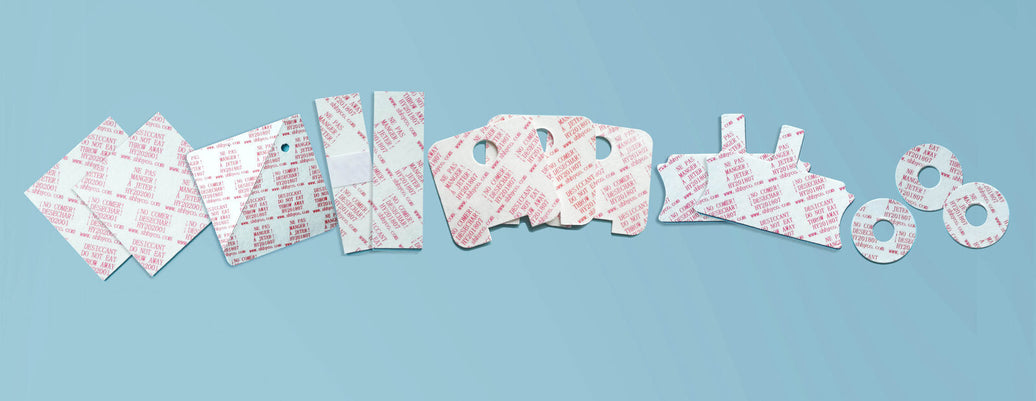
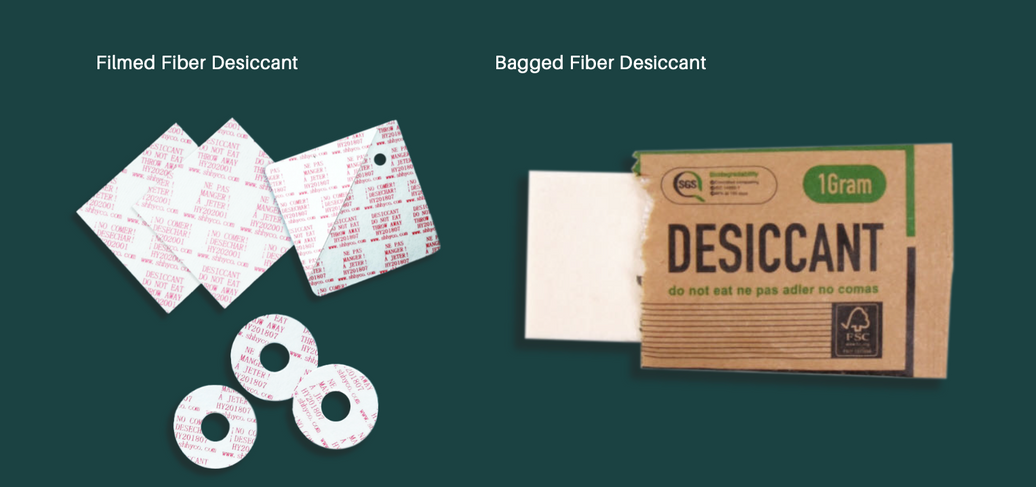
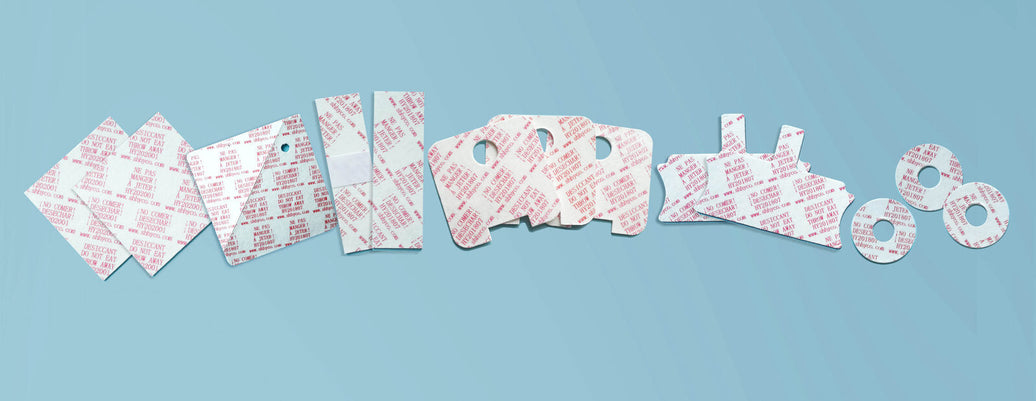
Example A — foil laminate stick pack, electrolyte powder. Very low wall ingress. The controlling term is sealed-in moisture from headspace and the powder itself. Dosage lands small — often a single film card rather than a sachet, because the headspace budget matters more than the capacity budget. See desiccant in stick packs.
Example B — compostable mono-material pouch, botanical extract. Wall ingress dominates and can be 20–50× the foil case. Two levers exist: raise desiccant mass, or shorten stated shelf life. Brands almost always prefer the first. This is the single most common reason a sustainability-driven packaging change quietly increases desiccant spend.
Where volume-based rules still help
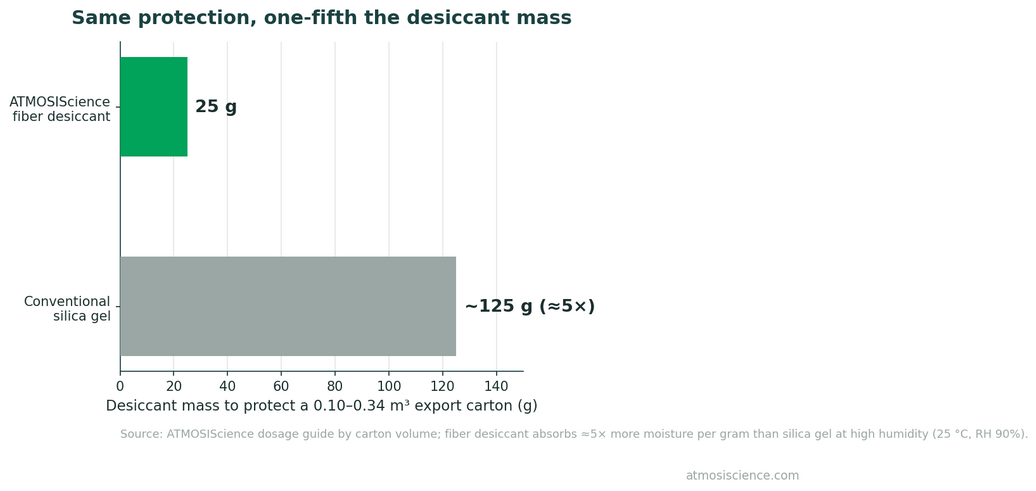
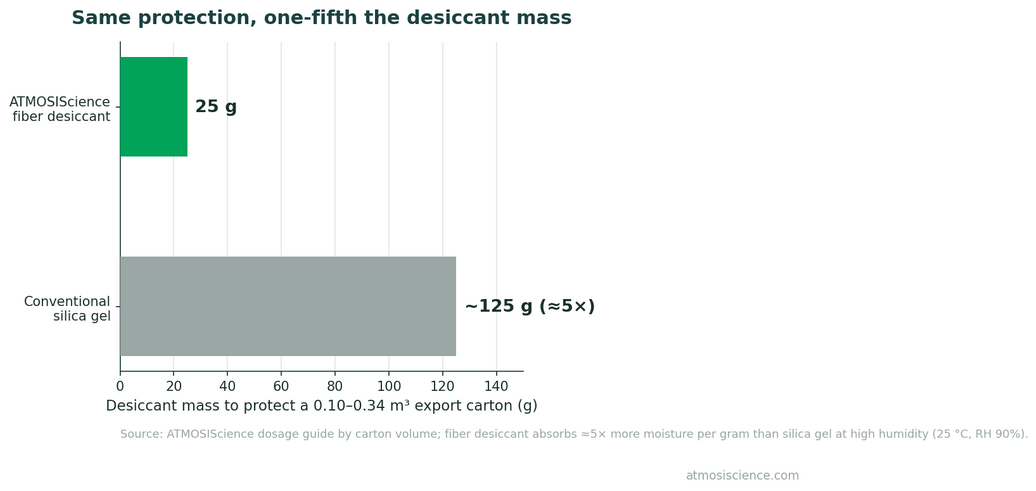
Volume rules are not useless. For cartons, containers and other large enclosures where the barrier is effectively "air-permeable box", volume is a reasonable proxy and the practical starting point is our dosage guide by carton volume. For sealed primary packaging, MVTR is the honest input.
What to ask a supplier before you commit
- Measured MVTR of the converted, sealed package — not the film datasheet — with method and conditions stated.
- Adsorption capacity at the specific RH you intend to hold, at 25°C.
- Whether the quoted capacity is equilibrium capacity or capacity after a stated exposure time.
- Kinetics: how fast the desiccant reaches useful capacity, since a slow desiccant in a fast-ingress pack never catches up.
- Whether the number was measured on the finished sachet or on the raw substrate.
FAQ
Is MVTR the same as WVTR?
Yes. MVTR, WVTR and moisture permeation rate are used interchangeably in packaging. The important qualifier is the test condition, not the acronym.
Can I use the film supplier's MVTR for my finished pouch?
Only as a starting estimate. Seals, gussets, zippers, spouts and laser scoring all add transmission paths that a flat-film test never sees. Finished-package data is always higher than film data, sometimes by a wide margin.
Does temperature change MVTR much?
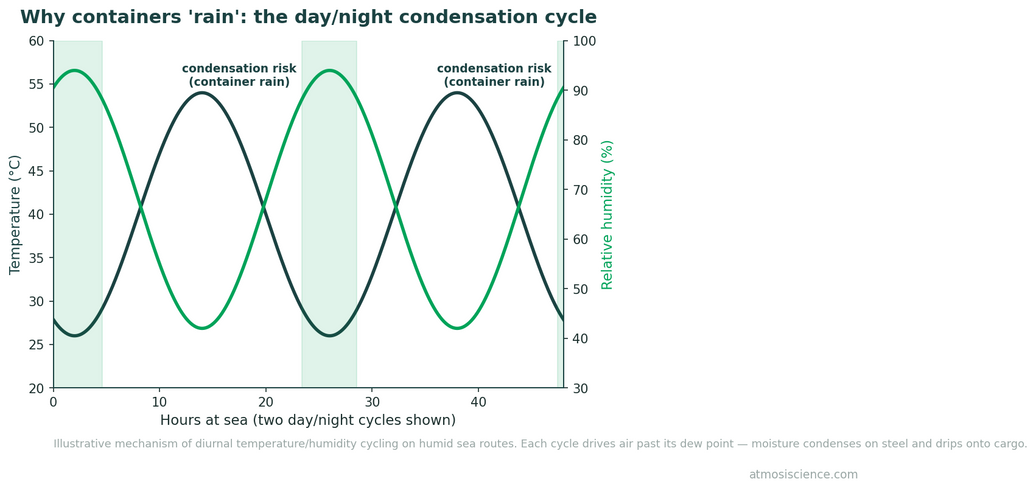
Substantially. Permeation rises with temperature, which is why a shipment routed through a hot lane behaves nothing like the same pallet in a climate-controlled warehouse. Size against the worst realistic lane, not the average one.
Does more desiccant always help?
No. Over-drying damages products with a required moisture window — gummies, dried fruit, some botanicals. For those, two-way humidity control that holds a band is the correct answer, not maximum capacity. See why "drier is better" is wrong.
How much margin should I add?
Common practice is to size to the calculated load and then validate with a worst-case chamber trial rather than adding an arbitrary multiplier. The worst-case sample evaluation protocol sets out how.
Send us your MVTR and we will size the desiccant
Share your package structure, surface area, target shelf life and target RH. ATMOSIScience engineers return a dosage recommendation and a sample plan.
Prefer email? info@atmosiscience.com