Quick answer: A new or newly-shipped instrument is at its most vulnerable in the first weeks: it was built and stored at a controlled humidity and now has to survive your climate. The first-90-days rule is simple — acclimate it slowly in a sealed case with a two-way 49% pack, watch the indicator card, and let the wood settle before you judge the setup or leave it out.
The forums are full of the same heartbreak: a dream guitar arrives, gets unboxed in a dry winter living room, and three weeks later there is a hairline crack or a buzz that was not there in the shop. It is rarely a bad instrument. It is a good instrument meeting a new climate too fast. Wood that was built at ~45–50% RH in a factory or luthier’s shop, then shipped through cold or dry transit, needs a gentle handoff to wherever it now lives.
Days 0–2: acclimate, don’t celebrate (yet)
The hardest instinct to resist is opening the case the second it arrives. If the box came through winter cold or a hot delivery truck, let it sit closed and come to room temperature for a few hours first — a cold instrument meeting warm room air condenses moisture on the finish, and that is how checking starts. Then open it, and before anything else, set up its climate.

Days 0–90: hold it steady while the wood settles
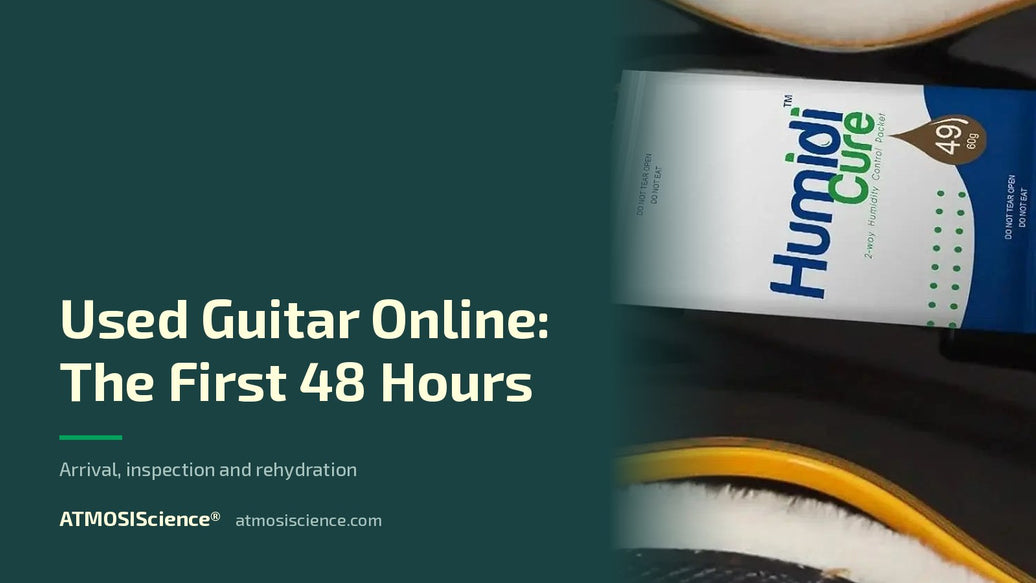
Drop a fresh RH indicator card and one 60 g Humidi-Cure® 49% pack into the case and keep it closed between sessions. For the first few weeks the instrument is equalising its moisture content to a stable 49% — the pack does the smoothing so it never over-shoots into dry-crack or swollen-top territory. Do not judge the action, relief or intonation in week one; wood is still moving. Give it a settling month at steady RH, then take it to a tech for a setup dialed to your climate — a setup done on an unsettled instrument won’t hold.
| When | Do | Why |
|---|---|---|
| On arrival (cold/hot transit) | Leave case closed a few hours to reach room temp | Prevents condensation and finish checking |
| Day 1 | Fit indicator card + 60 g pack; close case | Starts a stable 49% micro-climate immediately |
| Weeks 1–4 | Case closed between playing; read card weekly | Wood equalises without over-shooting |
| After ~1 month | Professional setup dialed to your climate | The neck and top have settled; the setup holds |
| Ongoing | Pack + card stay in; replace pack ~3 months | Every season after is just maintenance |

Buying across climates
Ordering a guitar from a dry US builder to humid Singapore, or a European classical to Australia, magnifies all of this — the instrument’s home climate and yours can be 30+ RH points apart. The case-and-pack handoff is what lets it cross that gap slowly instead of cracking on day 20. Market-specific routines: tropical, Korea seasonal, Australia, US winter.
For players: one 60 g pack per guitar or violin case, two for cello cases and cabinets. Start it right: 60 g Humidi-Cure® 49% pack →
Buying for a shop, school or fleet of cases? Wholesale tiers and custom RH programs are available — see wholesale programs or write to info@atmosiscience.com.
FAQ
My new guitar shipped with a little humidity pack already. Enough?
Shipping packs are often small or near end-of-life. Fit a fresh 60 g pack and a card so you know the case is actually holding 49% for the critical first months.
How long until I can trust the setup?
Give it about a month at stable RH before a proper setup, then a settling week after. Judging action in week one just means re-doing it.
Should a brand-new instrument crack this easily?
Good ones rarely crack in proper humidity — it is the fast handoff to a dry or damp room that does it. Controlling the case removes the risk almost entirely.
Is the first winter really the dangerous one?
Often, yes — a guitar bought in a mild season meets its first heating-season dry snap unprepared. Have the pack and card in before the furnace comes on.
Just got a new instrument? Get the first-90-days checklist
Tell the team what arrived and your climate. You will get the acclimation checklist as a printable sheet — and a sample-kit option if you want a pack and card to start today.
Prefer email? Write to info@atmosiscience.com — a specialist replies within one business day.