Quick answer: You do not need to know anything about instruments to protect one. Three rules cover a school year: the instrument sleeps in its closed case (never on the bed, radiator ledge or car); a two-way Humidi-Cure® 49% pack lives in that case and gets replaced about every 3 months — roughly once per school term; and once a week you spend five minutes wiping it down and checking the humidity card. That routine prevents the cracked-top and sharp-fret problems rental agreements bill parents for.
Every August and September, millions of families bring home a rented violin, cello, guitar or ukulele — in the US school-band season, in Korea's hagwon academies, in Singapore's music schools. The rental contract's damage clause rarely gets read until the spring inspection finds a crack. Here is the guide the rental counter wishes it had time to give you.
Why rentals crack more than owned instruments
Student instruments are built to a price — thinner margins for error — and they live hard lives: bedroom floors, radiator-warmed corners, winter car boots between school and lessons, weeks untouched over holidays. Wood is wood at every price point: it wants 45–55% relative humidity, and a heated winter bedroom at 25% RH shrinks a violin top the same way it shrinks a concert instrument's. The difference is who pays: on a rental, the repair bill lands on the agreement's damage clause — often a $100–300 crack repair on an instrument renting for $20 a month.
The five-minute weekly routine (child-friendly)
Minute 1: look — any new lines in the wood, gaps at the seams, sharp fret ends or open cracks? Minute 2: wipe strings and body with the dry cloth that lives in the case. Minute 3: check the humidity indicator card; if it reads outside 45–55%, note it. Minute 4: check the pack — if the card says the case is drifting, the pack is likely spent; swap it (about every 3 months in a tight case). Minute 5: latch the case properly — an unlatched case is a leaky case. Older kids can own the whole checklist; it doubles as instrument-respect training music teachers love.

The school-year humidity calendar
| Term | Climate risk | Parent action |
|---|---|---|
| Autumn arrival | Instrument adjusting to your home | Photograph condition on day one; fit a fresh 49% pack |
| Winter term | Heating drops rooms to 20–30% RH — crack season | Case stays shut when not playing; swap pack at mid-winter; never leave it in the car overnight |
| Spring term | Fast dry→humid swings | Two-way pack absorbs the swing; weekly card check |
| Summer break | Weeks unplayed; AC dryness or tropical damp | Fresh pack, case latched, stored in a living area — never attic, basement or garage |

Rental-return insurance for $8.99
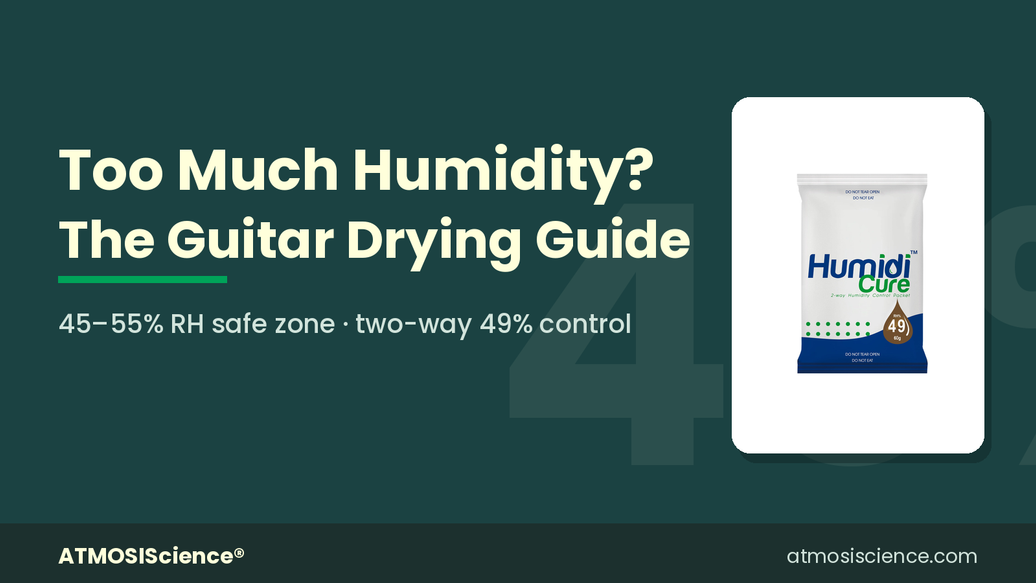
A Humidi-Cure® 49% 4-pack costs $8.99 and covers the whole school year with a spare: each pack works for about 3 months, two-way at ±2% — releasing moisture in heated winters, absorbing it in humid terms — with no liquid or gel to leak into a child's case and a food-contact-safe, compostable plant-fiber fill. Compare that to one damage-clause crack repair. Day-one photos plus a pack in the case is the cheapest insurance in music education. For house placement rules see small-space instrument care, and for why every instrument wants the same band, the 45–52% sweet-spot guide.
For schools and rental programs
Directors and rental shops: a pack in every case at issue time cuts winter repair queues dramatically — our school fleet humidity program covers per-case economics, and wholesale tiers exist for exactly this. Write to info@atmosiscience.com.
FAQ
The rental came with no humidity anything. Is that normal?
Common, unfortunately. Shops assume home care. Add a two-way pack yourself — it is the single highest-value addition to a rental case.
Where should the instrument live at home?
In its case, in a lived-in room — not the coldest bedroom, not by a radiator or vent, never attic, basement or garage. The case buffers; the pack controls.
My child forgets everything. What is the one rule?
'It sleeps in its case.' A latched case with a 49% pack forgives nearly every other lapse.
Do quarter-size and half-size instruments need special care?
Same rules, same pack. Fractional instruments are thinner-built if anything — stability helps them survive being upgraded out of, so the next family gets a playable instrument too.
School-year protection, sorted: Humidi-Cure® 49% Humidity Pack — 4-pack, $8.99 — one case, one year, one purchase. Browse the instrument collection.
Rental shop, school or music academy? Fleet pricing: wholesale programs · info@atmosiscience.com
Questions about a rental instrument?
Tell us what your child plays and your climate — we will send a one-page care plan. Or email info@atmosiscience.com.