Quick answer: Ouds, sitars and their cousins are among the thinnest-built string instruments in the world, and most were made in humid workshop climates. Move one into a heated or air-conditioned home and it can crack within its first dry season. Hold the case at 45–55% RH — a Humidi-Cure® 49% two-way pack keeps a closed case at 49% ±2% for about 3 months, in both directions.
The oud has no frets to buzz and no truss rod to tweak — what it has is a soundboard often thinner than 2 mm, a bowl coopered from dozens of slender ribs, and delicate carved rosettes. The sitar pairs a gourd resonator with a carved toon or cedar neck and celluloid bindings. Add the saz, pipa, bouzouki, charango and domra, and you have a family of instruments that share one trait: almost no structural margin against wood movement. This guide is for players keeping these instruments far from the climates they were built in.

Why these instruments are the extreme case
Wood shrinks across the grain as it dries — on a big Western guitar that stress is spread through bracing and a 2.5–3 mm top. An oud face at 1.5–2 mm with light ladder bracing concentrates the same force in less material, which is why oud cracks so often run long and open fast. The bowl is its own risk: each rib is a few millimetres of walnut or mahogany glued edge-to-edge, and a dry season can open a seam you can see light through. Sitars fail differently — the gourd itself is stable, but the neck-to-gourd joint, the flat carved tabli and celluloid ornament lines all telegraph movement as opened seams and lifted bindings.
There is also a built-in ambush: origin climate. Instruments built in workshops in humid cities equilibrated there — wood settles toward its environment, and a build climate near 60–70% RH is common along the traditional routes these instruments travel. Ship that instrument to a Phoenix living room, a Melbourne summer or a Seoul winter running ondol heat, and it will spend its first year shedding moisture it was built with. That first year is when most cracks happen — the same logic as our first-90-days guide, with less wood in reserve.
Feature-by-feature risk map
| Feature | Failure mode | Watch for |
|---|---|---|
| Ultra-thin soundboard (oud, pipa) | Grain cracks, sunken face | Action dropping; lines near the rosette |
| Coopered bowl ribs | Open rib seams | Light through the bowl; buzz on certain notes |
| Gourd + wood joints (sitar, tanpura) | Joint separation, lifted celluloid | Gaps at the gulu joint; binding edges catching |
| Hide-glue construction throughout | Glue creep in sustained damp | Braces rattling after humid months |
The plan: case, pack, patience
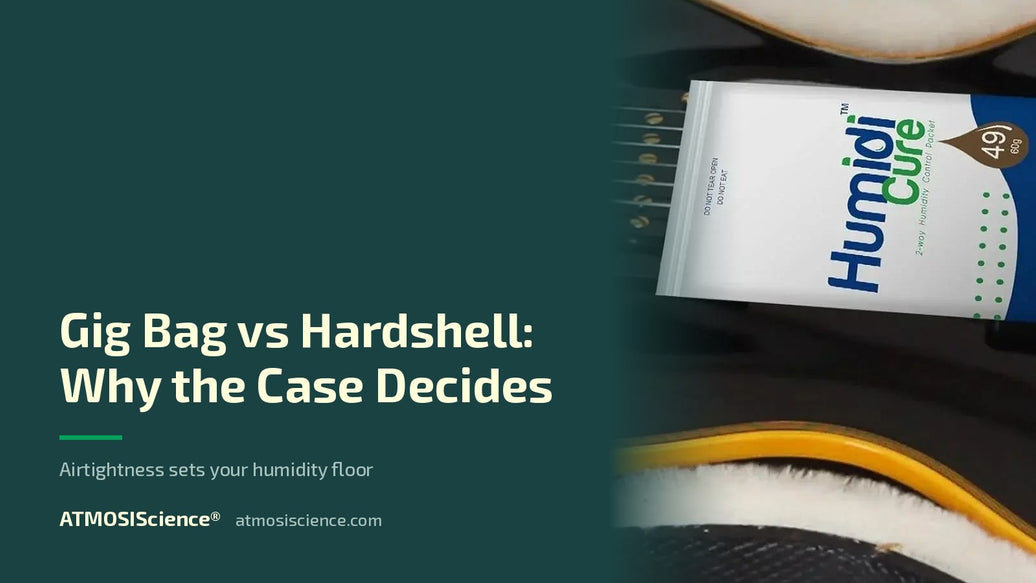
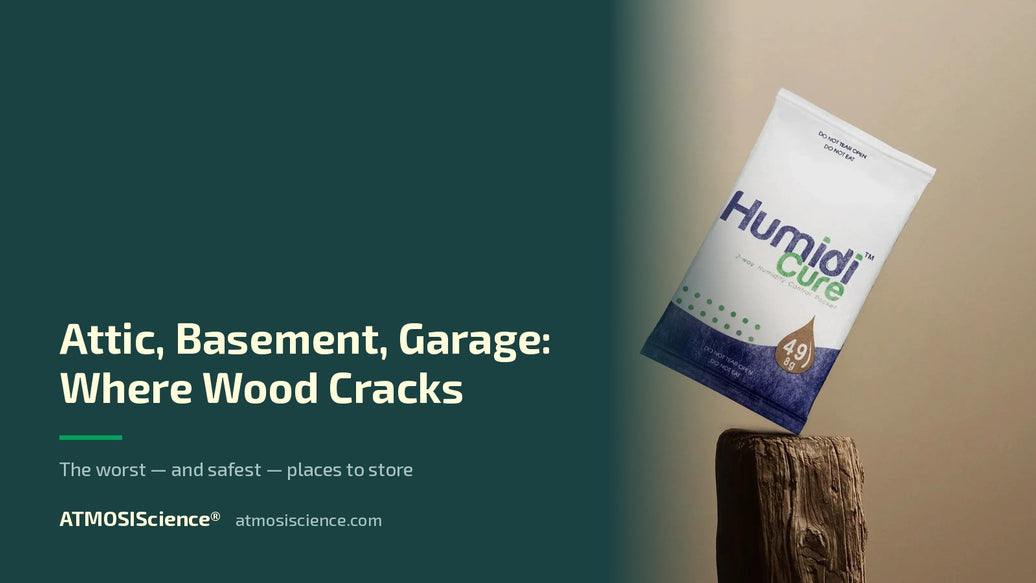
Soft gig bags are the default for many of these instruments, and they are almost no barrier to room air. Upgrade to a hard case if you can; if not, keep the gig-bagged instrument inside a closed cabinet or wardrobe and control that smaller volume. Then set the microclimate: one Humidi-Cure® 49% pack for a sitar or saz case, two for a large oud case given the bowl volume (see dosing). Add an RH indicator card near the soundhole area. Swap packs at about 3 months — sooner in leaky bags, since case airtightness is the number-one variable. The pack is two-way, so the same setup absorbs moisture during a Singapore monsoon stretch and releases it in heated winters; it contains no liquid or gel — a US-patented plant fiber sheet, food-contact safe and compostable.

Protect it today: Humidi-Cure® 49% Humidity Pack — 4-pack, $8.99 · All instrument humidity control
Teacher, ensemble or import shop? B2B & wholesale: wholesale program · info@atmosiscience.com
FAQ
My oud was fine for years — why did it crack this winter?
Cumulative dryness plus one sharp event (a cold snap, heating running harder than usual) is the usual account. Wood tolerates slow drift better than fast gradients; the fix is stabilising the case before the season turns.
Can I keep a sitar on a stand for looks?
Display is possible in a climate-checked room, but a gourd-and-celluloid instrument on an open stand in aircon or heating is asking for seam gaps. Case it between sessions during extreme months at minimum.
Are synthetic-skin or laminate versions safe?
More forgiving, yes — but necks, joints and bindings remain wood and glue. The moderate zone still pays for itself.
The instrument came from a humid country weeks ago. Too late to start?
Not at all — the first months are exactly when a stable 45–55% case matters most. Start now and let it finish acclimating slowly.
Get a free plan for your instrument
Or email info@atmosiscience.com.