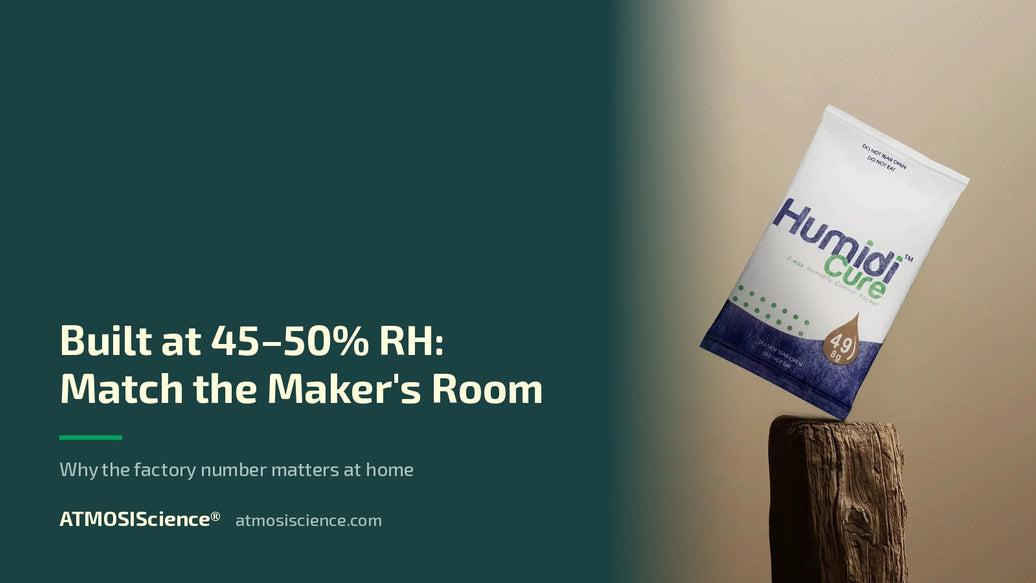
Quick answer: Builders hold the shop at 45–50% RH because wood glued together in that band stays together at the extremes customers live in. Zone it: wood storage and glue-ups get the tightest control, the bench tolerates more, and every customer instrument waits for pickup in a case held at 49% by a two-way pack.
Walk into a serious guitar factory and the most important tool is invisible: the air. Production builders run their assembly floors inside a narrow humidity band all year, which is why our guide to why guitars are built at 45–50% RH is really a guide to why your room should copy the factory. For the one-bench lutherie shop and the busy repair counter, the same physics applies with less HVAC budget behind it. Here is how working shops make the band hold.
Why the build band is non-negotiable
Wood keeps adjusting its moisture content to the air around it for its entire life, the equilibrium moisture content cycle. Whatever the air was on glue-up day is the state the assembly considers normal forever after. Join a braced top at 50% and send it to a 25% winter apartment, and the shrinking plate is preloaded against its own bracing before the customer plays a note. Build dry at 30% and the first humid summer bellies it. Building in the middle of the customer band, then telling the customer to hold that band at home, is the entire strategy, and it is why maker guidance like Taylor's 45–55% range exists.
The zone map
| Zone | Target | Why and how |
|---|---|---|
| Wood storage rack | 45–50%, steady | Sticker-stacked stock equilibrates for weeks before it is worked; a swing here bends future guitars |
| Assembly and glue-up area | 45–50%, strict | The band that gets locked into every joint; monitor with a calibrated hygrometer at plate height |
| Finish room | Stable, moderate | Follow the finish maker's spec; stability matters as much as the number |
| Repair bench | 40–55% acceptable | Short exposure is fine; the instrument's home base is its case |
| Customer holding shelf | Cased at 49% | Every waiting instrument latched with a Humidi-Cure® 49% pack, so it leaves better than it arrived |

The repair bench angle
Winter fills the bench with dried-out instruments: sunken tops, buzzing setups, sharp fret ends. The professional move is to rehydrate before you adjust, because a setup cut on shrunken wood is wrong again the week the top recovers. Case the instrument with a fresh 49% pack and give it days, not hours; severe cases want a week or two. Then measure, then cut. It is the difference between fixing the guitar and fixing the symptom, and the same logic our used-guitar arrival protocol gives owners.
Two habits pay for themselves at the counter. First, write the case RH on every work order: customers trust a shop that measures. Second, send every winter setup home with a 4-pack and thirty seconds of explanation. It protects your work, and it is retail margin sitting next to the register. The packs hold 49% within about 2 points, two-way, with no liquid or gel to threaten a finish, using US-patented plant fiber that is food-contact safe and compostable. Service life is about 3 months per pack, and case airtightness is the number one variable, which doubles as your reason to sell better cases.

Holding the band through the seasons
Shops in the US, Canada and Korea fight the dry side all heating season and often need room humidification running alongside case-level control. Benches in Singapore and coastal Australia fight the damp side with air-conditioning and dehumidifiers, and their glue-ups care just as much. The case-level layer is the constant in both hemispheres: room systems fail, power goes out, doors stay open on delivery day, but a latched case with a two-way pack rides through all of it.
FAQ
What RH should wood stock reach before I build with it?
Let it sit stickered in your 45–50% shop until its weight stabilizes, typically a few weeks for instrument sets. Building with wood that has not equilibrated imports someone else's climate into your joints.
How long does a dry guitar need at 49% before setup?
Mild dryness recovers in three to seven days in a cased 49% environment; a sunken top deserves one to two weeks and a re-measure. Quote turnaround accordingly in winter.
Does the finish room really need different treatment?
Finishes have their own temperature and humidity specs and punish swings with blush and adhesion trouble. Keep it stable and follow the manufacturer sheet rather than a single universal number.
Can a small shop stock packs for resale?
Yes, that is exactly what the wholesale program is for: counter stock, bench stock and show kits at trade pricing.
For the bench and the counter: Humidi-Cure® 49% Humidity Pack, 4-pack of 60 g packs, $8.99, and the full instrument humidity collection.
Builders, repair shops and schools: wholesale pricing or info@atmosiscience.com.
Talk shop with us
Tell us your bench count, climate and workload and we will suggest a zone setup and resale stock plan.