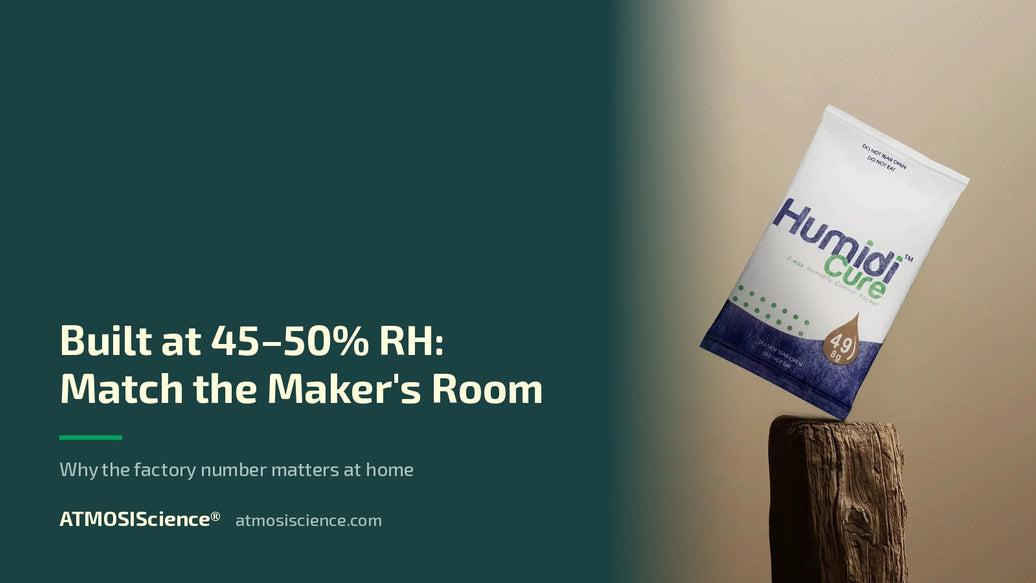
Quick answer: Museums protect wooden instruments by holding them near 45–55% RH and — above all — avoiding swings. You can reproduce the method at home: display in an enclosed case or cabinet rather than open air, put a two-way Humidi-Cure® 49% pack inside to hold the setpoint (±2% RH, no liquid or gel), and verify with an RH indicator card you can read through the glass.
A collection on open wall hangers looks wonderful and lives at the mercy of the room: every heating cycle, every humid spell, every air-conditioned afternoon passes straight through it. Conservation practice at major museums takes the opposite approach — collections sit in controlled envelopes, and the target for mixed organic materials like wood, glue and varnish sits in the mid-40s to mid-50s percent RH, held steady. Stability is the doctrine: conservators tolerate a slightly imperfect number far more readily than a moving one.
The display case as a microclimate
You do not need a building management system to apply this. A glass display case, a gasketed cabinet, or even a quality hardshell case standing open-lidded inside a larger vitrine is a microclimate — a bounded volume of air you can actually control. Enclose it, condition it, monitor it. That is the entire museum method in three words.

Choosing the level of protection
| Display setup | RH control | Recommendation |
|---|---|---|
| Open wall hangers | None — tracks the room | Only in a room you actively hold at 45–55%; rotate players' instruments back into cases |
| Glass display case | Good — slows exchange | One 49% pack per guitar-sized volume, hidden at the base; RH card visible through glass |
| Gasketed cabinet | Best — near-sealed microclimate | Packs hold 49% ±2% for about 3 months; seal quality is the biggest variable in pack life |
| Closed cases in a rack | Excellent per instrument | The standard for unseen storage — see the sealed-case method |
Two-way control matters more in display than anywhere else, because a case in a living room faces both directions across a year — heating-season dryness, then a humid summer. A conditioned-silica setup only absorbs unless it is actively managed; the plant-fiber platform behind Humidi-Cure® exchanges moisture in both directions around a fixed 49% setpoint, which is why the same fiber technology also serves industrial and archival storage applications. For the mechanism — and the sealed-box data above — see how two-way packs work.
Collection housekeeping conservators would recognize
Log it: a photo of each instrument and a monthly note of the RH card reading builds the care record that supports insurance and resale value — the same value logic in our vintage and antique guide. Place cases and cabinets on interior walls away from vents, radiators, windows and direct sun (light fades varnish; heat drives the RH swings). Replace packs about every 3 months, on a calendar, and refresh the card when you do. Whether the room is a dry US winter den, a Singapore apartment, or a Korean living room over ondol heating, the enclosure strategy is identical — the pack simply works in whichever direction the climate pushes; the target zone itself is covered in the 45–52% RH sweet spot.

FAQ
Silica gel or a two-way pack for a display case? Plain silica only absorbs — fine against damp, useless against winter dryness. A two-way pack holds a fixed setpoint in both directions without conditioning or maintenance.
How many packs does my case need? One per guitar-sized volume as a starting dose; double it for large multi-instrument vitrines or leakier enclosures, and let the RH card tell you the truth.
Does the case have to be airtight? No — but the better the seal, the steadier the reading and the longer each pack lasts (about 3 months in a well-sealed enclosure; airtightness is the #1 variable).
Is 49% right for very old instruments? It sits inside the conservation band. For fragile antiques with existing cracks or loose varnish, stability matters most — avoid any rapid change and involve a restorer before major moves.
Build your case's microclimate: Humidi-Cure® 49% Humidity Pack — 4-pack, $8.99 · all instrument humidity control. Two-way ±2% RH, no liquid or gel, food-contact safe, US-patented plant fiber, compostable.
Gallery, dealer or collection manager? Wholesale program · info@atmosiscience.com
Get a free humidity plan for your collection
Tell us what you display and where — we will reply from info@atmosiscience.com with an enclosure and dosing plan.