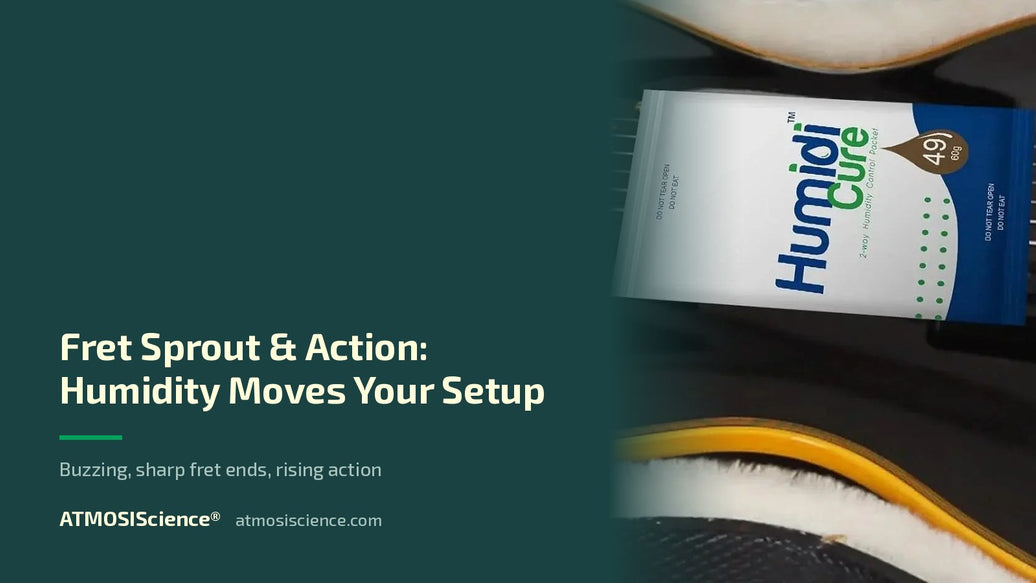
Quick answer: A two-way humidity pack is a moisture reservoir with a setpoint: below the setpoint it releases water vapor, above it it absorbs, until the sealed space rests at the target RH. The engineering difference is the carrier. Salt-solution packets hold the reservoir as a liquid; the ATMOSIScience fiber platform holds it in a solid plant-fiber matrix — no liquid to leak, faster exchange, and higher capacity per gram in sealed-box testing.
Every wooden instrument wants the same thing — steady mid-range humidity — and the two-way pack is the simplest machine ever built to deliver it: no power, no refills, no moving parts. This article explains what is actually happening inside the pack, and shows sealed-box lab numbers comparing the two dominant constructions.
The physics: equilibrium, not magic
Every hygroscopic material settles toward an equilibrium with the air around it. Engineer a material whose equilibrium sits at a chosen setpoint and seal it in a case: whenever case air drifts below the setpoint, the material gives up water vapor; whenever it drifts above, the material takes vapor in. The instrument inside stops seeing weather. Two numbers define quality: how tightly the pack holds its setpoint (accuracy), and how much moisture it can move before exhaustion (capacity).

Two ways to build the reservoir
Salt-solution packets — the construction most players met first — suspend a saturated salt solution behind a vapor-permeable membrane. Saturated solutions pin RH at a known value, which is sound science with a structural caveat: the working material is a liquid. Membranes can be punctured; packs can weep near end-of-life; and manufacturers themselves advise keeping a barrier between packet and instrument in some applications.
The fiber platform takes a different route: humidity-active compounds are bonded into a porous plant-fiber (bamboo-derived cellulose) matrix — a solid sheet, sealed in a breathable pack. The water is held in the fiber’s pore structure, never as free liquid. That construction is why a Humidi-Cure® pack can rest directly against varnish or hardware: there is no liquid or gel to leak, in any orientation, at any temperature an instrument case will ever see. The same fiber platform runs in electronics cabinets and museum display cases, where corrosion and artifact safety rule out liquid systems.
The sealed-box test
The standard way to compare two-way packs is a dry/wet balance test: seal the pack in a fixed volume at 25°C, force the air a step drier or wetter, and weigh how much moisture the pack moves to pull the space back. ATMOSIScience ran this against two leading imported salt-solution packets (8 g packs, 62% RH variants, 2020):

Three results worth reading twice. During forced dry-down, the fiber bag-type released 0.67 g of moisture against 0.33–0.37 g for the imported packets — roughly double the supply when a dry room is pulling on the case. During forced humid-up, fiber absorbed 0.79–0.80 g vs 0.73–0.74 g. And across repeated runs the fiber packs’ displayed RH stayed consistent while the imported samples scattered more widely between units — consistency is what a setpoint is for. (Same-platform test at the 62% setpoint; the 49% instrument pack shares the identical fiber chemistry, tuned lower.)
What this means inside a guitar case
Capacity per gram translates directly into service life and recovery speed: more moisture moved per pack means the case recovers faster after each opening and the pack lasts longer between replacements — about 3 months in a well-sealed case, with case airtightness the single biggest variable. Accuracy translates into a stable 49% ±2% instead of a slow wander. And the solid-state construction removes the one failure mode no player wants to discover on a vintage top. How this plays against sponges and gels — the other two tools on the shop wall — is covered in the three-way comparison, and the target number itself in the 45–52% sweet-spot guide.

For players: one 60 g pack per guitar or violin case, two for cello cases and cabinets. Get the 60 g Humidi-Cure® 49% pack →
Buying for a shop, school or fleet of cases? Wholesale tiers and custom RH programs are available — see wholesale programs or write to info@atmosiscience.com.
FAQ
Is the salt in a fiber pack a leak risk?
The humidity-active compounds are bound inside the solid fiber matrix and the pack contains no free liquid at any point in its life. Leak risk is a property of liquid reservoirs, not of the chemistry itself.
Why does the test use 62% packs if instruments need 49%?
The 2020 balance test was run on the platform’s 62% variant — the same fiber matrix and construction, tuned to a different setpoint. Capacity and stability are properties of the platform; the setpoint is the tuning.
Can I regenerate a spent pack in the sun or a rice jar?
No — drying a two-way pack changes its water load, not its calibration, and DIY re-wetting cannot restore the engineered moisture content. Replace it; composting is the intended end-of-life for the fiber (SGS-certified industrially compostable, EN 13432).
How do I know the pack is actually at work?
Pair it with an RH indicator card and watch the case settle to ~50% within a day — the card guide shows the full read-and-replace routine. Skeptics: run one controlled case and one bare case side by side for a week.
Want the lab summary or a technical question answered?
Materials engineers on the team answer setpoint, capacity and safety questions directly — and can share the sealed-box test summary. Distributors and OEM buyers: ask about custom RH setpoints (35–75%) and formats.
Prefer email? Write to info@atmosiscience.com — a specialist replies within one business day.