Your guitar is basically a living piece of wood. And wood does what wood does: it constantly tries to “match” the air around it. When it absorbs moisture, it swells. When it loses moisture, it shrinks. That’s why guitar humidity control is not a nice-to-have, it’s the difference between “plays like butter” and “why does my action feel weird?”
If you own a guitar (especially an acoustic), the invisible threat is not just temperature. It’s guitar humidity swings that quietly warp, crack, swell, corrode, and dull your tone over time.
Why guitar humidity control matters
Most humidity damage is preventable, but only if you catch it early.
When humidity is too low, the guitar gradually dries, wood shrinks, tops can sink, and cracks become more likely.
When humidity is too high, the guitar can swell, seams can separate, bridges can loosen, and action can become uncomfortable. High humidity can also make the guitar sound dull and lifeless because the wood holds extra water weight.
Seasonal transitions (spring and fall) are where many owners get surprised, because humidity can swing fast while you’re living your normal life.
What is the ideal humidity for guitars?
Most guitar makers and trusted instrument sources land in the same zone:
-
Ideal range: 45% to 55% RH
-
Optimum target: around 50% RH for preserving wooden guitars
-
“Safe zone” for many homes: 40% to 60% RH (especially if you’re monitoring consistently)
If you only remember one line: aim for 45–55% RH, and don’t let it bounce around.
Signs your guitar has a humidity problem
If your guitar is too dry (under-humidified)
Look for combinations of symptoms like:
-
Sharp fret ends (neck shrinks as wood loses moisture)
-
Fret buzz in areas that weren’t buzzing before
-
Top sinking or “caving” behind the bridge
-
Cracks (top cracks, side cracks, seam splits)
If your guitar is too humid (over-humidified)
Common clues:
-
High action (strings feel unusually high)
-
Swelling / bellying behind the bridge
-
Dull, lifeless tone
-
Tarnished hardware or corrosion in sustained high humidity
How to control humidity in a guitar (at home and on the go)
1) Measure first (don’t guess)
A hygrometer is the simplest “reality check.” Even Martin specifically calls out that you need a hygrometer to measure humidity if you’re using humidification.
Tip: measure inside the case, not just the room, because cases create their own micro-climate.
2) Use the case as your control chamber
Keeping the guitar in its case when not in use is one of the most effective precautions, especially during seasonal swings.

3) Stabilize with a 2-way system (not “add moisture and hope”)
2-way humidity control is popular because it:
-
releases moisture when air is too dry
-
absorbs moisture when air is too humid
That reduces the risky over-correction that happens with many one-way humidifiers.
4) Control the room when the environment is extreme
If you live somewhere consistently humid (or consistently dry), you may need a room humidifier or dehumidifier as the “base layer,” and then case control as the “precision layer.”
Key tools for guitar humidity control
Here’s the practical toolkit most owners end up with:
-
Hygrometer (digital is easiest) for guitar humidity monitoring
-
Guitar case humidifier (ideally a 2-way pack) to stabilize RH inside the case
-
Hard case or well-sealed cabinet to reduce swings
-
Room humidifier/dehumidifier if your region is extreme or seasonal
One caution: water-based soundhole humidifiers can over-humidify, and spills can be damaging because wood absorbs water quickly.
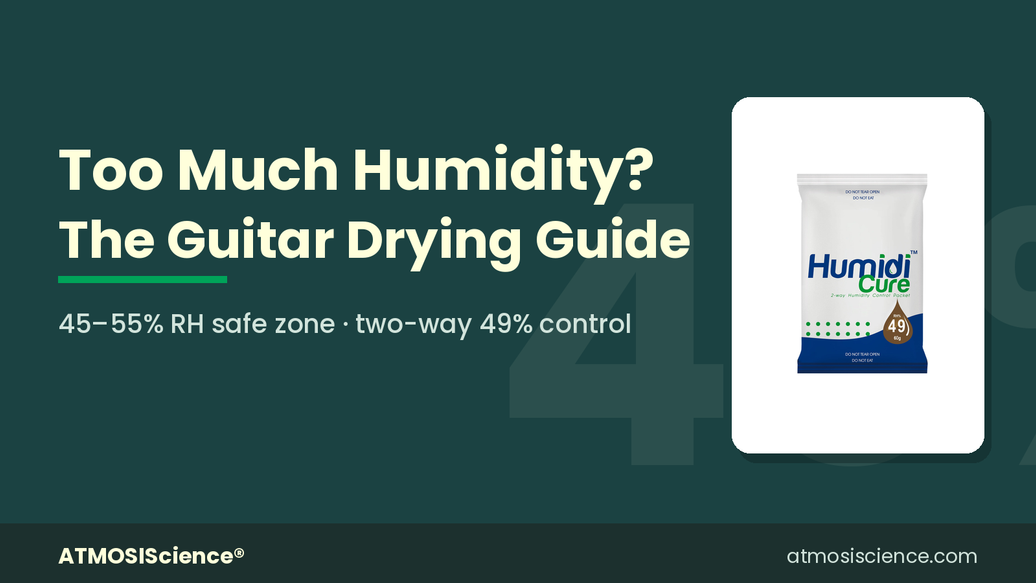
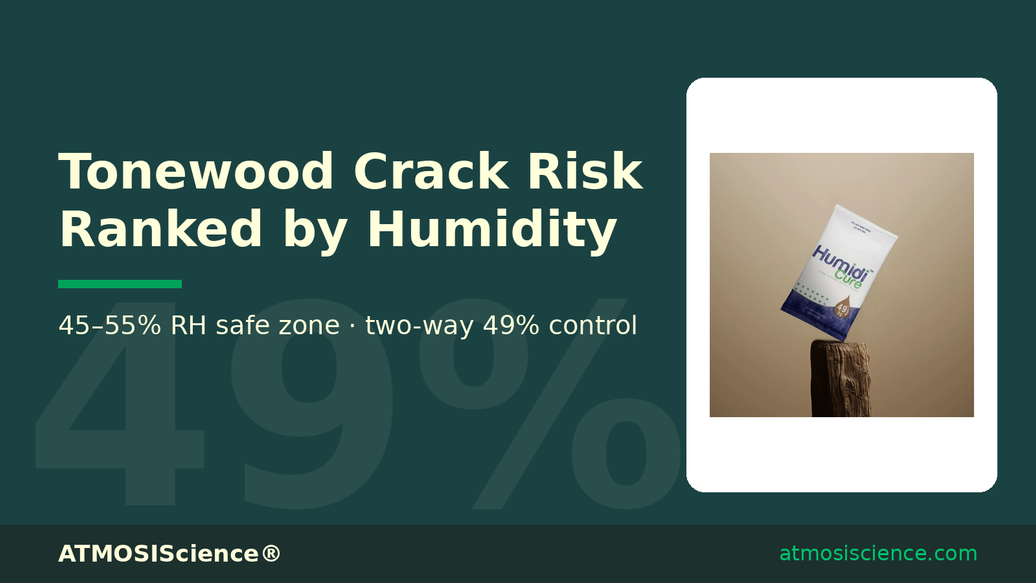
A simple option for acoustic guitar humidity control: Humidi-Cure 49% for Instruments
If you want “set it in the case and stop thinking about it,” this is where Humidi-Cure 49% for Instruments fits.

It’s a fiber-based, 2-way humidity control pack designed to hold your case at a stable 49% RH with ±2% precision. It releases moisture when too dry and absorbs when too humid. It’s also salt-free and liquid-less, which removes the usual leak and corrosion worries that make many guitar owners nervous.

Why 49% RH?
Because it sits right inside the widely recommended target zone (45–55% RH), and helps keep your guitar close to “factory-happy” conditions.
What you get (at a glance)
-
Maintains 49% RH (or custom RH depending on needs)
-
True 2-way humidity control (adds or removes moisture as needed)
-
±2% RH precision, designed to reduce swings
-
No salt, no liquid, designed to avoid leaks and corrosion
-
Typical lifespan: 3–6 months per pack, depending on environment and how sealed your case is
How to use it (takes 30 seconds)
-
Tear open the clear overwrap
-
Place the pack in your guitar case (or sealed cabinet)
-
Use the included indicator card and match the center dot to the ring
-
Replace when the indicator shows it’s time

This is built specifically for acoustic guitar humidity control, but also works for violins, violas, mandolins, banjos, ukuleles, woodwinds, and other wooden instruments.
FAQ
Can I leave my guitar on a stand if my room feels “fine”?
If your room consistently sits in the 40–60% RH safe zone, many guitars do fine. But if your home regularly dips below or spikes above that, case control becomes the safer default.
Do I still need a hygrometer if I use a case pack?
It’s smart. Even a simple check helps you spot a leaky case, a weather shift, or a pack that’s nearing replacement.
What’s the biggest mistake owners make?
Over-correcting. Either ignoring humidity until damage appears, or using water-based humidifiers aggressively and accidentally pushing the guitar too wet.
The takeaway
Guitar humidity control is not about being obsessive. It’s about keeping your instrument in its comfort zone so it stays stable, playable, and resonant.
If you want an easy, case-based solution, Humidi-Cure 49% for Instruments is designed to keep your guitar case at a precise RH level using a liquid-less, salt-free, 2-way fiber system.