A violin top is a few millimeters of carefully graduated spruce held together with hide glue that is designed to release before the wood cracks. That engineering is a blessing and a warning: bowed instruments are built to move with humidity, which means they suffer fast when humidity is wrong. An open seam, a sunken top, a sound that has gone thin: most are humidity stories. The defense is the same one professional players and luthiers rely on: hold the case at 49% RH.
This guide covers humidity control for violins, violas, and cellos, and how a two-way Humidi-Cure 49% packet keeps a bowed instrument stable.

Why bowed instruments are so vulnerable
The same hygroscopic physics that affects guitars hits bowed strings harder, because the plates are thinner and the arching is under constant tension. Below 40% RH the spruce top contracts and cracks open along the grain, and seams that were glued to give way do exactly that. Above 60% the top swells, the bridge geometry shifts, and tone goes dull and unresponsive. The safe band is 45 to 52% RH, centered on 49%, the climate that keeps the plates dimensionally stable and the seams intact.
Why a liquid-less fiber matters near varnish
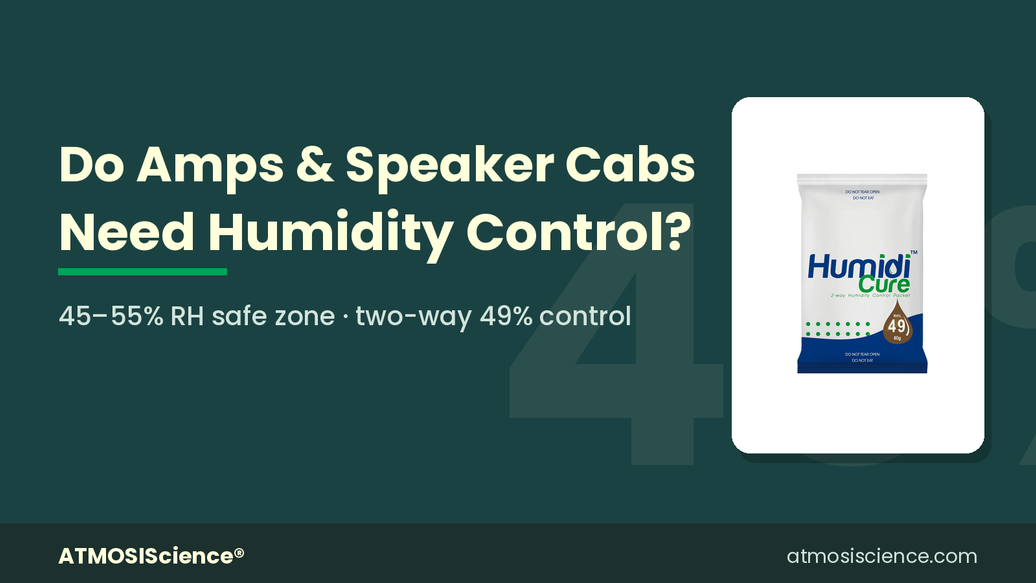
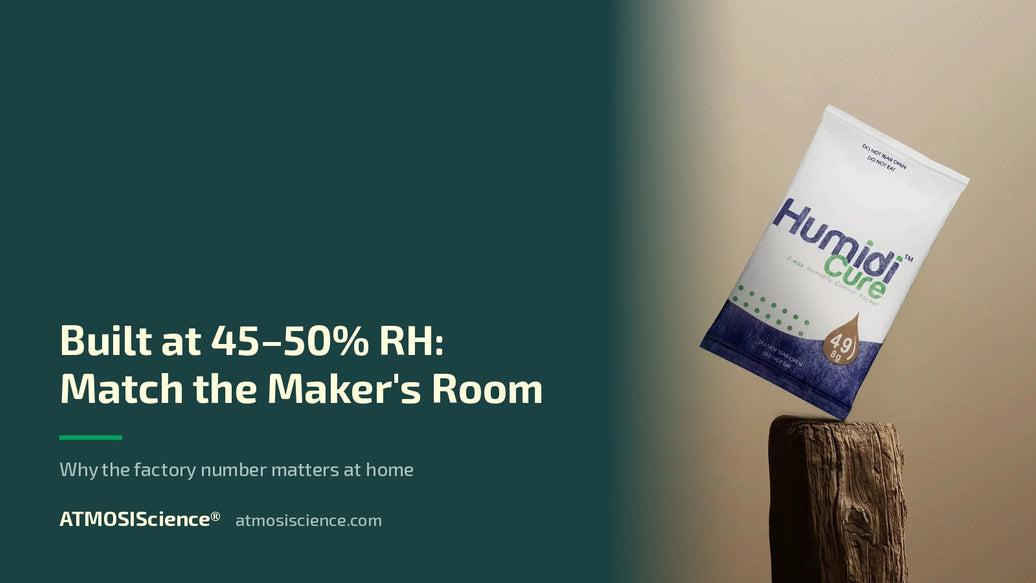
Violin varnish and fittings are unforgiving of anything wet. Humidi-Cure 49% holds its moisture inside a liquid-less plant fiber, so there is no liquid or gel in the pouch to seep out. For an instrument where the finish is part of the value, that matters as much as the RH number.
What it protects, and how to size it
One 60g Humidi-Cure 49% packet protects a single violin or viola case, holding 49% RH at ±2% for about 3 months. It suits the full bowed and orchestral range: violins, violas, cellos, double basses, and bow and rosin storage. For a cello case, a double-bass case or an instrument cabinet, use two packets at a time.
The economics for players and shops
Crack repair and seam regluing on a quality bowed instrument runs from the low hundreds into the thousands, and a repaired crack is never quite invisible or quite the same tonally. A two-way packet at a few dollars per season is the cheapest insurance a player or a string shop can buy. Drop it in, latch the case, and it reaches set point within 2 to 3 hours.
Frequently asked questions
What humidity is best for a violin or cello?
45 to 52% RH, ideally 49%. Humidi-Cure 49% holds that at ±2% inside a closed case.
Can a humidity packet leak onto the varnish?
The pack is liquid-less. The water is held inside plant fiber, so there's no liquid or gel in the pouch to seep out.
How many packets for a cello or double-bass case?
One 60g packet suits a violin or viola case. Use two for a cello or bass case.
How often do I replace it?
About every 3 months, or when the RH indicator reads 40% or lower (or 60% or higher) for more than a day. Sooner if the case is opened often.
Hold your bowed instrument at 49% RH
Protect the plates, the seams, and the tone with a two-way fiber packet that has nothing liquid inside to leak near varnish and fittings.
Shop Humidi-Cure 49% for Instruments, from $8.99 · learn how to read the RH card.
Related reading: The Best Humidity Pack for Guitar Cases · Ukulele, Mandolin & Woodwind Humidity Control
Bulk or retail? Get a quote for your store or studio
Tell us about your packaging needs, and our sales team will respond with a customized humidity-control solution, supporting certificates and competitive bulk pricing.