Every musician who has owned an acoustic instrument for more than a year has stood in front of the humidity-control wall at a music store and felt mildly confused. Sponges in plastic tubes. Salt packs in foil pouches. Gel humidifiers shaped like little hockey pucks. Fiber-based two-way packets. They all promise to save your instrument. They all do different things.
Here is the honest version, with no marketing-speak, of what each one actually does — and where each one fails.
Category 1: DIY Sponges (and Sound-Hole Tube Humidifiers)
These are the ones you fill with water yourself: the green sponge in a plastic tube, the clay-cylinder humidifier, the cigar-shaped one that rests across the strings.
What they do well: They release moisture into the case. They are cheap. They have been around forever.
Where they fail:
- One-way only. They release moisture but cannot absorb it. If your case is already too humid (summer in the Southeast, anyone?), the sponge does nothing — it just adds to the problem.
- No precision. A wet sponge in a small case can push humidity to 80%+. There is no "set point."
- Leak risk. Squeeze too hard, forget to wring it out, and you've got water dripping onto rosewood.
- Maintenance. Refill every few days to a week. Forget once and the sponge is dead air.
- Mold. Standing water in a closed case grows things you don't want next to your guitar.
Verdict: Better than nothing in winter. Actively dangerous in summer. Not a year-round solution.
Category 2: Gel Humidifiers
The hockey-puck or cassette-style humidifiers with a polymer gel inside. You soak them, they slowly release water vapor.
What they do well: More controlled release than a sponge. Less leak-prone if you don't overfill.
Where they fail:
- Still one-way. They release; they do not absorb. Same summer problem as sponges.
- Loose RH precision. Real-world performance is typically ±7–10% RH — enough variance to swing in and out of the safe zone repeatedly.
- Short cycle. Refill every 2–3 weeks. Most people forget.
- Drip risk. If the gel ruptures or overfills, you get a sticky polymer on your case lining.
Verdict: A small upgrade over sponges. Still no temperature/humidity self-regulation, still high-maintenance, still not a true climate-control solution.
Category 3: Salt-Based 2-Way Packets
The best-known of these is the saturated-salt-solution packet familiar to cigar collectors. They are genuinely two-way — they both absorb and release — and they target a specific RH set point.
What they do well:
- Two-way regulation. Absorbs in summer, releases in winter. This is the right idea.
- Set-point targeting. Hits the target RH within roughly ±4–5%.
- Longer cycle than sponges. 1–2 months between replacements.
Where they fail:
- Salt slurry. As the packet ages, the salt solution can ooze through the membrane. Salt residue on lacquer, fretboard wood, or metal hardware is bad news.
- Corrosion risk. Salt + metal frets + bridge pins + tuners = a slow chemical attack you don't see until it's too late.
- Plastic-and-salt waste. Not biodegradable. Goes straight to landfill.
- Replacement frequency. 1–2 months in real use. Better than gel, worse than fiber.
Verdict: Good idea, flawed material. The right approach (two-way absorb and release), but wrapped around a chemistry that has no business being inside a wooden instrument.
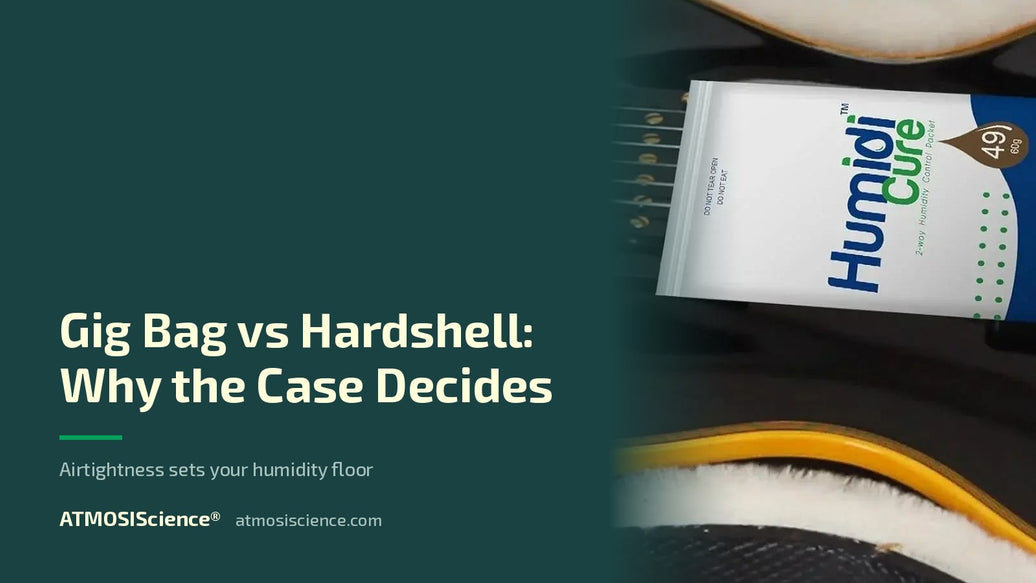
Category 4: Fiber-Based 2-Way Packets (Humidi-Cure)
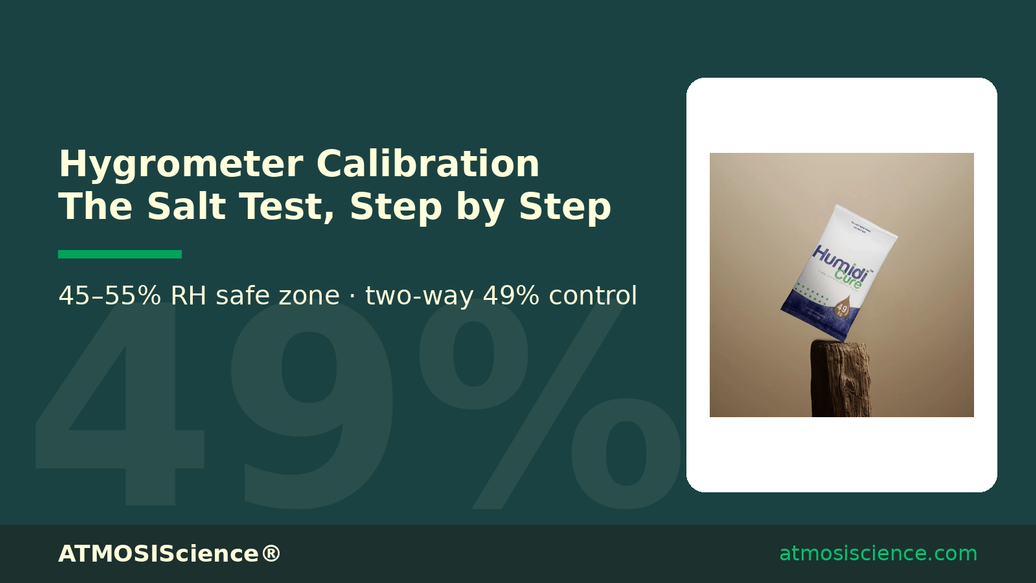
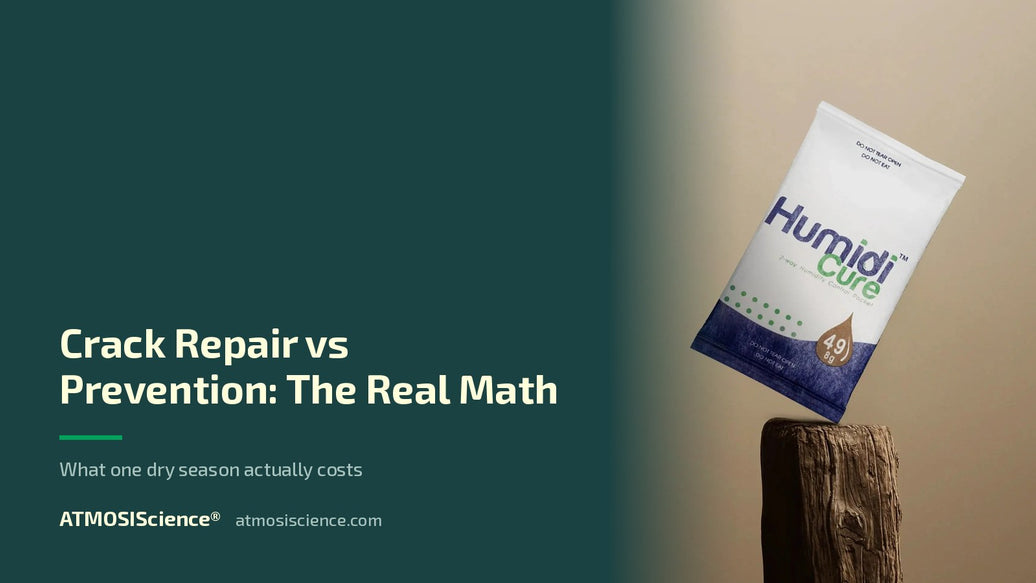
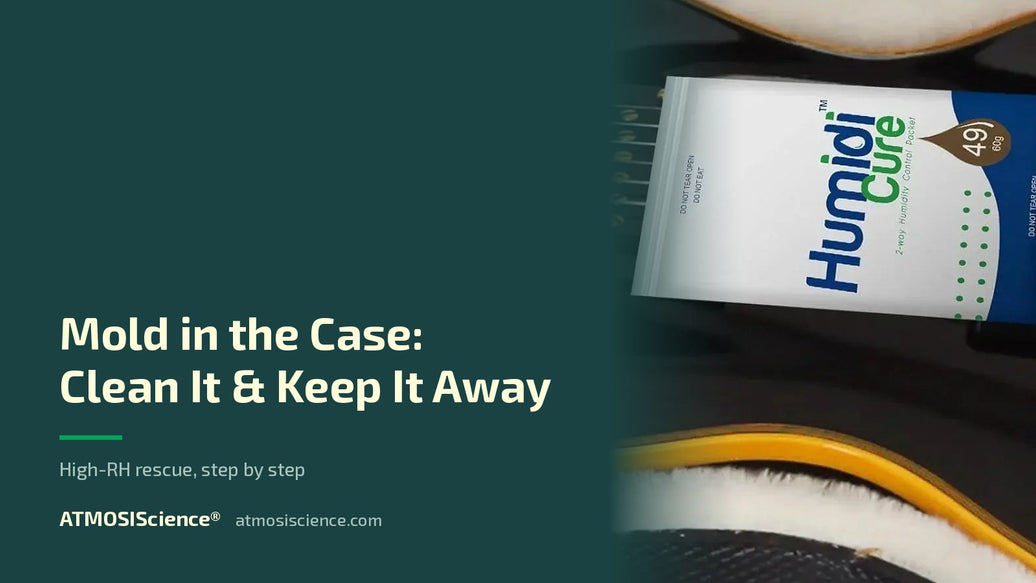
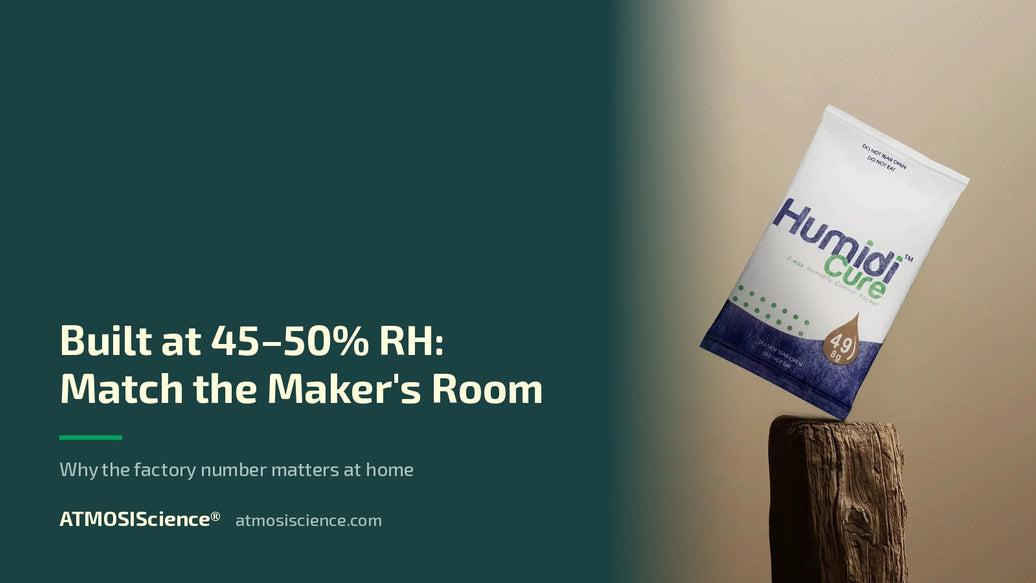
The newest category, and the one ATMOSIScience built Humidi-Cure 49% around. The active material is a US-patented bamboo-fiber matrix instead of a salt slurry or gel.
What it does well:
- ±2% RH precision. Tighter than any other format on the market.
- True two-way. Absorbs above 49%, releases below 49%, automatically.
- Zero leak risk. No liquid, no slurry, no gel. Even if you cut the packet open, nothing wet comes out.
- Non-corrosive. Plant fiber. Won't react with frets, strings, or hardware. Food-contact safe.
- 3–6 month working life. Two to three times longer than salt-based packets.
- Compostable. 100% biodegradable. Drop the spent packet in your green bin.
- Drop-and-forget maintenance. No refilling, no daily check.
Where it has tradeoffs:
- Higher upfront cost than a sponge. Around $9 for a 60g packet vs. $3–5 for a sponge. (You replace 6–10x fewer of them, so total cost lands lower.)
- Single set-point per packet. A 49% packet is for wooden instruments. If you also need a 62% packet for cigars or a 38% packet for cannabis flower, those are different SKUs.

Verdict: The most precise, lowest-maintenance, lowest-risk option currently available. Designed specifically for the 45–52% RH range that wooden instruments require.
Side-by-Side at a Glance
| Criterion | DIY Sponge | Gel Humidifier | Salt 2-Way | Humidi-Cure (Fiber) |
|---|---|---|---|---|
| RH precision | Uncontrolled | ±7–10% | ±4–5% | ±2% |
| Direction | Releases only | Releases only | Absorbs + releases | Absorbs + releases |
| Leak risk | High | Possible drip | Salt slurry | Zero — no liquid |
| Corrosion risk | Possible | Low | Possible salt residue | Non-corrosive |
| Working life | Days | 2–3 weeks | 1–2 months | 3–6 months |
| Maintenance | Constant | Refill weekly | Replace often | Drop & go |
| Sustainability | Single-use plastic | Plastic + gel | Plastic + salt | Compostable bamboo fiber |
So Which One Should You Buy?
If you live somewhere with mild, stable humidity year-round (parts of coastal California, for example), a sponge-style humidifier might keep you out of trouble.
For everyone else — meaning anyone with real winter, real summer, or both — the calculation is simple. A two-way fiber packet is the only option that protects against both shrinkage and swelling, with no leak risk, no corrosion risk, and no weekly maintenance.
The math gets even more obvious when you compare against the cost of a luthier repair. One cracked top is $200–$1,200. One Humidi-Cure 49% packet is under $10 and lasts six months.
The Conclusion
There is no perfect humidity solution for every situation, but there is a clear hierarchy. Fiber-based 2-way > salt-based 2-way > gel > sponge. The further down that list you go, the more time you spend maintaining, and the more risk you carry.
If your instrument is worth more than $200, the upgrade pays for itself the first season.