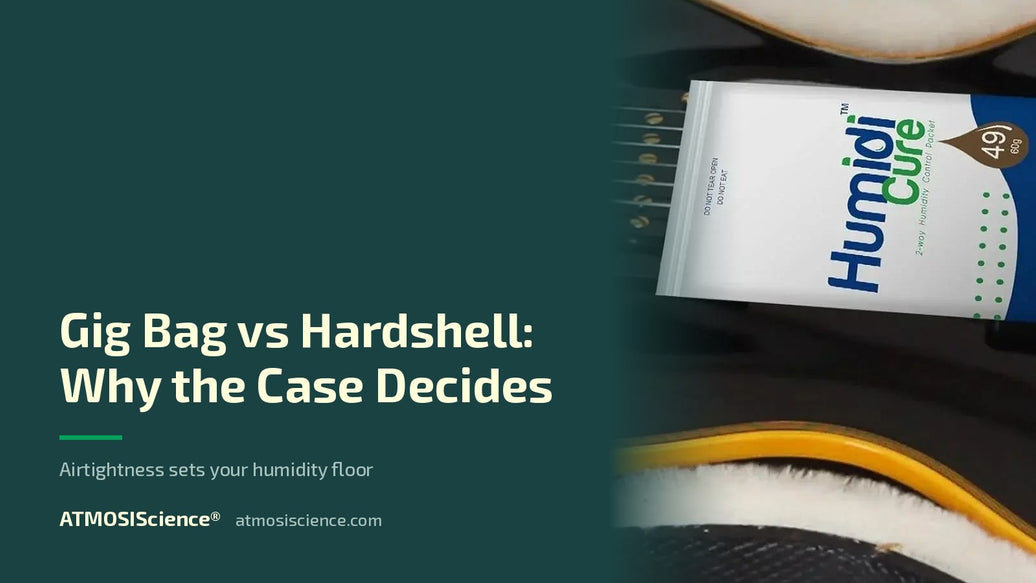
Quick answer: Classical and flamenco guitars want the same 45–55% RH as steel-strings — but their thin, lightly-braced cedar or spruce tops are the most crack-prone soundboards in the guitar world, so the margin for error is smaller. Keep the instrument in a sealed hard case with a two-way 49% pack and an indicator card, and a nylon-string top that would otherwise split in a dry winter simply never sees the dry air.
Ask a classical luthier why so many fine guitars develop a hairline crack down the lower bout and the answer is almost always the same: a few weeks below 40% RH. A classical top is built thin for responsiveness — often 2–2.5 mm of European spruce or western red cedar, fan-braced so lightly that the wood itself carries the load. That is exactly what makes the instrument sing, and exactly what makes it the first thing in the room to crack when the air dries out. Makers build in controlled shops at roughly 45–50% RH, and the wood wants to stay where it was born.

Why nylon-string tops are less forgiving
Three things make classical and flamenco guitars more humidity-sensitive than a dreadnought:
Thinner, lighter tops. Less wood means faster moisture loss and less structural reserve. A steel-string braced for string tension can ride out a dry spell a thin classical cannot.
Cedar’s quirks. Western red cedar — loved for its warm, immediate voice — is softer and slightly more reactive than spruce. Beautiful, but it telegraphs a dry room early.
French polish and delicate finishes. Many fine classicals wear a thin shellac French polish rather than thick modern lacquer. It shows every movement of the wood underneath, so finish checking and grain rise appear sooner.
The care routine that actually protects a classical
Flamenco players add one wrinkle: the fast, percussive golpe style and warm rooms of a peña swing humidity around, and lightweight flamenco blanca tops are thinner still. The routine is the same, just less negotiable.
1. A hard case with a real seal. A gig bag is not humidity control. A quality hard case with a gasketed lip is a slow-exchange micro-climate that a two-way pack can actually hold.
2. One 60 g Humidi-Cure® 49% pack inside. It releases moisture when heating season or an air-conditioned room pulls the case toward the danger zone, and absorbs when a humid week pushes past 55% — holding 49% RH ±2%. No liquid or gel, so it can rest against French polish without any risk of staining. One pack per guitar case; expect about 3 months of service, with case airtightness the biggest variable.
3. An RH indicator card at the headstock. Healthy reads ~50%; act on a card stuck at or below 40% (or above 60%) for more than a day. The full read-and-replace routine is in the card guide.

Already cracked?
A dry-crack on a classical top is repairable and, caught early while it is still tight, often nearly invisible after a luthier cleats it. But rehydrate before repair: a crack glued while the top is shrunken will re-open when humidity returns. Get the case to a stable 49% for a week or two, let the wood recover, then have the crack closed. What each symptom means is decoded in the 12-point symptom checker, and why one setpoint suits every wooden instrument is in the 45–52% sweet-spot guide.
For players: one 60 g pack per guitar or violin case, two for cello cases and cabinets. Get the 60 g Humidi-Cure® 49% pack →
Buying for a shop, school or fleet of cases? Wholesale tiers and custom RH programs are available — see wholesale programs or write to info@atmosiscience.com.
FAQ
Is 49% too high for a spruce classical?
No — 49% sits right in the 45–50% band makers build in. The danger is the dry side (below 40%), which is where thin tops split.
Cedar vs spruce — does one need more care?
Both want 45–55%. Cedar reacts a touch faster, so a cedar-top owner benefits even more from a stable case, but the target is identical.
My classical lives on a wall hanger in a humid country. Risk?
Out in the open it tracks the room. In a tropical climate that means a swollen top and high action — keep it cased with the pack absorbing; the tropical guide covers the wet-side routine.
Does the pack touch the French polish safely?
Yes. It is a solid plant-fiber pack with no liquid or gel to leak — the reason it can rest directly on delicate finishes, unlike wet sponge or gel humidifiers.
Own a fine classical or flamenco guitar? Get the care sheet
Tell the team what you play and your climate, and you will get the nylon-string care routine as a printable sheet — plus a sample-kit option if you want to try a pack and card first.
Prefer email? Write to info@atmosiscience.com — a specialist replies within one business day.