Quick answer: A single gig can drag your instrument from a 49% case through a hot, light-baked stage, an over-air-conditioned green room, a humid loading dock and a freezing van — five climates in six hours. The countermeasures are boring and bulletproof: keep the case closed with a two-way 49% pack whenever the instrument isn’t in your hands, acclimate closed-case at both ends, wipe sweat off before casing, and never let the gear sleep in the vehicle.
Home humidity care is a marathon; gig night is a street fight. None of the individual exposures is long enough to crack a top — wood is mercifully slow — but the repeat cycle, week after week, is exactly the fatigue that loosens seams, sprouts frets, rusts strings and sends tuning wandering mid-set. Working players don’t need lectures; they need a sequence. Here it is, stop by stop.
The timeline
Before you leave (H-2): case check — pack present and pliable, RH card in the green, strings wiped from last time. The case is your mobile safe room all night; make sure it’s actually holding 49% before you rely on it. Transport: instrument rides in the cabin with the humans, never the trunk — trunks in summer sun and winter cold are the harshest climates of the whole night, per our parked-car rules. Load-in: arriving from cold into a warm room? Leave the case shut for 20–30 minutes so the instrument warms slowly and condensation forms on the case, not the lacquer. Soundcheck to downbeat: if there’s an hour of waiting, the instrument waits in the case, not on a stand soaking up stage-light heat and bar AC. On stage: incandescent and halogen rigs cook the air around them — hot air holds more water, so relative humidity at the instrument plummets even in a crowded, sweaty room. One set won’t hurt; just don’t park the guitar under the lights between sets. Between sets & after: wipe neck, strings and anywhere your forearm touched — sweat is salt water, the accelerant behind string rust — then case it, latched. Load-out & overnight: the instrument comes inside. Every time. A van at 3 a.m. is where finishes check and glue joints wake up loose.

Know your venue
| Venue | The hazard | Your move |
|---|---|---|
| Club / bar with hard AC | Cold dry blast at the stage lip | Case between sets; don’t stand the guitar in the airstream |
| Outdoor festival (summer) | Sun on a stand; evening damp rolling in | Shade always; case at dusk; wipe down before casing |
| Church / hall, winter | Heated to 30% RH for the evening from cold storage | Longer closed-case acclimation both ends |
| Basement / tropical open-air | 70%+ humidity, condensation on cold gear | Two-way pack absorbs on the ride home; wipe everything |
| Fly date | Hold cold + cabin dryness + backline unknowns | Full flying protocol |

Why the case does most of the work
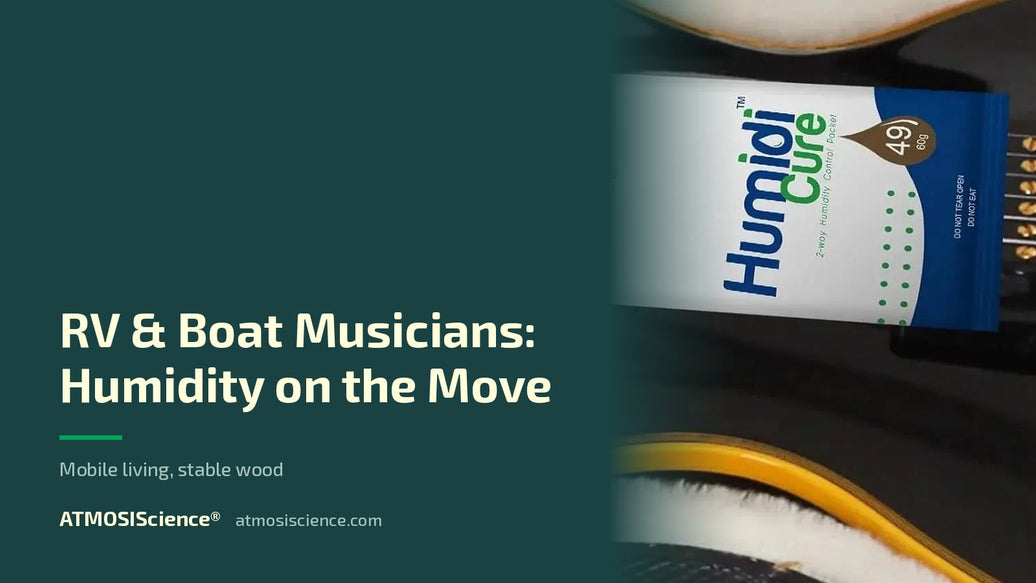
Everything above leans on one assumption: that the closed case really is a 49% micro-climate. That’s the two-way pack’s job — Humidi-Cure® 49% absorbs moisture above 49% RH (the humid dock, the sweaty club) and releases below it (the stage lights, the winter hall), holding ±2% with no liquid or gel to spill in transit, in a food-contact-safe, compostable plant-fiber pack. Gigging is the heavy-duty duty cycle: constant opening, big swings, rough handling — so expect the fast side of about 3 months per pack, and remember case airtightness is the number one variable; a latched hardshell keeps your pack (and your wood) on payroll far longer than a half-zipped bag.
FAQ
Do stage lights really dry out a guitar in one set?
One set, no — wood responds over hours and days. But surface layers and strings feel it immediately, tuning drifts, and the week-in-week-out cycle accumulates. The habit that matters is where the instrument waits when you’re not playing it.
Should the humidity pack come out on stage?
It stays in the case — that’s the environment it manages. The case then restores the instrument between sets and overnight.
What about backline instruments that live at the venue?
House guitars and basses deserve a case each with a pack, restocked on a calendar — that’s our studio & backline program.
Cold van, warm club — how long before I can play?
20–30 minutes closed-case for a normal winter delta; longer if the case is frosty to the touch. Opening early means condensation on the finish and a detuned, foggy instrument.
Five climates a night; one steady case.
→ Humidi-Cure® 49% Humidity Pack for Guitar, Violin & Wood Instruments (60g, 4-pack, $8.99) · browse all instrument humidity control
Music store, studio or school? Volume pricing via our wholesale program or info@atmosiscience.com.
Gigging weekly? Get a road-ready setup
Tell us the instrument, the venues and the schedule; we’ll spec packs, cards and replacement cadence.
Related reading
- The 45–52% RH Sweet Spot: Why Every Wooden Instrument Wants the Same Thing
- The Parked-Car Problem: Heat, Cold and Humidity Rules for Traveling Musicians
- Gig Bag vs Hardshell vs Flight Case: Airtightness Decides Your Humidity Control
- Why Your Strings Rust So Fast: Humidity, Sweat and the Case You Store Them In